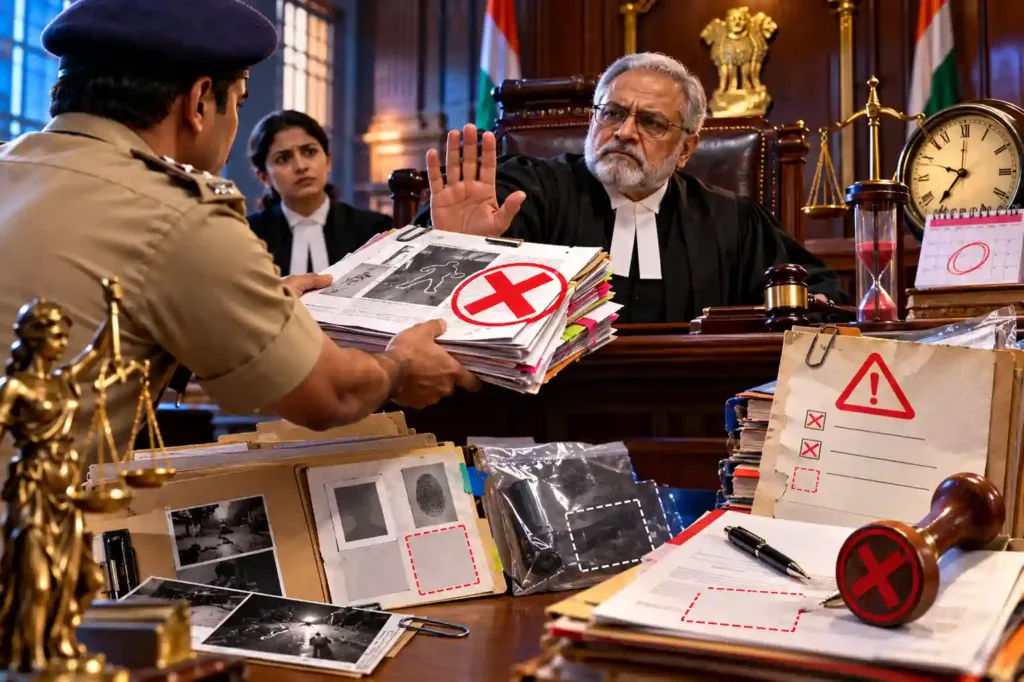
A chargesheet is more than the final document produced at the end of a police investigation. It is the document through which the investigating agency places the results of that investigation before the court, along with the material relied upon to support the case. That makes the quality and completeness of the chargesheet important.
A case may involve a valid FIR, a properly conducted investigation, witness statements, digital evidence, forensic examination and other supporting material. Yet weaknesses in how these elements are documented, connected or presented can create problems when the police report reaches the court.
This is why the phrase “chargesheet rejection” is commonly used, even though there is no single procedural event called rejection that covers every situation.
A chargesheet may face objections because required material is missing, the investigation or documentation is incomplete, the evidence does not adequately support the offences alleged, or important inconsistencies remain unresolved. In other cases, the court may proceed with the case but the weaknesses become significant later, including at the stage of discharge or trial.
For investigating officers, the practical lesson is simple: A chargesheet should not merely show that an investigation was conducted. It should clearly demonstrate how the evidence collected supports the case being presented.
What Does “Chargesheet Rejection” Actually Mean?
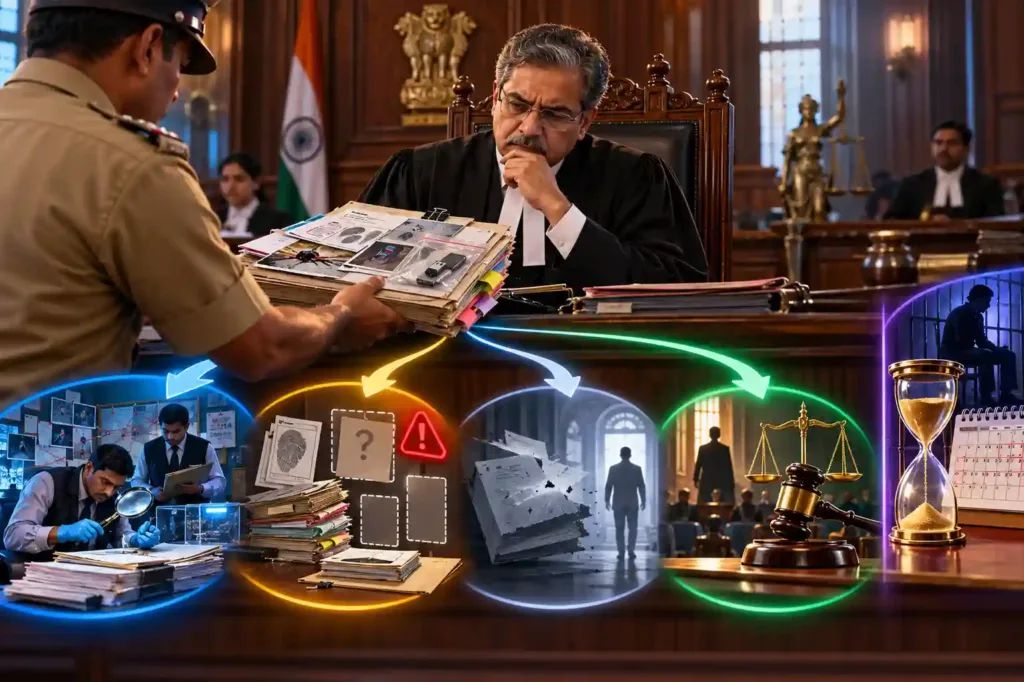
Under Section 193 of the Bharatiya Nagarik Suraksha Sanhita, 2023 (BNSS), the police officer submits a report to the Magistrate after completion of investigation. The provision specifies information that the report must contain and also deals with documents, witness statements, electronic communication and further investigation. IndiaCode by eCourtsIndia
If there are shortcomings, the consequences can vary. A court may require further investigation or deal with deficiencies in the material placed before it. An accused may seek discharge where the material does not justify proceeding to trial. And if a case proceeds to trial, gaps or contradictions in the evidence may ultimately contribute to an acquittal.
There is also a separate issue around default bail when the statutory period for completing the investigation and filing the required report has expired. That question is legally distinct from whether a chargesheet is generally “good” or “bad.”
This distinction matters because a missing document does not automatically mean that every chargesheet is legally invalid. The Supreme Court has held that, in the context of the earlier CrPC framework, the mere fact that some documents were not filed along with a chargesheet does not by itself invalidate it where the statutory requirements are otherwise satisfied and the court can take cognizance on the material presented. National Digital Library of India
So, when discussing chargesheet rejection, it is better to focus on the recurring weaknesses that make a police report vulnerable, rather than treating every missing document as an automatic rejection.
Missing or Incomplete Supporting Documents
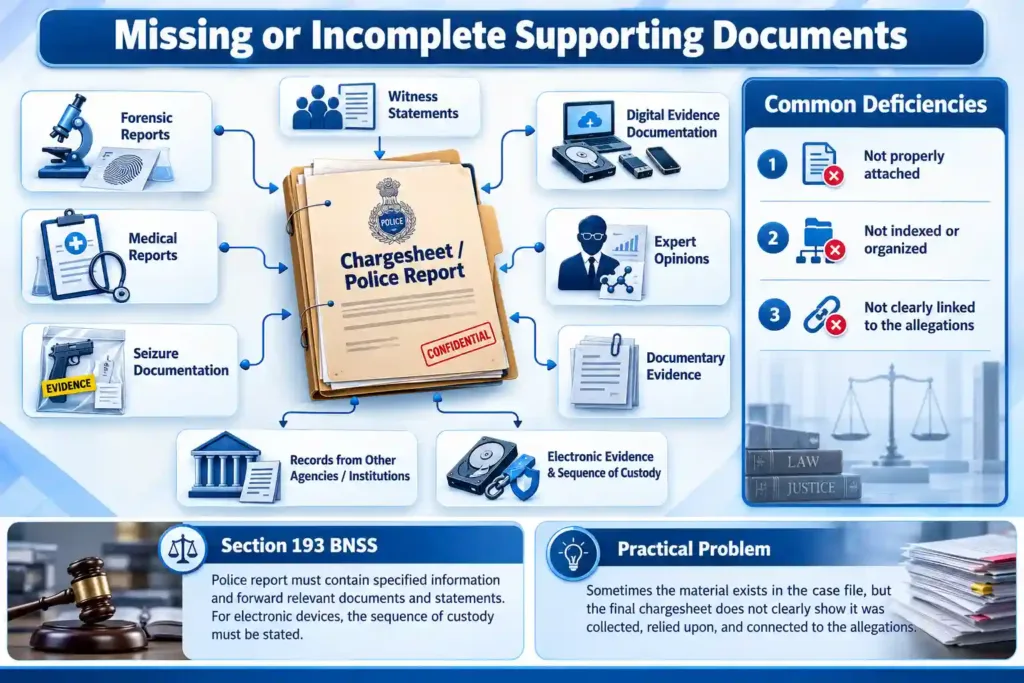
One of the most straightforward problems is also one of the easiest to prevent. A chargesheet may refer to evidence that is not properly attached, indexed or otherwise placed before the court as required.
Depending on the case, this could involve:
- Forensic reports
- Medical reports
- Seizure documentation
- Statements of witnesses
- Digital evidence documentation
- Expert opinions
- Documentary evidence
- Records obtained from other agencies or institutions
- Electronic evidence and its associated documentation
Section 193 BNSS requires the police report to contain specified information and provides for forwarding relevant documents and recorded statements along with the report in the circumstances covered by the provision. It also specifically requires the sequence of custody to be stated in the case of an electronic device. Vakeel Saathi
The practical problem is not always that the investigation failed to collect the material. Sometimes the material exists somewhere in the case file, but the final chargesheet does not clearly establish that it has been collected, relied upon and properly connected to the allegations.
Evidence That Exists but is Not Properly Connected
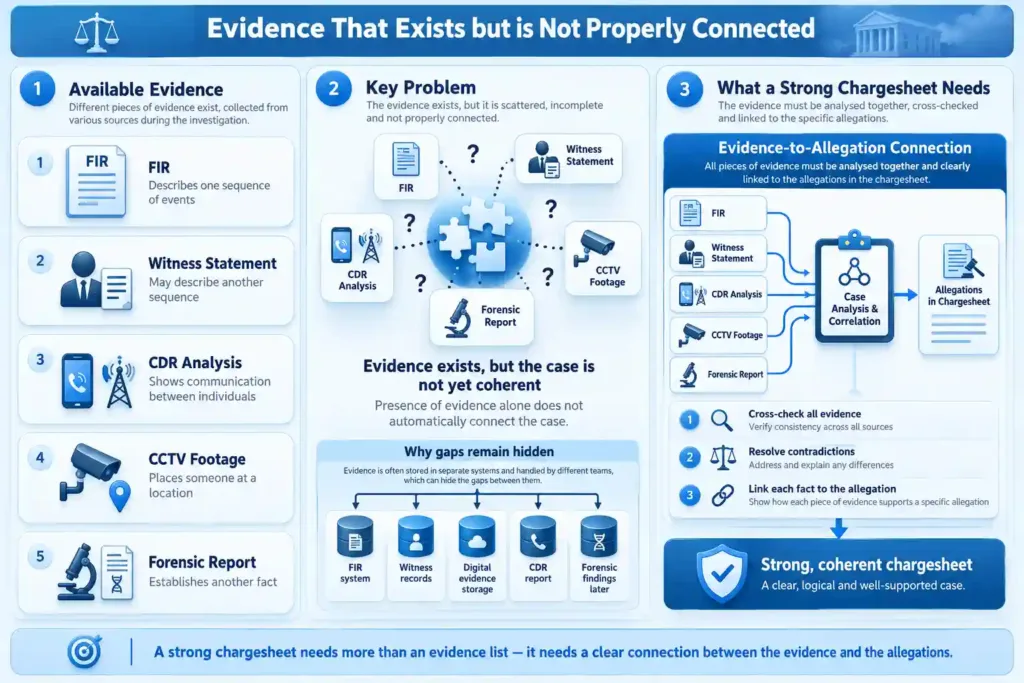
A chargesheet can contain a large amount of evidence and still leave important questions unanswered. Consider a case involving multiple sources of evidence:
- The FIR describes one sequence of events.
- A witness statement describes another.
- CDR information establishes communication between certain individuals.
- CCTV footage places someone at a location.
- A forensic report establishes another fact.
The presence of all five pieces of evidence does not automatically make the case coherent.
The investigator needs to establish how they relate to one another. This is one of the biggest challenges in complex investigations because evidence is often generated and stored separately. The FIR sits in one system. Witness statements are recorded separately. Digital evidence may be stored on another device or platform. CDR analysis may exist as a separate report. Forensic findings may arrive later.
If these pieces are not systematically cross-checked before the chargesheet is prepared, contradictions and missing links can remain hidden. A strong chargesheet therefore needs more than an evidence list. It needs an evidence-to-allegation connection.
Contradictions Between Witness Statements and Other Evidence
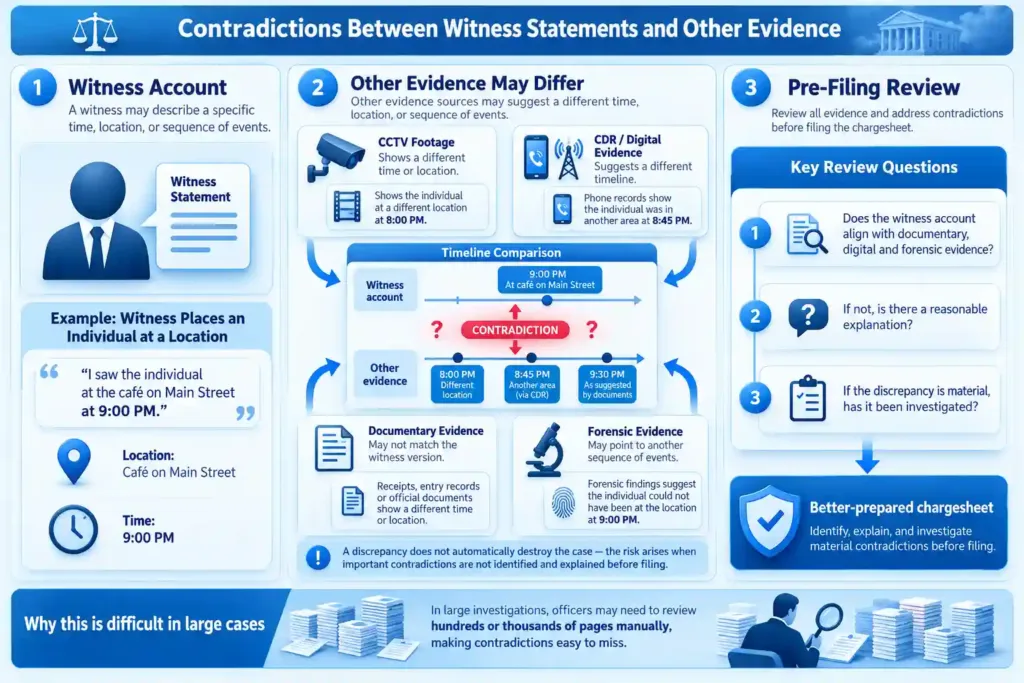
Witness statements are an important part of many investigations, but they do not exist in isolation. A statement may describe a particular time, location or sequence of events. Other evidence may point to something different. For example, a witness may place an individual at a particular location at 9 PM, while available digital or video evidence suggests a different timeline.
A single discrepancy does not automatically destroy a case. Investigations can contain genuine inconsistencies for many reasons. The problem arises when important contradictions are not identified and explained before the chargesheet is filed.
A pre-filing review should therefore ask: Does the witness account align with the documentary, digital and forensic evidence?
If not, is there a reasonable explanation? If the discrepancy is material, has it been investigated? This is particularly difficult in large cases where an investigating officer may have to review hundreds or thousands of pages of material manually.
Weak Chain of Custody for Physical or Digital Evidence
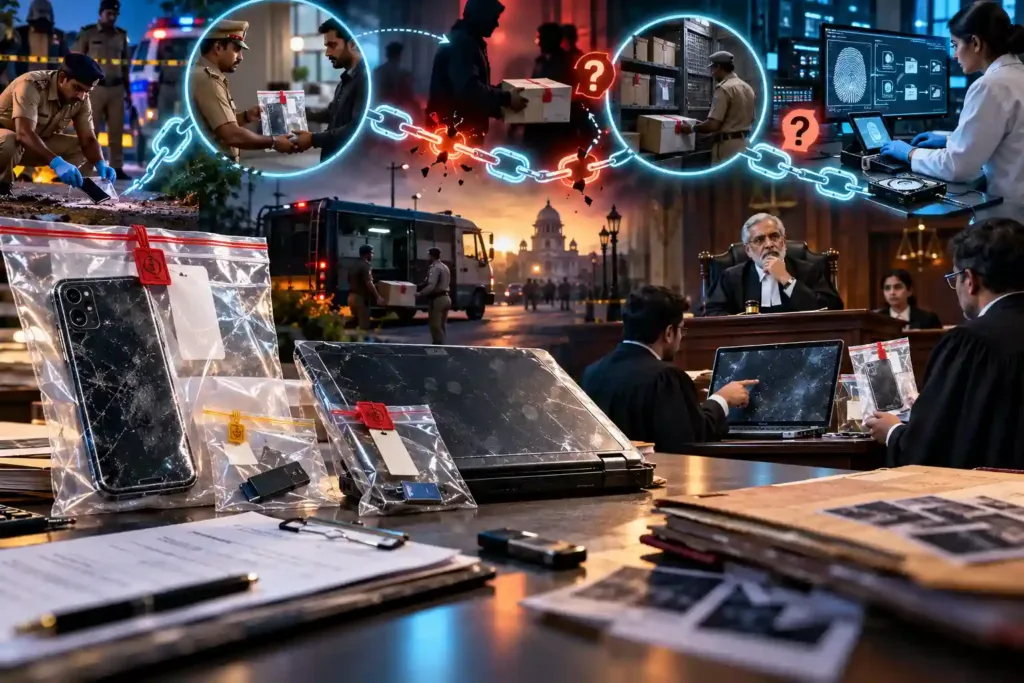
Evidence becomes much more useful when its origin and handling can be properly established. For physical evidence, this may involve documenting seizure, storage, transfer and examination. For digital evidence, the problem can become even more complicated.
A device may be seized by one officer, transferred to another location, examined by a forensic team and then referenced in multiple reports. Different digital artefacts may also originate from different devices. BNSS Section 193 specifically requires the police report to state the sequence of custody in the case of an electronic device. Vakilpedia
That is significant because digital evidence is not simply about producing a screenshot or attaching a file. The investigation should be able to explain where the evidence came from and how it was handled. If that trail is unclear, questions can arise around authenticity, integrity and reliability.
Also Read: Chain of Custody for Digital Evidence under BNSS: A Practical Guide for Investigators
Forensic Evidence is Missing, Delayed or Not Properly Integrated
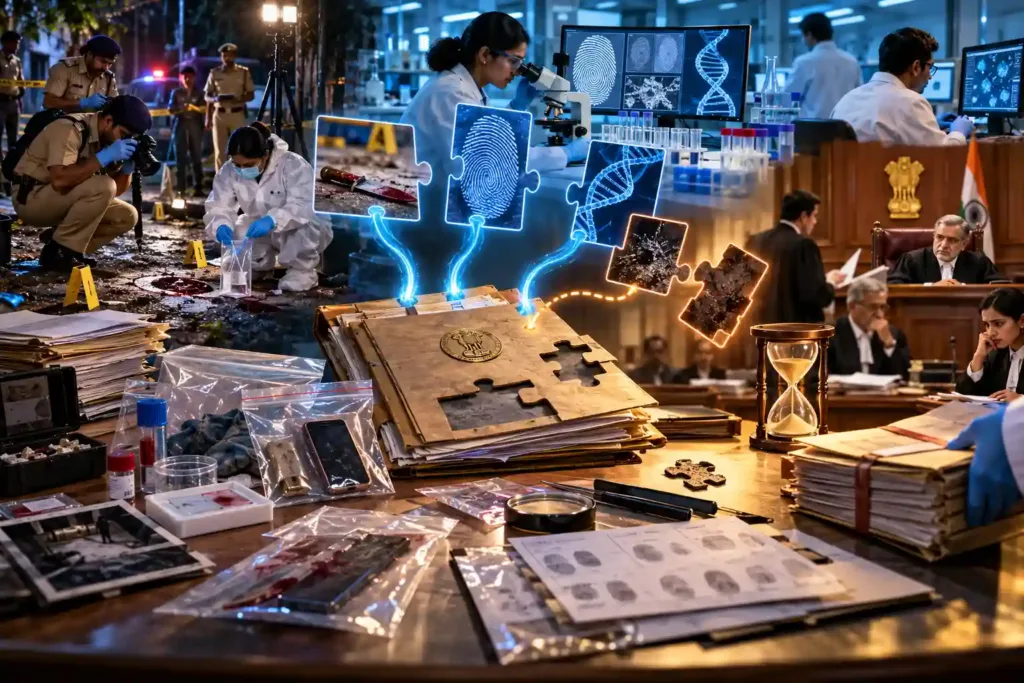
Forensic evidence has become an increasingly important part of modern investigations. BNSS Section 176(3) provides for forensic expert visits to crime scenes for offences punishable with seven years or more, along with videography of the process, from such date as may be notified by the relevant State Government within the statutory framework. India Code
This adds another layer to investigation management. It is not enough to send material for forensic examination. The resulting findings need to be incorporated into the broader investigation. A forensic report may answer one specific question, while the chargesheet needs to establish how that finding relates to the rest of the case.
For example, a forensic finding may identify a material, establish a match or provide another scientific observation. The chargesheet still needs to explain its relevance to the allegations and the other evidence.
And there is an important legal nuance here: the absence of a particular expert report does not automatically make every chargesheet legally incomplete. The Supreme Court has held that the absence of some documents, by itself, does not necessarily invalidate a chargesheet when the statutory requirements are otherwise satisfied. National Digital Library of India
The safer lesson for investigators is therefore not “every report must always be attached or the chargesheet fails.”
It is: Know which material is legally and factually necessary for the case, ensure it is properly documented, and make its relationship to the allegations clear.
Incorrect, Incomplete or Inconsistent Application of Legal Sections
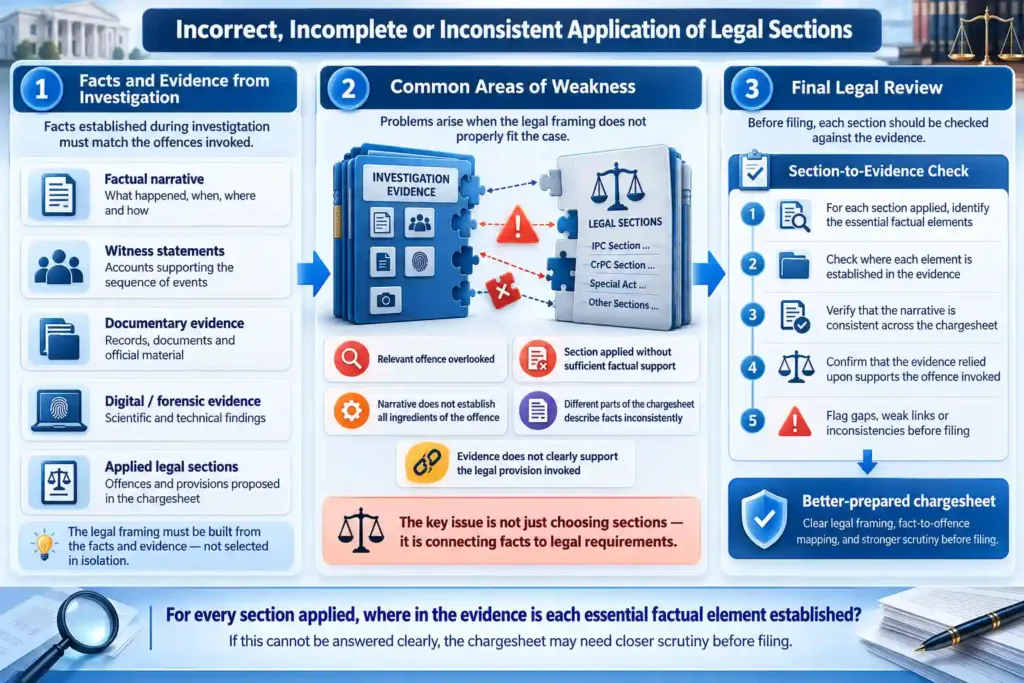
Another common area of weakness is the legal framing of the case. The facts established during investigation need to correspond to the offences and provisions invoked. Problems can arise when:
- A relevant offence is overlooked.
- A section is applied without sufficient factual support.
- The factual narrative does not clearly establish the ingredients of the offence.
- Different parts of the chargesheet describe facts inconsistently.
- The evidence relied upon does not clearly support the legal provision invoked.
This is not simply a matter of selecting sections from a list. The investigator has to connect the facts established by the investigation with the legal requirements of the offences alleged. That makes the final review particularly important.
A useful question is: For every section applied, where in the evidence is each essential factual element established?
If that question cannot be answered clearly, the chargesheet may need closer scrutiny before filing.
Electronic Evidence is Collected, but Its Documentation is Weak
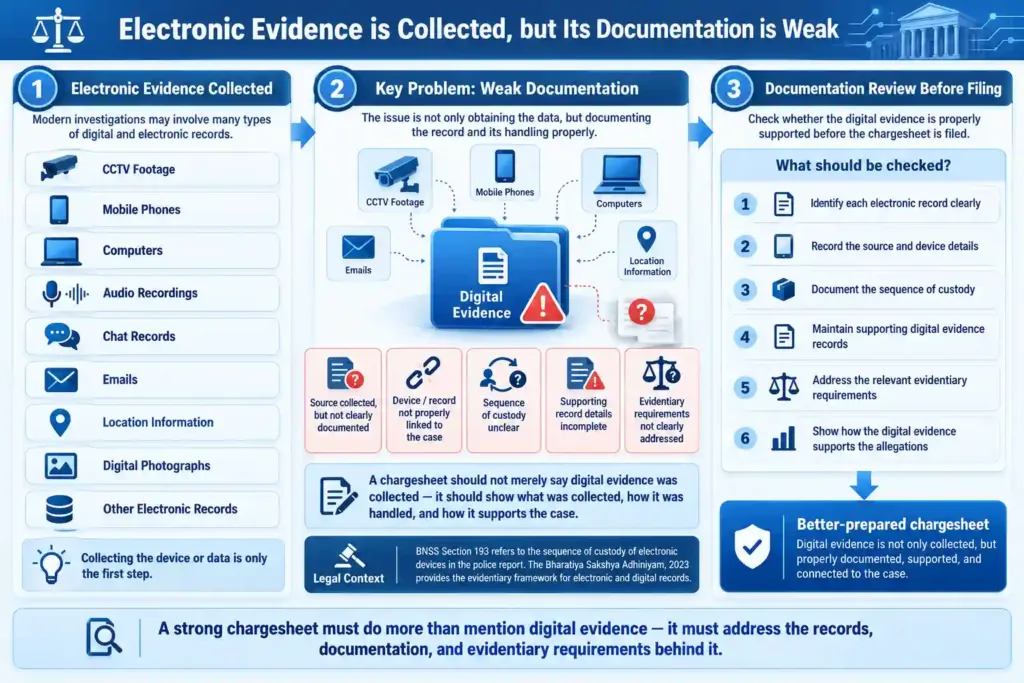
Modern investigations increasingly involve:
- CCTV footage
- Mobile phones
- Computers
- Audio recordings
- Chat records
- Emails
- Location information
- Digital photographs
- Other electronic records
The challenge is not simply obtaining the information. The investigator also needs to maintain the necessary documentation around the electronic record and its handling. BNSS Section 193 specifically refers to the sequence of custody of electronic devices in the police report. Vakilpedia
The Bharatiya Sakshya Adhiniyam, 2023 also provides the evidentiary framework for electronic and digital records.
Also Read: Section 63 BSA Certificate: A Practical Guide for Investigators and Legal Teams
A chargesheet that relies heavily on digital evidence therefore needs to ensure that the relevant records, documentation and evidentiary requirements have been addressed rather than simply mentioning that “digital evidence was collected.”
The Investigation Timeline and the Chargesheet Do Not Match
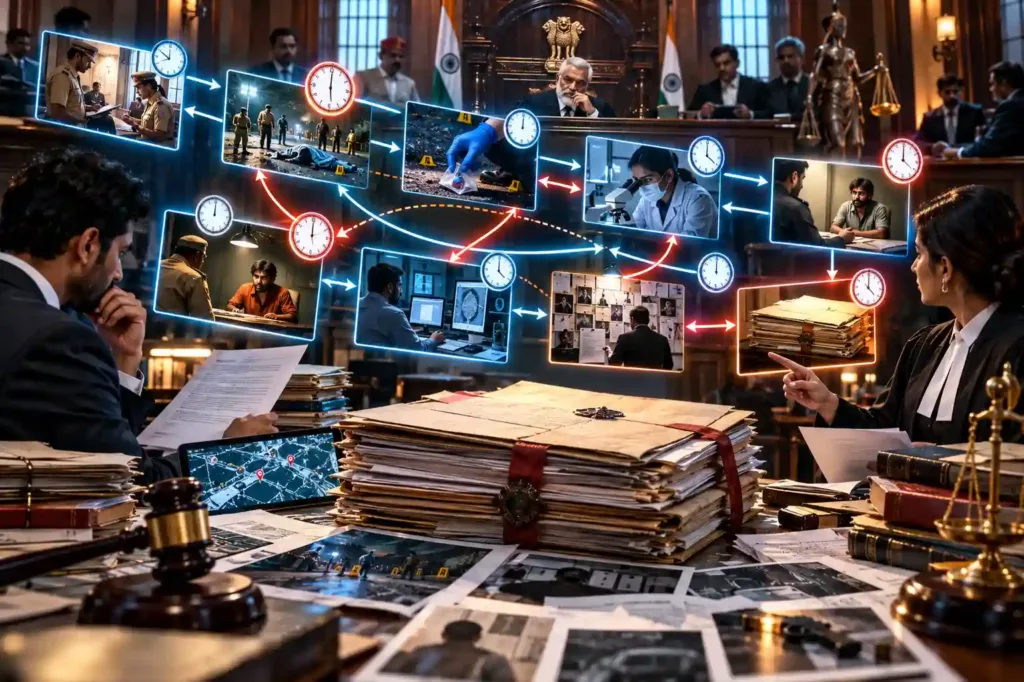
A chargesheet tells a story. The investigation records tell another. If those two timelines do not align, questions can arise.
For example, an investigation may state that an individual was identified after a particular piece of evidence was discovered, but another part of the file may show that the person was questioned or treated as a suspect earlier.
Similarly, a forensic finding may be dated after an investigative conclusion that appears to depend upon it. These inconsistencies may have innocent explanations. The problem is when they are not identified and reconciled. A good pre-filing review should therefore compare:
FIR → investigation events → evidence collection → forensic examination → witness statements → analysis → conclusions → chargesheet
The purpose is not to make every date identical. It is to ensure that the sequence makes sense.
Witnesses Are Listed Without Clearly Establishing Their Relevance
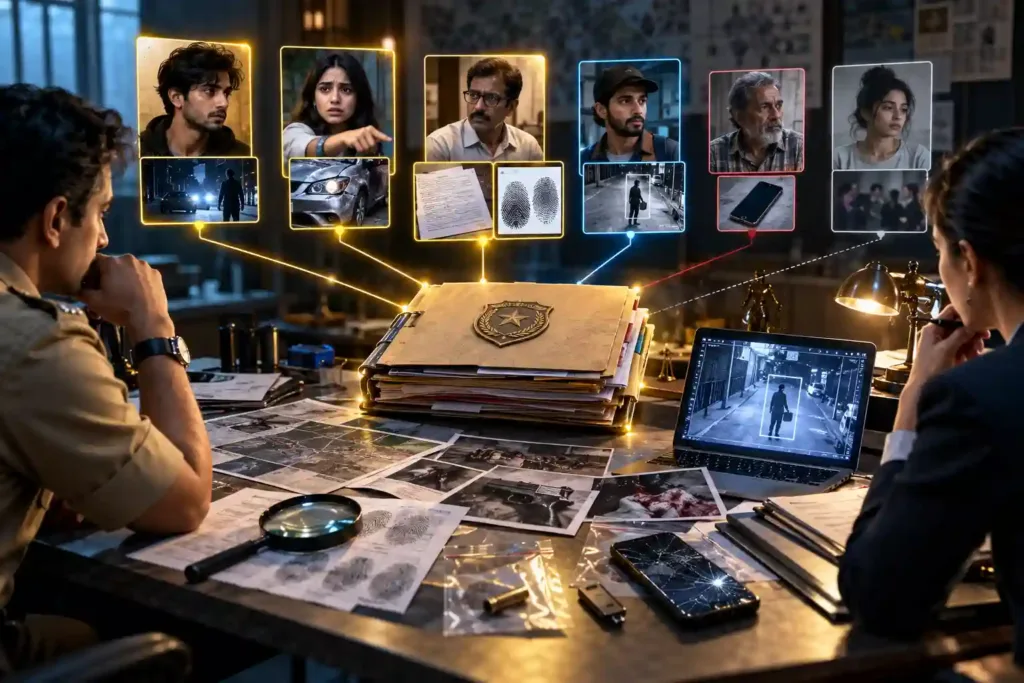
A chargesheet may contain a large witness list. But quantity is not the objective. The important question is whether the witnesses identified by the prosecution can actually establish the facts they are being relied upon for.
Section 193 BNSS specifically requires the police report to state the names of persons who appear to be acquainted with the circumstances of the case and also deals with the statements of persons whom the prosecution proposes to examine as witnesses. Vakeel Saathi
A strong investigation should therefore establish the relationship between: Witness → fact known → statement → supporting evidence
Where that relationship is unclear, the chargesheet becomes harder to understand and evaluate.
The Chargesheet Is Technically Complete but Narratively Weak
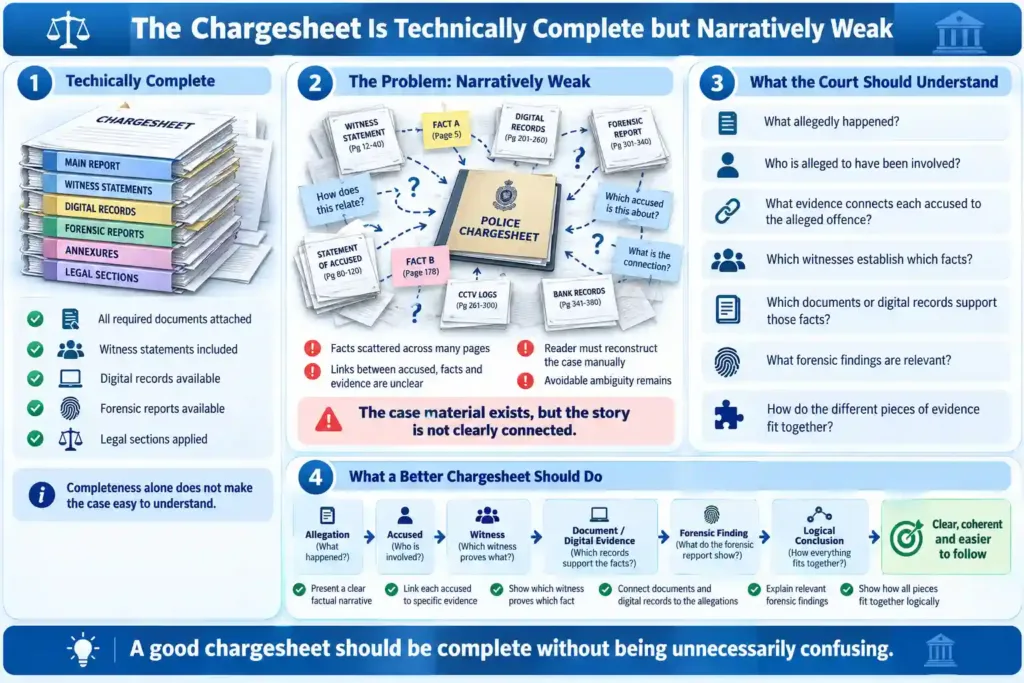
This is an underrated problem. A chargesheet can contain all the necessary documents and still be difficult to follow. The court should be able to understand:
- What allegedly happened?
- Who is alleged to have been involved?
- What evidence connects each accused to the alleged offence?
- Which witnesses establish which facts?
- Which documents or digital records support those facts?
- What forensic findings are relevant?
- How do the different pieces of evidence fit together?
If the answers are scattered across hundreds of pages without a clear logical connection, the reader has to reconstruct the case manually. That creates avoidable ambiguity. A good chargesheet should therefore be complete without being unnecessarily confusing.
Evidence From Multiple Sources Is Not Cross-Checked Before Filing
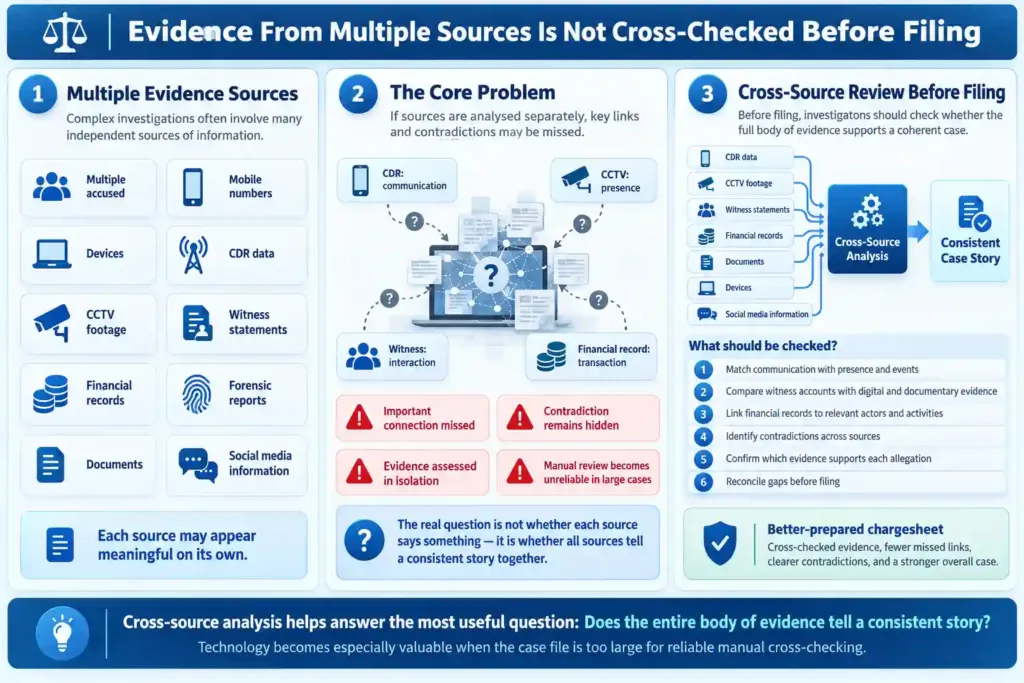
This is where the problem becomes particularly difficult in complex investigations. Consider a case involving:
- Multiple accused
- Several mobile numbers
- Multiple devices
- CDR data
- CCTV footage
- Witness statements
- Financial records
- Forensic reports
- Documents
- Social media information
Each source may look meaningful independently. The real investigative value comes from determining whether they support one another. For example, a CDR may show communication. CCTV may establish presence. A witness may describe an interaction. A financial record may establish a transaction.
If these are analysed independently, investigators may miss either an important connection or an important contradiction. Cross-source analysis helps answer a more useful question: Does the entire body of evidence tell a consistent story?
This is one of the strongest areas where technology can support investigation teams, particularly when case files become too large for reliable manual cross-checking.
The Chargesheet Is Filed Without a Serious Pre-Filing Quality Review
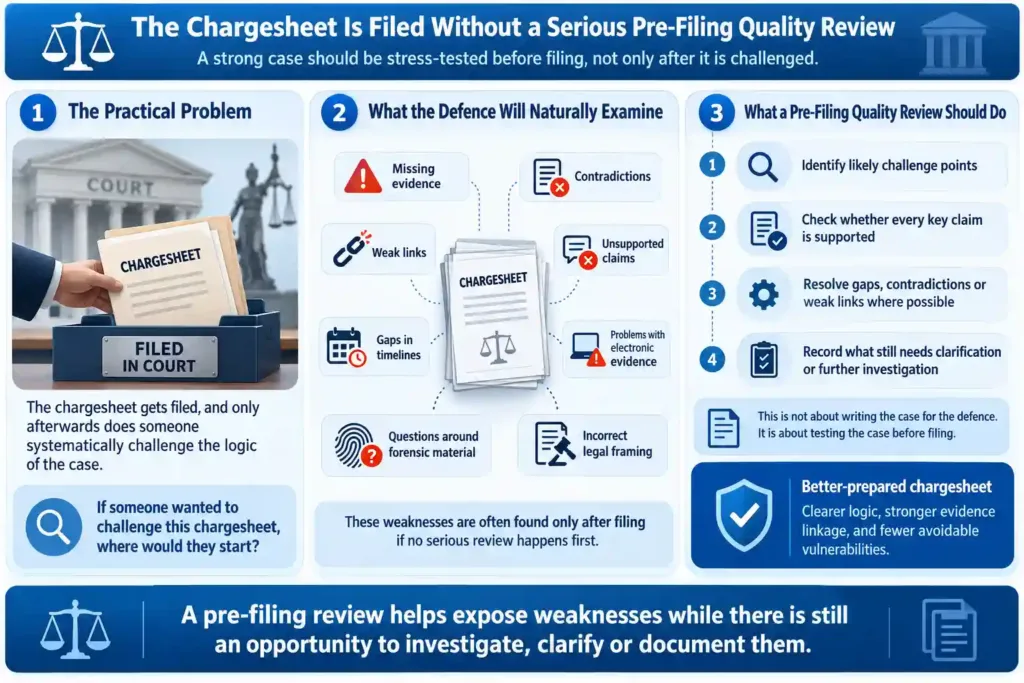
Perhaps the biggest practical problem is simple. The chargesheet gets filed, and only afterwards does someone systematically challenge the logic of the case. The defence will naturally examine:
- Missing evidence
- Contradictions
- Weak links
- Unsupported claims
- Gaps in timelines
- Problems with electronic evidence
- Questions around forensic material
- Incorrect legal framing
The prosecution should ideally conduct a similar exercise before filing. This does not mean trying to “write the case for the defence.”
It means asking: If someone wanted to challenge this chargesheet, where would they start?
That question can expose weaknesses while there is still an opportunity to investigate, clarify or document them.
A Practical Pre-Filing Chargesheet Review
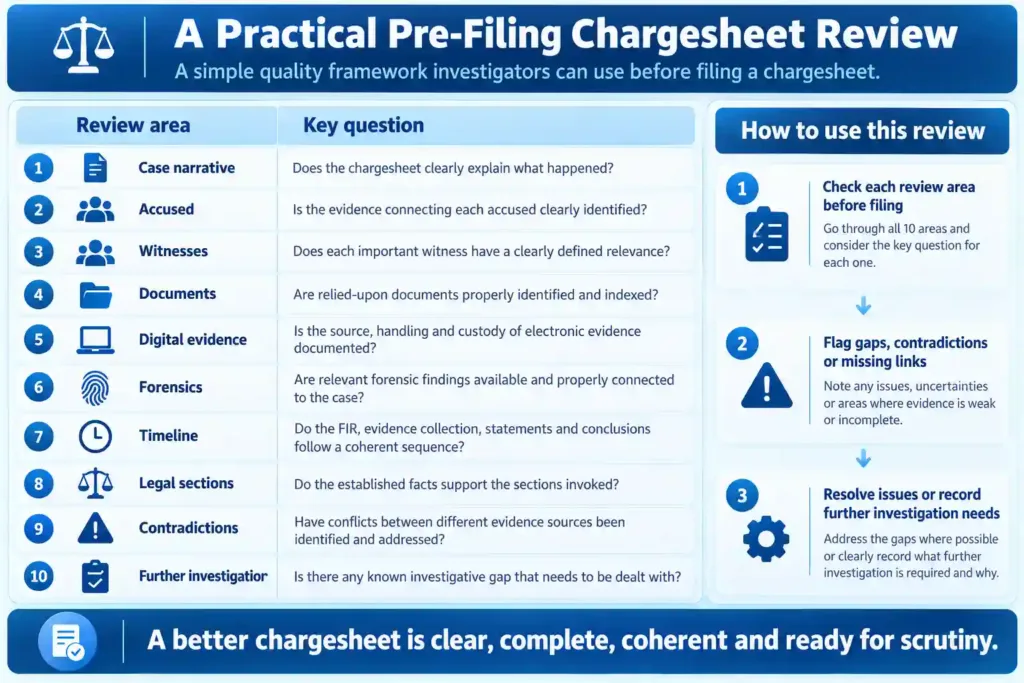
Before a chargesheet is filed, investigators can use a simple quality framework.
| Review area | Key question |
|---|---|
| Case narrative | Does the chargesheet clearly explain what happened? |
| Accused | Is the evidence connecting each accused clearly identified? |
| Witnesses | Does each important witness have a clearly defined relevance? |
| Documents | Are relied-upon documents properly identified and indexed? |
| Digital evidence | Is the source, handling and custody of electronic evidence documented? |
| Forensics | Are relevant forensic findings available and properly connected to the case? |
| Timeline | Do the FIR, evidence collection, statements and conclusions follow a coherent sequence? |
| Legal sections | Do the established facts support the sections invoked? |
| Contradictions | Have conflicts between different evidence sources been identified and addressed? |
| Further investigation | Is there any known investigative gap that needs to be dealt with? |
The objective is not to guarantee a particular judicial outcome. No checklist can do that. The objective is to reduce avoidable weaknesses in the investigation record and the final police report.
Where AI Can Help Without Replacing the Investigating Officer
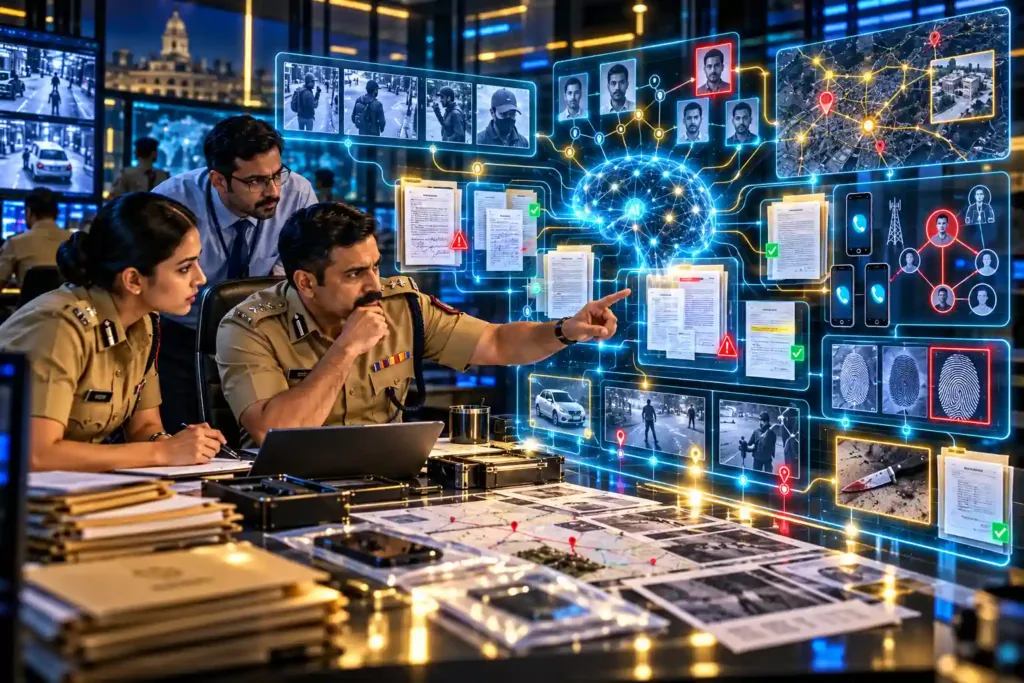
The most useful role for AI here is not to “write a chargesheet automatically.” It is to help investigators manage the complexity behind it. An AI system can potentially compare large volumes of case material, identify relationships between documents, flag contradictions and surface information that deserves human review.
For example, an investigator could have an AI system compare:
- FIR contents
- Witness statements
- Forensic reports
- CDR analysis
- Investigation notes
- Digital evidence
- Other case documents
The system could then flag areas where the information appears inconsistent or where a claim in the draft is not clearly supported by the available material. That changes the role of AI from a document generator into a quality-control layer around investigation workflows.
AI should not decide whether a person is guilty. It should not invent evidence. It should not replace the investigating officer’s judgement. Its value is in helping the officer see the entire case more clearly before the police report is filed.
How Sarvagata AI Can Support Chargesheet Preparation
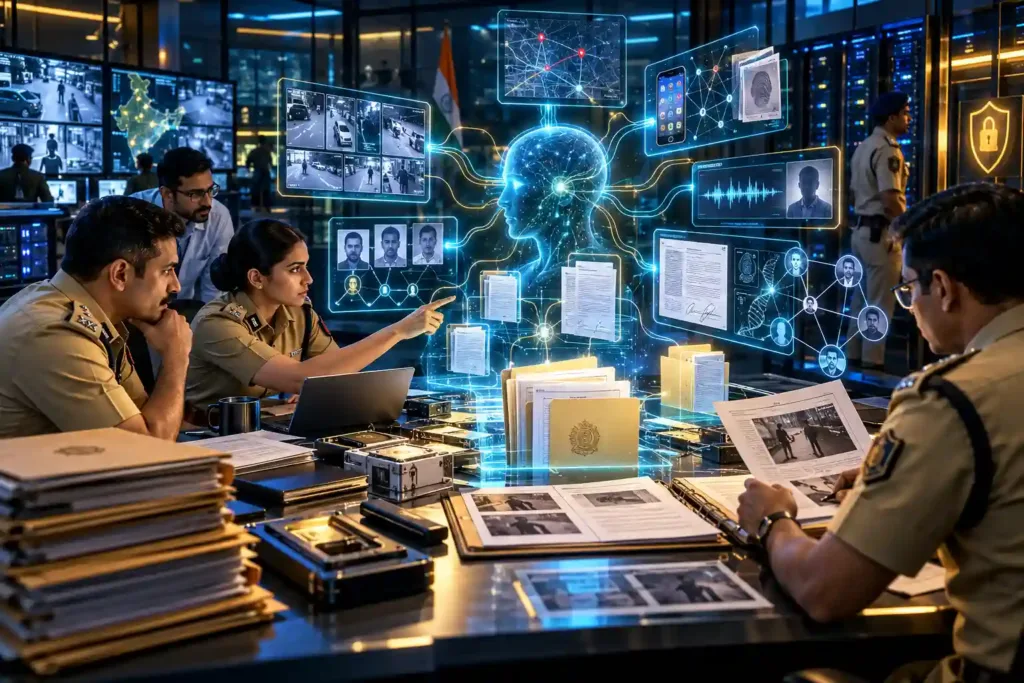
This is where Innefu’s Sarvagata AI fits naturally into the workflow. Sarvagata is an on-premise, air-gapped Agentic AI platform designed to process sensitive information within an organisation’s own environment. Its architecture supports private knowledge ingestion, natural-language querying and autonomous agents that can execute multi-step workflows.
For law enforcement, the platform is specifically positioned for use cases including chargesheet generation and querying CCTNS and other policing information. The important capability for chargesheet workflows is not simply document generation.
Sarvagata can be configured around an organisation’s own workflow so that agents can process documents and sensitive case material, identify relevant information and support structured outputs. Its product architecture includes private knowledge ingestion and an agentic AI engine for orchestrating multiple tasks.
That creates a possible workflow in which the investigating team can use AI to:
- Bring relevant case documents into a private knowledge environment
- Search case material using natural language
- Compare information across different evidence sources
- Identify apparent inconsistencies that require human review
- Organise relevant findings
- Assist with preparation of structured investigation documents
- Conduct a second review of the draft before filing
The key word here is assist. The investigating officer remains responsible for the investigation, the evidence collected and the report ultimately submitted to the court. AI can help make the review more systematic, but it cannot replace the legal and investigative judgement of the officer.
Frequently Asked Questions
1. What are the common reasons chargesheets become vulnerable in Indian courts?
Common issues include missing or poorly documented supporting material, contradictions between evidence sources, weak linkage between accused persons and the alleged offence, problems in documenting electronic evidence, gaps in forensic integration, inconsistent timelines and legal sections that are not clearly supported by the established facts.
2. Does a missing document automatically make a chargesheet invalid?
No. The legal effect depends on the nature of the document, the statutory requirements applicable to the case and the material otherwise placed before the court. The Supreme Court has held that the mere absence of some documents does not automatically invalidate a chargesheet when the statutory requirements are otherwise met. National Digital Library of India
3. What does Section 193 BNSS say about a chargesheet?
Section 193 BNSS deals with the report of the police officer on completion of investigation. It specifies information to be included in the report and contains provisions concerning documents, witness statements, electronic communication, further investigation and the sequence of custody of electronic devices. IndiaCode by eCourtsIndia
4. Can contradictions between evidence sources affect a chargesheet?
They can create significant weaknesses. A contradiction does not automatically invalidate a case, but unresolved inconsistencies between witness statements, forensic findings, digital evidence, timelines or other material can become important issues during judicial scrutiny.
5. Why is digital evidence particularly important during chargesheet preparation?
Digital evidence often comes from multiple devices and sources, making provenance, handling and custody important. BNSS Section 193 specifically requires the sequence of custody to be stated in the case of an electronic device. Vakilpedia
6. Can AI help investigators prepare better chargesheets?
Yes, as an assistance and quality-control capability. AI can help compare large volumes of case material, identify relationships and inconsistencies, organise findings and support document preparation. It should not replace the investigating officer’s judgement or create evidence that does not exist.
7. Can AI guarantee that a chargesheet will not be rejected?
No. That would be an irresponsible claim. AI can help identify certain document-level, evidence-correlation and consistency issues, but no technology can guarantee a particular judicial outcome.