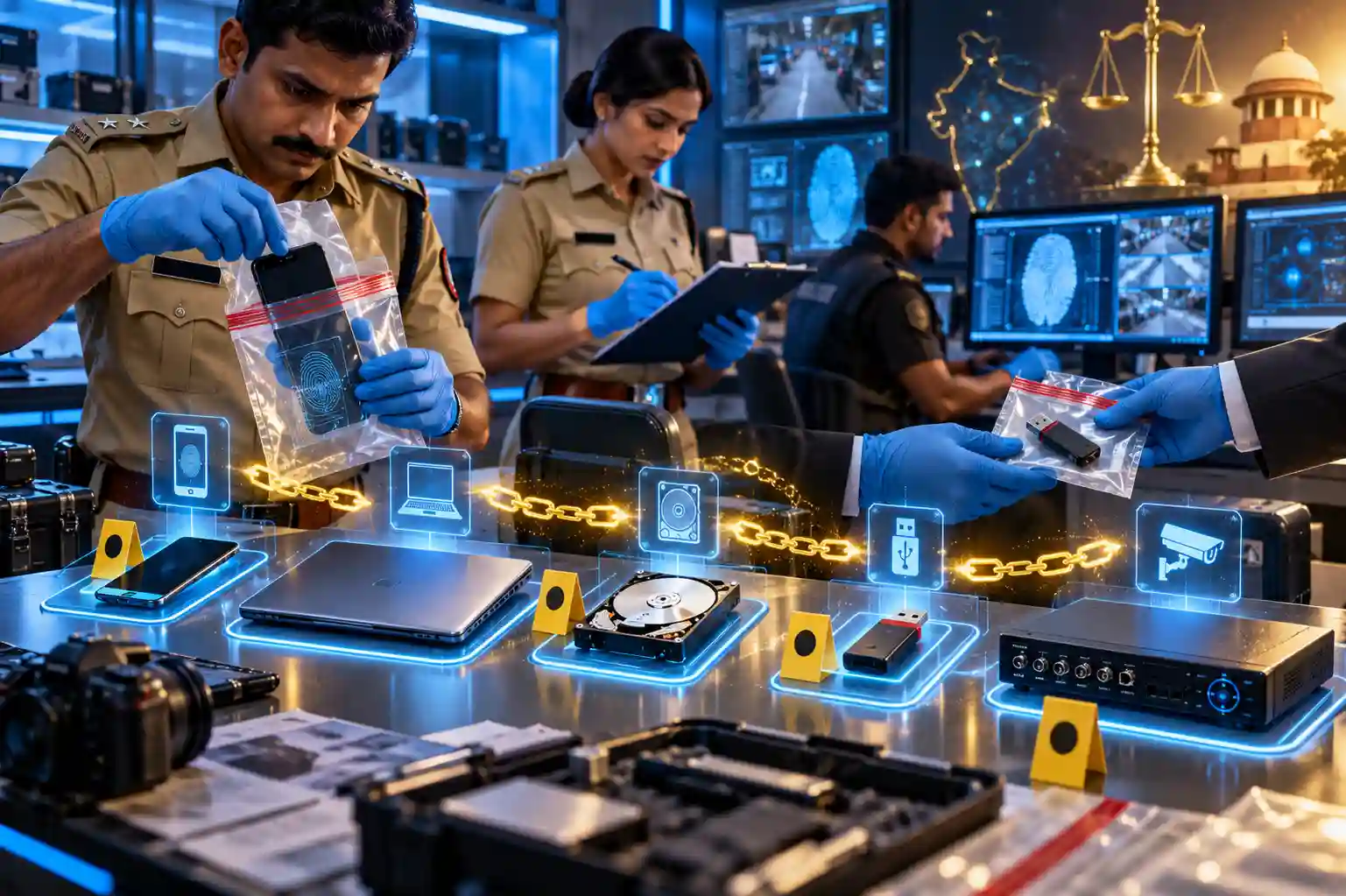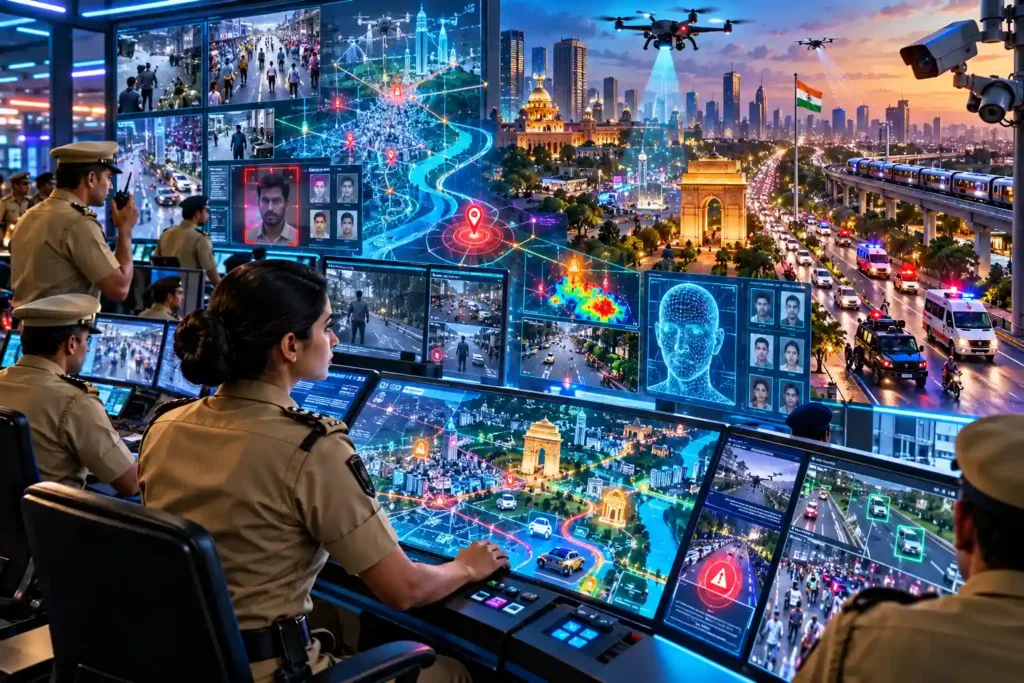
Smart policing is not just about putting CCTV cameras on streets or digitising police records. It is about using technology, data, trained personnel and connected systems to help police respond faster, investigate better, allocate resources intelligently and remain accountable to citizens.
In India, the idea of smart policing has been around for more than a decade. But its meaning has changed considerably.
The original SMART policing vision called for police forces that are Strict and Sensitive, Modern and Mobile, Alert and Accountable, Reliable and Responsive, and Tech-savvy and Trained. – Prime Minister of India
Today, that vision is increasingly being translated into practical systems across Indian states: interconnected police databases, emergency response platforms, GIS-based crime mapping, command and control centres, digital investigation tools, video analytics, mobile policing applications and AI-assisted analysis.
The important shift is this: Smart policing is moving from digitising police work to connecting data, people and decisions.
This article explains what that means in practical terms for Indian state police forces, what technologies are already being used, where the biggest gaps remain, and what the next generation of smart policing could look like.
Key Takeaways
- Smart policing is broader than surveillance or artificial intelligence.
- India’s original SMART policing framework combines technology with responsiveness, accountability, sensitivity and training.
- CCTNS has created a nationwide digital foundation for police records and investigation data. As of February 1, 2026, all 17,798 police stations in India were using CCTNS. Ministry of Home Affairs
- ICJS is taking the next step by connecting police, courts, prisons, prosecution and forensic systems.
- Emergency response systems such as ERSS-112 are turning emergency handling into a data-driven, GIS-enabled workflow.
- State-level implementations differ. Telangana, Kerala, Maharashtra and Uttar Pradesh illustrate different aspects of technology-enabled policing.
- AI can support investigation, video analysis, intelligence and decision-making, but it should augment police personnel rather than replace human judgment.
- The biggest challenge is increasingly not the absence of data. It is converting fragmented data into reliable, actionable intelligence.
What Does Smart Policing Mean?
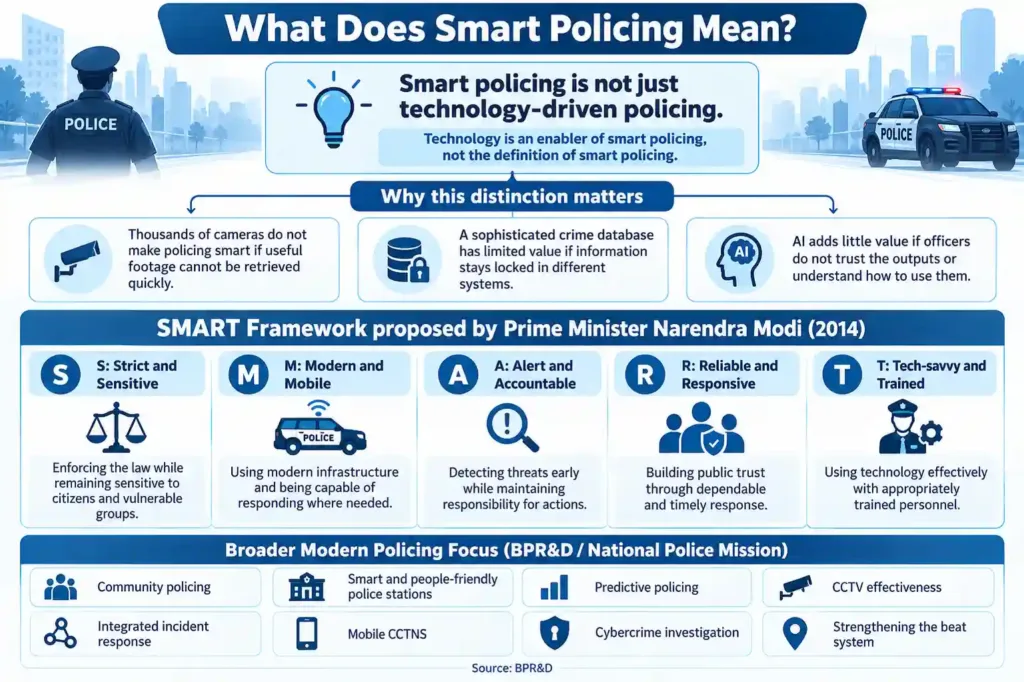
The term smart policing can sound like a synonym for technology-driven policing. It is not.
The original SMART framework proposed by Prime Minister Narendra Modi in 2014 described five characteristics of a modern police force:
| SMART | What it means |
|---|---|
| S: Strict and Sensitive | Enforcing the law while remaining sensitive to citizens and vulnerable groups |
| M: Modern and Mobile | Using modern infrastructure and being capable of responding where needed |
| A: Alert and Accountable | Detecting threats early while maintaining responsibility for actions |
| R: Reliable and Responsive | Building public trust through dependable and timely response |
| T: Tech-savvy and Trained | Using technology effectively with appropriately trained personnel |
This distinction matters.
A police department can have thousands of cameras and still not be smart if officers cannot retrieve useful footage quickly.
It can have a sophisticated crime database but still struggle if information remains locked inside different systems.
It can deploy AI but gain little value if officers do not trust the outputs or understand how to use them.
Technology is therefore an enabler of smart policing, not the definition of smart policing.
BPR&D’s current mandate reflects this broader view. Its National Police Mission identifies areas including community policing, smart and people-friendly police stations, predictive policing, CCTV effectiveness, integrated incident response, mobile CCTNS, cybercrime investigation and strengthening the beat system as components of modern policing. Source – BPRD
Why Smart Policing Matters More Today
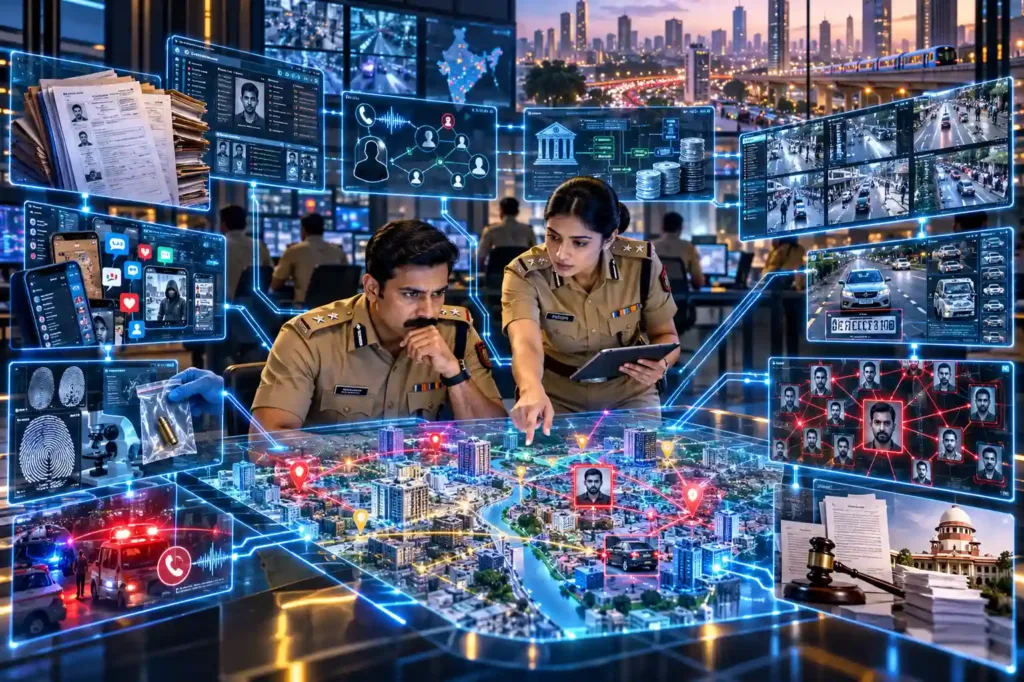
Indian police forces are dealing with a policing environment that is considerably more complex than the traditional police station model was designed for.
A single investigation may involve:
- FIR and CCTNS records
- previous case histories
- call data
- financial transactions
- CCTV footage
- mobile devices
- forensic evidence
- social media
- emergency calls
- vehicle records
- criminal networks
- court and prosecution information
The problem is no longer simply collecting information.
It is finding the relevant information, connecting it and turning it into something an officer can act upon.
This is one reason India’s policing architecture has increasingly moved towards interconnected digital systems.
MHA describes ICJS as an effort to integrate datasets across police, prisons, forensics, prosecution and courts, while improving data quality, reducing dependence on paper records and enabling the use of analytics and AI/ML in investigations. Ministry of Home Affairs
That represents a fundamental change in how policing can work.
Smart Policing Starts With Connected Data
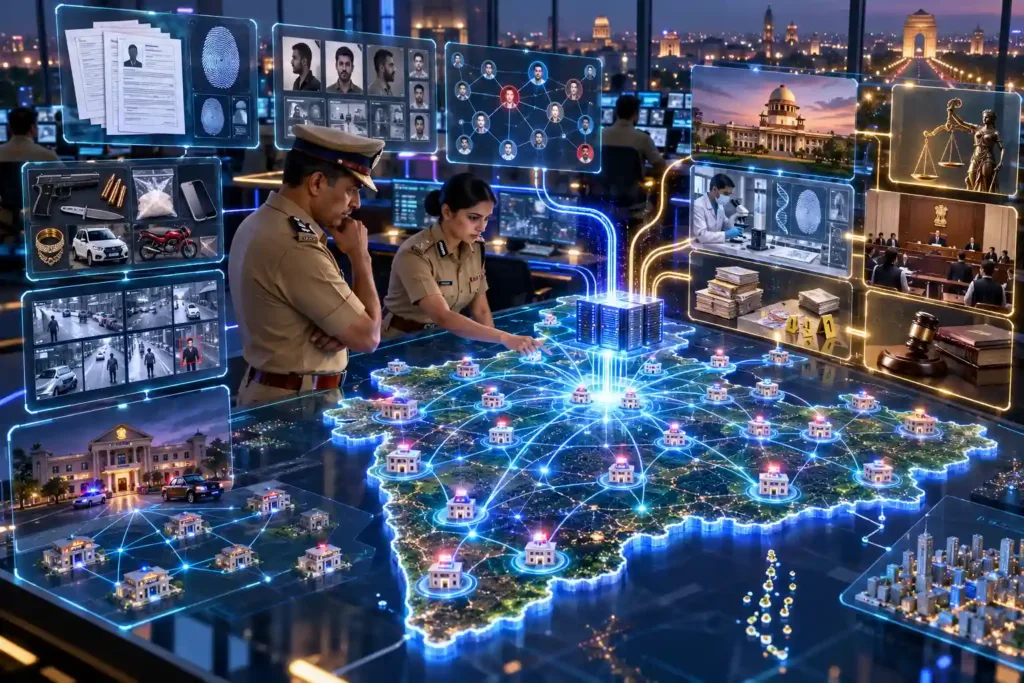
One of the most important foundations of smart policing is not AI.
It is structured and connected data.
CCTNS: The Digital Foundation
The Crime and Criminal Tracking Network & Systems (CCTNS) was launched in 2009 to connect police stations through a common application and support investigation, data analytics, research, policymaking and citizen services. Ministry of Home Affairs
The scale today is significant.
A March 2026 Rajya Sabha response stated that, as of February 1, 2026, all 17,798 police stations in India were using CCTNS.
The same response said police data entered through CCTNS is replicated in near real time at the National Data Centre, with police stations able to search crime, criminal and property-related information nationally. Standardised investigation forms and master codes are also used to improve consistency across jurisdictions. Ministry of Home Affairs
This creates something important for smart policing:
A common digital information layer across police stations.
But digitisation alone does not automatically produce intelligence.
The next question is how this information can be connected with other parts of the criminal justice system.
From CCTNS to ICJS: Connecting the Criminal Justice System

A police investigation rarely ends with the police database.
Evidence may move through forensic laboratories. The case goes to prosecution. Courts generate judicial records. Accused persons may enter the prison system.
Historically, these systems could operate as separate information silos.
The Interoperable Criminal Justice System (ICJS) is designed to address that problem.
MHA describes ICJS as integrating the major pillars of the criminal justice system:
- Police through CCTNS
- Courts through e-Courts
- Prisons through e-Prisons
- Forensics through e-Forensics
- Prosecution through e-Prosecution
The stated objective is to enable information to be entered once and used across relevant systems, while supporting data analytics and AI/ML in investigations. Ministry of Home Affairs
This is an important distinction between digital policing and smart policing.
Digital policing asks: “Can this record be stored electronically?”
Smart policing asks: “Can the right officer access the right information at the right time to make a better decision?”
Smart Policing Means Faster Emergency Response
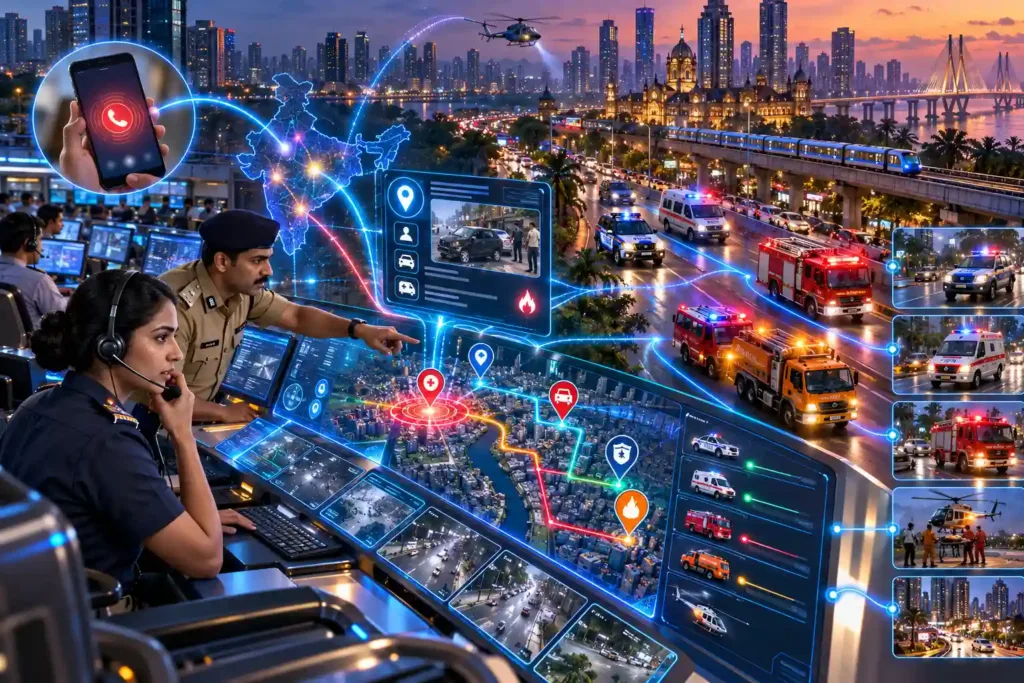
Smart policing is not restricted to investigations. It also changes what happens when a citizen needs help.
India’s Emergency Response Support System, ERSS-112, provides a unified emergency number and state-centric response infrastructure.
According to MHA, ERSS-112 can receive citizen distress information through multiple channels including voice calls, SMS, SOS, email, web requests, chatbots, media crawlers, IoT signals, WhatsApp and other external signals.
The system can then route actionable incidents to police, health, fire, disaster and other response services. Computer-aided dispatch and GIS-based systems help monitor field response units. Ministry of Home Affairs
That changes the traditional model of emergency response. Instead of:
Call → operator → manual communication → patrol
The objective becomes: Citizen signal → digital incident record → location intelligence → dispatch → field response → monitoring → closure
This creates data at every stage.
That data can eventually help police understand:
- where emergency calls are concentrated
- what types of incidents occur in particular areas
- when response demand increases
- where additional patrol resources may be needed
- whether certain locations repeatedly generate emergency calls
In other words, emergency response itself can become an input into smarter policing.
Command and Control Centres Are Becoming Intelligence Hubs

One of the most visible signs of smart policing in Indian cities is the command and control centre. But there is an important difference between a monitoring room and a policing intelligence hub. A room full of CCTV screens is not necessarily smart. The real value comes when different information sources can be brought together.
MHA’s framework for technology-enabled urban policing has included components such as:
- CCTV surveillance
- command and control centres
- emergency response systems
- fusion/data centres
- highway patrol
- aerial surveillance
alongside non-technical elements such as community policing, training and women police. Ministry of Home Affairs
Telangana provides a useful example.
The Telangana Integrated Command and Control Centre describes its role as bringing together emergency response, policing, traffic management and civic services.
Its stated functions include:
- unified emergency response
- real-time CCTV monitoring
- intelligent video detection
- traffic monitoring
- CCTNS-linked crime insights
- data-driven crime prevention
The objective is not merely to watch cameras. It is to support real-time coordination and decision-making. That distinction will become increasingly important as more states invest in command centres.
Smart Policing Uses Video as Data, Not Just Footage
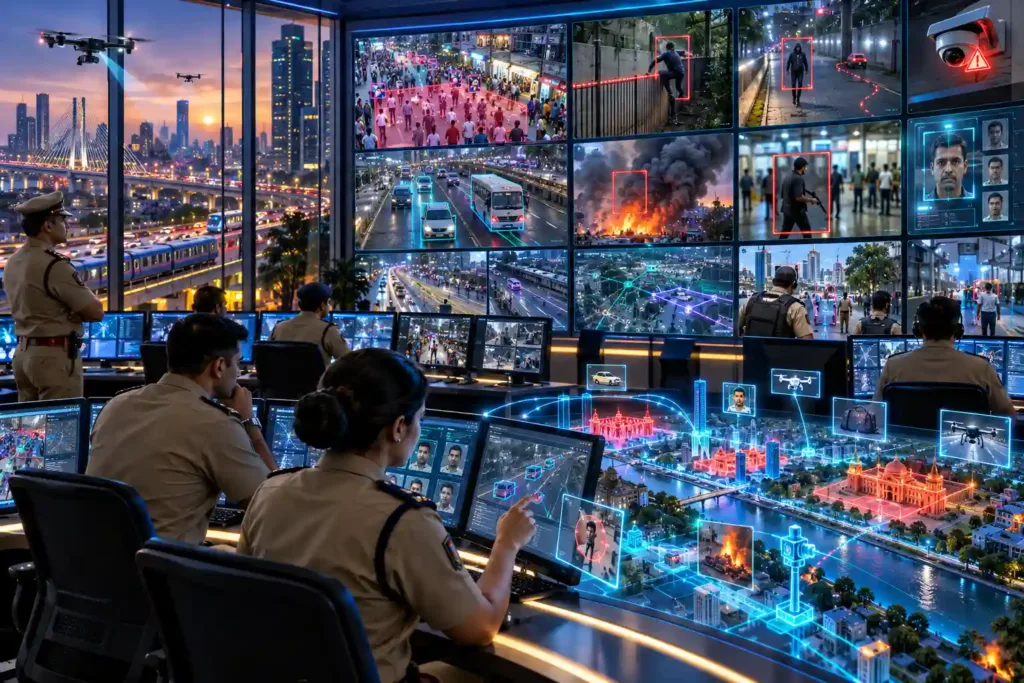
CCTV has become common across Indian cities. But conventional CCTV has an obvious limitation: A human being still has to watch the footage.
If an incident occurs at 2:15 PM, an investigator may have to review hours of footage from several cameras to reconstruct what happened.
Video analytics changes the role of the camera. Instead of simply recording an event, an intelligent video system can analyse feeds for predefined events or objects and generate alerts.
Depending on the deployment, this can include:
- crowd formation
- intrusion
- loitering
- abandoned objects
- vehicle-related events
- fire or smoke
- weapon detection
- camera tampering
- facial or object recognition
Innefu’s AI Vision, for example, is designed around automated video analysis, real-time alerts, unified camera feeds and automated extraction of useful information from large video datasets. The product material also describes integration with CCTV, body-worn cameras and drones.
The broader lesson is more important than any particular product: Smart policing turns video from a passive archive into a searchable operational data source.
However, automated detection should generate leads and alerts, not automatically determine guilt. Human review, operational protocols and appropriate safeguards remain essential.
Smart Policing Makes Investigations More Data-Driven
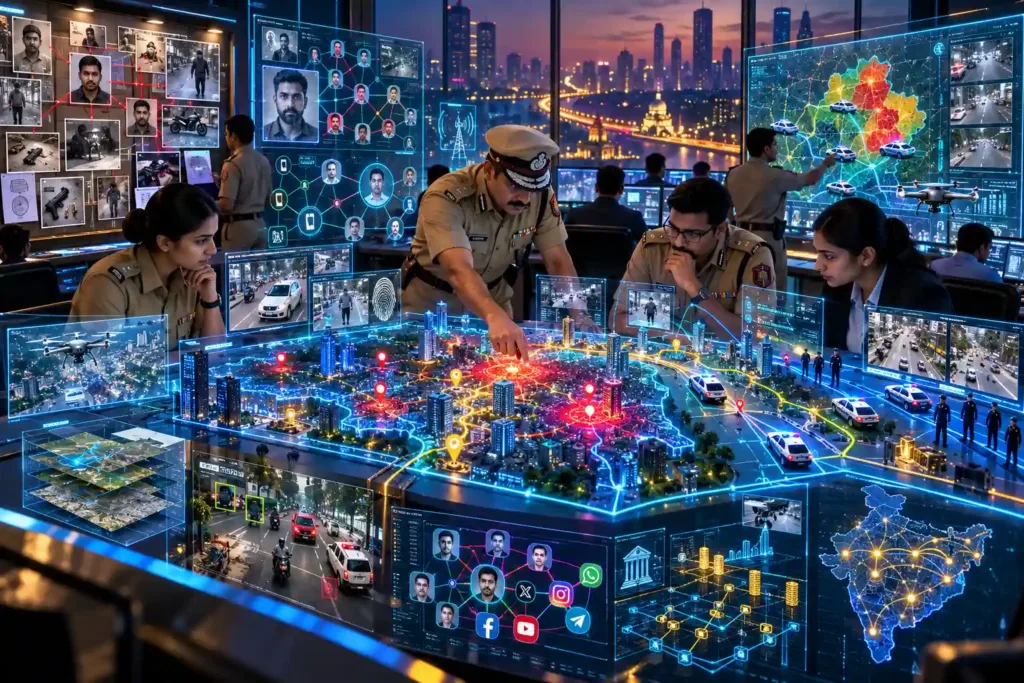
Modern investigations increasingly involve multiple datasets. Consider a hypothetical organised theft investigation.
An investigator may need to examine:
- previous FIRs
- known associates
- CDRs
- vehicle movements
- CCTV footage
- forensic evidence
- financial transactions
- social media
- locations connected to previous incidents
Individually, these datasets may not reveal much. The value emerges when relationships between them become visible. This is where link analysis, entity resolution, timelines, GIS and intelligence fusion become important.
For example, CDR analysis can help investigators examine communication relationships, device usage and geographic movement. Innefu’s Intelelinx is designed around importing CDR data, geospatial mapping, IMEI and multi-number analysis and visual link analysis.
The same principle applies to wider intelligence fusion. A police officer should not have to manually search five databases to answer a question that could be answered through a connected investigation environment.
From Reactive Policing to Proactive Policing
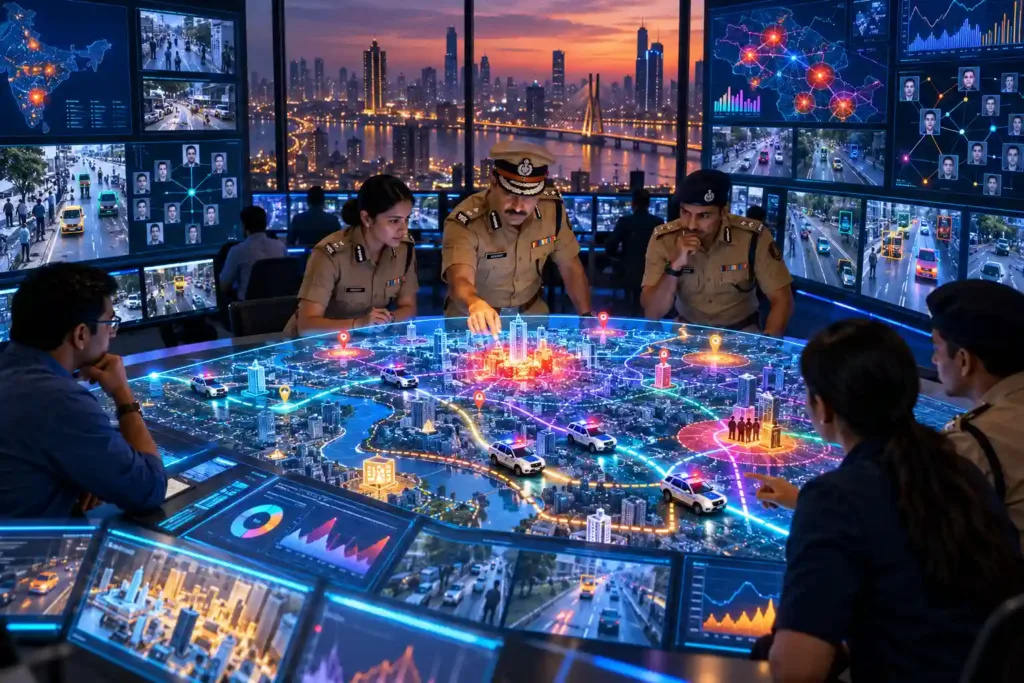
Traditional policing is often described as reactive: Crime happens → complaint is received → investigation begins.
Smart policing attempts to add another layer: What patterns are emerging, and where should police attention be directed before the situation escalates?
This can include:
- identifying crime hotspots
- analysing recurring incidents
- identifying repeat offenders
- recognising changes in crime patterns
- allocating patrol resources
- identifying vulnerable locations
- monitoring emergency-call patterns
This is where crime analytics and predictive policing enter the discussion. But the distinction is important.
Crime analytics
Looks at what has happened and what patterns exist.
Predictive policing
Uses historical and other relevant data to estimate where or when certain events may be more likely.
The second is much more sensitive and requires stronger validation. BPR&D’s recent work on AI in policing itself recognises both the potential of AI-assisted policing and the risks associated with areas such as predictive policing and deepfakes. BPRD Therefore, smart policing should not mean blindly trusting an algorithm. It should mean giving officers better evidence for human decision-making.
Smart Policing is Also About Empowering the Officer on the Ground
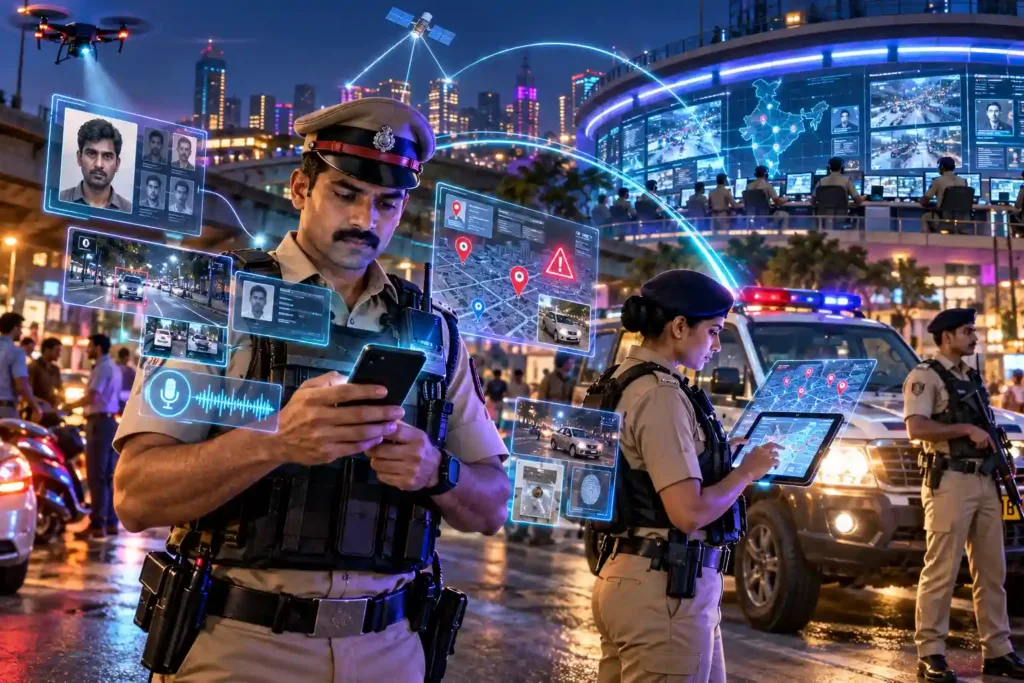
A common mistake is to think of smart policing as something that exists only at police headquarters. It does not. The constable, beat officer, investigating officer and patrol team are often the people who need technology most.
They may need to:
- access case information while in the field
- receive alerts
- verify information
- record evidence
- access maps
- communicate with command centres
- update incident information
- search criminal records
- capture audio or video
- coordinate with other units
This is why mobile policing is an important part of the original SMART framework. The principle is simple: The information system should move with the officer, not force the officer to move back to the information system.
Smart Policing Requires Better Crime Mapping
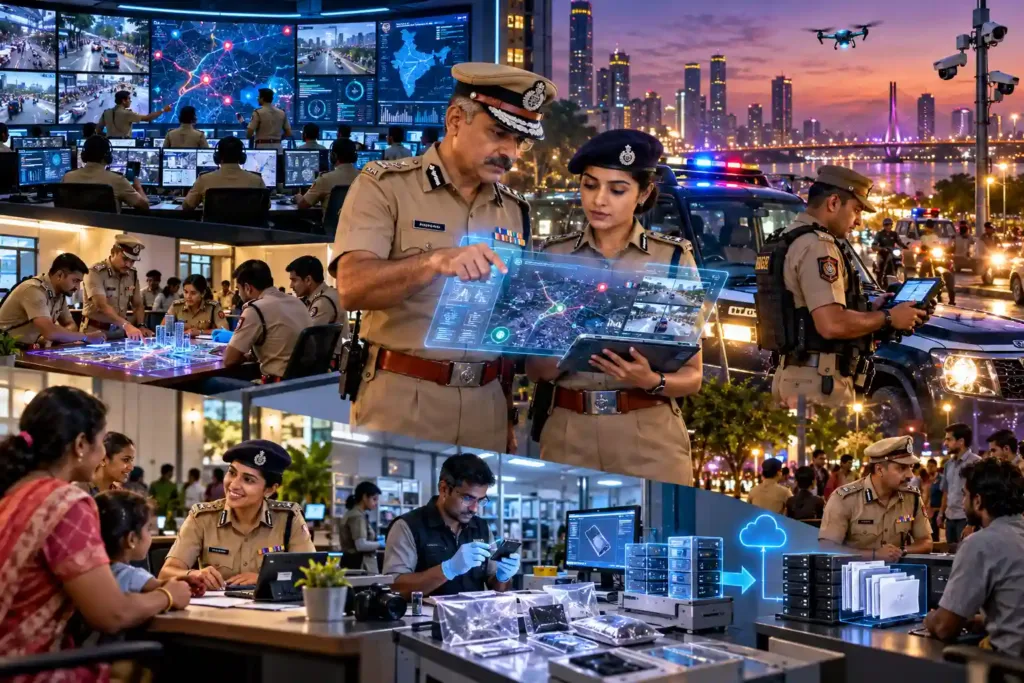
Crime does not happen randomly across a city. Different areas can experience different patterns because of:
- population density
- transport hubs
- commercial activity
- nightlife
- isolated locations
- recurring public events
- seasonal activity
- local socioeconomic conditions
GIS-based crime mapping allows police leadership to see these patterns geographically.
Kerala Police’s current iCoPS platform, for example, includes an analytics portal for interactive dashboards and real-time data analysis, as well as GIS crime mapping for visualising crime trends and supporting proactive law-enforcement planning. Kerala Police This makes the map itself an analytical tool.
A district officer can move from: “How many crimes occurred?” to: “Where are they occurring?” and then: “What patterns are visible around these locations?”
That is a much more useful operational question.
Smart Policing is Not Just About Technology
This is probably the most overlooked part. The original SMART framework included sensitivity, accountability, reliability and training alongside technology. Prime Minister of India
That remains relevant today. A technologically advanced police department can still fail if:
- officers are not trained
- systems are difficult to use
- databases contain poor-quality information
- different systems cannot communicate
- alerts are excessive and ignored
- technology operates without clear SOPs
- citizens cannot access services easily
- senior officers receive dashboards but field officers cannot act on them
BPR&D’s modernization mandate explicitly treats technology as a force multiplier and includes impact assessment, evaluation of police technology and capacity building as part of modernization. BPRD
The lesson is important: Buying technology is not the same as modernising policing.
Modernisation happens when technology changes the quality, speed or accountability of an operational process.
What Smart Policing Looks Like Across Indian States
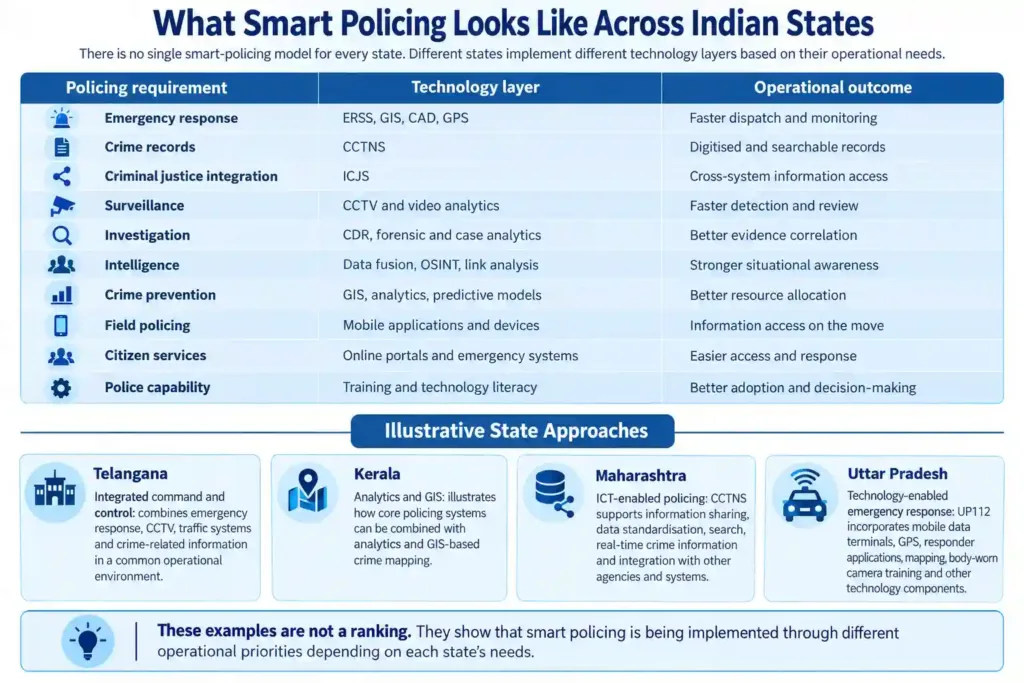
There is no single smart-policing model that every state should copy. The needs of Maharashtra are different from those of Himachal Pradesh. The policing environment in a major metropolitan area differs from that of a border district or a geographically dispersed rural state.
That is why smart policing is increasingly being built around different layers.
| Policing requirement | Technology layer | Operational outcome |
|---|---|---|
| Emergency response | ERSS, GIS, CAD, GPS | Faster dispatch and monitoring |
| Crime records | CCTNS | Digitised and searchable records |
| Criminal justice integration | ICJS | Cross-system information access |
| Surveillance | CCTV and video analytics | Faster detection and review |
| Investigation | CDR, forensic and case analytics | Better evidence correlation |
| Intelligence | Data fusion, OSINT, link analysis | Stronger situational awareness |
| Crime prevention | GIS, analytics, predictive models | Better resource allocation |
| Field policing | Mobile applications and devices | Information access on the move |
| Citizen services | Online portals and emergency systems | Easier access and response |
| Police capability | Training and technology literacy | Better adoption and decision-making |
Several states already illustrate different pieces of this model.
Telangana: Integrated command and control
Telangana’s integrated command and control infrastructure demonstrates the move towards combining emergency response, CCTV, traffic systems and crime-related information within a common operational environment.
Kerala: analytics and GIS
Kerala Police’s iCoPS ecosystem illustrates how core policing systems can be combined with analytics and GIS-based crime mapping.
Maharashtra: ICT-enabled policing
Maharashtra Police describes CCTNS as a platform for information sharing, data standardisation, search, real-time crime information and integration with other agencies and systems.
Uttar Pradesh: technology-enabled emergency response
UP112 demonstrates the field-response side of smart policing, with mobile data terminals, GPS, responder applications, mapping, body-worn camera training and other technology components incorporated into its operational ecosystem.
These examples should not be treated as a ranking of which state is “smartest”. They show something more useful: Smart policing is being implemented through different operational priorities depending on the state’s needs.
Where AI Fits Into Smart Policing
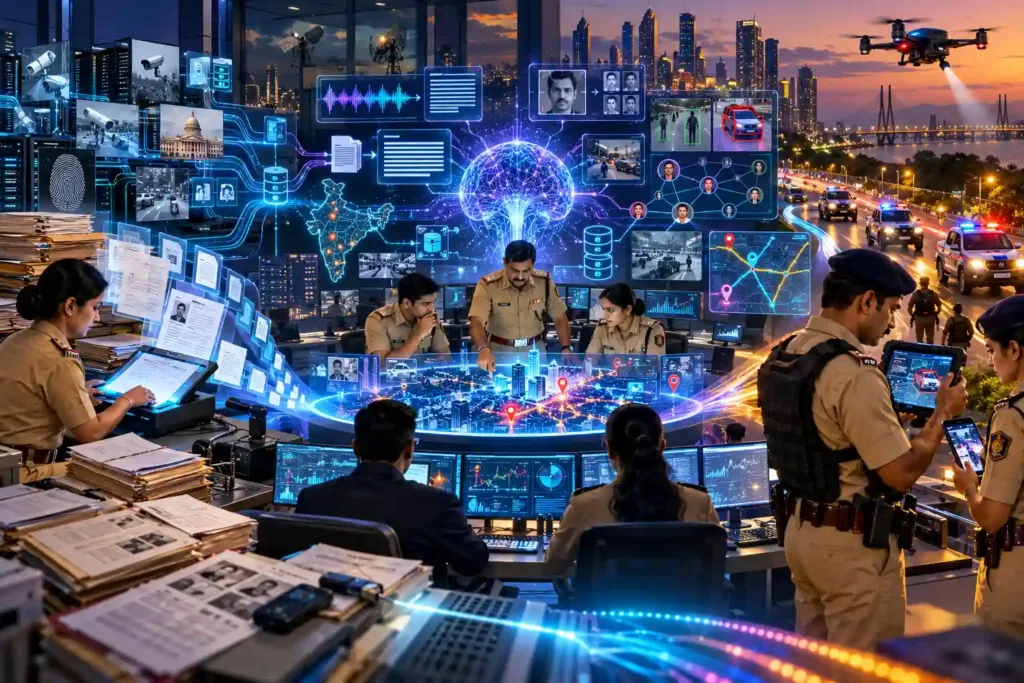
AI is likely to become one of the most important layers of smart policing, but it should not be treated as the starting point. A useful way to think about the progression is:
Stage 1: Digitise
Convert paper records and manual workflows into digital systems.
Stage 2: Connect
Allow authorised systems to exchange information.
Stage 3: Analyse
Use search, dashboards, GIS, correlation and analytics to identify patterns.
Stage 4: Assist
Use AI to help officers summarise, classify, search, transcribe, detect and prioritise information.
Stage 5: Act
Feed useful intelligence into response, investigation and resource allocation workflows.
This is where AI can become genuinely useful. For example:
- speech-to-text can reduce manual transcription
- computer vision can flag relevant video events
- NLP can search large volumes of text
- AI can summarise case material
- entity resolution can identify potentially related records
- analytics can identify patterns across datasets
- AI-assisted systems can help investigators navigate large evidence collections
Innefu’s product portfolio reflects several of these layers. Its Speech-to-Text solution, for instance, is designed to convert recorded police, radio and emergency communications into searchable text, with features such as noise reduction and multilingual support.
Similarly, Prophecy Alethia’s product architecture describes bringing multiple police datasets into an intelligence-fusion environment, with dashboards, GIS, crime trends, forensic correlation and predictive force deployment.
The important point is that AI becomes more useful when it sits on top of good data and connected workflows. AI cannot compensate indefinitely for poor data quality.
What Should a State Police Department Measure?
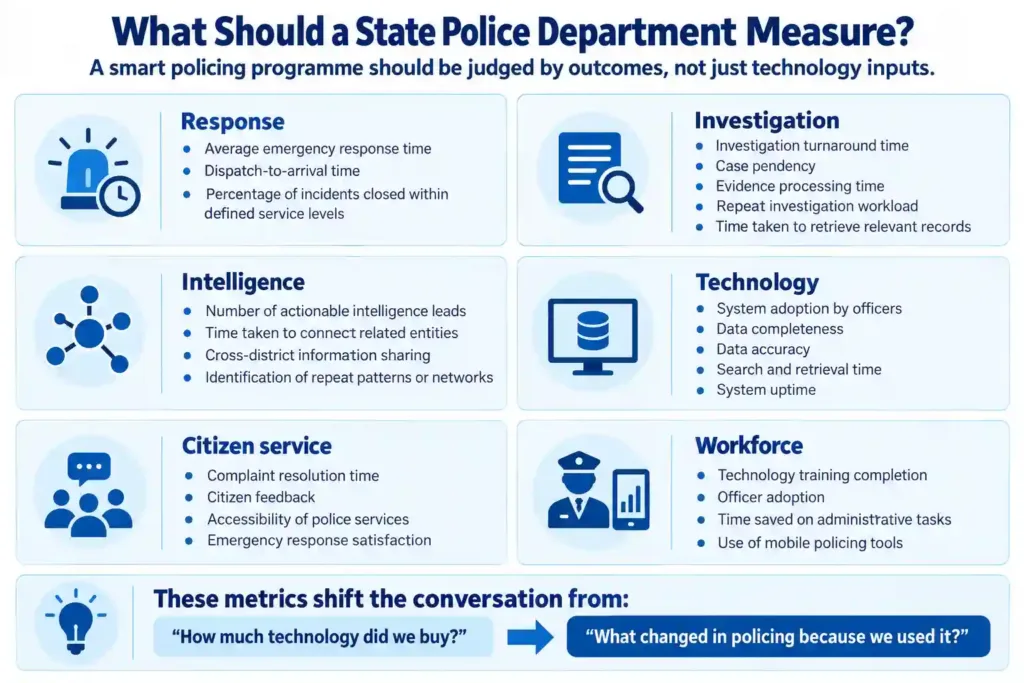
A smart policing programme should not be judged by the number of cameras installed, software licences purchased or dashboards created. Those are inputs. The real question is whether policing outcomes improve.
Useful KPIs can include:
Response
- Average emergency response time
- Dispatch-to-arrival time
- Percentage of incidents closed within defined service levels
Investigation
- Investigation turnaround time
- Case pendency
- Evidence processing time
- Repeat investigation workload
- Time taken to retrieve relevant records
Intelligence
- Number of actionable intelligence leads
- Time taken to connect related entities
- Cross-district information sharing
- Identification of repeat patterns or networks
Technology
- System adoption by officers
- Data completeness
- Data accuracy
- Search and retrieval time
- System uptime
Citizen service
- Complaint resolution time
- Citizen feedback
- Accessibility of police services
- Emergency response satisfaction
Workforce
- Technology training completion
- Officer adoption
- Time saved on administrative tasks
- Use of mobile policing tools
These metrics shift the conversation from: “How much technology did we buy?” to: “What changed in policing because we used it?”
Frequently Asked Questions
1. What is smart policing?
Smart policing is an approach to policing that combines technology, data, trained personnel, modern processes and accountability to improve crime prevention, investigation, emergency response and citizen services. In India, the concept is associated with the SMART framework: Strict and Sensitive, Modern and Mobile, Alert and Accountable, Reliable and Responsive, and Tech-savvy and Trained. Prime Minister of India
2. Is smart policing the same as AI policing?
No. AI is one component of smart policing. Smart policing also includes digitisation, CCTNS, ICJS, emergency response systems, GIS, mobile policing, video systems, investigation tools, training and citizen-facing services.
3. How is CCTNS helping smart policing?
CCTNS provides a common digital platform for police records and enables police stations to store, search and share crime, criminal and property-related information. As of February 1, 2026, all 17,798 police stations in India were using CCTNS. Ministry of Home Affairs
4. What is ICJS and why does it matter for smart policing?
ICJS is designed to integrate information across police, courts, prisons, prosecution and forensic systems. This can reduce information silos and support faster investigation and evidence-based decision-making. Ministry of Home Affairs
5. How does CCTV contribute to smart policing?
Traditional CCTV primarily records footage. Intelligent video analytics can analyse feeds and generate alerts for predefined events or objects, helping officers focus attention on relevant incidents rather than manually reviewing every minute of footage.
6. What role does GIS play in smart policing?
GIS allows police to analyse crime and incident information geographically. This can help identify hotspots, recurring patterns, vulnerable locations and resource requirements.
7. Can predictive policing replace police officers?
No. Predictive systems can provide estimates or identify patterns, but operational decisions require human judgment, appropriate oversight and an understanding of the limitations of the underlying data and models.
8. What is the biggest challenge in implementing smart policing?
Technology itself is rarely the only challenge. Data quality, interoperability, training, adoption, process redesign, cybersecurity, governance and the ability to convert analytical outputs into operational action are equally important.
Editorial note: This article is intended as an informational overview of smart policing in India, not as a legal, operational or procurement directive. State systems, policies and technology deployments change over time, so specific implementation decisions should be checked against the relevant state government’s current rules, SOPs and procurement documents.