Circular trading is a loop of invoices between connected firms, where goods or services are billed round and round without real supply, to inflate turnover or pass on input tax credit (ITC). A benami network hides who really owns the assets and companies behind those firms by placing them in other people’s names. The two often travel together: circular trading generates the paper trail and the cash, and benami arrangements keep the real owner out of sight. Investigators break both by tracing the real movement of goods and money, and the real source of funds behind each name.
Key Takeaways
- Circular trading is billing without supply: the invoices move in a loop, the goods and services do not
- Benami means one person holds an asset while another person pays for it. The Prohibition of Benami Property Transactions Act, 1988, as amended in 2016, makes it an offence
- Central tax officers detected fake ITC of ₹74,782 crore across 30,162 cases in FY 2025-26, as reported to Parliament
- The strongest evidence comes from comparing invoices with e-way bills, FASTag records, bank statements and stock records
- A single red flag proves nothing. A cluster of flags across data sources is what justifies a closer look
- Benami cases turn on one question: who actually paid, and where did that money come from?
- Banks and large enterprises can reduce exposure through supplier due diligence and cross-checks on turnover claims
What circular trading is

Imagine firm A bills firm B for goods, B bills C, and C bills A again. On paper, each firm sells and buys. In reality, no truck moved, no stock changed hands and no service was delivered. The invoices exist only to create a record.
The reasons differ by case, and it helps to name them plainly:
- To pass or encash ITC: Fake invoices let ITC flow through a chain, which can then be used to offset tax or claim a refund
- To inflate turnover: Higher reported sales can make a firm look larger to lenders, tender evaluators or prospective buyers
- To move or layer money: Payments that travel in a loop between connected accounts can make funds look like business income
“Circular trading” is a descriptive term, not a defined offence in the GST law. Where it involves invoices without supply, it falls under the fake-invoicing and fraudulent ITC provisions of the CGST Act. The same word is also used in securities markets, which is a different subject and is not covered here.
How it usually works
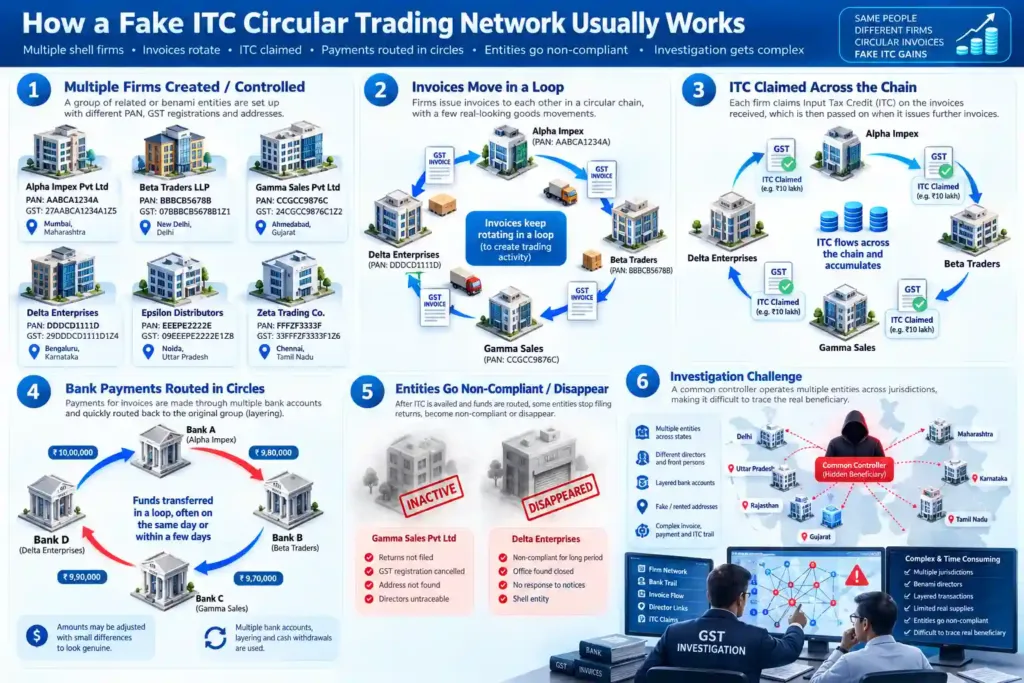
- A group of firms is set up or acquired, often with different PANs and registered addresses
- Invoices pass between them in a loop or a ring, sometimes with a few real transactions mixed in to look genuine
- ITC is claimed along the chain
- Payments are routed through bank accounts, often returning to where they started
- Some entities are dropped or go non-compliant once the chain has served its purpose
Central tax officers have described the hard part. In a written reply to the Lok Sabha in July 2024, the Minister of State for Finance said the challenge in tracking fake ITC lies with masterminds who run these operations through a complex web of entities created across jurisdictions.
The scale of the problem
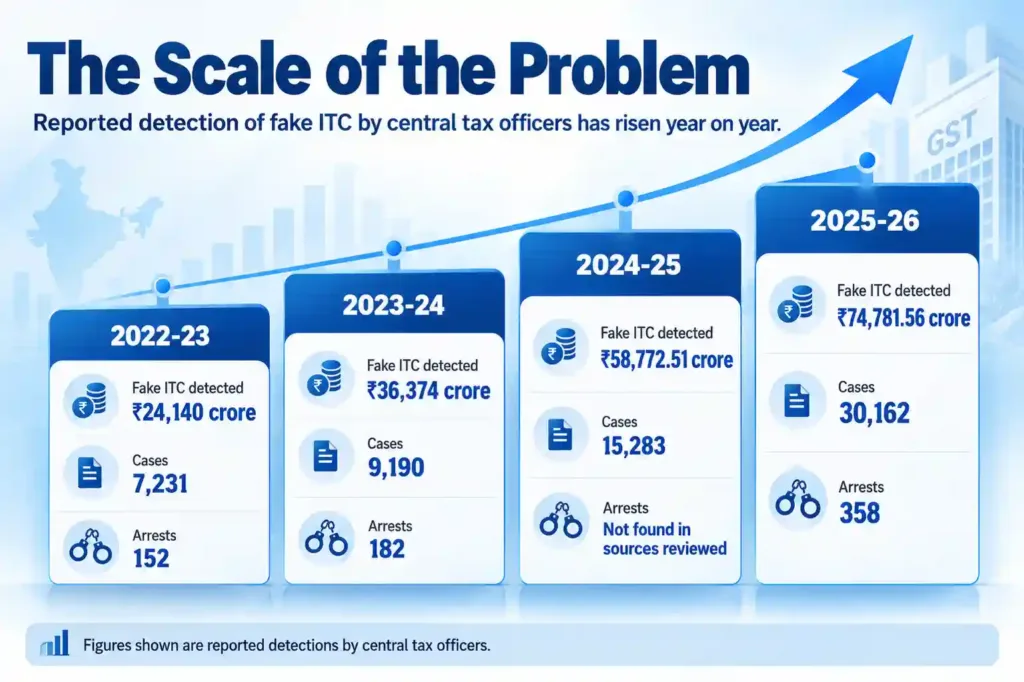
Reported detection of fake ITC by central tax officers has risen year on year.
| Financial year | Fake ITC detected | Cases | Arrests |
|---|---|---|---|
| 2022-23 | ₹24,140 crore | 7,231 | 152 |
| 2023-24 | ₹36,374 crore | 9,190 | 182 |
| 2024-25 | ₹58,772.51 crore | 15,283 | Not found in sources reviewed |
| 2025-26 | ₹74,781.56 crore | 30,162 | 358 |
Sources: Lok Sabha reply of July 2024 as reported by Deccan Herald for 2022-23 and 2023-24, and a Rajya Sabha reply as reported by Daily Financial for 2024-25 and 2025-26. Fake ITC covers all patterns of invoice fraud, so these figures are not a measure of circular trading alone. Higher detection also reflects better analytics, not only more fraud.
What a benami transaction is

Under the Prohibition of Benami Property Transactions Act, 1988 (the PBPT Act, earlier called the Benami Transactions (Prohibition) Act), a benami transaction is, in simple terms, one where property is held by one person and paid for by another. The person whose name is on the property is the benamidar. The person who actually paid and benefits is the beneficial owner.
The Benami Transactions (Prohibition) Amendment Act, 2016 came into force on 1 November 2016 and strengthened the law considerably.
What the law provides
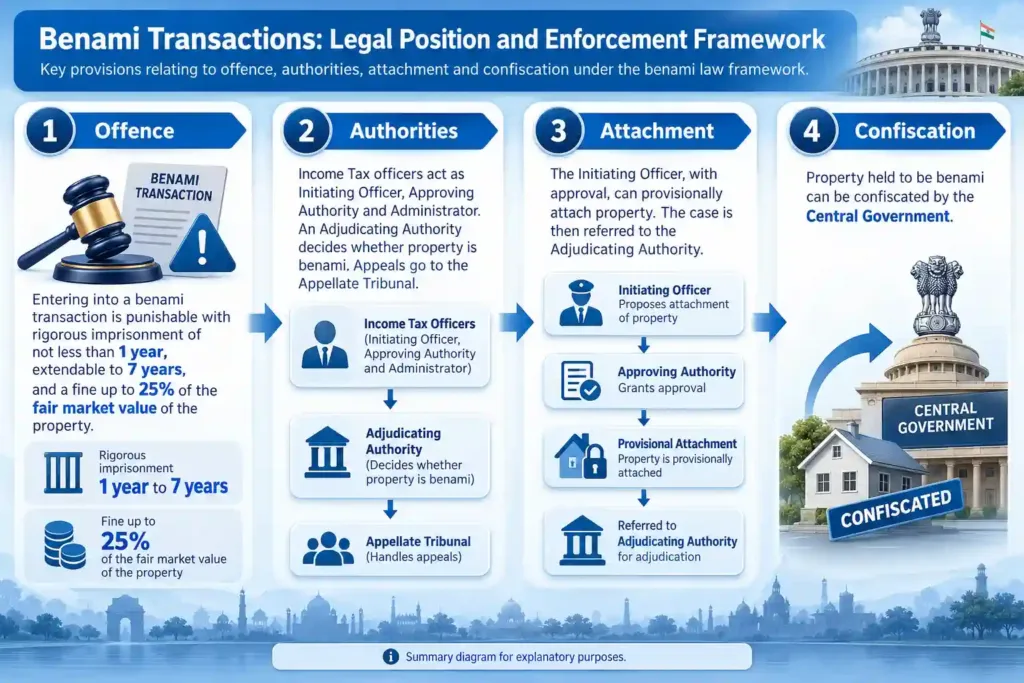
| Point | Position |
|---|---|
| Offence | Entering into a benami transaction is punishable with rigorous imprisonment of not less than one year, extendable to seven years, and a fine up to 25% of the fair market value of the property |
| Authorities | Income Tax officers act as Initiating Officer, Approving Authority and Administrator. An Adjudicating Authority decides whether property is benami. Appeals go to the Appellate Tribunal |
| Attachment | The Initiating Officer, with approval, can provisionally attach property. The case is then referred to the Adjudicating Authority |
| Confiscation | Property held to be benami can be confiscated by the Central Government |
An important court ruling

In August 2022, a three-judge bench of the Supreme Court held that Sections 3(2) and 5 of the Act, as introduced in 2016, were unconstitutional to the extent they operated on transactions made before the amendment, and that the 2016 amendment applies prospectively. For a new case, the date of the transaction therefore matters a great deal. Check the current legal position with counsel.
The Act has exceptions, for example for certain property held by family members or in a fiduciary capacity. If you are drafting internal guidance, read the definition in the Act itself and have your legal team confirm how the exceptions apply.
Where circular trading and benami networks meet
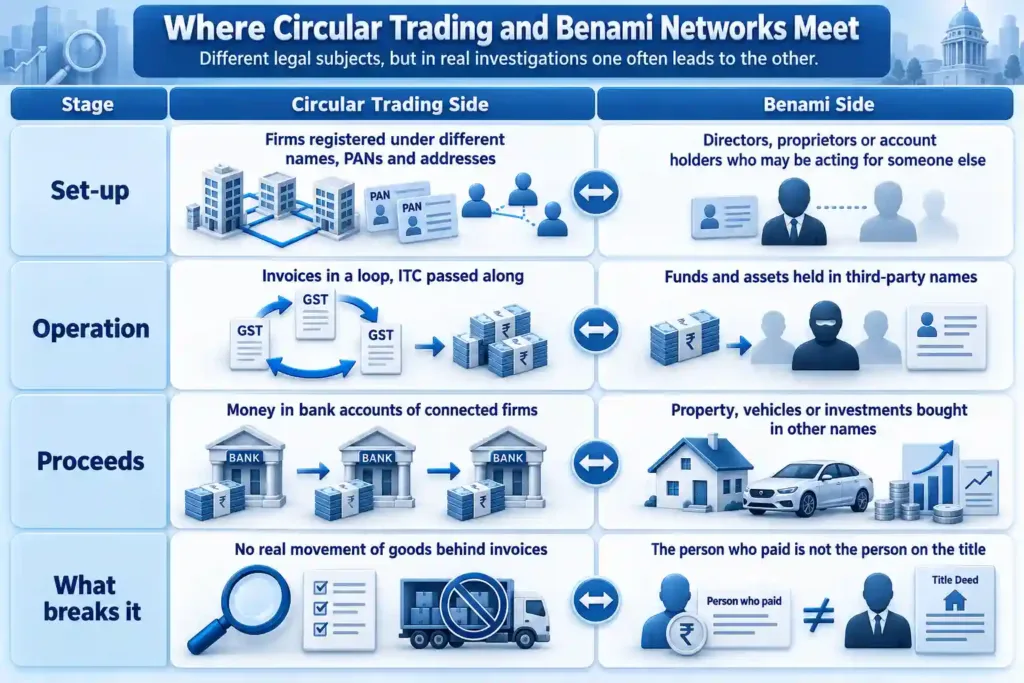
They are different legal subjects. One concerns tax and invoices. The other concerns property and ownership. But in a real investigation, one often leads to the other.
| Stage | What the circular trading side shows | What the benami side shows |
|---|---|---|
| Set-up | Firms registered under different names, PANs and addresses | Directors, proprietors or account holders who may be acting for someone else |
| Operation | Invoices in a loop, ITC passed along | Funds and assets held in third-party names |
| Proceeds | Money in bank accounts of connected firms | Property, vehicles or investments bought in other names |
| What breaks it | No real movement of goods behind invoices | The person who paid is not the person on the title |
Note that a nominee director or a front proprietor is not automatically a benamidar under the Act, which concerns property. The overlap is in the pattern: someone is named on paper, and someone else is in control.
Red flags that justify a closer look
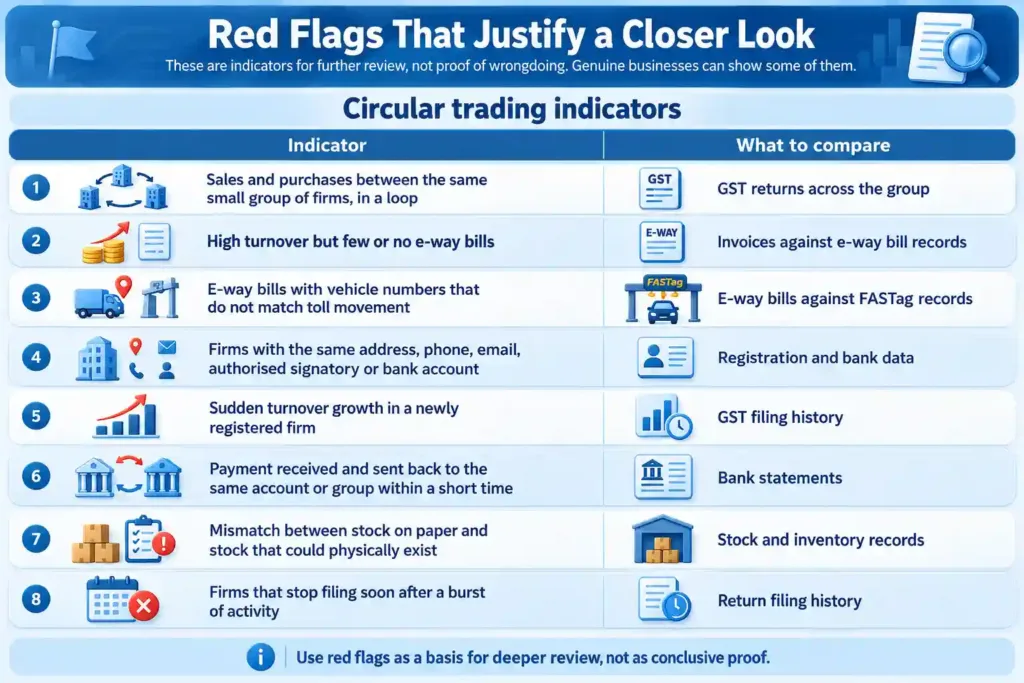
These are indicators for further review, not proof of wrongdoing. Genuine businesses can show some of them.
Circular trading indicators
| Indicator | What to compare |
|---|---|
| Sales and purchases between the same small group of firms, in a loop | GST returns across the group |
| High turnover but few or no e-way bills | Invoices against e-way bill records |
| E-way bills with vehicle numbers that do not match toll movement | E-way bills against FASTag records |
| Firms with the same address, phone, email, authorised signatory or bank account | Registration and bank data |
| Sudden turnover growth in a newly registered firm | GST filing history |
| Payment received and sent back to the same account or group within a short time | Bank statements |
| Mismatch between stock on paper and stock that could physically exist | Stock and inventory records |
| Firms that stop filing soon after a burst of activity | Return filing history |
Benami indicators
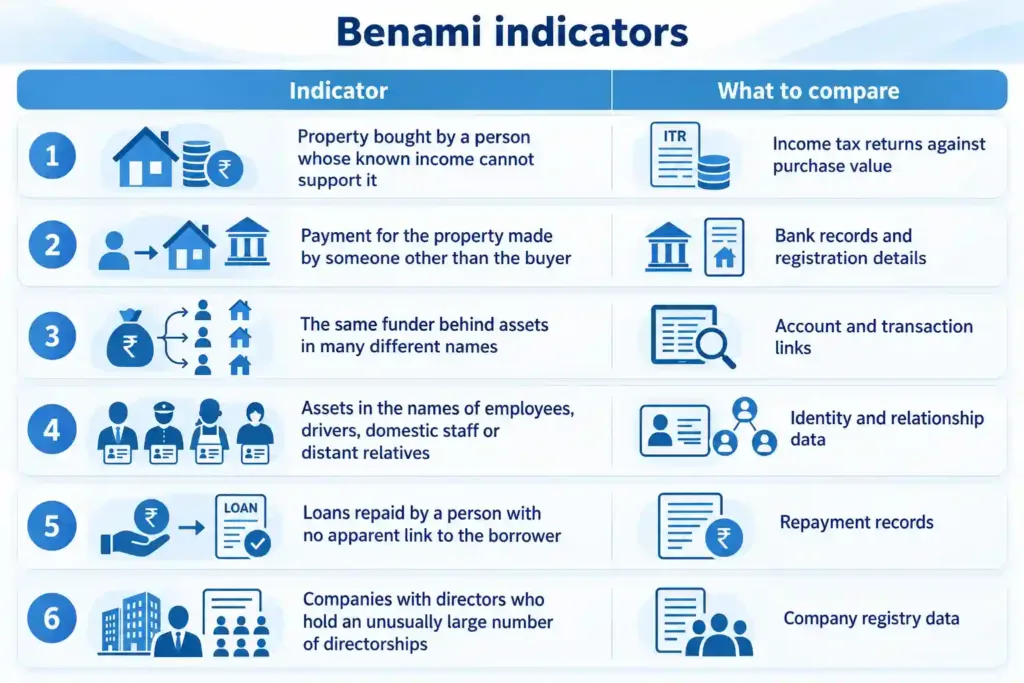
| Indicator | What to compare |
|---|---|
| Property bought by a person whose known income cannot support it | Income tax returns against purchase value |
| Payment for the property made by someone other than the buyer | Bank records and registration details |
| The same funder behind assets in many different names | Account and transaction links |
| Assets in the names of employees, drivers, domestic staff or distant relatives | Identity and relationship data |
| Loans repaid by a person with no apparent link to the borrower | Repayment records |
| Companies with directors who hold an unusually large number of directorships | Company registry data |
A single indicator from either list is weak. Several indicators across several data sources together are a reason to open a proper inquiry.
How investigators actually break these networks

Follow the goods, not the invoice
The most reliable test for circular trading is physical. If an invoice says goods moved, something should show it: an e-way bill, a vehicle, a toll record, a weighbridge slip, a goods receipt, a stock entry. Generally, goods movement above a value threshold needs an e-way bill, so a large claimed supply with no e-way bill, or with a vehicle that does not fit, is a strong lead. Check the current threshold and exceptions in the rules.
Follow the money
Bank statements show whether payments are real and where they end up. A loop of payments that returns to a common account, or that fully offsets itself, is a pattern worth mapping.
Map the network
Individual records mean little. A graph of firms, people, addresses, phone numbers, bank accounts and vehicles shows structure: clusters, rings and the single person who connects them. Shared identifiers are often the first sign that “independent” firms are not independent.
Establish who controls it
For benami questions, the focus shifts from the name on the record to the source of the money. Who paid? From which account? Did that person have the means? Who gained?
Preserve the evidence properly
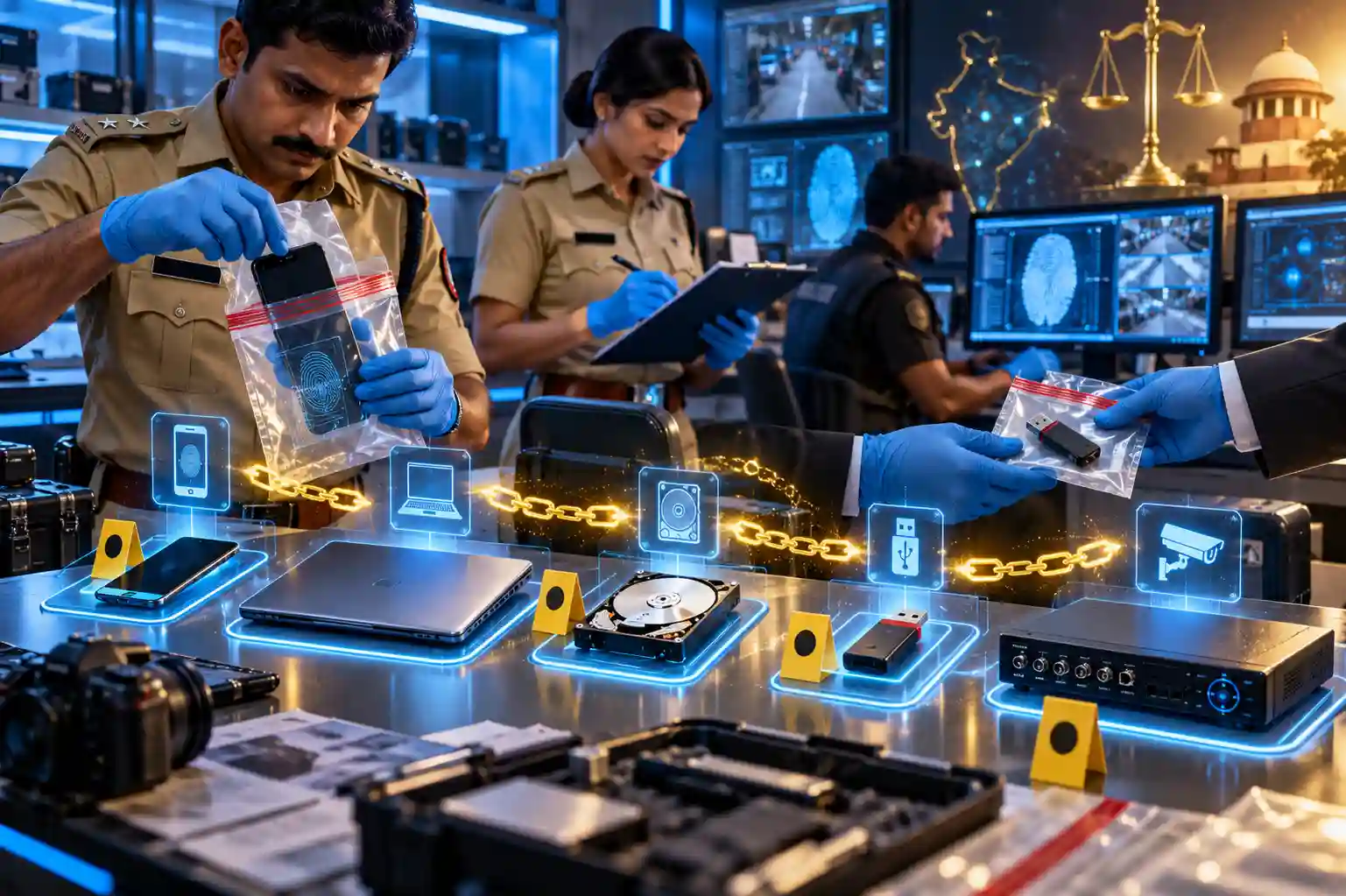
Raids and searches produce documents, devices and data. Evidence from electronic records should be handled with an unbroken record of custody and, where it is produced in court, a Section 63 BSA certificate. See our guides on the Section 63 BSA certificate and chain of custody for digital evidence under the BNSS.
What the law says on penalties, and what may change
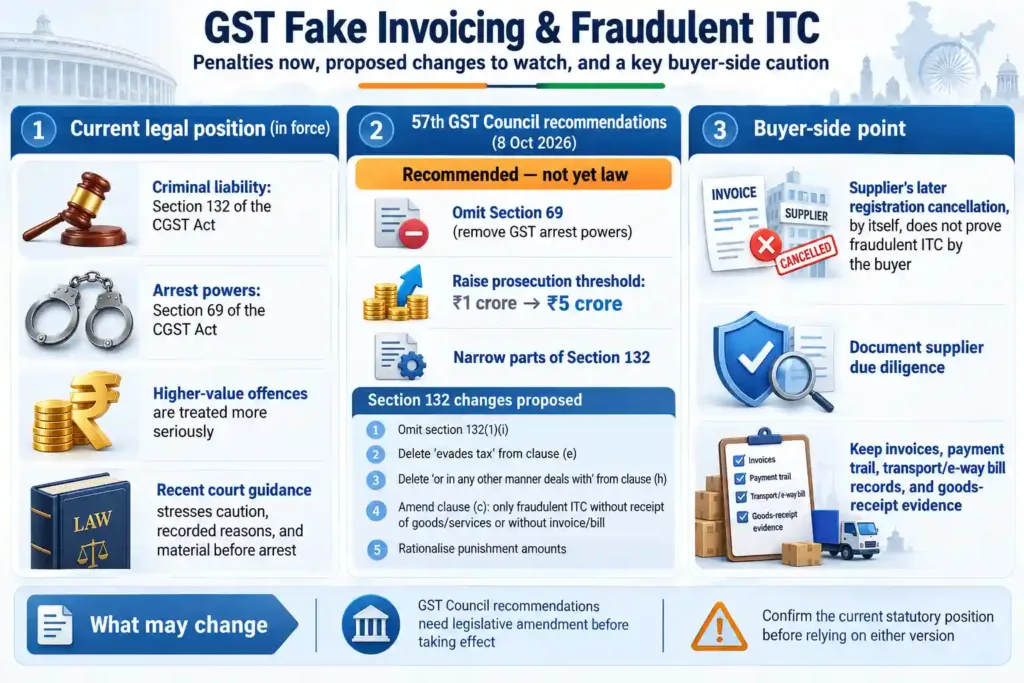
For GST fake invoicing and fraudulent ITC, criminal liability sits under Section 132 of the CGST Act, with arrest powers under Section 69. Offences involving higher amounts are treated as more serious, and the Karnataka High Court has recently stressed that arrest under Section 69 should be exercised with great circumspection, on recorded reasons based on material.
A recent development to watch
Reports on the 57th GST Council meeting, held on 8 October 2026, say the Council recommended omitting Section 69, raising the prosecution threshold from ₹1 crore to ₹5 crore, and narrowing parts of Section 132. These are recommendations. They need legislative amendment before they take effect, so confirm the current statutory position before relying on either version.
A point on buyers
The Karnataka High Court has also observed that a supplier’s later registration cancellation, by itself, does not prove that the buyer took ITC on fraudulent invoices. That makes documented supplier due diligence important for any genuine business.
What banks and enterprises can do

You do not need to be an investigator to reduce exposure.
For lenders and BFSI teams
- Compare GST turnover with bank credits and with e-way bill volumes before sanctioning working capital
- Look for round-tripping in account statements: money out and back in to the same group within days
- Check whether multiple borrowers share addresses, phone numbers, directors or bank accounts
- Treat sudden turnover jumps in new firms as a trigger for review, not as a sign of success
For enterprises that buy from many suppliers
- Verify supplier registration, filing history and place of business before onboarding
- Match purchase orders, delivery proof and invoices, not only invoices and payments
- Keep a record of due diligence. It helps if a supplier later turns out to be non-compliant
- Review suppliers with sudden changes in turnover, address or ownership
Where Prophecy Eagle I fits

Prophecy Eagle I is Innefu’s investigation platform for GST and indirect tax fraud. It brings together data such as GST records, PAN and directorship information, e-way bills and FASTag records. It flags patterns such as one individual linked to many companies under different PAN numbers or holding an unusual number of directorships, and it checks whether GST sales and purchases are supported by e-way bill and FASTag movement, which is the check that exposes carousel-style invoicing.
During investigations, it helps analyse evidence collected in raids, such as e-way bills, FASTag data, bank statements and forensic data, against what the companies reported.
Frequently Asked Questions
1. What is circular trading?
It is a loop of invoices between connected firms in which goods or services are billed but not actually supplied, often to pass on input tax credit, inflate turnover or layer money.
2. Is circular trading illegal in India?
Where it involves invoices without real supply, it falls under the fake-invoicing and fraudulent ITC provisions of the CGST Act, which carry demand, penalty and, in serious cases, prosecution. The phrase itself is descriptive and not a defined term in the GST law.
3. What is a benami transaction?
A transaction in which property is held by one person, the benamidar, while another person, the beneficial owner, pays for it. It is prohibited under the PBPT Act, 1988, as amended in 2016.
4. What is the punishment for benami transactions?
Rigorous imprisonment of not less than one year, extendable to seven years, and a fine up to 25% of the fair market value of the property. The property can also be attached and confiscated. Whether the amended penalties apply depends on the date of the transaction, following the Supreme Court’s 2022 ruling.
5. How is circular trading detected?
By comparing invoices with e-way bills, toll records, bank statements and stock records, and by mapping links between firms through shared addresses, directors, bank accounts and contact details.
6. How are benami properties identified?
By tracing who funded the purchase and comparing it with the buyer’s known income, then examining links between the funder and the other names involved.
7. Are circular trading and benami transactions the same thing?
No. Circular trading is about billing without supply. Benami is about hiding the real owner of property. They can appear in the same network, but they are different legal matters handled by different authorities.
8. How can a business protect itself from fake ITC chains?
Verify suppliers before onboarding, match deliveries with invoices and payments, keep due diligence records, and review suppliers whose turnover, address or ownership changes suddenly.
This article is for general information and is not legal, tax or investigative advice. Laws, GST Council recommendations and court decisions change. Confirm the current position with qualified counsel before relying on it in a specific matter.