
AI models for government are rapidly transforming how public sector organizations deliver citizen services, strengthen national security, detect fraud, and modernize governance. From Sovereign AI infrastructure and intelligent surveillance systems to AI-powered cybersecurity and public administration platforms, governments worldwide are investing heavily in secure and scalable AI ecosystems.
From intelligent surveillance systems and cyber defense platforms to AI-powered tax fraud detection and citizen support systems, governments are moving beyond experimentation and deploying AI at scale.
At the center of this transformation is the growing importance of Sovereign AI — the ability of nations to build, manage, and secure their own AI infrastructure, datasets, and AI models.
According to industry estimates, the global AI in government market was valued at more than USD 22 billion in 2024 and is expected to grow rapidly over the next decade. Governments worldwide are increasingly viewing AI not just as a technology investment, but as strategic national infrastructure.
However, government AI is fundamentally different from commercial AI.
Public sector AI systems must handle highly sensitive information, operate securely, comply with regulations, and remain transparent and accountable. This is why discussions around AI models for government and Sovereign AI have become central to digital governance strategies globally.
According to the OECD AI governance report, governments worldwide are increasingly adopting AI to improve public services and operational efficiency.
In this blog, we explore how AI is transforming governments, why Sovereign AI matters, key public sector use cases, challenges in adoption, and what the future of AI-powered governance will look like.
What Are AI Models for Government?
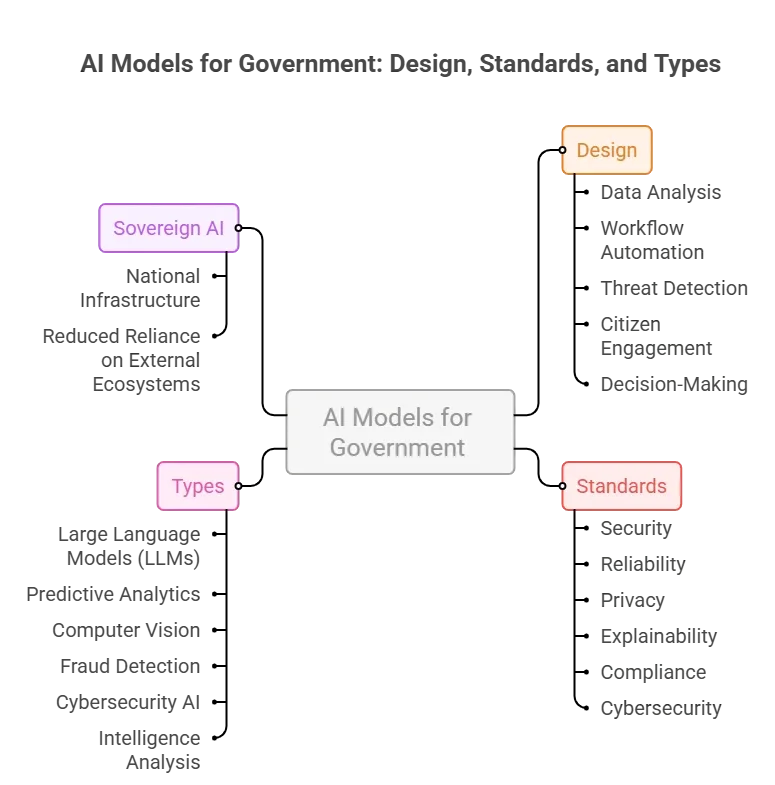
AI models for government are artificial intelligence systems specifically designed for public sector operations. These systems help government agencies analyze large volumes of data, automate repetitive workflows, detect threats and fraud, improve citizen engagement, and support faster decision-making.
Unlike commercial AI systems, government AI models must meet significantly higher standards of security and reliability. Government agencies deal with critical infrastructure, classified intelligence, financial systems, law enforcement databases, and citizen information. As a result, public sector AI systems require strong safeguards around privacy, explainability, compliance, and cybersecurity.
These AI models may include Large Language Models (LLMs), predictive analytics systems, computer vision platforms, fraud detection engines, cybersecurity AI solutions, and intelligence analysis platforms.
Increasingly, governments are moving toward Sovereign AI models that are trained and deployed within national infrastructure instead of relying entirely on external or foreign-controlled ecosystems.
Why Governments Are Investing in Sovereign AI
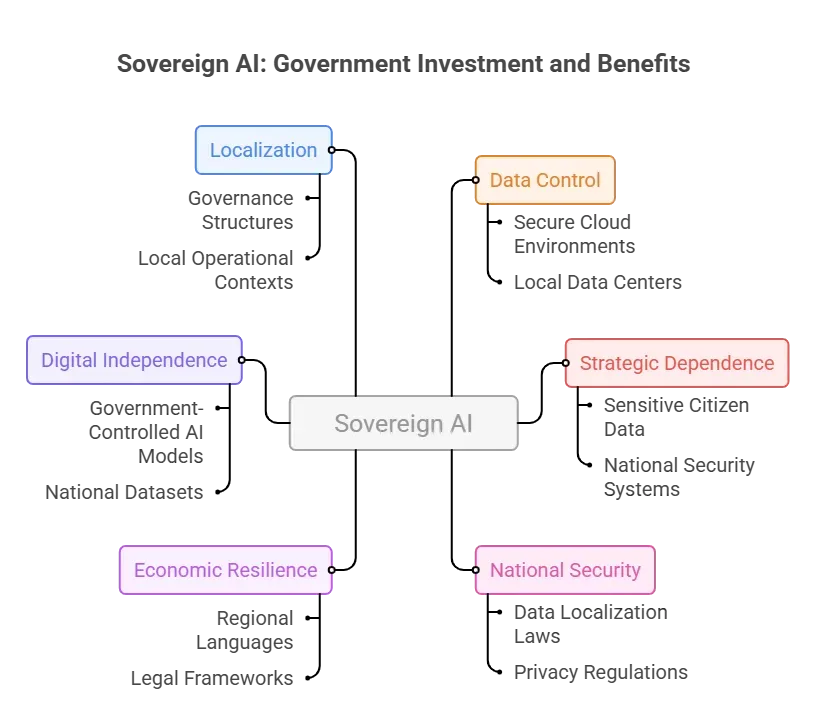
Governments today face a unique challenge. While AI offers enormous opportunities for efficiency and innovation, it also introduces concerns around data control, strategic dependence, and national security.
This is where Sovereign AI becomes critical.
Sovereign AI refers to a country’s ability to develop, deploy, and manage AI capabilities within its own jurisdiction. This includes domestic AI infrastructure, secure cloud environments, local data centers, national datasets, and government-controlled AI models.
The importance of Sovereign AI is growing because governments increasingly recognize that AI systems will become foundational to national governance, security, economic resilience, and digital independence.
Countries that rely entirely on external AI providers may face long-term strategic risks, especially when sensitive citizen data or national security systems are involved.
Sovereign AI allows governments to maintain greater control over how data is stored, processed, and used. It also helps countries comply with data localization laws and privacy regulations while reducing dependency on foreign technology ecosystems.
Another major advantage of Sovereign AI is localization. Government AI systems often need to support regional languages, legal frameworks, governance structures, and local operational contexts. Sovereign AI models can be trained specifically for these national requirements, making them more accurate and effective.
How Governments Are Using AI Today
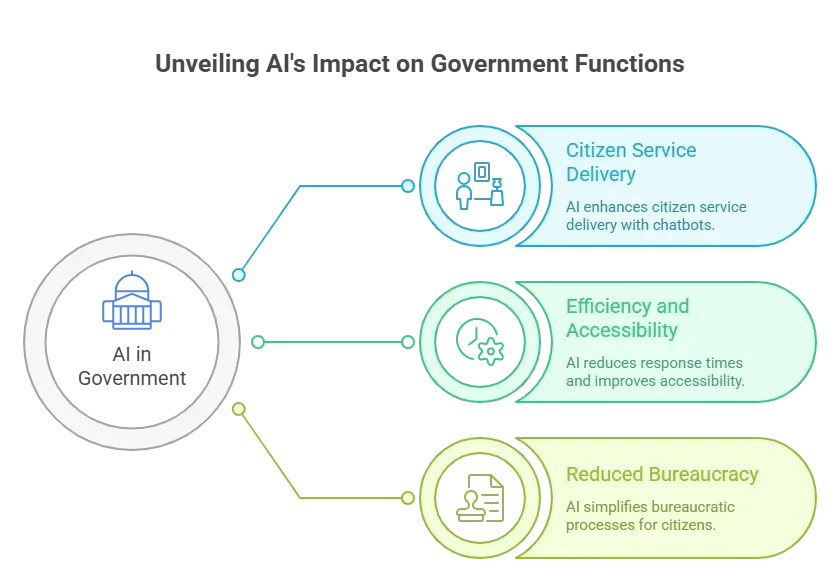
AI is now being used across almost every major government function. While adoption levels vary by country, the direction is clear — governments are rapidly integrating AI into public sector operations.
One of the most visible applications is citizen service delivery. Governments are deploying AI-powered chatbots and virtual assistants to handle citizen queries related to taxation, healthcare, passports, welfare schemes, land records, and grievance management.
These AI systems significantly reduce response times and improve accessibility by offering 24/7 support. Citizens no longer need to wait in long queues or navigate complex bureaucratic processes for routine information.
AI is also transforming defense and intelligence operations. Intelligence agencies process enormous amounts of structured and unstructured data every day, including satellite imagery, communication records, surveillance feeds, and cyber intelligence.
AI helps analysts identify patterns, detect threats, and process intelligence faster than traditional systems. Modern AI models are increasingly being used for intelligence fusion, drone analytics, battlefield awareness, predictive threat detection, and command-and-control systems.
Law enforcement agencies are also adopting AI for criminal investigations, video analytics, facial recognition, and digital forensics. AI can help investigators connect hidden relationships across large datasets and identify suspicious behavior more efficiently.
In financial governance, AI models are helping tax authorities and regulatory agencies detect fraud, shell entities, fake invoicing, subsidy abuse, and suspicious financial transactions. Governments lose billions annually due to financial crimes, and AI-driven analytics significantly improve fraud detection capabilities.
Healthcare and welfare administration is another growing area for AI adoption. Governments are using AI for disease surveillance, hospital resource planning, public health forecasting, and welfare targeting. AI systems help improve efficiency while enabling governments to serve larger populations more effectively.
The Role of Large Language Models in Government

Large Language Models, or LLMs, are among the fastest-growing AI technologies in the public sector.
These models can understand and generate human-like language, making them highly valuable for government workflows that involve large volumes of documents, reports, regulations, and citizen communication.
Government agencies are exploring LLMs for policy drafting, legal analysis, document summarization, citizen interaction, multilingual communication, and internal knowledge management.
However, governments are increasingly cautious about using public AI models for sensitive operations. This is why Sovereign AI-based LLMs are gaining importance.
Sovereign AI language models can be hosted within secure national infrastructure, trained on government-approved datasets, and aligned with local compliance requirements. This gives governments greater control over data security and operational reliability.
Why Cybersecurity is Critical for Government AI

As governments expand AI adoption, cybersecurity is becoming even more important.
Government AI systems themselves can become targets for cyberattacks, espionage, data theft, and manipulation attempts. A compromised AI system could potentially impact national security, public trust, or critical infrastructure operations.
AI-powered cybersecurity platforms are now helping governments detect anomalies, monitor network behavior, identify insider threats, and automate incident response.
At the same time, governments must secure the AI infrastructure itself. Protecting Sovereign AI ecosystems is becoming a national priority for many countries.
This includes securing:
- AI data pipelines
- Training environments
- Cloud infrastructure
- AI models
- Sensitive government datasets
- AI supply chains
Cybersecurity and AI are now deeply interconnected in modern governance.
Challenges in Government AI Adoption
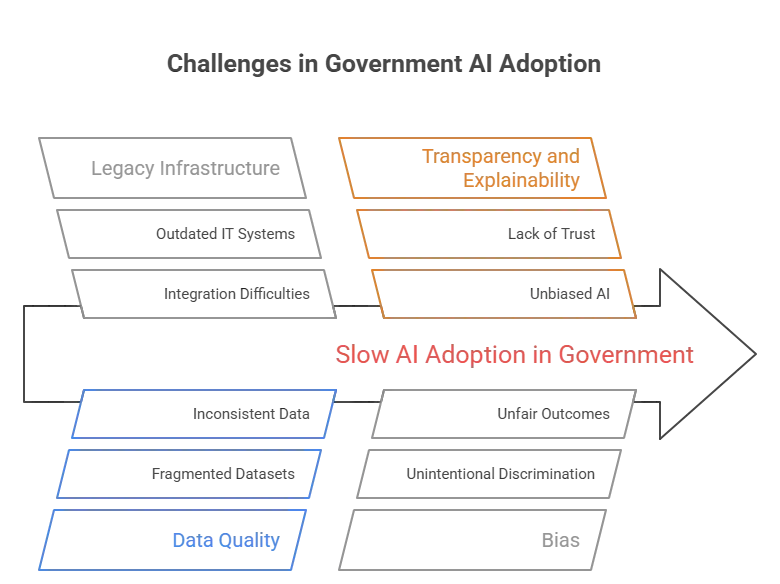
Despite the enormous potential of AI, government adoption is not without challenges.
One major issue is legacy infrastructure. Many public sector organizations still rely on outdated IT systems that are difficult to integrate with modern AI technologies. Digital transformation at government scale often takes time and requires substantial investment.
Data quality is another challenge. AI systems are only as effective as the data they process. Fragmented, inconsistent, or incomplete government datasets can reduce the accuracy and reliability of AI models.
Governments must also address concerns around transparency and explainability. Citizens need confidence that AI systems are fair, accountable, and unbiased — especially in areas such as law enforcement, welfare distribution, and public administration.
Bias in AI systems remains a serious concern globally. If not carefully managed, AI can unintentionally reinforce discrimination or unfair outcomes.
This is why responsible AI governance is becoming essential for public sector AI deployment.
Why Domain Expertise Matters in Government AI
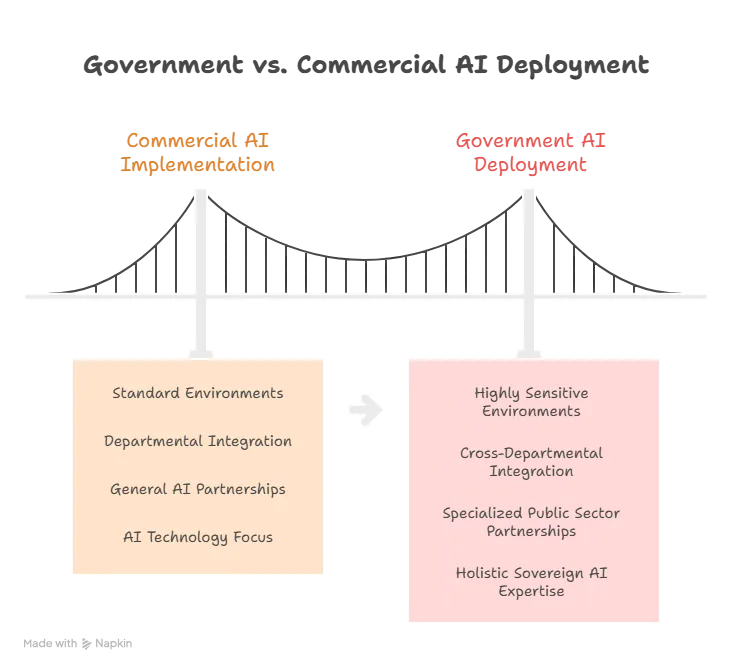
Government AI deployment is very different from commercial AI implementation.
Public sector AI systems must operate in highly sensitive environments where reliability, security, and compliance are critical. Government agencies also require systems that can integrate across multiple departments and support mission-critical operations.
This is why governments increasingly partner with specialized AI and cybersecurity organizations that understand public sector requirements deeply.
Building effective Sovereign AI systems requires expertise not only in AI technologies, but also in cybersecurity, intelligence, governance, compliance, and large-scale digital infrastructure.
Conclusion
AI models for government are becoming foundational to the future of governance.
From citizen service automation and fraud detection to intelligence analysis and cybersecurity, AI is helping governments become faster, smarter, and more efficient.
At the same time, the rise of Sovereign AI is changing how nations think about digital independence, national security, and strategic technology control.
The future of governance will not simply be AI-enabled — it will increasingly be powered by secure, trusted, and Sovereign AI ecosystems.
Governments that invest early in responsible AI frameworks, secure infrastructure, and national AI capabilities will lead the next era of digital transformation.
FAQs
1. What is Sovereign AI?
Sovereign AI refers to a nation’s ability to develop, host, manage, and control its own AI infrastructure, datasets, and AI models within its jurisdiction.
2. Why is Sovereign AI important for governments?
Sovereign AI helps governments maintain control over sensitive data, reduce dependency on foreign technology ecosystems, strengthen national security, and comply with data localization requirements.
3. What are AI models for government?
AI models for government are artificial intelligence systems designed for public sector applications such as citizen services, cybersecurity, intelligence analysis, fraud detection, and governance automation.
4. How are governments using AI today?
Governments use AI for chatbots, predictive analytics, surveillance systems, cybersecurity, healthcare planning, fraud detection, and intelligence operations.
5. What are the biggest challenges in government AI adoption?
Key challenges include legacy infrastructure, poor data quality, cybersecurity risks, AI bias, explainability concerns, and compliance requirements.
6. Can Sovereign AI improve national security?
Yes. Sovereign AI gives governments greater control over defense intelligence, cybersecurity systems, critical infrastructure, and sensitive citizen data.
7. What is the future of Sovereign AI?
The future includes domestic AI ecosystems, government-specific Large Language Models, autonomous cybersecurity systems, AI-powered governance platforms, and secure national AI infrastructure.