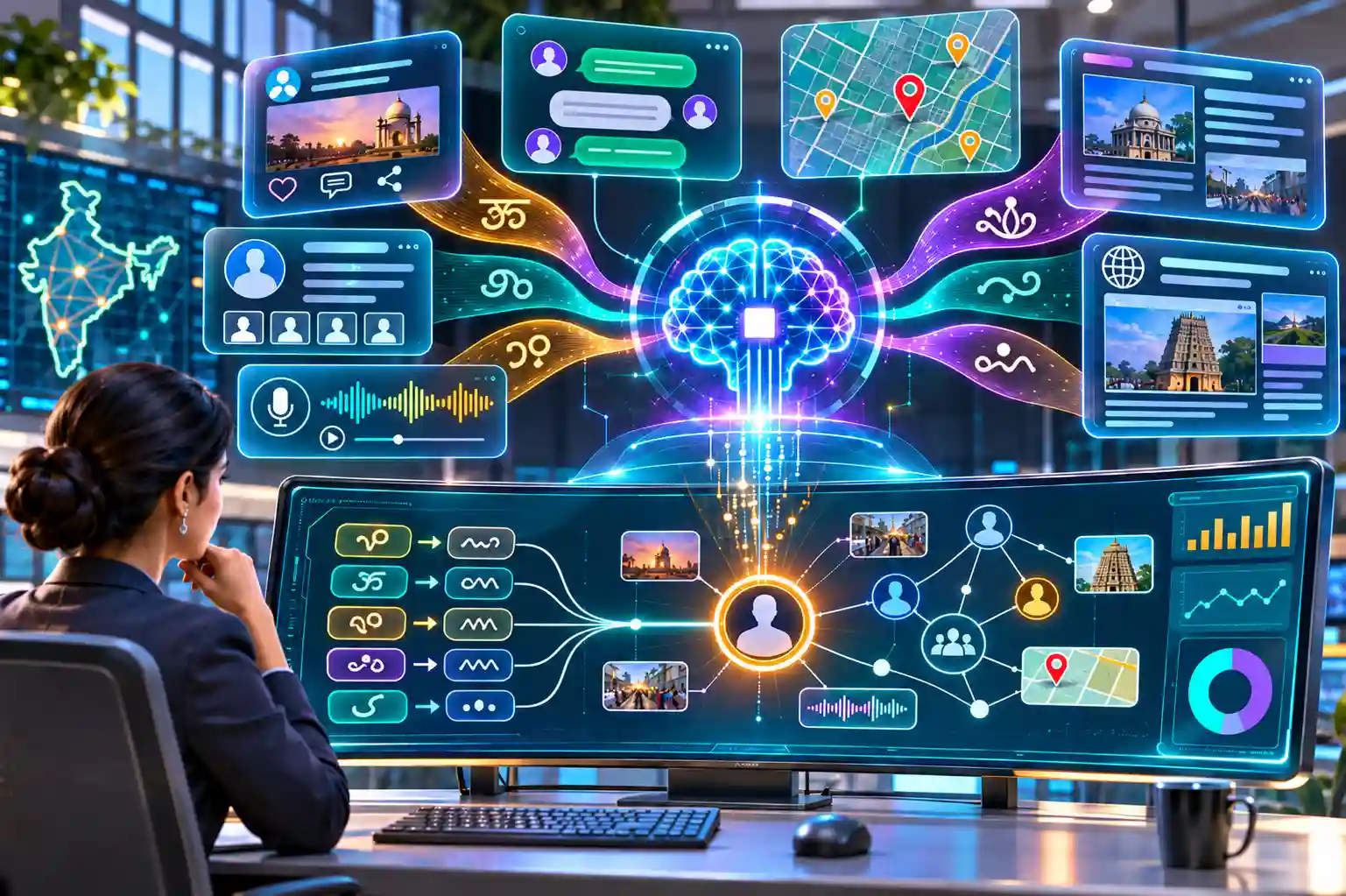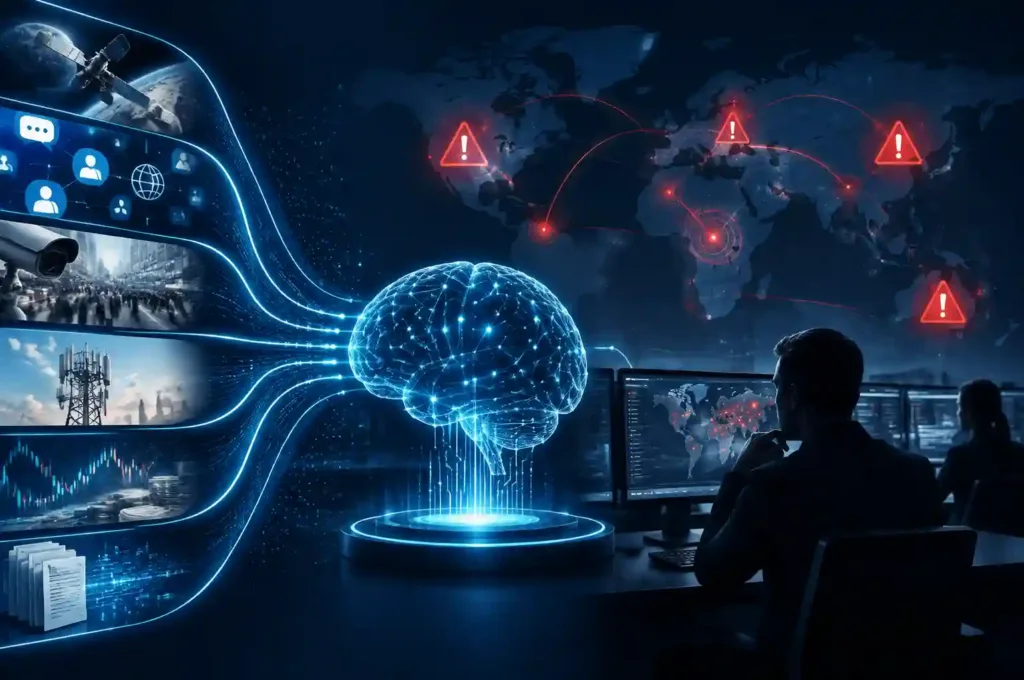
AI-driven data analytics enables early threat detection by continuously analysing behavioural, network, and open-source signals to flag deviations from normal patterns before they escalate into confirmed incidents. Instead of waiting for a known signature to match, these systems build a baseline of normal activity, correlate weak signals across data sources, and surface anomalies for human analysts to investigate. For India’s defence, law enforcement, and financial intelligence agencies, this shift matters because the country’s threat volume has outgrown what manual review can realistically cover.
Key Takeaways
- Modern threats form quietly through behavioural and network signals long before any visible action
- CERT-In handled 29.44 lakh cyber incidents in 2025, up 85% from 15.92 lakh in 2023
- Rule-based detection only catches what has already been defined, so it misses adaptive threats
- AI analytics works through pattern recognition, anomaly detection, and network modelling across fused data sources
- Early warning supports human decision-making; it does not automate the decision itself
- India already runs AI-assisted early warning at national scale through CERT-In’s Early Warning Framework and I4C’s cybercrime pattern detection
- Integrated intelligence platforms that fuse multiple data sources outperform siloed, single-source tools
What Is AI-Driven Threat Detection and Early Warning?
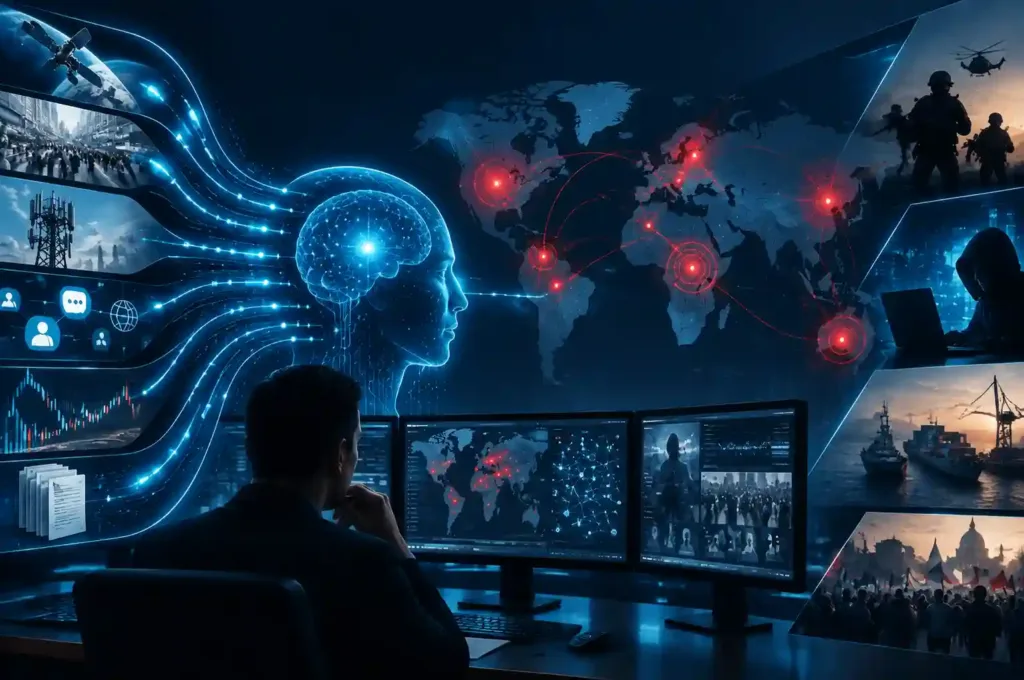
AI-driven threat detection is the use of machine learning and data analytics to identify early indicators of risk, behavioural deviations, network anomalies, or unusual patterns across large volumes of structured and unstructured data, before a threat fully materialises. It differs from traditional monitoring in one specific way: traditional systems alert on things they already know to look for, while AI systems learn what normal looks like and flag what falls outside it.
This distinction is the entire reason early warning has become an AI problem rather than a rules problem. A rule can only catch a pattern someone has already written down. An adversary who knows the rule can simply avoid it. A behavioural baseline, by contrast, has to be evaded blindly, because the adversary doesn’t know exactly where the boundary sits.
In practice, this applies across layers of risk that security and intelligence teams already think in. Tactical threats need an immediate response. Operational threats involve the networks, logistics, and planning that support hostile action. Strategic threats unfold over months, shaping influence operations or sustained destabilisation efforts. AI-driven analytics contributes at all three layers, but its biggest advantage shows up furthest from the point of action, in the operational and strategic layers, where the signals are weakest and most scattered.
Why India’s Threat Volume Has Outgrown Manual Detection
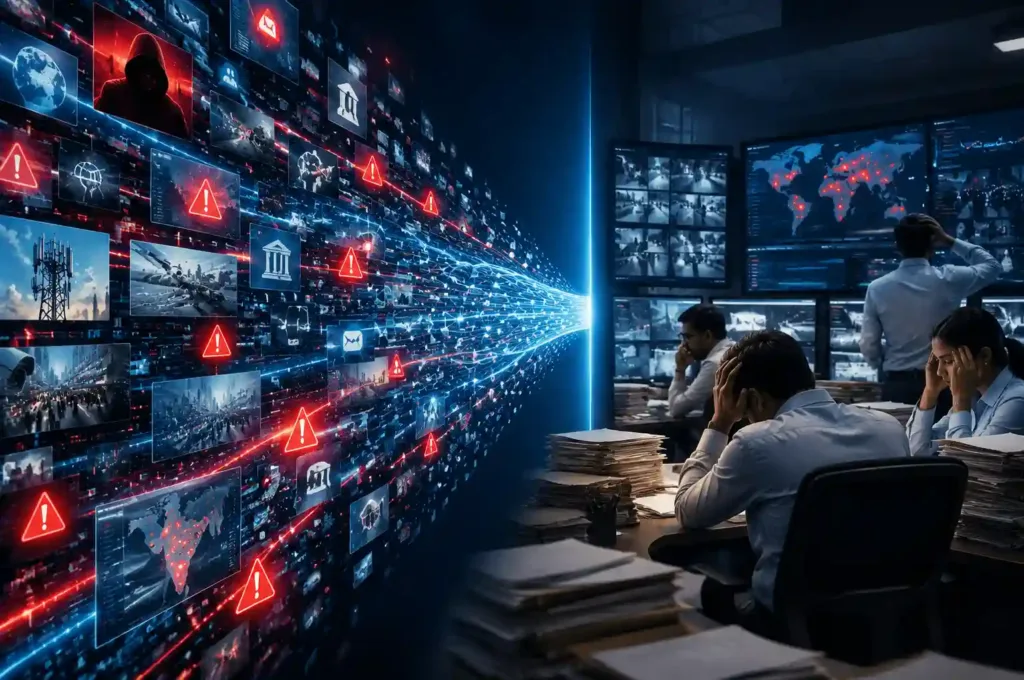
The scale argument isn’t abstract for Indian agencies, it’s already visible in the numbers.
CERT-In handled over 29.44 lakh cybersecurity incidents in 2025, up from 20.41 lakh in 2024 and 15.92 lakh in 2023, an 85% jump in two years, according to figures the government placed before the Lok Sabha. Source: Press Information Bureau. Of that 2025 total, unauthorised network scanning and probing alone accounted for roughly 24.36 lakh incidents, close to 83% of everything CERT-In processed. That single number tells you something important: the overwhelming majority of raw signal is reconnaissance noise, and the actual work of threat detection is finding the small fraction of activity that turns into something real.
On the financial fraud side, the numbers move the same way. The National Cyber Crime Reporting Portal recorded 24.02 lakh financial fraud complaints in 2025, against 19.18 lakh in 2024 and 13.10 lakh in 2023. Source: Press Information Bureau. I4C’s own estimates put projected annual losses to cyber fraud at close to 0.7% of GDP. None of this is a future risk. It’s the operating environment right now.
Three structural problems explain why manual review can’t keep pace with this volume.
Data lives in silos
Sensor feeds, communication metadata, financial transaction data, and open-source intelligence typically sit in separate systems, reviewed by separate teams. A pattern that only becomes visible when you combine two of those sources stays invisible if no one combines them.
Static rules can’t catch adaptive behaviour
Rule-based alerting triggers on known indicators, specific keywords, transaction thresholds, or behavioural signatures that match past incidents. Adversaries who understand this simply operate below the threshold, spread activity across platforms, or exploit the gap between two monitoring systems that don’t talk to each other. When detection logic only recognises what has already happened, it stays permanently one step behind.
Time works against manual coordination
Getting a signal from one team’s desk to a decision-maker’s desk, across departments and sometimes jurisdictions, takes hours or days. Digital coordination between bad actors can escalate in minutes. Every hour spent on manual correlation is an hour the threat window stays open.
The Core AI Techniques Behind Modern Threat Detection
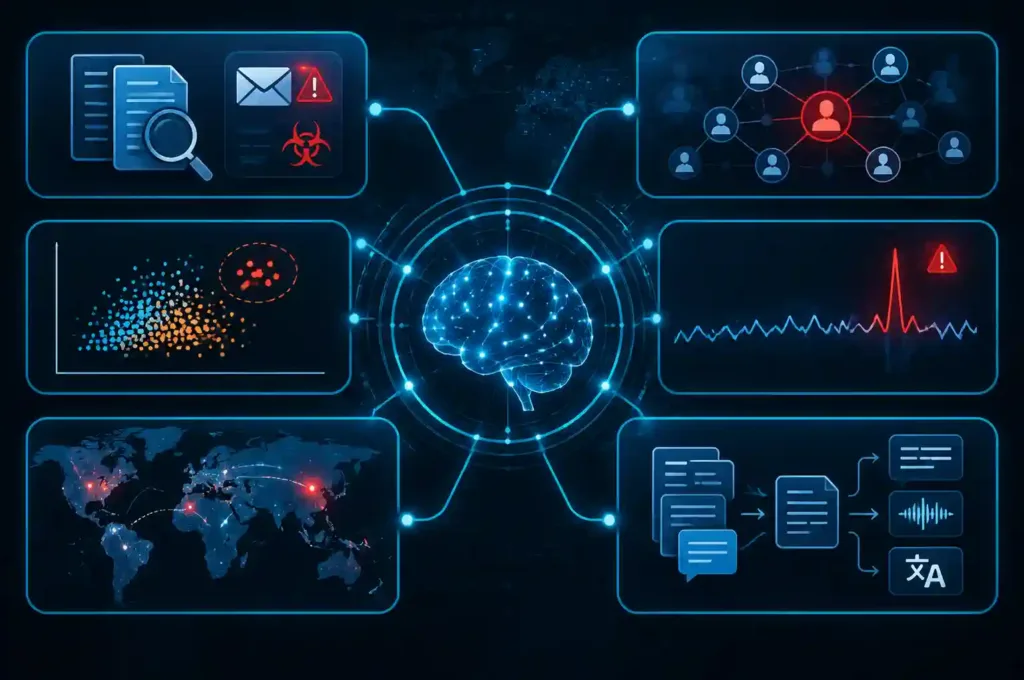
“AI-powered” is a vague phrase until you name the actual technique doing the work. Here’s what’s actually running underneath early warning systems today.
| Technique | What it does | Where it’s used |
|---|---|---|
| Supervised machine learning | Classifies events against labelled examples of known-good and known-bad activity | Phishing filters, known fraud pattern classification, malware family identification |
| Unsupervised machine learning | Builds a baseline of normal activity and flags statistical deviations without needing labelled examples | Insider threat detection, mule account identification, zero-day pattern discovery |
| Behavioural and network modelling | Maps relationships between entities over time to reveal who coordinates, enables, or connects a network | Identifying key nodes in a smuggling or trafficking network, tracing coordination between accounts |
| Anomaly detection | Establishes what normal looks like for an entity, then flags departures from that baseline | Unusual login patterns, abnormal movement of funds, deviation from a unit’s typical activity pattern |
| Geospatial and link analysis | Correlates location, movement, and relationship data on a unified map | Infiltration route prediction, hotspot identification, satellite communication pattern analysis |
| Natural language processing | Extracts meaning, sentiment, and intent from unstructured text and speech | Open-source monitoring, extremist narrative tracking, multilingual report summarisation |
ndividually, each of these is a narrow tool. Early warning happens when they run against the same fused dataset at the same time, because that’s when a weak signal in one system starts correlating with a weak signal in another.
How AI-Driven Early Warning Actually Works
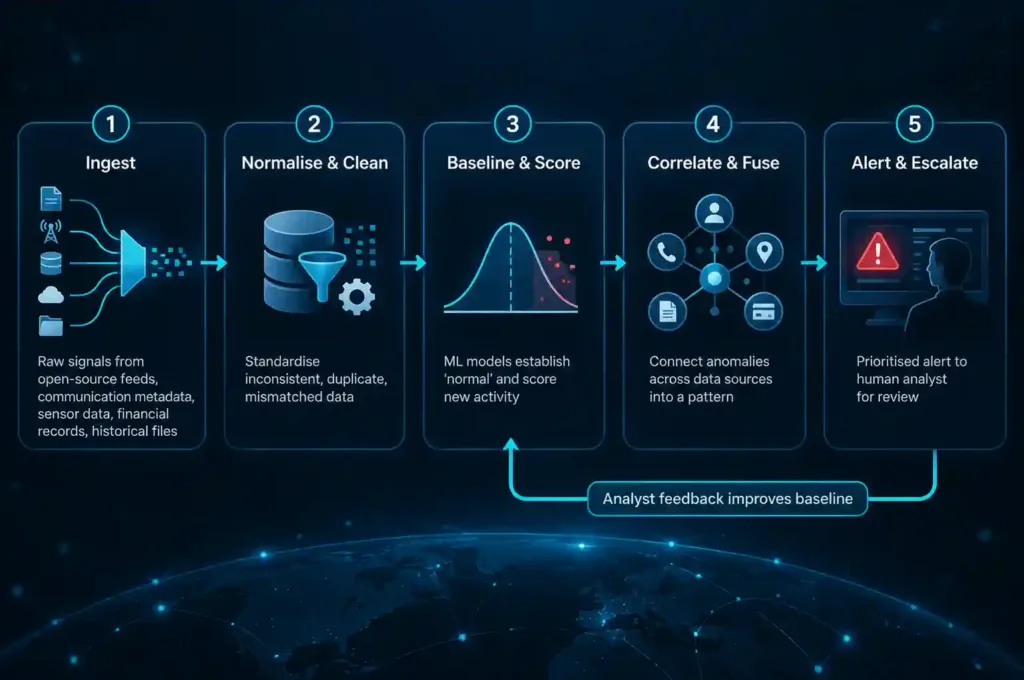
Strip away the marketing language and the process is a five-stage pipeline.
- Ingest: Raw signals come in from open-source feeds, communication metadata, sensor data, financial transaction records, and historical case files. The wider the intake, the better the eventual correlation, but also the more noise has to get filtered downstream.
- Normalise and clean: Raw data is inconsistent by default, duplicate entries, missing fields, mismatched formats. This step standardises everything into a form a model can actually learn from. Skip this step and every downstream prediction inherits the mess.
- Baseline and score: Machine learning models establish what normal looks like for a given entity, an account, a unit, a communication pattern, and score new activity against that baseline. This is where unsupervised learning does most of the heavy lifting, because it doesn’t require someone to have already labelled a similar past incident.
- Correlate and fuse: Individual anomalies get connected across data sources. A single unusual login means little. That same login combined with an unusual fund transfer and an anomalous location ping starts to look like a coherent pattern. This is the step that turns isolated flags into an actual early warning signal.
- Alert and escalate for human review: The system doesn’t decide anything on its own at this stage. It surfaces a prioritised, context-attached alert to an analyst, who investigates, applies judgement, and decides what happens next. Analyst feedback on false positives and missed signals also flows back into the model, so the baseline gets sharper over time.
This is roughly the same architecture CERT-In’s own Early Warning Framework tool runs on for detecting botnets, APTs, and ransomware at the DNS and BGP level, using machine learning against known threat intelligence patterns. It’s also the model behind I4C functioning as an early warning system for law enforcement agencies, spotting emerging cybercrime patterns before they scale into a wave of reported cases.
From Detection to Decision: Why Human Judgement Still Leads
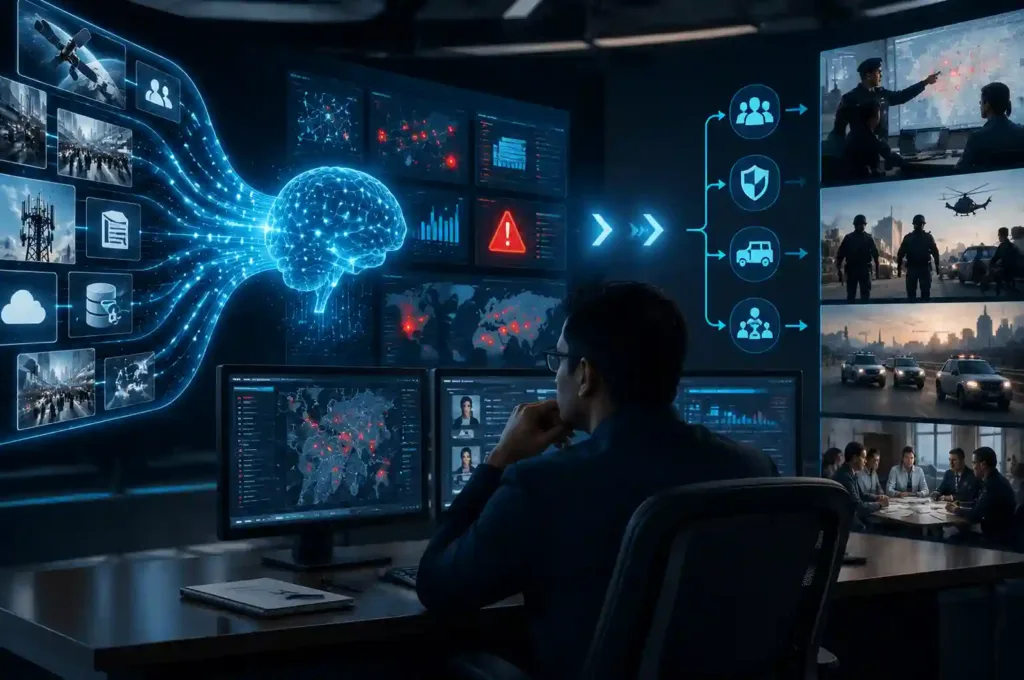
Detection only has value if it changes a decision. An anomaly flag that sits unread in a dashboard prevents nothing.
What AI-driven early warning actually buys an agency is time and context, not automated action. When an indicator surfaces sooner, a commander has room to plan a preventive deployment instead of scrambling one. A financial intelligence unit can prioritise the accounts most likely to be part of an active laundering chain instead of working through a queue in the order it arrived. Inter-agency coordination shifts from reactive scrambling to a planned response, because the relevant desk has more lead time.
None of this replaces the analyst or the officer. AI surfaces what’s statistically unusual. A human still has to decide whether that anomaly reflects genuine intent, an operational error, or something entirely benign, and what proportionate response, if any, follows. Keeping that authority with people isn’t a limitation of the technology. It’s what makes early warning defensible, auditable, and trusted enough to actually act on.
What This Looks Like Inside an Integrated Intelligence Platform
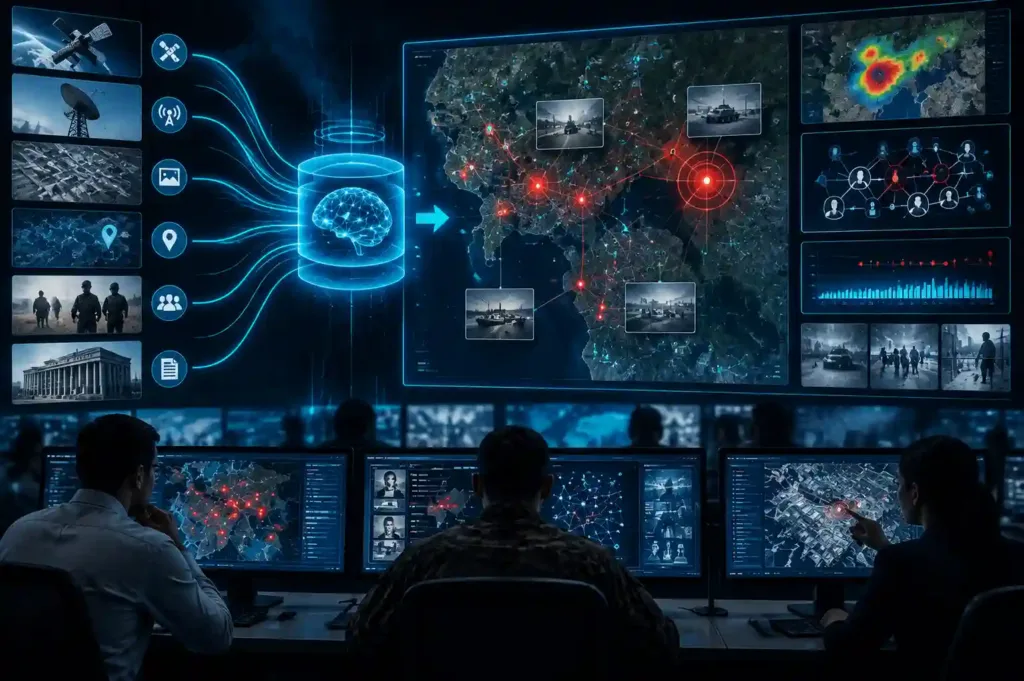
Early warning breaks down fastest at the point where data should have been combined but wasn’t. A geospatial team, a signals intelligence team, and a field reporting team each hold a piece of the picture, and if those pieces sit in separate systems, the correlation that would have flagged a threat early simply never happens.
This is the specific gap integrated intelligence fusion platforms are built to close. Innefu’s Prophecy Guardian, for instance, is designed to bring together intelligence from diverse sources, including ELINT, IMINT, geospatial data, and reports from sister agencies and downstream intelligence units, into a single analytical environment.
It runs an inbuilt GIS engine for mapping and hotspot analysis, a knowledge graph for link and network analysis between individuals and units, temporal analysis to track how a pattern develops over time, and an alerting layer that flags sensitive activity, such as repeated visits to a specific location, for analyst attention.
It also runs ProphecyGPT, Innefu’s own on-premise LLM, allowing analysts to query fused intelligence data in natural language without any of it leaving a sovereign, offline environment.
Actual Case Study
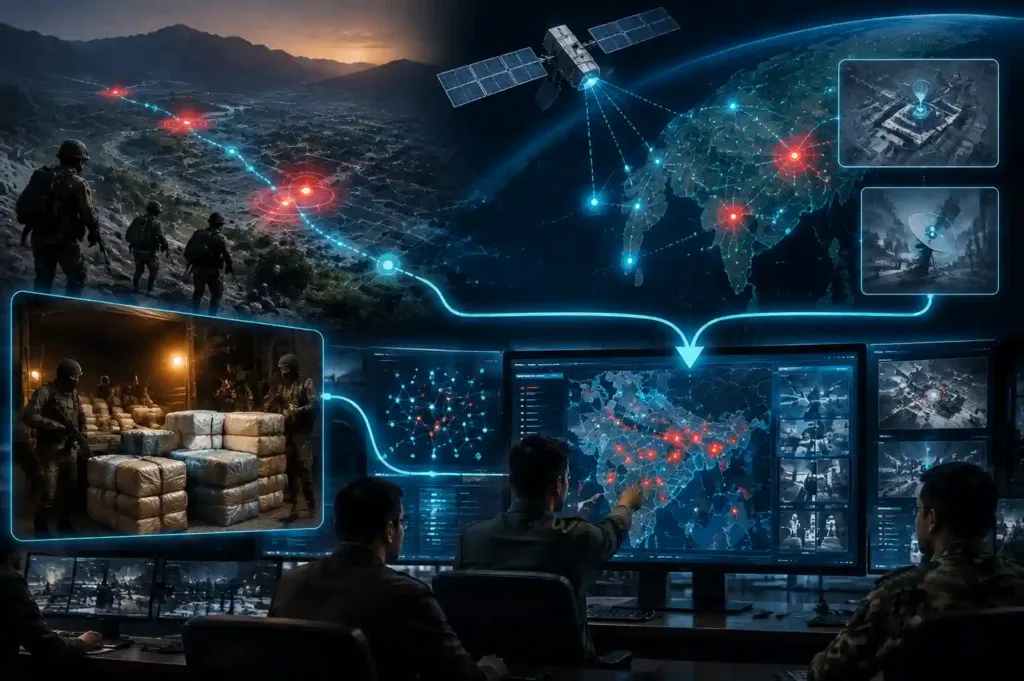
In one deployment, a paramilitary force used this kind of fusion capability to identify infiltration routes and predict hotspots for incidents like smuggling, correlating data that had previously sat in separate systems.
That correlation contributed to intercepting a narcotics smuggling attempt worth over five crore rupees, a result that would have been far harder to reach if the underlying signals had stayed siloed across separate desks. In a separate case, a signals intelligence unit used the same class of platform to map intercepted satellite communication locations on a live GIS layer, turning scattered call data into a visible pattern of activity hotspots.
The broader point isn’t specific to any one platform. It’s that fusion, not any single detection algorithm, is what turns scattered weak signals into an actual early warning. A model running against one data source in isolation will always miss what only becomes visible when you look across three.
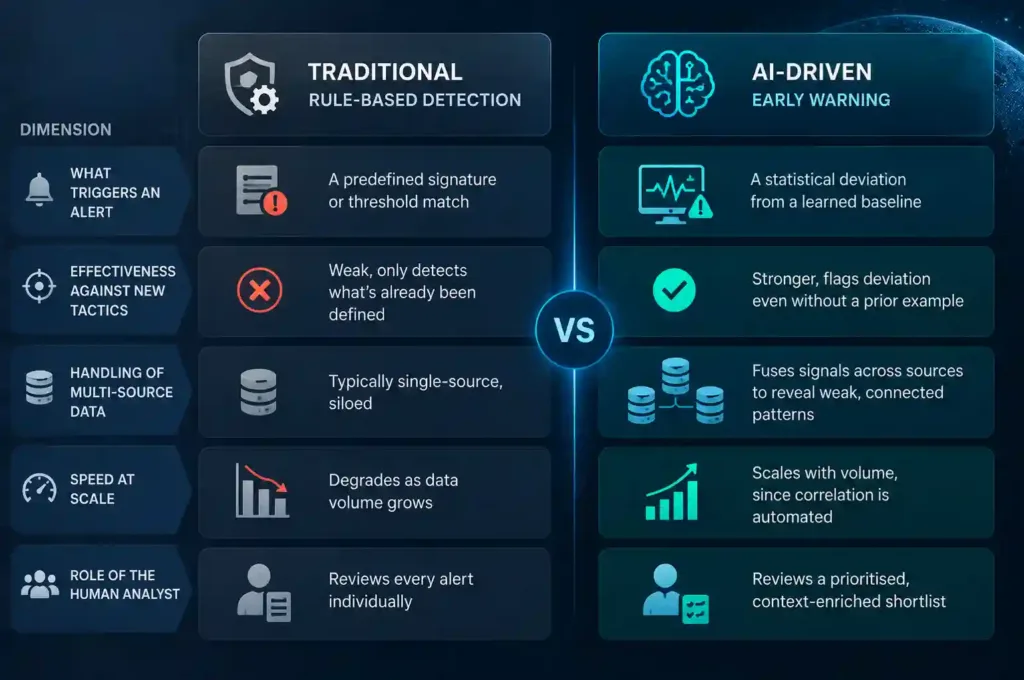
Traditional Detection vs AI-Driven Early Warning
| Dimension | Traditional rule-based detection | AI-driven early warning |
|---|---|---|
| What triggers an alert | A predefined signature or threshold match | A statistical deviation from a learned baseline |
| Effectiveness against new tactics | Weak, only detects what’s already been defined | Stronger, flags deviation even without a prior example |
| Handling of multi-source data | Typically single-source, siloed | Fuses signals across sources to reveal weak, connected patterns |
| Speed at scale | Degrades as data volume grows | Scales with volume, since correlation is automated |
| Role of the human analyst | Reviews every alert individually | Reviews a prioritised, context-enriched shortlist |
Frequently Asked Questions
1. What is AI-driven threat detection?
AI-driven threat detection uses machine learning to identify early indicators of risk by analysing large volumes of structured and unstructured data for patterns and anomalies, rather than relying only on known signatures or predefined rules.
2. How is early warning different from traditional threat monitoring?
Traditional monitoring reacts to alerts tied to known indicators. Early warning focuses on detecting weak, unlabelled signals and deviations from normal behaviour, often well before a threat becomes explicit or confirmed.
3. Does AI replace human analysts in threat detection?
No. AI accelerates data processing and narrows down what deserves attention. Interpreting intent, assessing context, and deciding on a response remain human responsibilities.
4. Is India already using AI for cyber early warning?
Yes. CERT-In’s Early Warning Framework applies machine learning to DNS, BGP, and security event data to detect botnets, APTs, and ransomware, and shares early warning threat intelligence with over 700 organisations. I4C similarly functions as an early warning layer for law enforcement by identifying emerging cybercrime patterns from national reporting data.
5. Why does data fusion matter more than any single AI model?
Most meaningful threats only become visible when signals from separate sources, geospatial, financial, communications, are combined. A model running against one data source in isolation misses correlations that only exist across sources.