
In December 2025, Delhi Police’s Cyber Cell busted an organised vehicle loan fraud syndicate operating across multiple banks – The Tribune. The main accused, working under at least three different aliases, had used forged Aadhaar cards, PAN cards, and fabricated income tax returns to obtain vehicle loans from multiple lenders. After disbursement, the vehicles were sold. The loans were never repaid. What caught him was not a fraud analyst’s intuition. It was this: when investigators ran Aadhaar and PAN records, the photographs across all the different identities matched the same person.
The fraud worked because each bank saw one clean application. None of them saw the others. The ring was invisible until someone looked at all of it simultaneously.
That is organised loan ring fraud in a single case. And it is not rare.
Key Takeaways
- Organised loan ring fraud is the most damaging loan fraud typology in rupee terms: A single coordinated ring can generate crores in fraudulent disbursements across days before any single lender has assembled enough information to identify what is happening.
- The ring is invisible to any institution looking only at its own applications: The fraud is a network-level phenomenon that only becomes visible when all applications across lenders are analysed simultaneously.
- Three types of shared fields identify ring membership: Shared photographs, shared identity fields (mobile, PAN, address, employer ID), and shared document characteristics across applications that appear independent.
- Mule borrowers and ghost borrowers are the two primary participant types: Real recruited individuals and fictitious identities are both used, often within the same ring operation.
- OCR field cross-check is the primary ring detection mechanism: The same mobile number appearing under three different names in the same week is a ring signal that no individual lender would see without cross-application field deduplication.
- Network clustering connects the individual flags into the full ring picture: One shared field is a flag; multiple applications sharing overlapping fields is evidence of coordination.
- Detection at origination is the only point where the fraud can be stopped: Post-disbursement recovery from organised rings is structurally difficult and often incomplete.
What Organised Loan Ring Fraud Actually Is

Loan ring fraud is coordinated financial crime, not one person submitting multiple applications, but an organised operation submitting many applications across many lenders simultaneously, using recruited or fabricated identities, with the explicit goal of generating maximum disbursements before the pattern is detected.
Think of it as the difference between a single fraudster and a franchise operation. The single fraudster is constrained by their one identity and the time it takes to apply one place at a time. The ring operator has built infrastructure: recruited participants, manufactured or stolen identities, coordinated documentation, and a disbursement mechanism to extract and distribute the proceeds.
What makes it an organised ring rather than independent fraud is the coordination, shared elements across applications that tie them to the same criminal operation even when each application appears, on its face, to be from a different person at a different lender.
The Three Participants in a Loan Ring

Understanding who participates in a loan fraud ring is important for understanding how detection works, because different participant types leave different evidence trails.
Mule Borrowers
Real individuals, recruited, paid, or coerced, who allow their identity and photographs to be used in fraudulent loan applications. Some mule borrowers know exactly what they are participating in and are paid a fee. Others are deceived, told they are participating in a legitimate fast-track loan scheme, or that their identity is being used for something harmless.
The mule borrower’s role is to provide a real identity that passes KYC verification. Their Aadhaar is genuine. Their PAN is their own. Their photograph is real. What is fabricated is the income, the employer, the bank statement that makes the application look creditworthy.
The mule borrower profile in application data looks legitimate at the individual level. The fraud becomes visible when that mule’s mobile number, address, or employer ID also appears on other applications in the same cluster, connecting the apparently independent applications to the same ring.
Related Read: Mule Account Detection: How AI Catches What Rule-Based AML Systems Miss
Ghost Borrowers
Fictitious identities, fabricated entirely or assembled from stolen identity components, that have no real person behind them. Ghost borrowers may use entirely invented Aadhaar and PAN numbers, or they may use real documents belonging to real people who have no knowledge their identity is being used.
Ghost borrowers are more sophisticated to create than mule borrowers but leave a different detection signature: the photograph on the application, when matched against the face repository, may return no prior history, but the identity documents, when checked against bureau data or government identity databases, may return inconsistencies. A PAN that does not exist, an Aadhaar number associated with a different photograph, an employer that does not exist at the address declared.
The Ring Operator
Not an applicant, the person or organisation coordinating the operation. The ring operator recruits mule borrowers, manufactures ghost identities, coordinates simultaneous application submission across lenders, and manages the disbursement and distribution of proceeds. They typically appear nowhere in the application data themselves, their role is operational, not applicant.
Detecting the ring operator requires network analysis, connecting the individual applications back to their common operational origin through the shared fields and coordination patterns that the ring leaves behind.
How a Loan Ring Operates: The Mechanics

Consider a representative scenario, not a specific named case, but a composite that reflects how these operations typically function based on documented fraud patterns in India.
A ring operator has assembled twelve identities, eight mule borrowers and four ghost borrowers. The operation targets five lenders simultaneously: two banks and three NBFCs. Applications are submitted within a 72-hour window, close enough in time to disburse before any single lender’s fraud investigation is complete, spread enough across channels that no single institution sees the volume.
The shared elements across the twelve applications:
- Three applications share the same registered mobile number, each under a different name. The number is a temporary SIM used specifically for OTP receipt during the application process.
- Four applications list the same employer, a fabricated company at a real address, set up specifically to provide employment verification for ring applications.
- Two applications share a residential address, a rented property briefly used for document verification purposes.
- All twelve applications were submitted through the same DSA channel, an agent who is either a knowing participant or an unknowing conduit for the ring.
At the individual lender level, each application looks independent. The income is inflated but not egregiously. The documents, forged or manipulated, pass visual inspection. The KYC fields, address, employer, mobile, are internally consistent within each individual application.
The ring is only visible when you look across all twelve applications simultaneously and ask: what do these apparently unrelated applications have in common?
The answer is in the shared fields. The same mobile number across three applications. The same employer across four. The same DSA submission agent across all twelve. These connections are not visible to any individual lender reviewing their own applications in isolation. They are immediately apparent to a cross-application field deduplication system.
Why Individual Lenders Cannot See the Ring

This is the central structural problem, and understanding it is essential for understanding why single-institution fraud controls are insufficient against organised rings.
Each lender sees only their applications
A bank that receives three applications in the same week, each from apparently different individuals, has no visibility into the nine other applications submitted to other lenders as part of the same coordinated operation. The shared operational elements, the common mobile number, the common employer, the DSA channel, are only visible in aggregate.
Internal cross-application checking catches within-institution rings but misses cross-institution rings
If the same ring submits one application to each of twelve different lenders, no single lender has more than one application to compare. Their internal deduplication systems, if any, find nothing, because there is nothing to deduplicate within their own application database.
The timing window is deliberately shorter than fraud investigation timelines
A lender’s fraud investigation team may take days or weeks to raise and investigate a concern. A ring operation is designed to complete disbursement, including the actual transfer of funds out of the system, within that window. By the time any single lender has assembled enough evidence to identify the ring, the proceeds are gone.
This is why cross-institution data sharing, or, within an institution, a detection system that can identify network-level patterns across all current applications simultaneously, is the only structural answer to ring-level fraud.
How AI Detects Ring Fraud: The Two-Layer Approach

Ring fraud detection requires two things operating together: individual application risk signals and network-level cluster analysis that connects those signals across applications.
Layer 1: OCR Field Cross-Check, The Individual Flag
When every loan application is processed through an OCR document intelligence engine, the extracted fields, full name, mobile number, PAN number, Aadhaar number, address, employer name and ID, bank account number, salary, income, are cross-referenced against a searchable index of all prior and current applications.
The cross-check flags specific patterns that indicate ring membership:
Same mobile number, different name
A mobile number appearing under three different named applicants in the same week is a HIGH risk flag. Legitimate customers do not share mobile numbers across loan applications. A ring operation reuses mobile numbers, particularly temporary SIMs used specifically for OTP receipt during digital application processes.
Same employer ID, different employee
If the same employer ID appears on four applications from apparently different individuals, the probability that all four legitimately work at the same employer is low. The probability that they are part of a coordinated ring using a fabricated employer is significantly higher.
Same address, different name
Multiple applicants with the same residential address, different names, and no apparent familial relationship is a ring signal.
Account number reused
A bank account number appearing on applications under different names, used for disbursement routing, is a CRITICAL flag and a direct indicator of organised fraud rather than individual fraud.
PAN under different name
A PAN number appearing under a different named applicant is a CRITICAL flag, PAN numbers are unique identifiers, and their appearance under a different name indicates either identity theft, document forgery, or ring coordination.
Each of these flags is visible at the individual application level. What converts them from individual fraud indicators into ring evidence is what happens next.
Layer 2: Network Clustering, Connecting the Flags Into the Ring Picture
Individual field overlap flags are significant on their own. But the real analytical power is in connecting them, identifying that Application A and Application C share a mobile number, Application B and Application D share an employer ID, and Applications A, B, C, and D were all submitted through the same DSA channel in the same 72-hour window.
Network clustering analysis takes the individual flags and constructs a graph, a map of connections between applications based on shared fields. Applications that share any field are connected in the graph. Applications that share multiple fields, or that are connected through intermediary shared applications, form clusters.
A cluster of applications with multiple shared fields submitted in a compressed time window is the signature of an organised ring operation. The cluster flag is categorically more significant than any individual application flag, because it indicates coordination, which is the defining characteristic of ring fraud as distinct from individual fraud.
The alert the fraud analyst receives shows not just a single suspicious application but the full cluster: every application connected to the same field overlaps, their shared elements highlighted, the submission timeline displayed, the DSA or channel information for each. The analyst can see the ring, not just a suspicious individual application.
The DSA Channel Risk: Why Rings Often Exploit Third-Party Origination
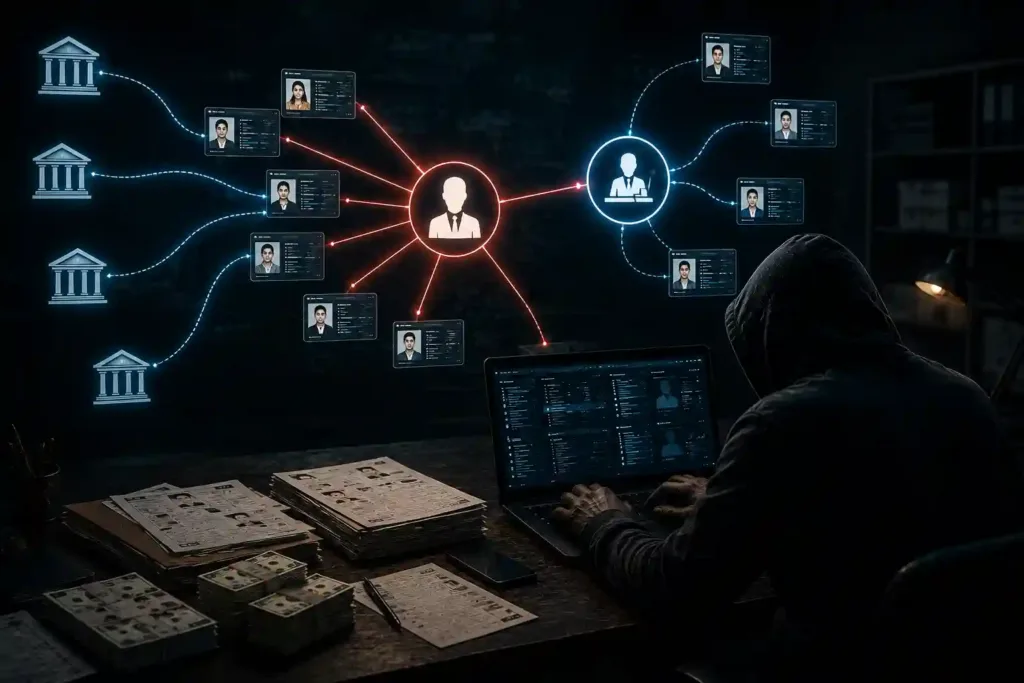
One pattern that appears consistently in organised loan ring fraud in India is the exploitation of DSA (Direct Sales Agent) origination channels.
DSAs are a legitimate and important part of the lending ecosystem, they extend a lender’s origination reach, particularly in markets where branch coverage is limited. But the DSA model creates a specific fraud risk: a DSA who is either a willing participant in a ring operation or an unknowing conduit for ring-submitted applications.
A ring operator who has established a relationship with a compliant DSA, or has set up a fraudulent DSA entity themselves, can route multiple ring applications through the same channel, creating a consistent submission pathway that also provides a cover of legitimacy (applications coming through an established channel partner rather than direct walk-ins).
Detection of DSA-linked ring fraud requires that the origination channel is a tracked field in the application data and is included in the cross-application analysis. Multiple applications from the same DSA, within a short time window, sharing identity field overlaps, is a specific pattern that warrants elevated scrutiny of the DSA relationship as well as the individual applications.
What Good Ring Detection Looks Like in Practice
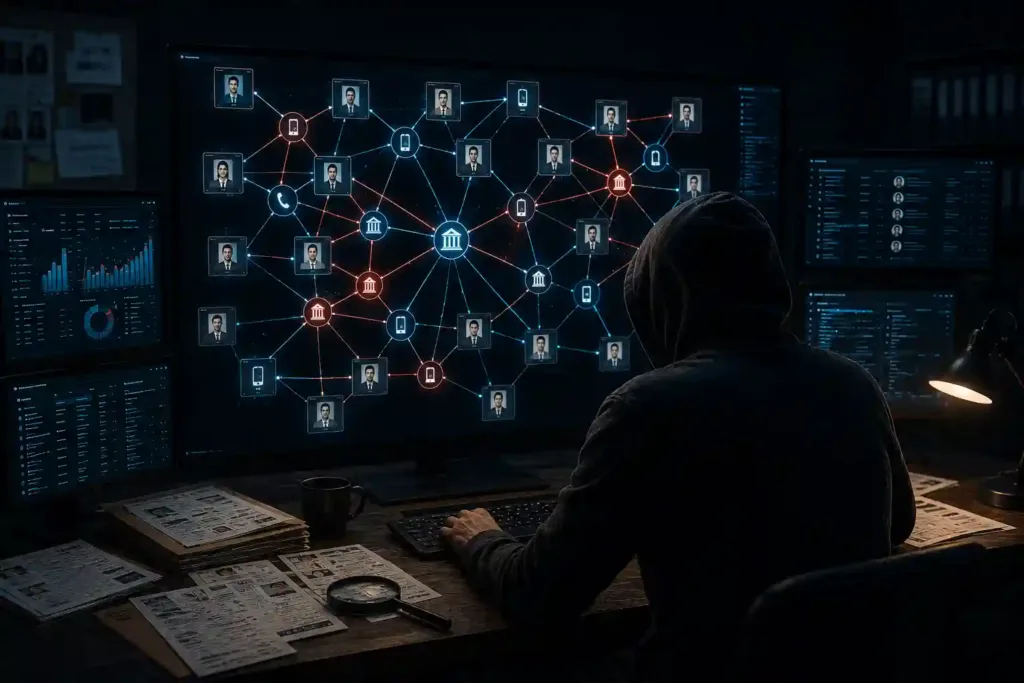
When the detection system identifies a potential ring cluster, the alert that reaches the fraud team contains:
The cluster map: A visual representation of all applications connected through shared fields, nodes representing applications, edges representing the specific shared fields connecting them. The analyst can see at a glance how many applications are in the cluster and how they are connected.
The shared field detail: For each connection in the cluster, the specific field that triggered the connection, which mobile number is shared across which applications, which employer ID, which address.
The individual risk scores: Each application’s composite risk score, combining its own individual field flags with its cluster membership, so the analyst can prioritise which applications within the cluster require immediate action.
The submission timeline: When each application was submitted, through which channel or branch, so the coordinated timing of the ring operation is visible.
The recommended action: Hold all applications in the cluster pending review. Escalate to fraud investigation team. Flag the DSA channel for additional scrutiny if applicable.
The fraud team’s response to a ring alert is different from a response to an individual fraud alert, it typically involves holding all applications in the cluster simultaneously, investigating the DSA or submission channel, and potentially reporting to the appropriate authorities if the ring is large enough to trigger mandatory reporting obligations.
The vehicle loan fraud ring busted by Delhi Police in December 2025 was caught the way most rings eventually are: retrospectively, by investigators who could look across all the applications and see what no individual lender could see in real time.
The question for every bank and NBFC is whether they catch the ring before disbursement or after it. Before disbursement, the fraud is prevented. After disbursement, you are a creditor with a claim against people who had no intention of repaying and funds that have already moved.
Cross-application field deduplication and network clustering analysis are what move the detection point from after-the-fact investigation to before-disbursement prevention. That is the difference between stopping the fraud and documenting it.
Learn how Innefu’s AI-powered Loan Fraud Detection works →
Related Reads:
For the complete picture of loan fraud typologies, read: Loan Fraud Detection: The Complete Guide for Banks and NBFCs in India →
For how photo matching catches the identity reuse that often underlies ring operations, read: Identity Reuse Fraud in Loan Applications →
Frequently Asked Questions
1. What is organised loan ring fraud?
Organised loan ring fraud is a coordinated financial crime where a network of individuals, some real recruited mule borrowers, some fictitious ghost identities, submit simultaneous loan applications across multiple lenders, using shared identity elements, forged documents, and fabricated income. No individual lender sees the full picture, each sees only the applications submitted to them. The ring is only visible when all applications are analysed simultaneously for shared fields and coordination patterns. It is the most damaging loan fraud typology in terms of total rupee exposure.
2. What is a mule borrower in loan fraud?
A mule borrower is a real individual, recruited, paid, or coerced, who allows their identity and photograph to be used in a fraudulent loan application. The mule’s genuine identity passes KYC verification; what is fabricated is the income, employer, and financial documentation that makes the application creditworthy. Mule borrowers are a core component of organised loan rings because their genuine identity is harder to flag at onboarding than a completely fabricated identity.
3. What is a ghost borrower?
A ghost borrower is a fictitious identity, entirely invented or assembled from stolen identity components, with no real living person behind it. Ghost borrower applications may use fabricated Aadhaar and PAN numbers, real documents belonging to real people who have no knowledge their identity is being used, or synthetic identities that combine real and fictitious elements. Ghost borrowers are detected through identity verification inconsistencies, PAN numbers that do not exist, Aadhaar records that return different photographs, employers at non-existent addresses.
4. How does OCR cross-check detect ring fraud?
OCR field cross-check extracts identity fields from every submitted document, name, mobile number, PAN, Aadhaar, address, employer ID, bank account number, and cross-references them against all prior and current applications in the database. Shared fields across applications filed under different names are flagged as potential ring indicators. A mobile number appearing under three different named applicants in the same week, or the same employer ID across four apparently independent applications, are the specific patterns that identify ring membership even when each individual application appears legitimate in isolation.
5. Why can’t individual lenders detect loan rings on their own?
Each lender sees only the applications submitted to them. If a ring submits one application per lender across twelve institutions, no single institution has more than one application to compare internally. The ring’s coordination is only visible in the aggregate, across all applications submitted to all lenders simultaneously. This is why cross-application field deduplication within an institution needs to be combined with broader data sharing mechanisms to address cross-institution rings effectively.
6. What is network clustering in loan fraud detection?
Network clustering is an analytical technique that maps connections between loan applications based on shared identity fields, constructs a graph of those connections, and identifies clusters, groups of applications that share multiple connecting fields or that are connected through intermediary shared applications. A cluster of applications with multiple shared fields submitted in a compressed time window is the statistical signature of an organised ring. Network clustering converts individual field overlap flags into ring-level evidence.
7. How are DSA channels exploited in loan ring fraud?
DSA (Direct Sales Agent) channels are exploited because they provide a legitimate-looking submission pathway for ring applications. A ring operator who has established a relationship with a complicit DSA, or has set up a fraudulent DSA entity, can route multiple ring applications through the same channel, creating the appearance of independently sourced applications. Detection requires tracking the origination channel as a field in cross-application analysis, multiple applications from the same DSA, sharing identity field overlaps within a compressed time window is a specific ring signal.