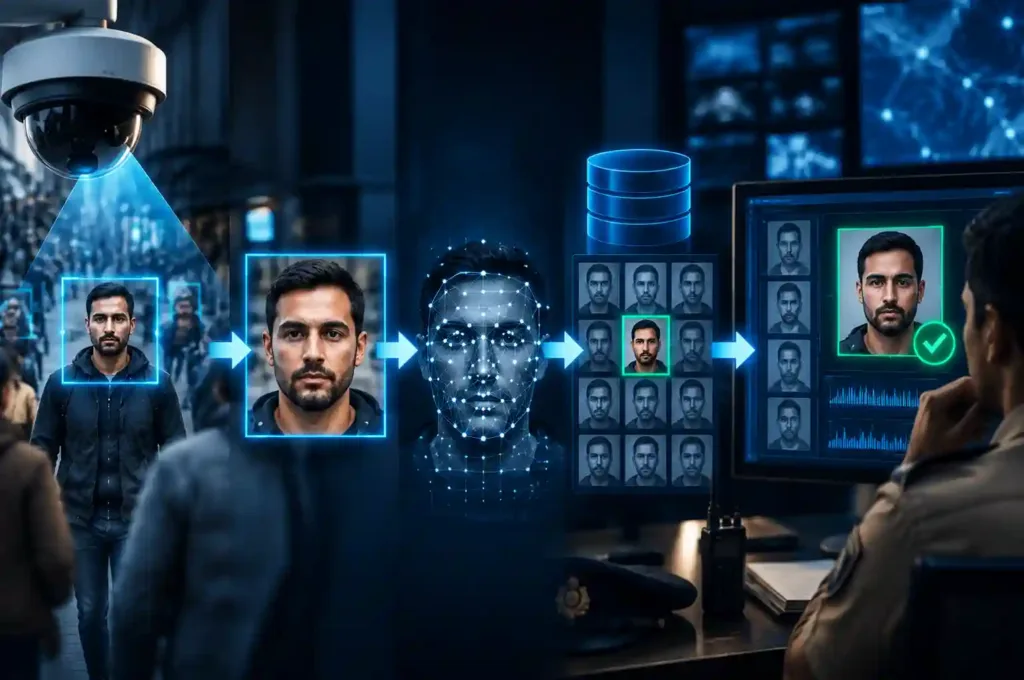
Spotting a possible match and confirming an identification are two different jobs. Detection is the system flagging a face in a database as worth a second look. Confirmation is a trained analyst verifying that flag against the original image before it becomes something an officer can act on. This piece covers that full path, from the moment a camera captures a face to the point a match is solid enough to inform an investigation. It covers facial recognition used for suspect identification specifically, not facial recognition used for airport boarding, device unlock, or other verification use cases, which run on different accuracy requirements and different risk profiles.
Key Takeaways
- Facial recognition detection and facial recognition confirmation are separate stages, and most public discussion collapses them into one.
- Detection narrows a database of millions down to a short candidate list; confirmation is where a human decides if any candidate is actually a match.
- A facial recognition search typically draws on two data layers: the captured image (CCTV, body-worn camera, field photo) and the reference database (mugshots, license records, watchlists).
- Cross-checking a candidate match against image quality, angle, and lighting conditions is how analysts separate a real hit from a coincidental similarity.
- NIST’s Face Recognition Technology Evaluation is the closest thing to an independent standard for algorithm accuracy, and any procurement decision should be anchored to it, not to vendor claims.
- AI can narrow a search and rank candidates far faster than manual review, but it does not replace analyst judgment or the legal standard for what counts as an identification.
What “Raw” Actually Looks Like in a Facial Recognition Search
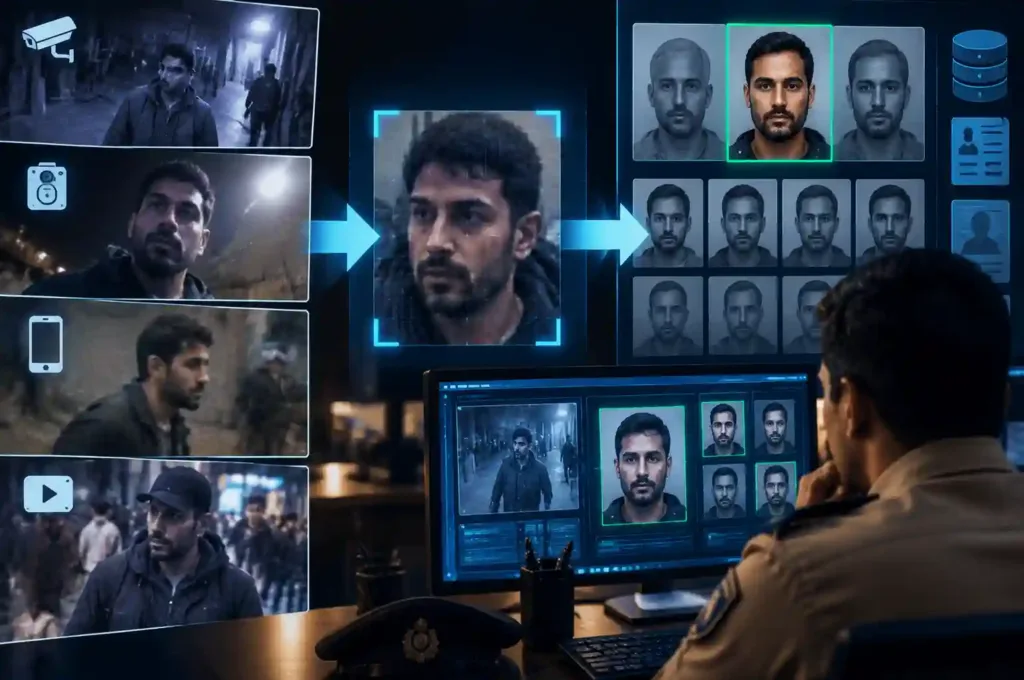
Before an algorithm can produce a candidate list, the input itself has to be usable, and usable footage is harder to come by than it sounds.
The image side of a search typically comes from:
CCTV footage, often low resolution, off angle, or poorly lit
Body-worn camera frames, which move and vary in exposure by nature of the job
Field photographs, taken quickly and not always frontal
Video stills, where the clearest frame still has to be manually or automatically selected
The reference side pulls from whatever database the agency is authorized to query, a mugshot repository, a driving license database, or a watchlist. Courts and independent testing bodies have been explicit that the quality of both sides of this comparison, the captured image and the reference image, drives accuracy far more than the sophistication of the algorithm itself. NIST’s real-world venue testing found accuracy ranging from 36 to 87 percent depending on camera placement alone, even using algorithms that scored above 98 percent under controlled lab conditions (source).
The practical problem is that these two layers rarely arrive in matched quality. A crisp mugshot might be compared against a grainy, angled CCTV frame. An analyst has to account for that gap before treating any match score as meaningful.
Fusing Capture and Database Into a Verified Match
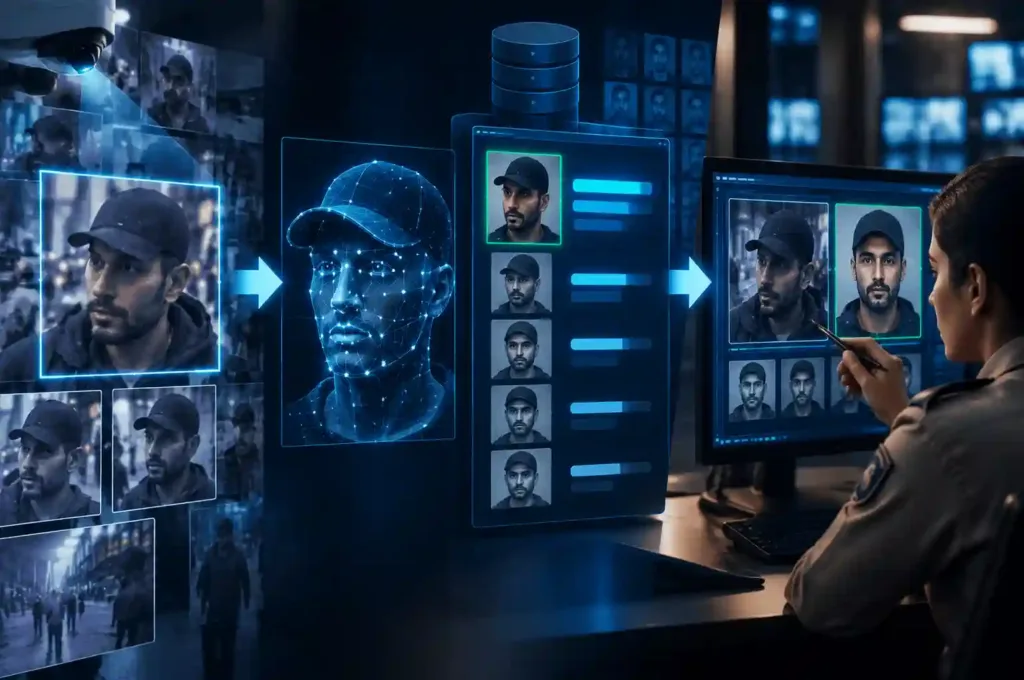
This is the part of the workflow AI genuinely changes, not by replacing the analyst’s judgment, but by removing the manual search effort that eats most of the time.
Facial geometry mapping
The system maps landmark points on the captured face, the distance between the eyes, jawline contours, cheekbone structure, and converts them into a numerical template. Even a partially obscured face can produce a usable template, since the model is estimating structure from the visible geometry rather than requiring a full unobstructed view.
Candidate ranking against the database
The template is searched against the reference database and returned as a ranked list scored by similarity, not a single yes-or-no answer. This is exactly how a database of millions gets reduced to a short, reviewable list in seconds instead of days.
Human confirmation
An analyst reviews each candidate against the original captured image before any match is treated as actionable. This step is not a formality. NIST’s demographic testing has found meaningfully uneven false-positive rates across demographic groups, which is precisely why an automated ranking is never the final word (source).
What “Case-Ready” Actually Means
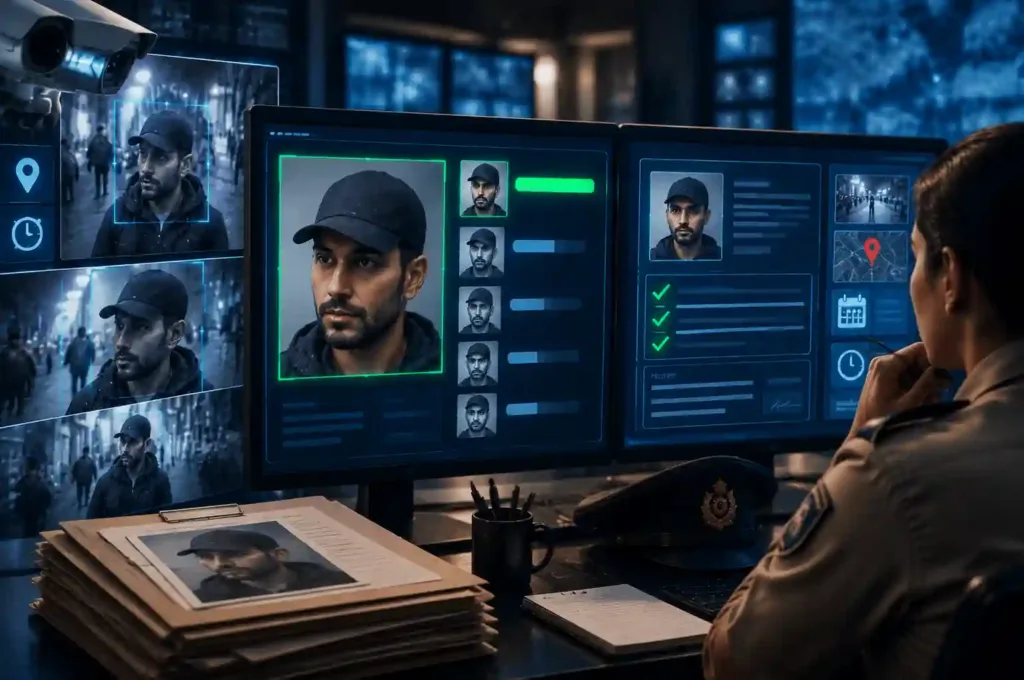
A case-ready match is not just a similarity score. It is:
A captured image paired with its source, camera location, date, and time
A ranked candidate list showing where the top match sits relative to others, not just the top result in isolation
An analyst’s documented confirmation, including notes on image quality and any factors that affected confidence
A clear separation between what the algorithm produced and what still requires human interpretation or corroborating evidence
That last point matters more than it might seem. AI-assisted matching strengthens what an officer can bring to an investigation; it does not certify that match as legally conclusive on its own. Whether an identification holds up depends on image quality, procedural compliance, and how it is corroborated with other evidence, and that remains squarely a matter of analyst and legal judgment, not something the software determines by itself.
Learn more about our [AI Vision Facial Recognition platform].
Frequently Asked Questions
1. What is the difference between facial recognition detection and facial recognition identification
Detection is the system generating a ranked candidate list from a database search. Identification is the process that follows: an analyst reviews that list, compares image quality and match confidence, and confirms or rejects each candidate before it is treated as an actual identification.
2. How accurate is facial recognition in real conditions, not lab testing?
It depends heavily on image quality and camera placement. NIST’s real-world testing found accuracy ranging from 36 to 87 percent depending on camera placement, compared to 98 to 99.4 percent under controlled conditions with high-quality images. This gap is why human confirmation is built into the workflow rather than treated as optional.
3. Can facial recognition identify someone whose face is partially covered?
It can generate candidate matches by estimating facial structure from visible landmark points, but confidence is lower than with a fully clear image, and any resulting match should be treated as a narrower lead requiring closer review, not a confirmed identification.
4. Does facial recognition perform equally well across all demographic groups?
No. NIST’s testing has documented measurable differences in false-positive rates across demographic groups. This is a central reason mandatory human confirmation exists before any match is acted on.
5. Does AI facial recognition replace manual investigative work?
No. It automates the search and ranking step across large databases, which significantly reduces manual review time. It does not replace analyst judgment, and it does not substitute for the corroborating evidence or procedural standards required before an identification is treated as reliable.