On a phone, “delete” usually does not erase data straight away. It marks the space as free and removes the entry that points to the data. Whether the data can still be recovered depends on five things: whether the space has been overwritten, whether the phone’s flash storage has already cleaned it up, whether the encryption key for that data has been discarded, whether the app deletes data in a way that leaves traces, and whether copies exist somewhere else, such as a backup, the cloud or the other person’s phone.
That is why recovery can range from straightforward (a recently deleted chat in an app database) to practically impossible (an old file on a newer encrypted phone after a factory reset). A realistic expectation at the start of an investigation saves time and avoids overpromising in a report or in court.
Key takeaways
- Deleting usually marks space as free, it does not wipe it
- Overwriting by new data is the oldest enemy of recovery
- Flash storage cleans itself in the background, which shrinks the recovery window
- Modern encryption can make deleted data unreadable once its key is gone
- App design decides how much a deleted message leaves behind
- Time between deletion and seizure matters more than almost anything else
- Backups, cloud copies and the other party’s device are often the better source
- Reports should state clearly what could and could not be recovered
What “delete” actually does

Think of a library. When a book is “deleted”, the card is removed from the catalogue, but the book may still sit on the shelf until a new book takes its place. A forensic examiner who walks the shelves may still find it.
That picture held well for older computers and early phones. On modern phones, three things have changed the picture: the way flash memory works, the way data is encrypted, and the way apps manage their own data. The levels at which an examiner can reach into a device also matter.
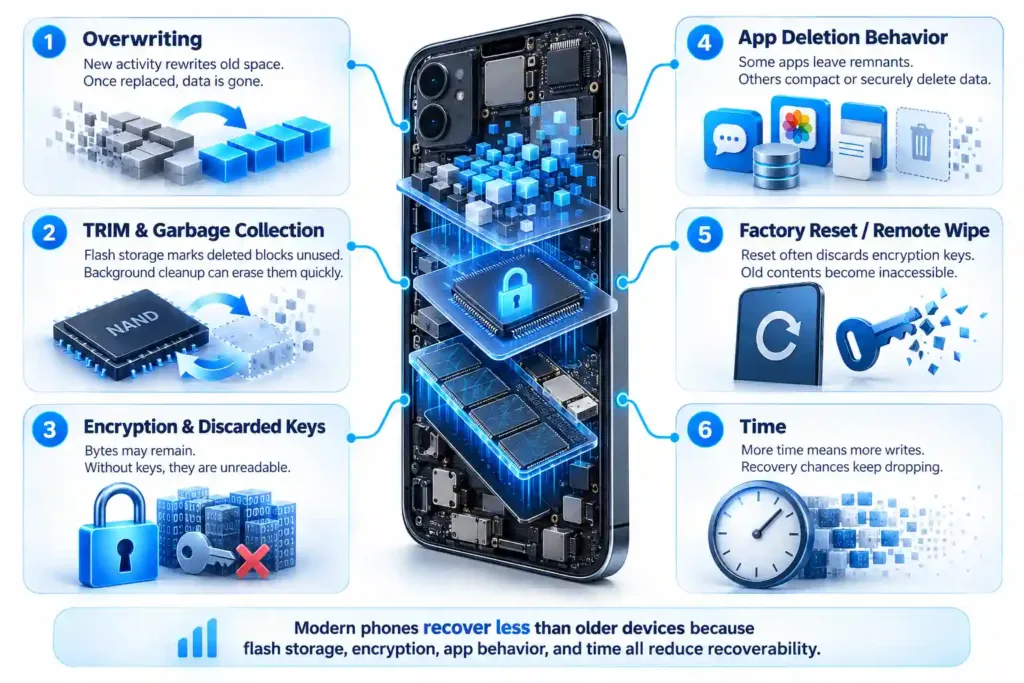
Why modern phones recover less than older devices
Overwriting
When new data is written, it can reuse the space that deleted data occupied. A phone that is in daily use writes constantly: app updates, cached images, messages, location points, system logs. The more the phone is used after the deletion, the lower the chance that the old data survives. Overwriting is permanent. No tool brings back data that has been replaced.
Flash housekeeping: TRIM and garbage collection
Phones store data on flash memory, not on spinning disks. Flash cannot overwrite data in place the way a magnetic disk can. It has to erase a block before writing to it again. To keep the phone fast, the operating system tells the storage which blocks are no longer in use (commonly called TRIM), and the storage controller erases them in the background (garbage collection).
The practical result is that deleted data on flash can be physically erased soon after deletion, without any user action. Once that happens, even a physical image of the memory will not show it. How soon this happens varies with the device, the storage type and how busy the phone is, so there is no standard time window.
Encryption and discarded keys
Modern smartphones encrypt stored data by default. Android’s file-based encryption, introduced in Android 7.0, and Apple’s Data Protection both use keys tied to the device and, in many cases, to the user’s passcode. Data is encrypted per file or per class of data.
This changes what “deleted” can mean. When a file or a key is discarded, the leftover bytes in storage may remain, but they are encrypted and cannot be read without the key. Apple’s design documentation describes dedicated mechanisms intended to erase keys quickly, which is how a factory reset can be near-instant. The same idea, often called cryptographic erase, applies on many Android devices. A raw image of such memory can be complete and still unreadable.
Encryption also affects access before deletion even comes into play. Many protected data classes are only available after the user has unlocked the phone at least once since it started. A device that has restarted and not been unlocked may give an examiner far less than the same device did before it restarted.
How the app handles deletion
Much of the evidence on a phone lives inside app databases, not in loose files. How an app deletes its records decides what is left.
- Many apps use database formats where deleted rows stay in unused areas of the file until they are overwritten or the database is compacted. This is why a recent deleted chat can sometimes be recovered from the app’s database.
- Some apps compact or overwrite their databases regularly, which removes those remnants.
- Some apps offer disappearing messages, view-once media or secure-delete options by design. These are meant to leave very little behind.
- Some apps keep thumbnails, caches, notification previews or temporary files that survive the deletion of the main item.
- Behaviour changes with each app version, so a method that worked last year may not work today.
Factory resets and wipes
A factory reset on a modern encrypted phone typically discards the encryption keys, which makes the old contents unreadable even if bytes remain. Remote wipe commands from the owner’s account have a similar effect. This is one reason the first hours after seizure matter, and why teams often isolate a device from the network early.
Time
Every day between deletion and seizure adds more writes, more housekeeping and more chances for the data to vanish. A phone seized within hours of a deletion can give very different results from one examined weeks later.
What can still be found, and where

When the original is gone, there are often other places a trace may exist.
| Source | What it may hold | Things to keep in mind |
|---|---|---|
| Free areas of app databases | Deleted rows, partial chats, old records | Chances fall with phone use and app maintenance |
| Database journal and write-ahead files | Recent changes, sometimes deleted entries | Short lived, change quickly |
| Thumbnails and caches | Small versions of deleted photos or media | Depends on the gallery or app |
| “Recently deleted” and trash folders | Items kept for a limited period | Duration varies by app and version |
| Notification and system logs | Message previews, app activity, timestamps | Content can be partial |
| Device backups (local or cloud) | Older copies of chats, photos, contacts | Needs lawful access and the right credentials |
| Cloud accounts | Synced photos, email, location history, backups | Separate legal and technical path |
| The other party’s device or account | Messages the sender deleted | Another seizure, another authority |
| Telecom records | Call and SMS metadata held by the operator | Retention period is set by licence conditions |
Teams often run these as parallel workstreams. For many cases, the phone itself is one piece, and the rest of the picture is built from the others.
Setting realistic expectations
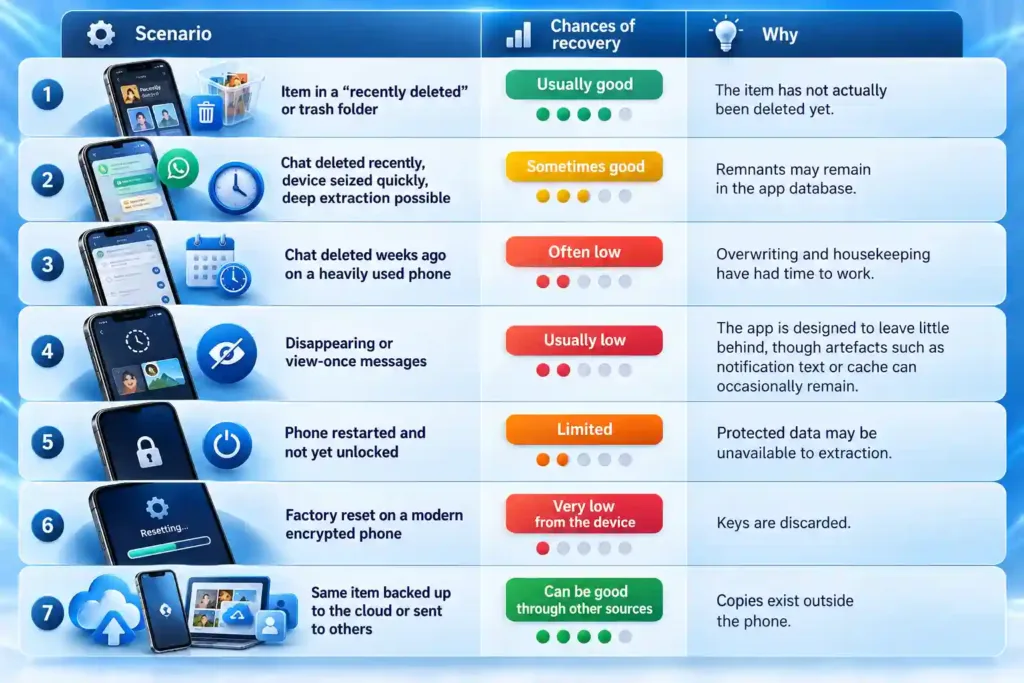
The table below gives a qualitative picture only. Every case depends on the device model, operating system version, app, lock state and handling.
| Scenario | Chances of recovery | Why |
|---|---|---|
| Item in a “recently deleted” or trash folder | Usually good | The item has not actually been deleted yet |
| Chat deleted recently, device seized quickly, deep extraction possible | Sometimes good | Remnants may remain in the app database |
| Chat deleted weeks ago on a heavily used phone | Often low | Overwriting and housekeeping have had time to work |
| Disappearing or view-once messages | Usually low | The app is designed to leave little behind, though artefacts such as notification text or cache can occasionally remain |
| Phone restarted and not yet unlocked | Limited | Protected data may be unavailable to extraction |
| Factory reset on a modern encrypted phone | Very low from the device | Keys are discarded |
| Same item backed up to the cloud or sent to others | Can be good through other sources | Copies exist outside the phone |
What affects the chances most

Some factors are outside anyone’s control. Others can be influenced by how the device is handled.
- How quickly the device is secured: Fewer hours between deletion and preservation means more data left.
- Keeping the phone’s state: A powered-on, previously unlocked device can offer options that a restarted device does not. Teams commonly avoid unnecessary restarts and reduce the risk of remote wipe through network isolation.
- Avoiding unneeded use: Browsing the phone after seizure writes new data and can overwrite remnants.
- Early involvement of the forensic lab: The lab can advise on a specific model and software version before anyone attempts access.
- Capturing the other sources early: Backups, cloud accounts and the counterparty’s device often have shorter windows than people expect, so early lawful requests help.
Reporting what was and was not recovered
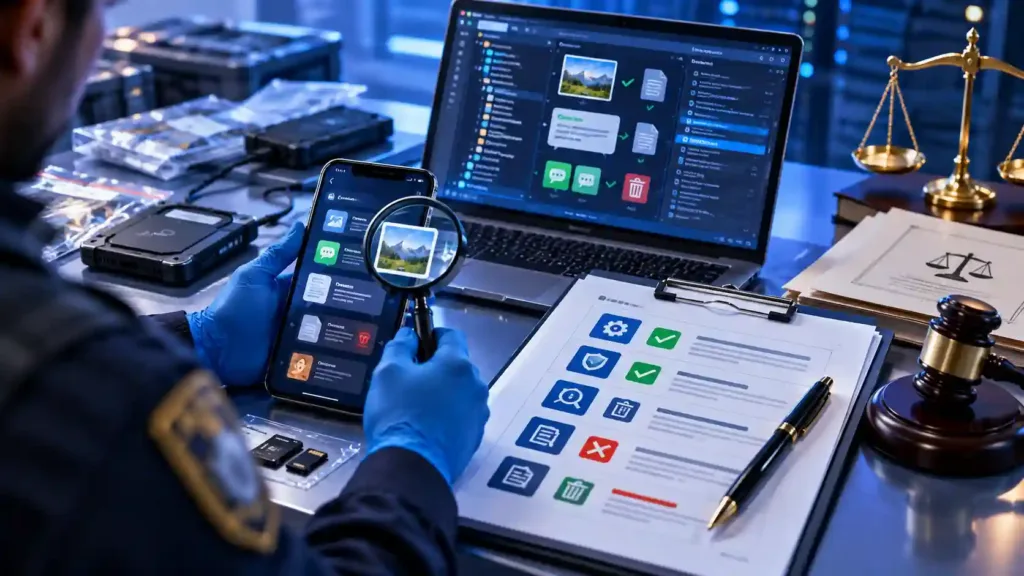
Absence of data on a phone is not proof that it never existed. Equally, a recovered fragment is not always a complete or correctly timestamped record. A balanced forensic report generally:
- states the method and extraction level used, with the tool name and version
- records hash values of the extracted image
- lists what was recovered and what could not be, with likely reasons
- avoids concluding that a message “was never sent” or “never existed” from its absence
- explains the limits of recovered fragments, such as missing context or uncertain timestamps
- is supported by a Section 63 certificate under the Bharatiya Sakshya Adhiniyam, 2023, where the data is to be produced as evidence
For the certificate itself, see our Section 63 BSA certificate guide. For handling and documentation from seizure onwards, see our guide on chain of custody for digital evidence under BNSS.
When deletion itself is relevant to the case
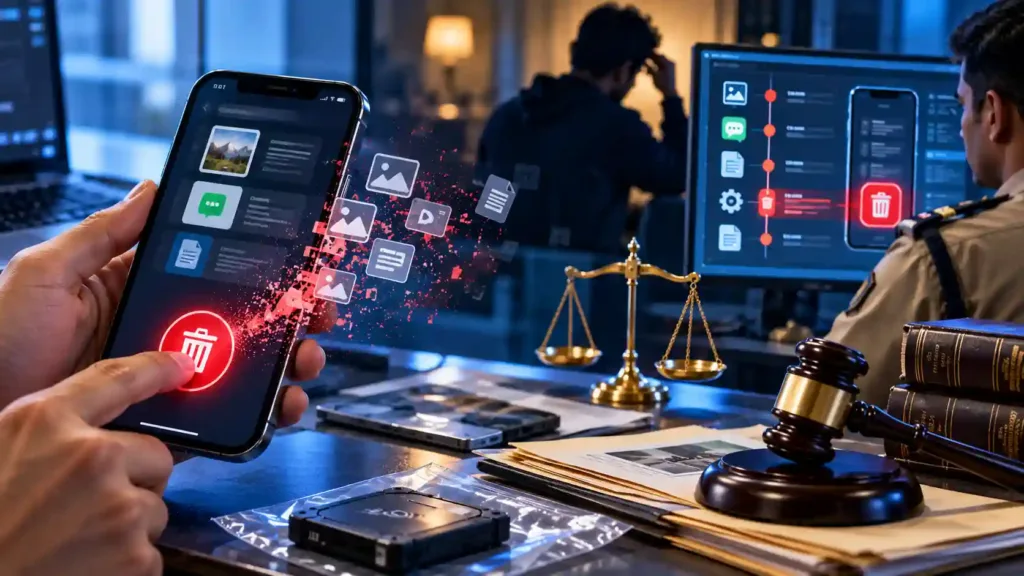
Sometimes the deletion is part of the story. A person who deletes data after learning of an investigation may raise questions of intent. Indian law has provisions on causing the disappearance of evidence, for example Section 238 of the Bharatiya Nyaya Sanhita, 2023. Whether a particular deletion amounts to an offence depends on the facts and is a matter for the investigating officer and legal advisers. Forensic artefacts such as the time of deletion, the app’s activity log or a factory reset record can support that question, though they need careful interpretation.
Common misconceptions

- “Deleted data can always be recovered.” It cannot. Encryption, overwriting and flash housekeeping can all end the chances.
- “Nothing can be recovered from a modern phone.” Also incorrect. Recent deletions, app remnants, caches, backups and other parties’ devices often yield something.
- “A deeper extraction always finds more.” On encrypted phones, a deeper image can still be unreadable.
- “If it is not on the phone, it is gone.” Cloud, backups and recipients’ devices may hold copies.
- “Recovered means complete.” Fragments can be partial, out of context or wrongly timestamped.
Frequently asked questions
1. Can deleted WhatsApp messages be recovered from a phone?
Sometimes. Recent deletions may remain in the app’s database until the space is overwritten or the database is compacted. Chances fall with time and phone use, and are low for disappearing messages. Backups and the recipient’s phone are other possible sources.
2. Why can’t deleted data always be recovered even with a physical extraction?
A physical extraction copies the raw memory. On modern phones that memory may already have been erased by flash housekeeping, or it may be encrypted with keys that no longer exist, so the data cannot be read.
3. What is TRIM and why does it matter for forensics?
TRIM is a command through which the operating system tells flash storage which blocks are no longer used. The storage can then erase them in the background. This can remove deleted data physically soon after deletion.
4. Does a factory reset delete everything permanently?
On modern encrypted phones, a factory reset typically discards the encryption keys, which leaves the old data unreadable even if bytes remain. Cloud backups and copies on other devices are unaffected.
5. How long after deletion can data still be recovered?
There is no fixed period. It can range from minutes to weeks depending on the device, the app and how much the phone is used. Quicker preservation generally gives better chances.
6. Can deleted photos be recovered?
Photos in a “recently deleted” or trash folder are usually easy to restore. Others may survive as thumbnails or in backups. Results vary by device and app.
7. Should investigators avoid using the phone after seizure?
Teams commonly avoid unnecessary use, because new activity writes data and may overwrite remnants. Preservation steps are best agreed with the forensic lab.
8. Does a missing message prove it was deleted?
No. A message can be missing because it was never stored on that device, because of app settings, or because of data loss unrelated to any deliberate deletion. Conclusions need corroboration.