
Here’s the situation intelligence agencies across India are quietly navigating right now.
An experienced analyst sits down with a 600-page intelligence dossier. Manually reading, cross-referencing, and summarising it will take two days. The same analyst can open ChatGPT, paste in the document, and can have a structured summary in forty-five seconds.
The analyst knows this. Their supervisor knows this. Everyone in the room knows this. And nobody in a classified environment can do it, because the moment that dossier leaves the network, the intelligence operation it describes is potentially compromised.
This is not a hypothetical tension. It’s the daily operational reality of intelligence and national security work. The productivity of AI is visible and compelling. The security cost of using cloud-based AI on classified data is simply not acceptable. And until recently, there was no way to have both.
That has changed. The technology now exists to deploy a fully offline, on-premise large language model, one that delivers the summarisation, translation, search, and analysis capabilities of ChatGPT, operates entirely within a secure network perimeter, connects to no external server, and is tuned specifically for the intelligence and national security context. The data never leaves. The capability is real.
This is what a sovereign LLM is. And it is the most significant AI development for the intelligence community in the current decade.
Why Cloud AI Is Specifically Incompatible With Intelligence Work

Before getting into the solution, it’s worth being precise about the problem, because “security concerns” is used loosely and the actual risk is more specific than the phrase implies.
When an analyst uses ChatGPT, Claude, Gemini, or any other commercially available large language model, the text they submit, their query, their document, their data, travels from their device to a server operated by a foreign technology company. It is processed there. The response comes back. In most cases, some version of that data is retained, used for model improvement, or subject to the legal jurisdiction of the country where those servers operate.
For routine business tasks, this is an acceptable trade-off. For classified intelligence data, it is not, for three distinct reasons.
The data sovereignty risk
The US CLOUD Act (2018) means that American technology companies, including Microsoft, Google, and OpenAI, can be compelled by US authorities to hand over data stored on their servers, regardless of where in the world those servers are physically located. An Indian intelligence agency using Azure OpenAI Service, even hosted in an Indian data centre, remains subject to this legal framework. The data is not sovereign. It is subject to extraterritorial legal access.
The training data risk
Most commercial AI systems improve over time by learning from user interactions. Data submitted to a commercial LLM today may, through various mechanisms, influence the model’s behaviour in ways that expose the existence or content of that data to other users tomorrow. The exact mechanisms and safeguards differ across providers, and they change. For classified information, “our terms of service say we don’t do this” is not an adequate security guarantee.
The network perimeter risk
Classified operations maintain strict network segmentation for a reason. A tool that requires internet connectivity to function is structurally incompatible with air-gapped or highly segmented network environments, regardless of what security claims the vendor makes. If the tool needs to reach an external server to work, it cannot work in a truly secure environment.
These three risks are not theoretical. They are the specific reasons that “just use ChatGPT” is not available as an option to an intelligence analyst working with sensitive data, and they define exactly what a sovereign LLM must address.
What is a Sovereign LLM? Explained Without the Jargon

A large language model, at its core, is a system trained on vast quantities of text that learns to understand and generate language with contextual sophistication. ChatGPT is one. The thing that makes it feel remarkably capable is that it can read a document you give it, understand what it means, answer questions about it, summarise it, translate it, and extract specific information from it, tasks that previously required human reading time.
A sovereign LLM does all of this. The difference is entirely in where it runs.
A sovereign LLM is deployed on hardware within the organisation’s own physical infrastructure. It operates completely offline. It connects to no external server, no cloud service, no third-party API. The model runs on local compute. The data it processes never leaves the network perimeter. The intelligence agency owns and controls the entire system.
Think of it this way. ChatGPT is a brilliant analyst who works in an office you don’t own, reads documents you send them, and whose notes are subject to their employer’s filing policies. A sovereign LLM is the same brilliant analyst, but they work in your building, in a secure room, under your security clearance, with no outside communication permitted.
Same capability. Completely different security architecture.
Why “Private Cloud” is Not the Same as On-Premise
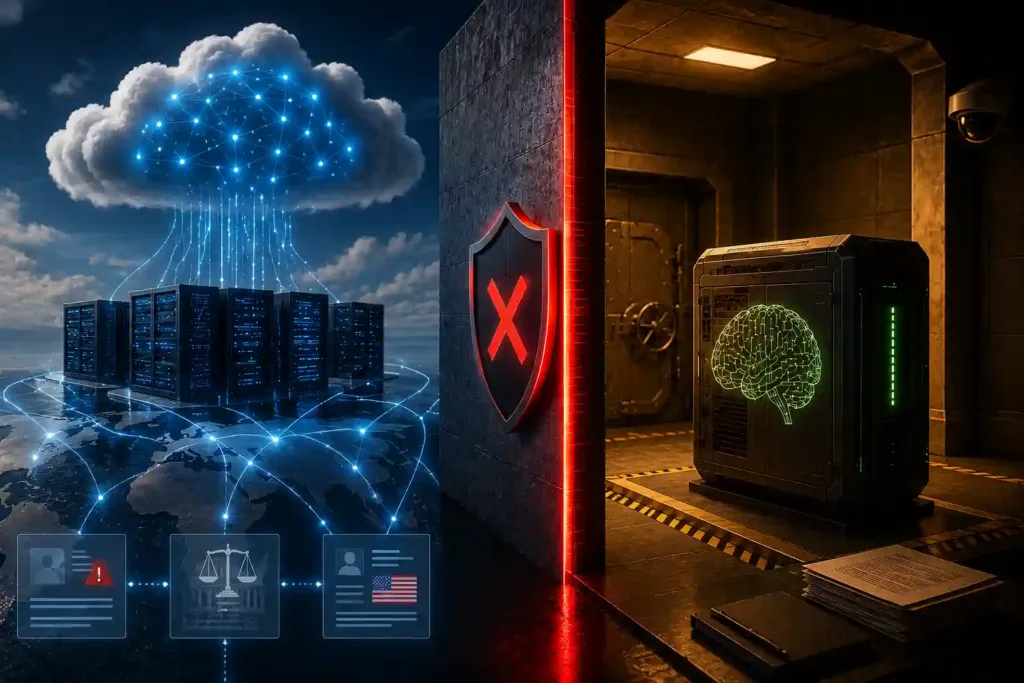
This is where many organisations make a mistake that matters for intelligence contexts specifically.
A private cloud deployment means your data runs on a cloud provider’s infrastructure, partitioned for your organisation’s exclusive use. Microsoft’s Government Cloud, Amazon GovCloud, and similar offerings fall into this category. They offer stronger isolation than standard commercial cloud. They do not offer the same security posture as a genuine on-premise, air-gapped deployment.
The differences that matter:
Air-gap is binary
Either the system connects to no external network, or it does. A private cloud, by definition, connects to the cloud provider’s infrastructure, which connects to the internet. An air-gapped system does not. For intelligence environments requiring the highest classification levels, this distinction is not negotiable.
Vendor access persists in cloud
On a cloud provider’s infrastructure, the vendor retains the technical ability to access systems for maintenance, compliance, or legal purposes. On your own hardware, no vendor has physical or network access to the deployment.
Foreign vendor jurisdiction applies regardless of geography
As discussed, a US-headquartered vendor’s India-based servers remain subject to US legal frameworks. The physical location of the data centre is less relevant than the jurisdiction of the entity that controls the infrastructure.
A genuine on-premise, air-gapped LLM deployment eliminates all three of these risks. The hardware is yours. The network perimeter is yours. The legal jurisdiction is yours. There is no vendor in the loop once the system is deployed.
What ProphecyGPT Actually Delivers

ProphecyGPT, built by Innefu Labs, is the world’s first offline on-premise LLM purpose-built for intelligence operations. The capability set is substantially broader than summarisation and question answering. Here is what the platform delivers within a secure, offline environment.
Across text and documents
The system reads, summarises, and answers questions from any text-based input, intelligence reports, case files, surveillance logs, legal documents, intercepted communications. Smart semantic search means an analyst can ask a natural language question, What intelligence do we have on suspicious activity near this location in the last eighteen months?, and receive a contextually relevant answer drawn from the entire document corpus, not just a keyword match. OCR capability means printed and handwritten documents, field reports, physical records, older archived intelligence, are digitised, indexed, and made query-able automatically.
Translation across 70+ languages means foreign-language documents, intercepts, open-source intelligence, cross-border materials, are immediately accessible to analysts regardless of language barrier. For an Indian intelligence context where relevant materials may be in Pashto, Dari, Burmese, Chinese, Arabic, or dozens of regional languages, this is not a marginal feature. It is a core analytical capability.
Across images and video
The platform integrates facial recognition and object detection, meaning an analyst can query the system about individuals or objects appearing in images and video without those materials leaving the secure environment. Video interpretation, including analysis of actions and context within footage, extends the same capability to moving image intelligence. Image captioning automates the description and indexing of visual intelligence materials.
Across audio
Speech-to-text in multiple languages converts intercepted or recorded audio into searchable, indexable text. Text-to-speech capability generates natural-sounding audio output for briefing materials. The audio processing layer, like everything else, runs locally, no audio data is transmitted externally.
What makes this genuinely different from a collection of individual AI tools is the integration. A single analyst can submit a multilingual document, have it translated and summarised, cross-reference its contents against a classified database, identify individuals in accompanying images, and generate a structured intelligence report, all within the same secure offline environment, without switching systems or exposing any data to external networks.
How This Works in Practice for an Intelligence Analyst

Consider what a typical analytical task looks like with and without this capability.
Without ProphecyGPT: An analyst receives a batch of documents, some in regional languages, some scanned physical records, some transcripts of intercepted communications. They read through them manually, which takes days. Translation of foreign-language materials requires either a trusted human translator or manual use of an online tool that creates data exposure risk. Cross-referencing against historical intelligence requires manual searches across multiple database systems. The final analysis is assembled in a report written from scratch.
With ProphecyGPT: The analyst submits the full document batch to the system. OCR processes the scanned physical records. Translation renders the foreign-language materials into English instantly. The semantic search engine cross-references the content against the full historical intelligence corpus automatically, surfacing relevant connections. The analyst queries the system in plain language, What does this material tell us about the network described in the 2022 assessment? Are there any individuals in the accompanying images who match existing profiles?, and receives structured, sourced responses. The report is generated from AI-synthesised outputs that the analyst reviews, validates, and finalises.
The task that took days takes hours. The analyst’s time is spent on judgement, evaluating, contextualising, deciding, rather than reading, translating, and manually cross-referencing.
Multiply this across a department. Across an agency. Across all the institutional knowledge that previously sat in unreadable archives and paper files. The compounding effect on analytical output is significant.
The Bottom Line

The analyst reading a 600-page dossier by hand while their colleague does the same task in forty-five seconds using ChatGPT is not going to stay patient with that situation indefinitely. The productivity differential is too obvious. The operational stakes of falling behind on analytical throughput are too real.
The question was never whether intelligence agencies should use AI. It was always whether AI could be made compatible with the security requirements of classified work. The answer, as of 2026, is clearly yes, but only with a specific architecture. On-premise. Air-gapped. Data sovereign. Built for the operational context.
ProphecyGPT is Innefu Labs’ answer to that architecture, built specifically for Indian intelligence and national security operations. The deployment is fully offline. The data never leaves.
Frequently Asked Questions
1. What is a sovereign LLM and why do intelligence agencies need one?
A sovereign LLM is a large language model deployed entirely within an organisation’s own physical infrastructure, operating without internet connectivity or connection to any external server. Intelligence agencies need sovereign LLMs because standard commercial AI tools, ChatGPT, Gemini, and others, process data on servers operated by foreign technology companies, subjecting it to foreign legal jurisdiction, vendor data retention policies, and network exposure that is incompatible with classified information security requirements. A sovereign LLM delivers the same analytical capabilities, summarisation, translation, question answering, semantic search, while keeping all data within the agency’s secure perimeter.
2. What is the difference between an on-premise LLM and a cloud-based LLM?
A cloud-based LLM runs on servers operated by a third-party vendor, even if those servers are in India, the data remains subject to the vendor’s legal and technical control. An on-premise LLM runs on hardware owned and operated by the deploying organisation, within their physical facility, connected to no external network. The critical operational difference is that on-premise deployment ensures no data leaves the organisation’s network perimeter under any circumstances, not for processing, not for model improvement, not in response to legal compulsion directed at a vendor.
3. What is an air-gapped AI system?
An air-gapped AI system operates on infrastructure that is physically and electronically isolated from all external networks, including the internet. No data enters or exits the system through any network connection, any updates, model changes, or data transfers happen through physically controlled mechanisms. Air-gapping is the standard security architecture for the most sensitive classified environments because it eliminates all network-based attack vectors and ensures complete data sovereignty. An air-gapped LLM deployment can function fully offline in forward deployments, remote postings, or secure facilities where internet connectivity is either unavailable or operationally prohibited.
4. What capabilities does ProphecyGPT provide for intelligence work?
ProphecyGPT delivers a comprehensive suite of AI capabilities within a secure, offline environment: AI-powered summarisation of large document sets; natural language question answering across classified document corpora; semantic search that understands the meaning behind queries rather than just matching keywords; OCR processing of printed and handwritten physical documents; translation across 70+ languages; facial recognition and object detection in images; video interpretation including action and context analysis; and speech-to-text conversion of audio recordings. All of these capabilities operate entirely within the secure network perimeter, no data is transmitted externally at any stage.
5. How does a sovereign LLM get trained on an organisation’s own classified data?
Sovereign LLMs for intelligence use typically employ a technique called Retrieval Augmented Generation (RAG). Rather than retraining the entire language model on classified data, which is computationally intensive and creates its own security management challenges, RAG connects the LLM to a secure internal knowledge base containing the organisation’s documents, reports, and records. When an analyst poses a query, the system retrieves relevant content from the internal knowledge base and uses it to generate a contextually informed response. The LLM’s general language capability comes from its pre-training; the domain-specific intelligence comes from the secure internal corpus. This means the system can be continuously updated as new intelligence is added to the knowledge base, without retraining the model.
6. Why isn’t a private cloud deployment sufficient for intelligence agencies?
A private cloud deployment, such as Microsoft Government Cloud or Amazon GovCloud, provides stronger isolation than standard commercial cloud infrastructure, but it does not provide the same security posture as on-premise air-gapped deployment for three reasons. First, it maintains network connectivity to the cloud provider’s infrastructure, making true air-gapping impossible. Second, the cloud vendor retains technical access to the infrastructure for maintenance and compliance purposes. Third, US-headquartered cloud vendors remain subject to the US CLOUD Act regardless of where their data centres are physically located, meaning foreign legal frameworks can compel data access even when physical data residency appears to be in India. An on-premise, air-gapped deployment eliminates all three of these risk vectors.