
AI-based GST fraud detection works by cross-referencing filed returns against independent data sources, such as e-way bills, FASTag vehicle movement records, and banking transactions, then applying machine learning models to flag mismatches, shell entity networks, and circular trading patterns that indicate fake invoicing or fraudulent Input Tax Credit (ITC) claims. Instead of an officer manually comparing thousands of filings, the system does the correlation in seconds and surfaces only the entities worth investigating.
That single shift, from manual reconciliation to automated cross-verification, is quietly becoming one of the most consequential changes in how India enforces indirect tax compliance.
The Scale of the Problem Enforcement Teams Are Dealing With
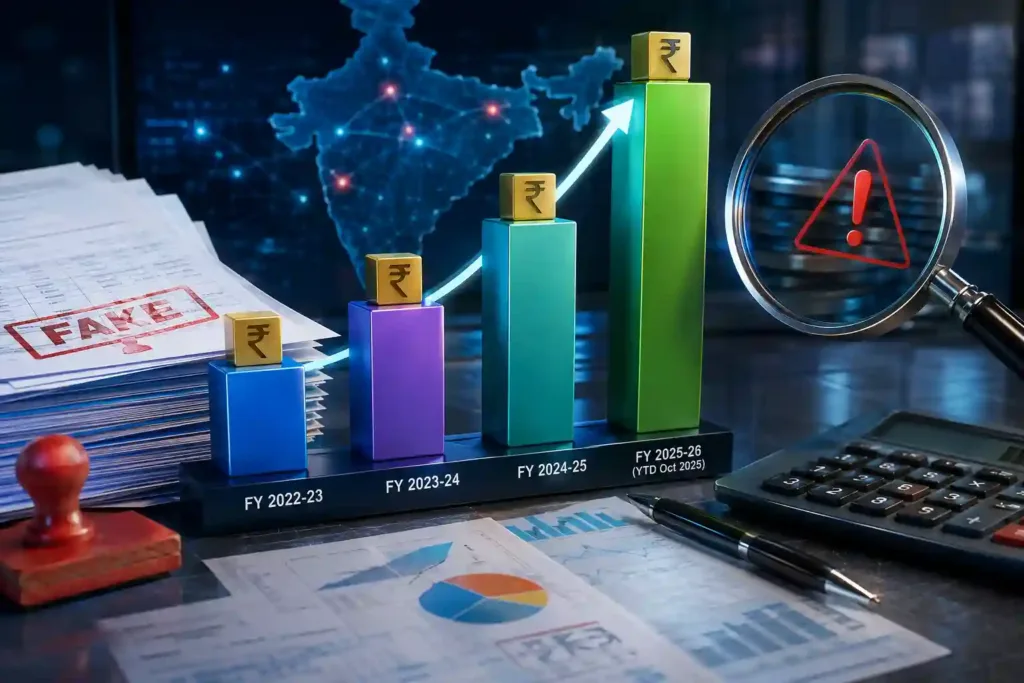
Fake invoicing is not a marginal issue in India’s GST system, it is a structural one, and the numbers back this up.
Parliamentary data shared by the Ministry of Finance shows fake ITC detections have climbed sharply over the past four fiscal years. Cases rose from 7,231 involving roughly ₹24,140 crore in FY 2022–23, to 9,190 cases worth ₹36,374 crore in FY 2023–24, a 51 percent jump in value in a single year. By FY 2024–25, the figure had reached 15,283 cases involving ₹58,772 crore. In the current fiscal year alone, 24,109 cases worth ₹41,664 crore had already been identified as of October 2025. Source: The Economic Times.
Separately, the Directorate General of GST Intelligence (DGGI), the apex investigation body under CBIC, has detected fake ITC worth more than ₹1.14 lakh crore between 2020 and 2025. Source: ET CFO.
These are not abstract numbers. They represent thousands of shell entities, fabricated invoices, and circular transactions that never involved a single real good or service changing hands, yet successfully drained tax credit from the exchequer until someone, or something, caught the pattern.
How Fake Invoicing and Input Tax Credit Fraud Actually Work
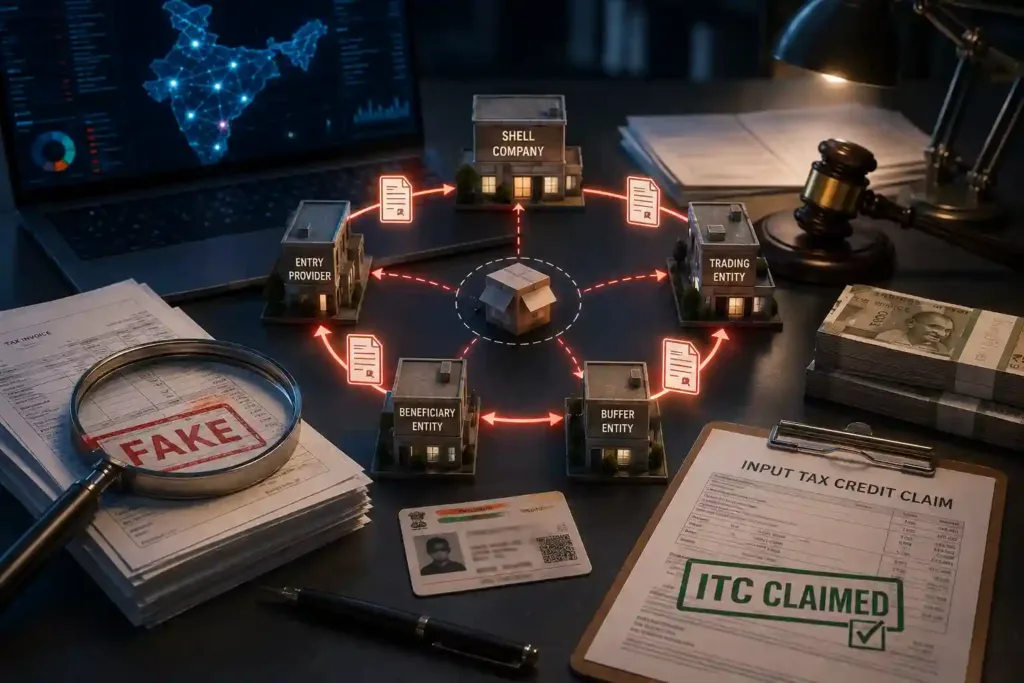
Most fake invoicing schemes follow a recognisable structure, even when the entities involved try to disguise it.
A shell company is registered, often using someone else’s PAN, Aadhaar, or KYC documents obtained through payment or coercion. It generates invoices for goods or services that never actually move. A second entity claims Input Tax Credit against those invoices. In more elaborate versions, several dummy firms pass invoices between each other in a loop, commonly called circular or carousel trading, to inflate turnover and legitimise larger fraudulent claims.
Public enforcement records illustrate how this plays out in practice. In one case, CGST officers in Thane uncovered a racket involving more than 18 dummy entities and fraudulent invoicing worth ₹140 crore, used to avail roughly ₹27 crore in fraudulent ITC, built entirely on misused Aadhaar and PAN documents.
The common thread across these cases is that the fraud is invisible on paper. The invoices look procedurally correct. What exposes them is the absence of a matching physical or financial trail, no corresponding e-way bill, no vehicle movement, no genuine bank settlement pattern. Finding that absence across millions of filings is exactly the kind of problem AI is suited to solve and humans are not.
How AI-Based Fake Invoicing Detection Software Actually Works
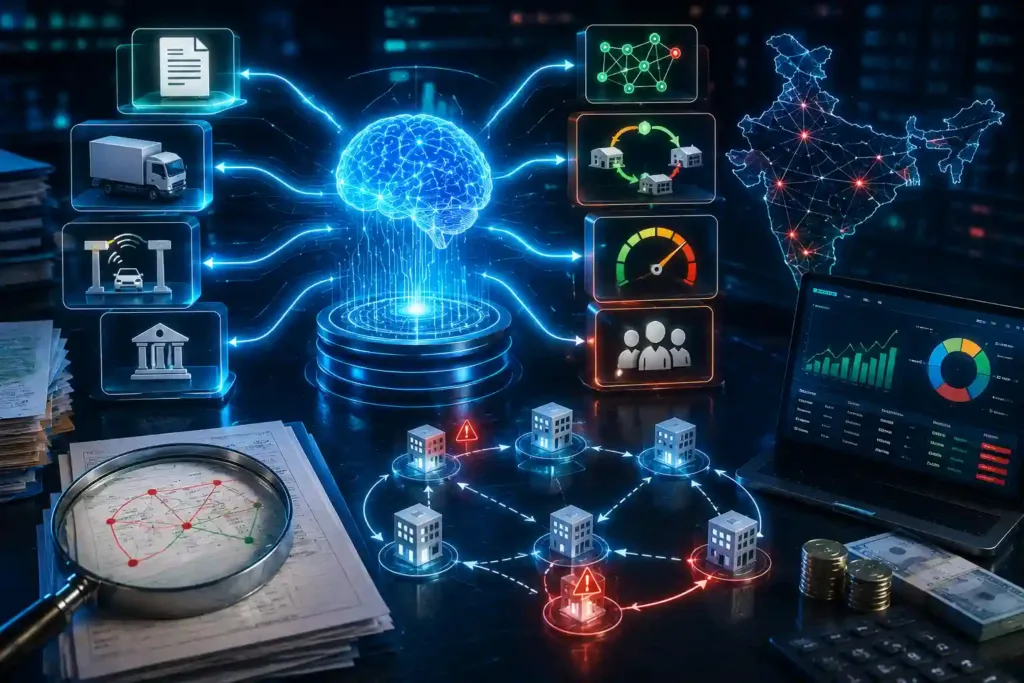
Cross-Referencing Independent Data Sources
The core technique behind AI GST fraud detection is triangulation. A GST return by itself is just a self-reported number. It becomes verifiable only when checked against something the filer does not directly control, such as e-way bill generation, FASTag toll records showing actual vehicle movement, or bank statement flows. When a company reports high-value goods transactions but no corresponding e-way bill or toll crossing exists, that mismatch is a strong fraud signal. This is the same logic increasingly used by fake invoicing detection software across enforcement platforms today.
Entity and Network Analysis
Fraud rarely involves a single company acting alone. AI systems build relationship graphs that map which individuals are directors of multiple companies, which entities share addresses or contact details, and which PAN numbers show unusual registration patterns, such as one person controlling ten or more companies with no genuine business activity. When these relationships cluster in ways that do not resemble normal business behaviour, the system raises a flag well before a human investigator would think to look.
Circular Trading and Carousel Fraud Detection
Circular trading is difficult to catch manually because each individual transaction can look legitimate in isolation. It is only visible when you trace the full loop, Company A to B to C and back to A. AI models designed for input tax credit fraud detection are built specifically to trace these multi-hop chains, something that is computationally trivial for a graph-based system and practically impossible to do by hand across thousands of filings.
Real-Time Risk Scoring
Rather than waiting for an annual audit cycle, modern systems assign a live risk score to each taxpayer based on filing history, ITC-to-turnover ratios, sector benchmarks, and behavioural anomalies. High-risk entities get surfaced for scrutiny immediately, while compliant businesses experience minimal friction. This is a meaningful shift from reactive investigation to proactive enforcement.
A Practical Framework: What Effective ITC Fraud Detection AI Actually Requires
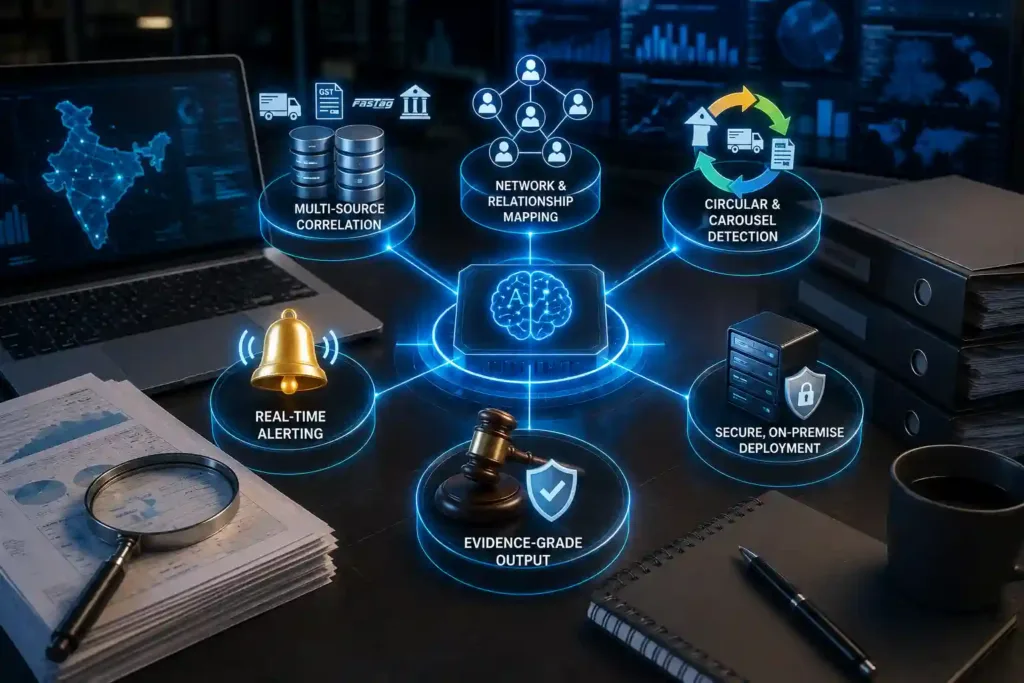
Not every analytics tool marketed for tax enforcement is built for this specific job. Based on how fraud actually plays out, effective fake invoicing and ITC fraud detection AI needs to deliver on a few non-negotiables:
- Multi-source correlation: The ability to pull in and cross-check GST returns, e-way bills, FASTag data, and banking records together, not in isolated silos.
- Network and relationship mapping: To expose shared directorships, common addresses, and PAN-level clustering across entities.
- Circular and carousel trading detection: Built to trace multi-hop transaction loops, not just flag single suspicious invoices.
- Real-time alerting: So enforcement teams act on live risk signals instead of discovering fraud during a delayed audit cycle.
- Evidence-grade output: Findings need to hold up in raids, prosecutions, and tribunal proceedings, not just exist as a dashboard score.
- Secure, on-premise deployment: Given the sensitivity of taxpayer financial data, especially for agencies handling classified or high-value investigations.
A platform that is missing even one of these tends to produce alerts that look useful but don’t translate into an actionable, defensible case.
Where Platforms Like Prophecy Eagle I Fit In
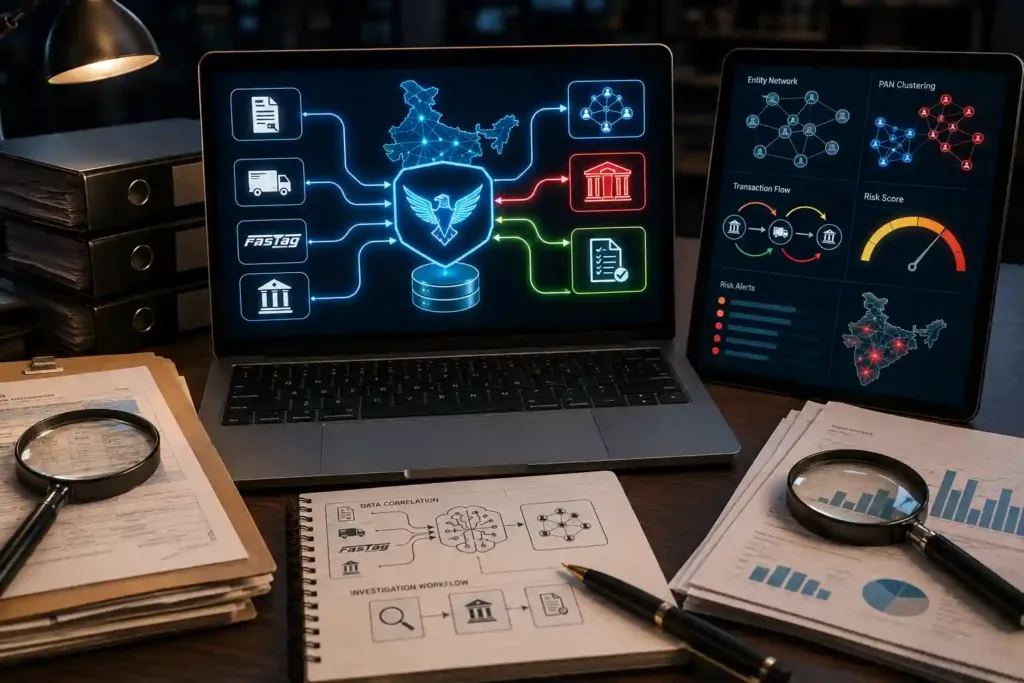
This is precisely the gap purpose-built financial intelligence platforms are designed to close. Platforms such as Prophecy Eagle I, for instance, are built to correlate GST transaction data with e-way bill records and FASTag movement data to verify whether reported sales and purchases reflect real movement of goods, while simultaneously tracking PAN and directorship patterns to flag individuals silently controlling multiple shell entities.
When enforcement teams run raids or investigations, the same platform can help analyse seized bank statements, invoices, and forensic data together to confirm whether reported transactions match actual financial activity, turning a fragmented investigation into a single coherent evidence trail.
The value isn’t the AI model in isolation; it’s having verification, network analysis, and investigation support work off the same secure, correlated dataset.
FAQ
1. How does AI detect GST fraud?
AI detects GST fraud primarily by cross-referencing self-reported GST returns against independent data sources like e-way bills, FASTag toll records, and bank transactions, then using pattern recognition and network analysis to flag mismatches, shell entity clusters, and circular trading that indicate fabricated invoicing.
2. What is ITC fraud in GST?
ITC fraud occurs when an entity claims Input Tax Credit against invoices for goods or services that were never actually supplied, typically through shell companies created solely to generate paper transactions with no real business activity behind them.
3. Can AI detect fake invoices without any real goods movement?
Yes. This is one of AI’s core strengths in this context. By checking whether a reported GST transaction has a corresponding e-way bill and vehicle movement record via FASTag, AI systems can flag invoices where goods were billed but never physically moved, a primary indicator of carousel or circular trading fraud.
4. Is the Indian government already using AI for GST enforcement?
Yes. CBIC’s ADVAIT platform and DGGI’s BIFA tool are both operational AI and analytics systems currently used to detect anomalies, fraud patterns, and circular trading across GST filings, alongside GSTN’s ongoing AI-based risk profiling of taxpayers.
5. What is circular trading in GST fraud, and why is it hard to detect manually?
Circular trading involves multiple linked entities passing invoices between each other in a loop to artificially inflate turnover and legitimise fraudulent ITC claims. It is difficult to detect manually because each individual invoice can appear legitimate; the fraud is only visible when the full transaction chain is traced, which is where AI-based network analysis is significantly more effective than manual review.
6. Does using AI for GST fraud detection replace human investigators?
No. AI narrows down which entities and transactions warrant scrutiny out of millions of filings, but confirming intent, building a prosecutable case, and conducting raids or interrogations still requires human investigators. AI changes where investigators spend their time, not whether they’re needed.