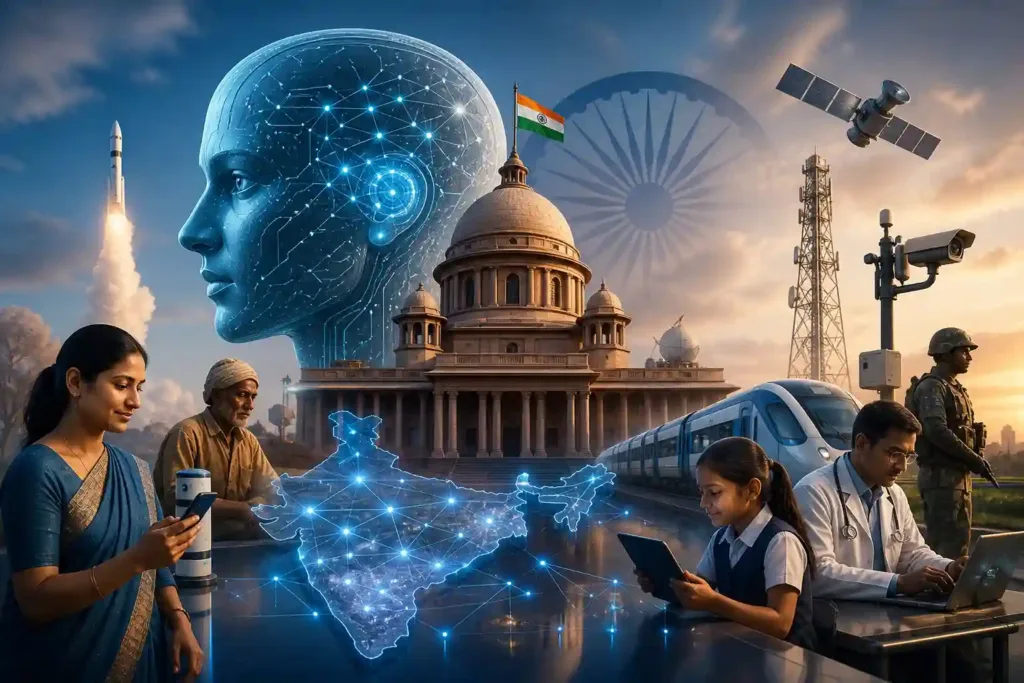
What Does “AI for Government” Actually Mean?
Artificial intelligence in government refers to the use of AI technologies across governmental functions, from how public services are delivered to how laws are enforced, how national threats are anticipated, and how financial crimes are detected and stopped.
But government AI is not one thing. It’s a spectrum.
The core idea behind every government AI deployment is that the state holds more data about citizens, institutions, and events than any other entity. The question is whether that data remains siloed and underused, or whether it is put to work in ways that actually improve outcomes for citizens, protect the integrity of institutions, and keep the country safer.
There is also an honest tension here worth naming. India already has the highest AI skill penetration in the world, with 47% of Indian enterprises reporting several Generative AI use cases live, while another 23% are in pilot stages, source: EY-CII Report 2025.
The Global Picture, and Why India Is Different
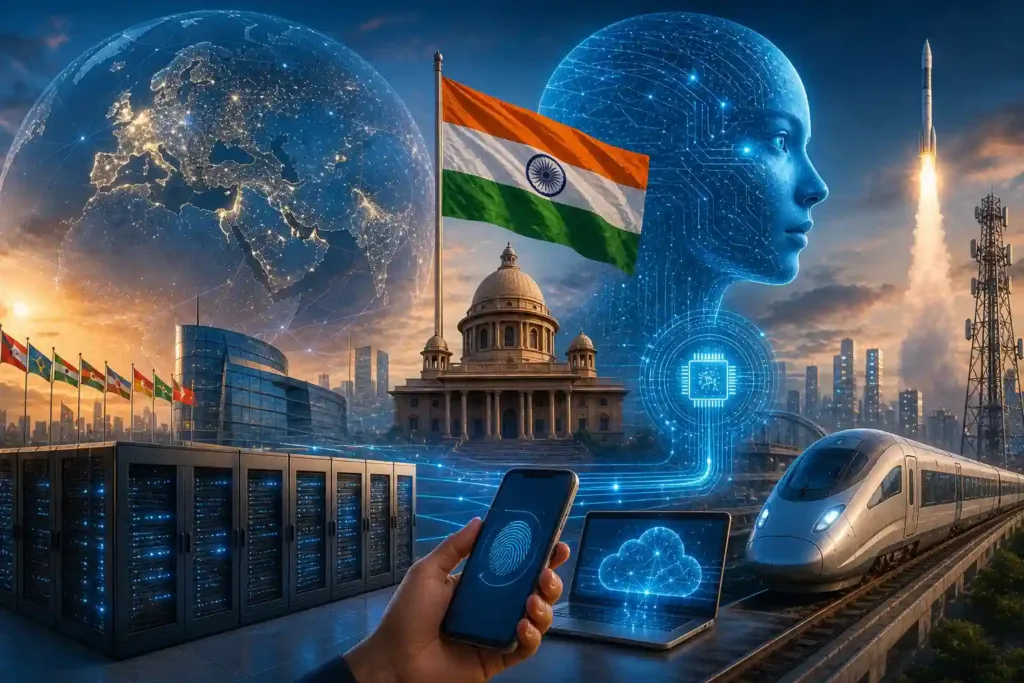
Globally, the AI-in-government movement has reached a scale that would have seemed implausible five years ago. The global AI in government and public services market was valued at $22.41 billion in 2024 and is projected to reach $98.13 billion by 2033, growing at a CAGR of 17.8%, source. The growth is driven not by enthusiasm alone, but by concrete operational need: governments facing rising cyberthreats, overwhelmed public service systems, financial crime at scale, and security challenges that outpace human capacity to monitor them. Source: IBM
Internationally, frameworks are multiplying. The OECD now tracks over 1,000 AI policy initiatives from 69 countries. The EU has enacted the AI Act, the most comprehensive AI regulatory framework currently in force. The US, UK, and China are each pursuing distinct national AI strategies, reflecting their different geopolitical priorities and governance philosophies.
India’s path is its own, and in several important ways, it is more ambitious and more grounded than the frameworks being built elsewhere.
India is not starting from scratch. It is building on a Digital Public Infrastructure, Aadhaar, UPI, DigiLocker, that already reaches over a billion citizens and has no real parallel anywhere in the world. India’s AI governance approach directly links with this proven Digital Public Infrastructure as the foundation on which AI-powered services can be layered for impact at scale, particularly in finance and governance sectors.
The IndiaAI Mission, approved by Cabinet in March 2024 with a budget of ₹10,371.92 crore, formalises this ambition. Guided by the vision of “Making AI in India and Making AI Work for India,” the mission has deployed over 38,000 GPUs at a subsidised rate of ₹65 per hour, making high-end AI computing accessible to startups, researchers, and government agencies that would otherwise be priced out of it. Source: Press Information Bureau
The direction is clear. The question is how the technology is actually being put to use across different functions of government.
Types of AI Being Deployed in Indian Government

The terminology matters here, because “AI” is often used as a single concept when it actually refers to several distinct technologies, each with different capabilities, limitations, and appropriate use contexts.
Machine Learning (ML)
Machine Learning is the most broadly deployed form of AI across government. It involves systems that learn patterns from historical data to make predictions or classifications. In India’s context, ML is used for fraud detection in tax filings, predictive analytics in law enforcement, and crop yield forecasting under programmes like PM-KISAN. The advantage is scalability, ML models, once trained, can process millions of data points in the time it takes a human analyst to review ten.
Natural Language Processing (NLP)
NLP powers intelligence analysis of text-based data, translating, summarising, and extracting entities from documents at a speed and volume that human analysts cannot match. Coming to citizen services, India’s AI-enabled Kisan-eMitra chatbot under PM-KISAN handles millions of farmer grievances in multiple Indian languages using large language models and NLP. Natural Language Processing is transforming how citizens interact with government. In a country with 22 scheduled languages, NLP’s ability to operate across languages is not a feature, it’s a necessity.
Computer Vision
Computer Vision enables machines to extract meaningful information from images and videos. Government applications range from satellite imagery analysis for agricultural monitoring and disaster assessment, to CCTV-based crowd management (demonstrated at Mahakumbh 2025), to document verification and facial recognition for identity services. As with all powerful tools, computer vision deployments in sensitive contexts require robust governance frameworks to prevent misuse.
Generative AI
Gen-AI is the newest and most rapidly evolving category. India launched BharatGen, the country’s first government-funded, multimodal large language model, which supports 22 Indian languages and is designed to reflect India’s cultural and linguistic diversity. In government contexts, generative AI is beginning to be used for document drafting, policy analysis, citizen communication, and training simulations.
Intelligent Automation (RPA + AI)
It combines workflow automation with AI decision-making to handle repetitive, rule-based government processes, processing applications, verifying documents, routing cases, at speed and volume impossible to achieve manually. This is where government agencies dealing with high-volume transactional work (tax authorities, permit offices, public benefit disbursement) can achieve the fastest measurable efficiency gains.
Optical Character Recognition (OCR)
OCR is foundational but underappreciated. India’s government still operates with enormous volumes of paper records, land registries, court documents, historical files. OCR with AI makes these searchable, linkable, and analytically useful. Without it, the vast majority of India’s historical government data remains effectively invisible to modern analytics.
Where AI is Making a Measurable Difference in Indian Government

Public Service Delivery and Administration
The most visible government AI deployments in India are citizen-facing, and for good reason. India’s public administration operates at a scale that makes manual processing of services genuinely unmanageable. Hundreds of millions of subsidy applications, tax filings, permit requests, and grievance submissions require processing every year.
AI automation of routine processing, document verification, eligibility checks, fraud screening for benefit payments, addresses a real bottleneck. It is also where AI’s benefits are most democratically distributed: a farmer in Chhattisgarh and a business owner in Chennai both benefit from faster, more accurate processing of their applications.
AI-driven platforms are improving healthcare accessibility in rural and underserved communities through remote diagnostics and personalised recommendations, while reducing the strain on overstretched public healthcare systems. India’s three existing Centres of Excellence for AI focus on precisely this public-good orientation, Healthcare, Agriculture, and Sustainable Cities. Source: Press Information Bureau
Financial Intelligence and Revenue Protection
This is an area where the stakes are extremely high, the data is rich, and AI’s pattern-recognition capabilities translate directly into measurable outcomes.
India’s tax authorities manage crores of income tax filers and a GST ecosystem covering lakhs and lakhs of businesses. The challenge isn’t collecting data, it’s making sense of it fast enough to identify anomalies before they become entrenched. Shell company structures, circular transactions, invoice fraud, and layered money movements are all designed to look unremarkable when viewed in isolation. They only reveal themselves when you can see the full network, across entities, time periods, and jurisdictions simultaneously.
For agencies tasked with anti-money laundering, tax enforcement, and financial crime investigation, AI doesn’t replace investigators, it makes their time worth more by eliminating the months of manual cross-referencing that used to precede every substantive lead.
Read more: The Complete Guide to Anti-Money Laundering (AML)
Law Enforcement and Public Safety Intelligence
Law enforcement agencies in India, from state police forces to central investigation agencies, are increasingly deploying AI to address a fundamental operational challenge: the volume of data relevant to any investigation exceeds what human analysts can manually process in the time available to act.
Crime pattern analysis, cross-jurisdictional case linkage, call data record analytics, and open-source intelligence monitoring are all areas where AI systems are enabling faster, evidence-based decision-making. Research has found that AI-powered smart city technologies can help agencies reduce crime rates by 30 to 40 percent and reduce emergency response times by 20 to 35 percent. Source: Deloitte
The important caveat, and it is worth stating directly, is that the effectiveness of these systems depends entirely on the quality of the underlying data, the rigour of the governance frameworks around them, and the preservation of human oversight at decision points. Predictive analytics is a decision-support tool. When it is allowed to become a decision-making tool without human verification, it creates both operational and civil liberties risks.
National Security and Critical Infrastructure Protection
India’s critical infrastructure, power grids, financial systems, telecommunications networks, transportation, faces a threat environment that has become significantly more sophisticated and more frequent in recent years. Cyberattacks on government systems, financial fraud targeting public institutions, and attempts to exploit data from government databases are no longer edge cases. They are operational realities.
The government and national security segment is anticipated to grow at the fastest rate among all sectors in AI-powered cybersecurity, driven by the strategic imperative to identify advanced cyber espionage campaigns and protect critical infrastructure across energy, transportation, and communications sectors.
AI’s contribution here is multi-layered. Threat detection systems that establish behavioural baselines across networks and flag anomalies in real time. Digital forensics platforms that can rapidly process terabytes of evidence data to reconstruct attack timelines. Authentication systems that verify identities at the point of access without creating bottlenecks. And multi-source intelligence fusion platforms that synthesise data from disparate sensors and feeds into a unified operational picture.
The requirement for these deployments is different from consumer or enterprise AI in one critical respect: the data cannot leave secure government infrastructure. On-premise and sovereign-cloud deployment are baseline requirements, not optional configurations.
Innefu Labs: An Indigenous AI Provider for Indian Government
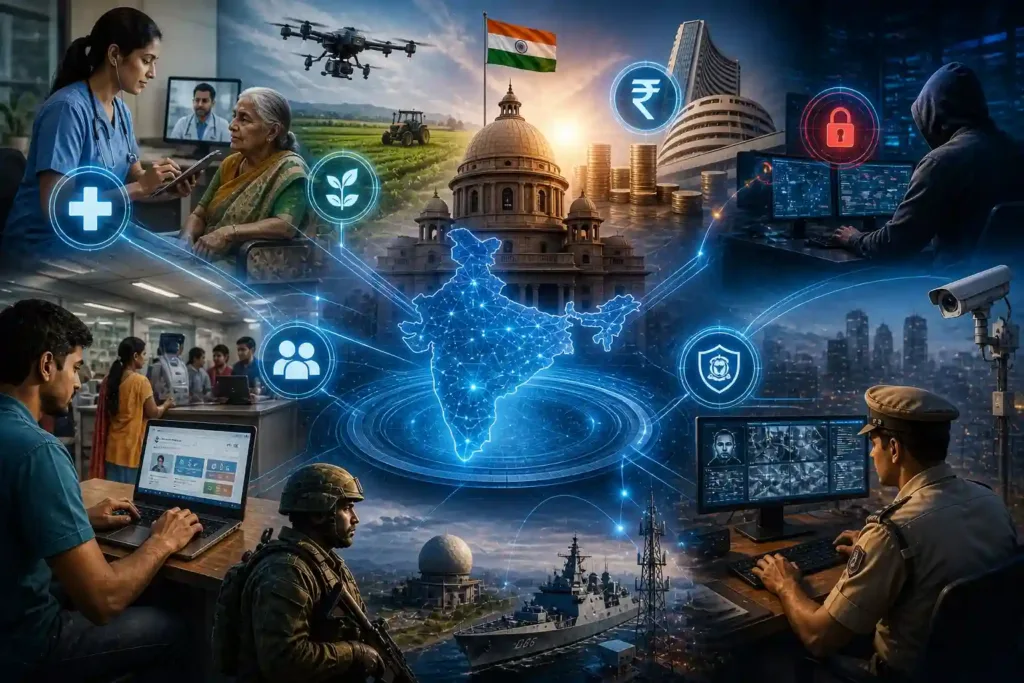
Innefu is among the few indigenous AI companies empanelled by the National e-Governance Division (NeGD) as an official AI solutions provider to Government of India ministries and departments. This empanelment reflects not just technical capability but compliance with the security, data sovereignty, and governance requirements that distinguish government-grade AI from commercial AI.
Innefu’s products are not repurposed enterprise tools; they are built for the specific operational, legal, and security constraints of the government environment.
The distinction matters because the difference between a tool that works in a demo and one that holds up in a court proceeding, a regulatory audit, or an active incident is significant, and it’s exactly what government agencies need to verify before deployment.
Request a demo to see how Innefu’s AI capabilities apply to your agency’s specific requirements.
Frequently Asked Questions
1. What is AI for government?
AI for government refers to the deployment of artificial intelligence technologies, including machine learning, natural language processing, computer vision, and intelligent automation, across government functions. This includes citizen service delivery, public safety, financial crime detection, national security, healthcare, agriculture, and administration. In India, government AI operates within a framework that prioritises data sovereignty, explainability, and the use of Digital Public Infrastructure like Aadhaar and UPI as the delivery foundation.
2. How is India using AI in government specifically?
India’s AI-in-government deployments span multiple domains. In agriculture, NLP-powered chatbots handle farmer grievances in regional languages under PM-KISAN. In healthcare, AI diagnostics platforms are improving rural access. In financial intelligence, ML-based systems are detecting tax fraud and money laundering at scale. In public safety, predictive analytics and OSINT tools are supporting law enforcement. Underpinning all of this is the IndiaAI Mission, a ₹10,371.92 crore national programme to build AI infrastructure, develop indigenous models, and ensure AI deployment across critical sectors.
3. What is the IndiaAI Mission?
The IndiaAI Mission was approved by the Cabinet in March 2024 with a budget outlay of ₹10,371.92 crore over five years. It aims to build India’s AI computing infrastructure (targeting 38,000+ GPUs), develop indigenous large language models in Indian languages, establish sector-specific AI Centres of Excellence, create a national datasets platform, and support responsible AI deployment across government and the private sector. It is implemented by the IndiaAI independent business division under MeitY.
4. What types of AI are used in Indian government?
The primary AI technologies deployed in Indian government include machine learning (for fraud detection, predictive analytics, and pattern recognition), natural language processing (for multilingual citizen services and intelligence analysis), computer vision (for surveillance, disaster management, and identity verification), generative AI (for BharatGen and citizen communication), intelligent automation (for high-volume administrative processing), and optical character recognition (for digitising and making searchable India’s vast paper record archives).
5. What is the difference between government AI and commercial AI?
Government AI must meet requirements that commercial AI does not prioritise. Data cannot leave secure national infrastructure. Decisions must be explainable and auditable for legal and regulatory purposes. Systems must integrate with decades-old legacy infrastructure rather than requiring complete replacement. Models must be trained on mission-relevant data reflecting the actual operational context. And governance frameworks must ensure that AI outputs remain subject to human oversight, particularly in high-stakes decisions affecting citizen rights, public safety, or financial outcomes.
6. What is NeGD empanelment and why does it matter?
The National e-Governance Division (NeGD) under MeitY empanels technology companies that meet the technical, security, and governance standards required to provide digital solutions to Government of India ministries and departments. Empanelment means the vendor has been formally evaluated and approved for government procurement, providing ministries with a pre-vetted shortlist of suppliers rather than requiring each agency to conduct independent due diligence from scratch.