
Open source intelligence helps cyber fraud investigators since scams leave public footprints. A fake website has a domain, hosting and certificate history. A scam handle has a creation date, profile photos and linked numbers. A phone number or UPI ID shows up again and again across complaints. OSINT collects and connects these public traces so that one complaint becomes a pattern, the infrastructure behind it can be reported for takedown, and the evidence is preserved before the scam page disappears. It does not replace bank, telecom or device records. It tells investigators where to look next, and quickly.
Key takeaways
- Scams are built from reusable parts: sites, handles, numbers, payment IDs and apps
- Each part leaves public traces that can link one scam to others
- Preserving evidence first matters, since scam pages often vanish within days
- One complaint rarely tells the story, but ten complaints sharing an identifier often do
- OSINT gives leads, and bank, telecom and platform records confirm them
- Careful attribution matters, because a number or account may belong to a victim or a mule
- Takedown and blocking channels exist and work best when reports are fast and well documented
- Documentation and a clean evidence trail decide whether findings hold up later
Why OSINT matters in cyber fraud

Cyber fraud is among the highest-volume crime categories in India. According to the Government’s reply in Parliament in July 2025, as reported in the press, about 22.68 lakh cybercrime incidents were registered in 2024, with citizens losing more than ₹22,845 crore. Source: PIB. Complaints arrive through the National Cyber Crime Reporting Portal and the 1930 helpline, and are spread across police stations and states.
Three features of this crime make OSINT useful.
- It is fast and cross-jurisdiction: A scam site hosted abroad can target victims in Pune, Patna and Coimbatore within hours. Investigators in each place see only a slice.
- It is repetitive: The same scammers reuse numbers, templates, images and payment details across many victims.
- It is public by design: To reach victims, scams need public websites, ads, channels and phone numbers. That visibility is what OSINT works with.
The scam footprint: what can be seen in public
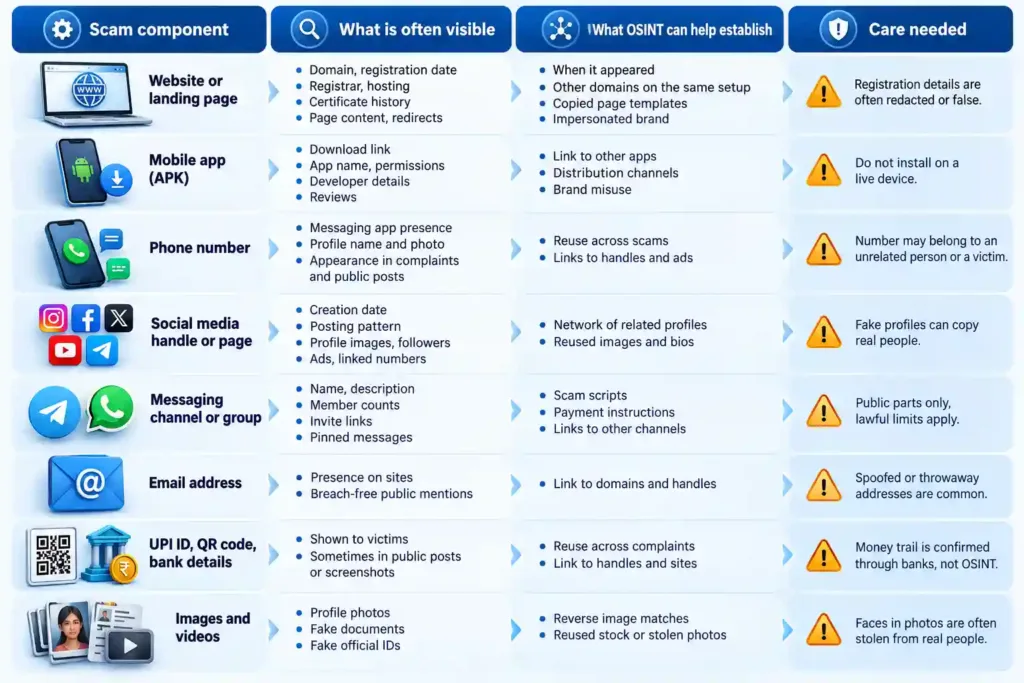
| Scam component | What is often visible | What OSINT can help establish | Care needed |
|---|---|---|---|
| Website or landing page | Domain, registration date, registrar, hosting, certificate history, page content, redirects | When it appeared, other domains on the same setup, copied page templates, impersonated brand | Registration details are often redacted or false |
| Mobile app (APK) | Download link, app name, permissions, developer details, reviews | Link to other apps, distribution channels, brand misuse | Do not install on a live device |
| Phone number | Messaging app presence, profile name and photo, appearance in complaints and public posts | Reuse across scams, links to handles and ads | Number may belong to an unrelated person or a victim |
| Social media handle or page | Creation date, posting pattern, profile images, followers, ads, linked numbers | Network of related profiles, reused images and bios | Fake profiles can copy real people |
| Messaging channel or group | Name, description, member counts, invite links, pinned messages | Scam scripts, payment instructions, links to other channels | Public parts only, lawful limits apply |
| Email address | Presence on sites and breach-free public mentions | Link to domains and handles | Spoofed or throwaway addresses are common |
| UPI ID, QR code, bank details | Shown to victims, sometimes in public posts or screenshots | Reuse across complaints, link to handles and sites | Money trail is confirmed through banks, not OSINT |
| Images and videos | Profile photos, fake documents, fake official IDs | Reverse image matches, reused stock or stolen photos | Faces in photos are often stolen from real people |
A practical workflow
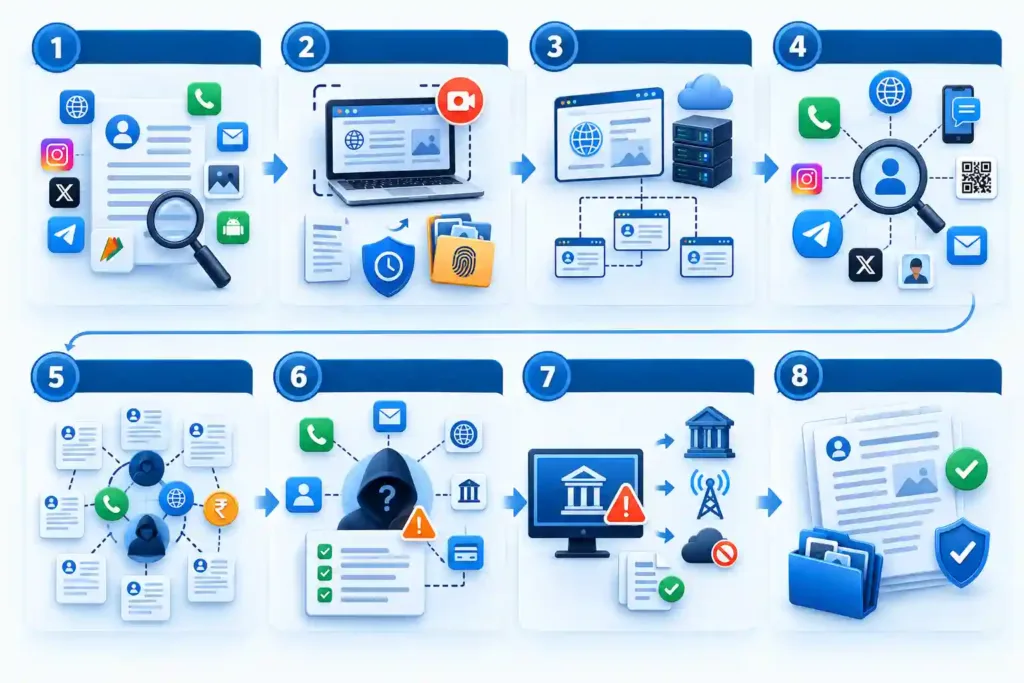
The sequence below reflects what many cyber cells and corporate fraud teams do in some form.
Triage the complaint
Identify every digital identifier in the complaint: the website link, phone numbers, handles, payment IDs, app names, email addresses and screenshots. Note times and amounts. This list becomes the starting point and, later, the register that links complaints.
Preserve before anything else
Scam pages, handles and channels are often taken down or abandoned quickly, sometimes within days. The first step is to capture them in a way that can be defended later.
- Capture the page with date and time, the full URL and the page source where possible
- Record how the page was reached and from which device and network
- Compute and record hash values of saved files
- Keep a simple log of who captured what, and when
This feeds the certificate requirements under Section 63 of the Bharatiya Sakshya Adhiniyam, 2023. See our guides on the Section 63 BSA certificate and chain of custody for digital evidence.
Map the infrastructure
For a fake site, teams often look at when the domain was registered, which registrar and hosting provider it uses, its certificate history, which other domains share the same hosting, and whether the page is a copy of a real organisation’s site. A newly registered domain imitating a bank, courier or government service is a common warning sign. Page structure, images and scripts that match other scam pages can link several sites to one operation.
For a handle or profile, teams look at the creation date, reused profile photos, bio text, posting patterns, linked phone numbers or payment details, and ads run through the platform’s public ad library where available.
Pivot and connect
Every identifier is a thread. A phone number may appear in other complaints, on a fake customer care page and in a messaging profile. A QR code may be reused across several victims. Following these threads, one identifier at a time, builds a map of the scam operation.
Cluster complaints
This is where OSINT often changes the outcome. A single complaint from one victim shows a loss. Ten complaints from different states sharing a number, a domain or a payment ID show an organised operation, which supports bigger actions, joint investigation and more effective requests for records. A structured register of identifiers across complaints makes this possible.
Attribute with caution
Public traces show infrastructure, not always the person behind it. Numbers get rented or sold, accounts get hired out, and mule accounts often belong to people who do not know how they are being used. A careful approach is to treat OSINT findings as leads, confirm through official records such as telecom and bank data, and describe the confidence level in the report.
Act through lawful channels
Findings are most useful when they lead to action. Depending on the case, teams use reporting and blocking routes such as:
- the National Cyber Crime Reporting Portal and the 1930 helpline, which help trigger quick holds on funds through banks
- the Department of Telecommunications Sanchar Saathi portal and its Chakshu facility, for reporting suspected fraudulent communications and numbers
- takedown requests to registrars, hosting providers and platforms
- lawful requests to banks, telecom operators and intermediaries for records and account holds
Document and report
Record what was found, how, when and with what level of confidence. Keep the original captures, the hash values and the identifier register together. This makes the work repeatable and defensible.
Common Indian scam patterns and the OSINT leads they offer
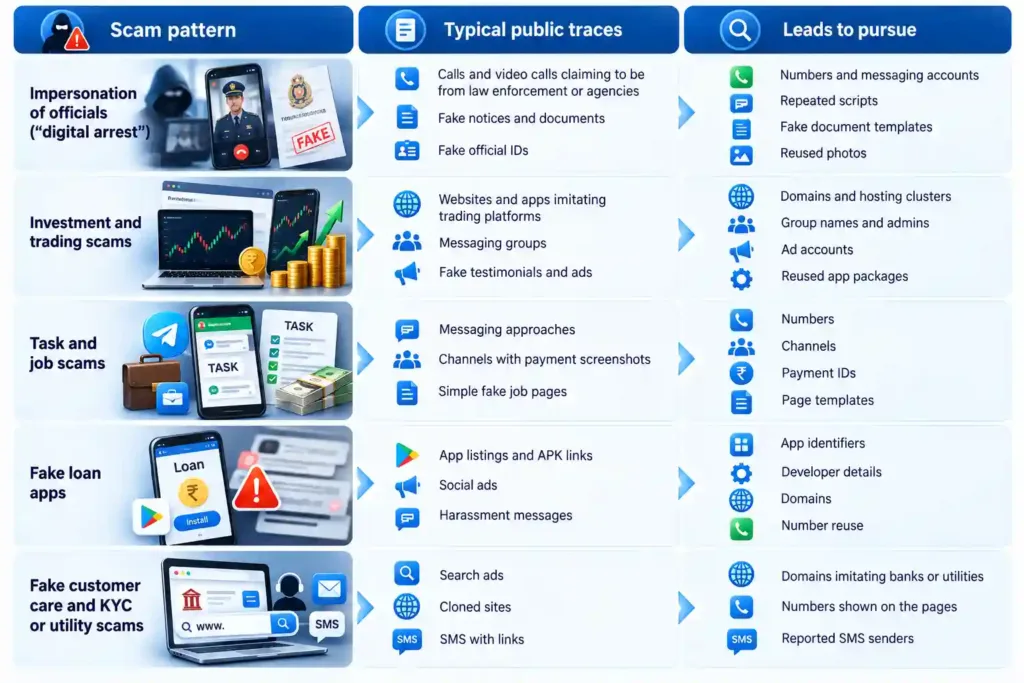
| Scam pattern | Typical public traces | Leads to pursue |
|---|---|---|
| Impersonation of officials (“digital arrest”) | Calls and video calls claiming to be from law enforcement or agencies, fake notices, fake IDs | Numbers and messaging accounts, repeated scripts, fake document templates, reused photos. The Indian Cyber Crime Coordination Centre has publicly advised that agencies do not make arrests over video calls |
| Investment and trading scams | Websites and apps imitating trading platforms, messaging groups, fake testimonials, ads | Domains and hosting clusters, group names and admins, ad accounts, reused app packages |
| Task and job scams | Messaging approaches, channels with payment screenshots, simple fake job pages | Numbers, channels, payment IDs, page templates |
| Fake loan apps | App listings and APK links, social ads, harassment messages | App identifiers, developer details, domains, number reuse |
| Fake customer care and KYC or utility scams | Search ads, cloned sites, SMS with links | Domains imitating banks or utilities, numbers shown on the pages, reported SMS senders |
These patterns evolve quickly. The point of the table is that each pattern leaves different footprints, so the starting identifiers differ.
Pitfalls worth watching for
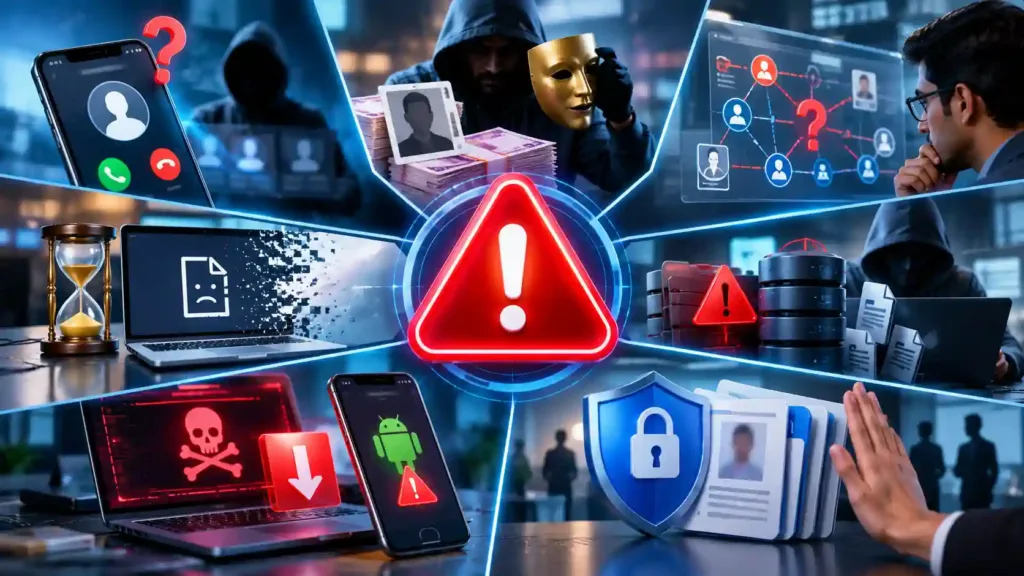
- Treating a number as a person: Numbers are rented, spoofed and reassigned.
- Treating a mule as the mastermind: The person whose account received funds may be a victim or a low-level participant. Their treatment is a matter for the investigating officer and the law.
- Confirmation bias: Teams sometimes find what they expected. Recording alternatives and confidence levels helps.
- Losing the evidence: Delay in capture means the page is gone and only a screenshot remains.
- Relying on questionable data: Material from leaked or unlawfully obtained databases can raise legal and admissibility questions. Teams commonly prefer lawful, documentable sources.
- Unsafe handling: Opening scam links or installing apps on a normal device can expose the investigator. Isolated environments are commonly used.
- Privacy overreach: Public information about private individuals still deserves proportionate handling. The Digital Personal Data Protection Act, 2023, and department policy apply.
Legal context in brief
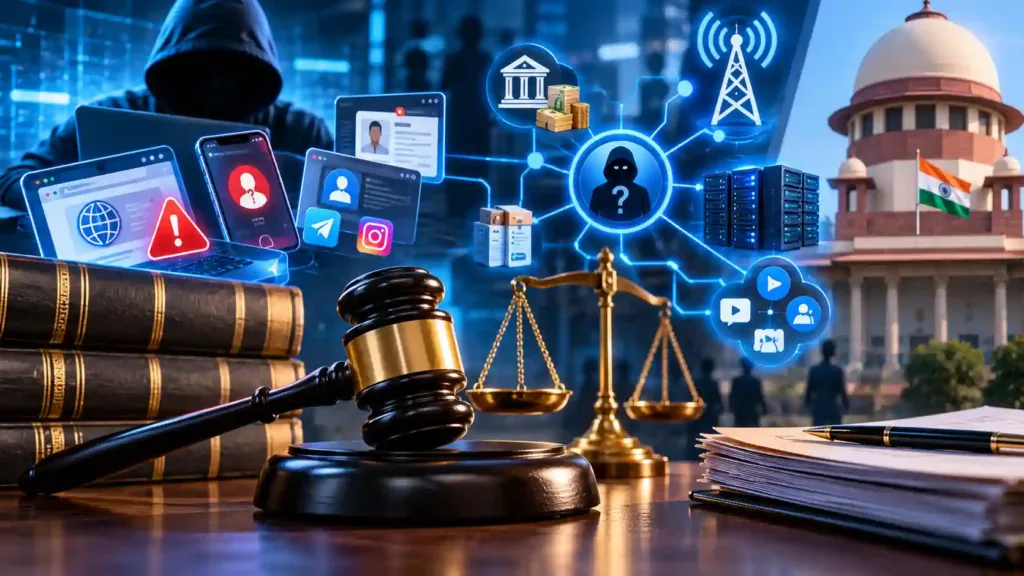
Cyber frauds are charged under provisions such as cheating and cheating by personation in the Bharatiya Nyaya Sanhita, 2023 (Sections 318 and 319) and the Information Technology Act, 2000 (including Sections 66C and 66D). Records from banks, telecom operators and platforms are generally obtained through lawful process under the Bharatiya Nagarik Suraksha Sanhita, 2023. OSINT supports this process, but the records that confirm identity and money flow come through those channels. The exact provisions that apply depend on the facts and are best confirmed with legal advisers.
Where technology helps

Doing this by hand across many complaints is slow. Platforms can help in two ways.
Collection and monitoring
Innefu’s Innsight gathers open source data from social media and other public sources, can build profiles around mobile numbers, emails and social media accounts, shows connections and link analysis between profiles, and supports keyword alerts by SMS and email. This supports the discovery and pivoting steps.
Connecting seized-device and bank data

Innefu’s Argus brings forensic data from multiple devices and bank statements into one repository. It identifies common contacts, locations, applications and WhatsApp groups across suspect devices and helps trace the flow of money across accounts. This supports the confirmation steps once devices and statements are in hand.
Neither replaces investigative judgment. They reduce the manual effort of collecting, linking and searching, so analysts spend more time on interpretation.
Frequently asked questions
1. Can OSINT identify the person behind a scam?
It can reveal infrastructure and link activity across many scams, which often narrows the search. Confirming the identity of a person usually relies on official records such as telecom, bank and platform data obtained lawfully. OSINT findings are best treated as leads.
2. What should be preserved first in a cyber fraud case?
The scam website, handle, channel or app listing, because these can disappear quickly. Teams typically capture the page with date and time, save the source, record hash values and keep a capture log.
3. How do investigators link several scam complaints?
By recording every identifier in each complaint, such as phone numbers, domains, handles and payment IDs, and looking for repeats across complaints. A shared identifier can show that separate complaints belong to one operation.
4. How are scam websites traced?
Investigators look at domain registration details, registrar, hosting, certificate history, page similarity to other sites and shared infrastructure. Registration details are often redacted or false, so the pattern across sites is usually more useful than any single detail.
5. What is the 1930 helpline and why does speed matter?
1930 is the national helpline for reporting cyber financial fraud, linked to the reporting system that helps banks place quick holds on funds. Public advisories stress reporting as early as possible because money moves between accounts quickly.
6. Is it safe to open a scam link during an investigation?
It carries risk. Many teams use isolated environments and avoid installing suspect apps on normal devices. Procedures set by the department or organisation should guide this.
7. Can banks and fraud teams use OSINT too?
Yes. Bank, fintech and corporate fraud teams use it to check suspicious domains, impersonation of their brand, fake support numbers and social handles, and to support takedown requests.
8. Is OSINT evidence admissible in court?
It can be, if collected lawfully and documented properly, with hash values, a clear capture record and a Section 63 certificate where electronic records are produced. Handling and legal advice should follow local practice.