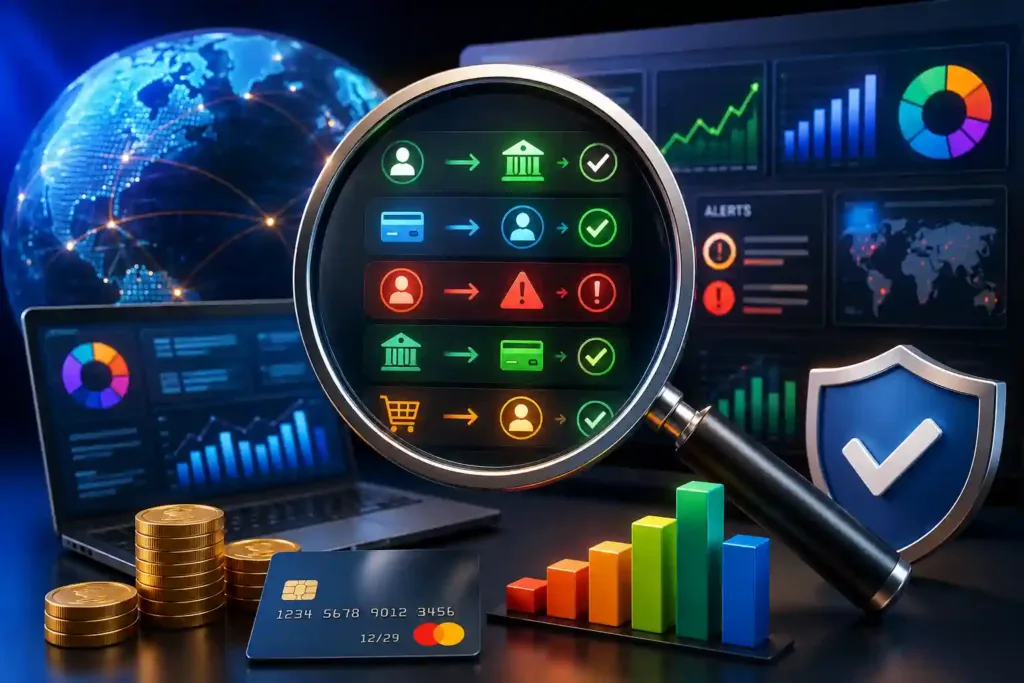
Transaction monitoring is the process of continuously reviewing financial transactions to spot activity that looks unusual, risky, or potentially illegal. Banks, payment companies, fintechs, and insurers use it to catch things like money laundering, fraud, and other financial crime before they cause real damage.
That’s the short answer. The rest of this guide breaks down how it actually works, what tools are involved, and where it fits alongside related terms like AML monitoring and fraud detection, since people often use these interchangeably when they mean slightly different things.
Key Takeaways
- Transaction monitoring is the ongoing review of financial activity to detect suspicious or high-risk behavior.
- It’s broader than AML monitoring. AML is one major use case, not the whole definition.
- Systems use a mix of fixed rules, behavior-based analysis, and increasingly, AI.
- Suspicious activity gets scored, flagged, and sent to an analyst for review, not automatically blocked.
- Transaction monitoring software is what makes this possible at scale, since no team can manually review millions of transactions a day.
What Is Transaction Monitoring, Exactly?
At its core, transaction monitoring means watching financial transactions as they happen, or shortly after, and comparing them against expected patterns. When something breaks that pattern, be it an unusually large transfer, a sudden change in behavior, or a payment to a high-risk destination, the system raises a flag for someone to look at.
It’s easy to assume this only applies to money laundering, largely because AML transaction monitoring is the most regulated and widely discussed version of it. But the underlying practice is broader. The same core mechanics power:
- Fraud detection on credit and debit cards
- Anti-money laundering (AML) and sanctions screening in banks and fintechs
- Chargeback and payment risk monitoring in e-commerce
- Claims fraud detection in insurance
- Wallet and transfer monitoring in digital payment apps
Any organization that moves money and has something to lose from that money being misused typically needs some form of transaction monitoring, whether or not it’s a regulatory requirement for them.
Why Transaction Monitoring Matters
The scale of the problem is worth sitting with for a second. In the last five years, India’s Enforcement Directorate has filed 4,622 cases under the Prevention of Money Laundering Act, including 1,080 in FY26 alone, a four-year high, the government told Parliament in August 2026. Prosecution complaints have been filed in 2,444 of those cases before special courts so far. Source: The Wire.
That gap is exactly why transaction monitoring exists. It’s not there to catch every bad transaction; that’s not realistic. It’s there to raise the odds of catching enough of them, consistently, that laundering money or moving stolen funds through a legitimate institution becomes genuinely harder to do.
For regulated institutions specifically, there’s also a direct cost to getting this wrong. Regulators worldwide have fined banks and fintechs hundreds of millions of dollars for weak or outdated transaction monitoring controls in the last two years alone. The reputational damage from being named in one of those cases often outlasts the fine itself.
How Does Transaction Monitoring Work?
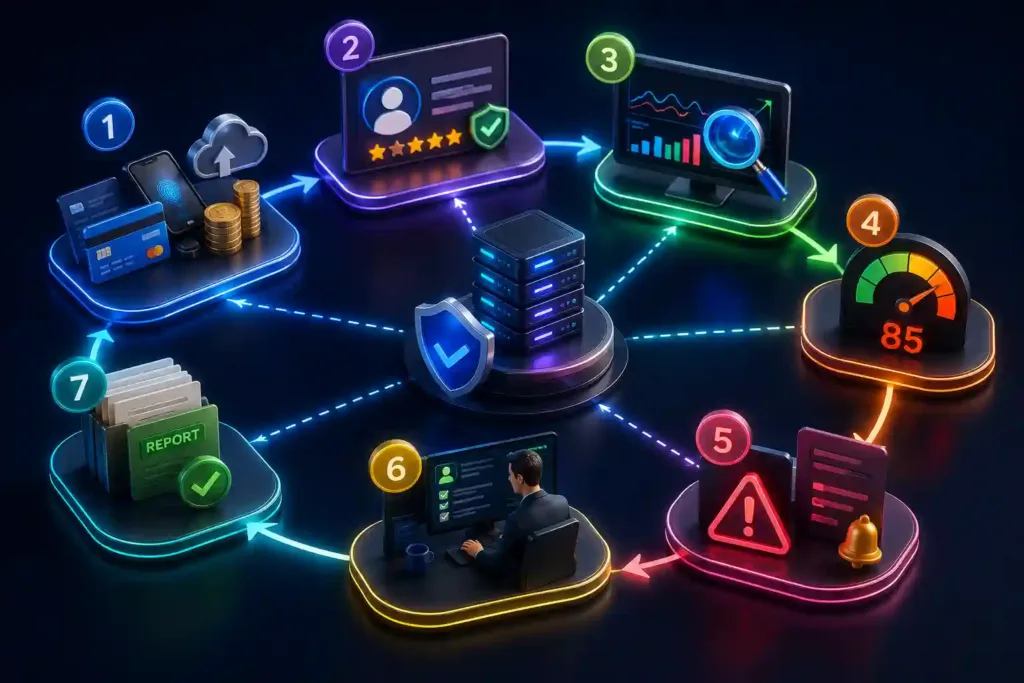
Strip away the vendor jargon, and most transaction monitoring systems follow the same basic sequence.
Data collection
The system pulls in transaction data from every relevant channel: card payments, wire transfers, wallet top-ups, ATM withdrawals, whatever applies to that business. This can happen in real time or in scheduled batches.
Customer and account context
Raw transaction data on its own doesn’t mean much. The system layers in context: who the customer is, their risk profile, their typical behaviour, and any watchlist or sanctions flags tied to them.
Analysis against rules and patterns
Every transaction gets checked against a set of rules (say, deposits over a certain amount) and compared to the customer’s own historical behaviour. A transaction that’s unremarkable for one customer might be a glaring outlier for another.
Risk scoring
Instead of a simple flag or no-flag outcome, most modern systems assign a risk score. This helps prioritize which alerts actually need a human to look at them first.
Alert generation
When a transaction or pattern crosses the risk threshold, the system creates an alert. Well-built systems also group related alerts together instead of firing off ten separate ones for the same underlying issue.
Investigation
A compliance or fraud analyst reviews the flagged activity, checks supporting information, and decides whether it’s genuinely suspicious, needs escalation, or was a false alarm.
Reporting and feedback
If the activity is confirmed suspicious, it may need to be formally reported to a regulator. Either way, the outcome gets fed back into the system, which is what allows detection to improve over time instead of staying static.
We’ve written a much deeper breakdown of this workflow specifically for AML programs, covering entity resolution, link analysis, and case management, in our guide on how AML transaction monitoring works.
Rule-Based vs. AI-Driven Monitoring
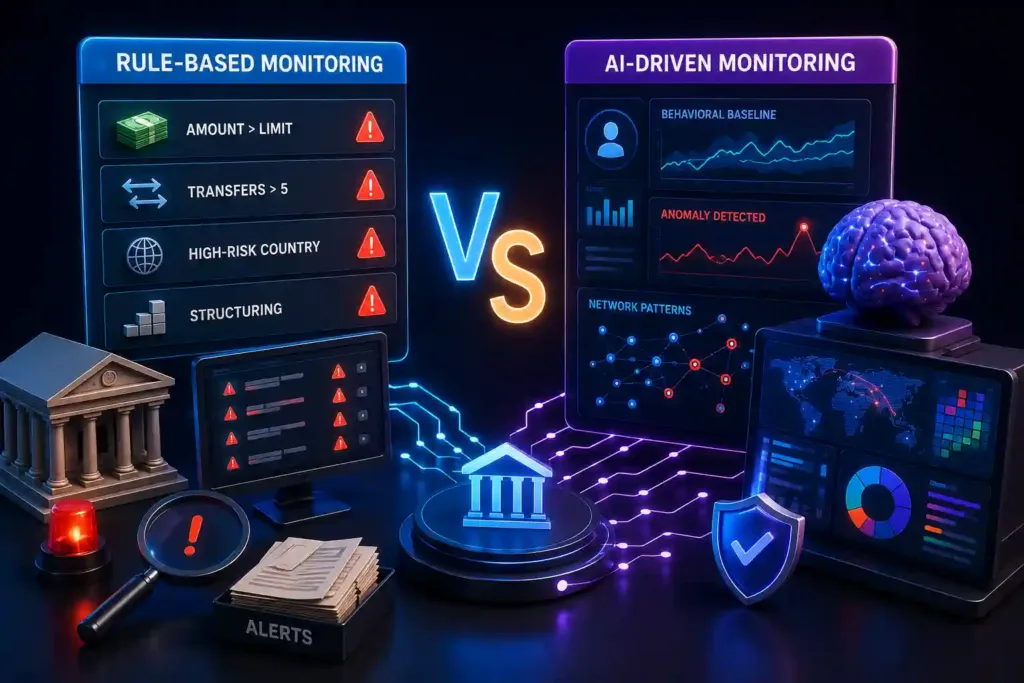
Most systems use a combination of two broad approaches, not just one.
Rule-based monitoring flags transactions that break a predefined threshold, like more than five transfers in an hour, or a deposit over a set amount. It’s simple, transparent, and easy to audit, which is exactly why regulators like it. Its weakness is that it only catches what it’s told to look for, and it tends to generate a lot of false positives from perfectly normal customer behaviour.
AI-driven and behavioural monitoring looks at each customer’s own history and typical patterns and flags meaningful deviations from that baseline rather than a fixed number. It can also spot patterns across accounts and networks that a static rule would never catch, like a group of seemingly unrelated accounts all funnelling money to the same destination.
Most mature programs run both in parallel. Rules catch the known, obvious cases. Behavioural and AI models catch the ones that don’t fit a pattern anyone thought to write a rule for.
What is Transaction Monitoring Software?
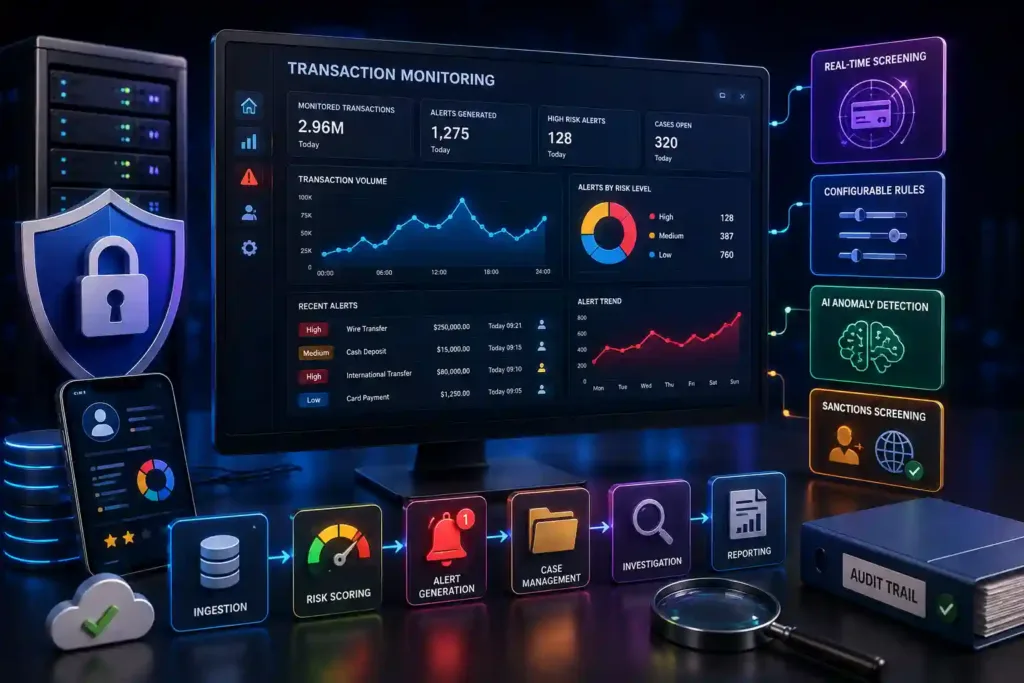
Transaction monitoring software is the platform that actually runs this process at scale. Manually reviewing millions of transactions a day isn’t possible, so this software handles the ingestion, scoring, alerting, and case management in one place.
At a minimum, decent transaction monitoring software should offer:
- Real-time or near-real-time transaction screening
- Configurable rules that don’t require a developer to update
- Behavioural or AI-based anomaly detection, not just static thresholds
- Sanctions and watchlist screening
- Alert scoring and case management, so analysts aren’t drowning in noise
- An audit trail that holds up to regulatory scrutiny
- Deployment flexibility, since many institutions in regulated or sensitive sectors need on-premise or air-gapped options rather than a pure cloud setup
The gap between good and mediocre software usually comes down to one thing: false positive rates. A system that floods analysts with alerts that turn out to be nothing doesn’t just waste time; it makes it more likely that a genuinely suspicious transaction gets missed in the noise.
Transaction Monitoring vs. Fraud Detection vs. AML Monitoring
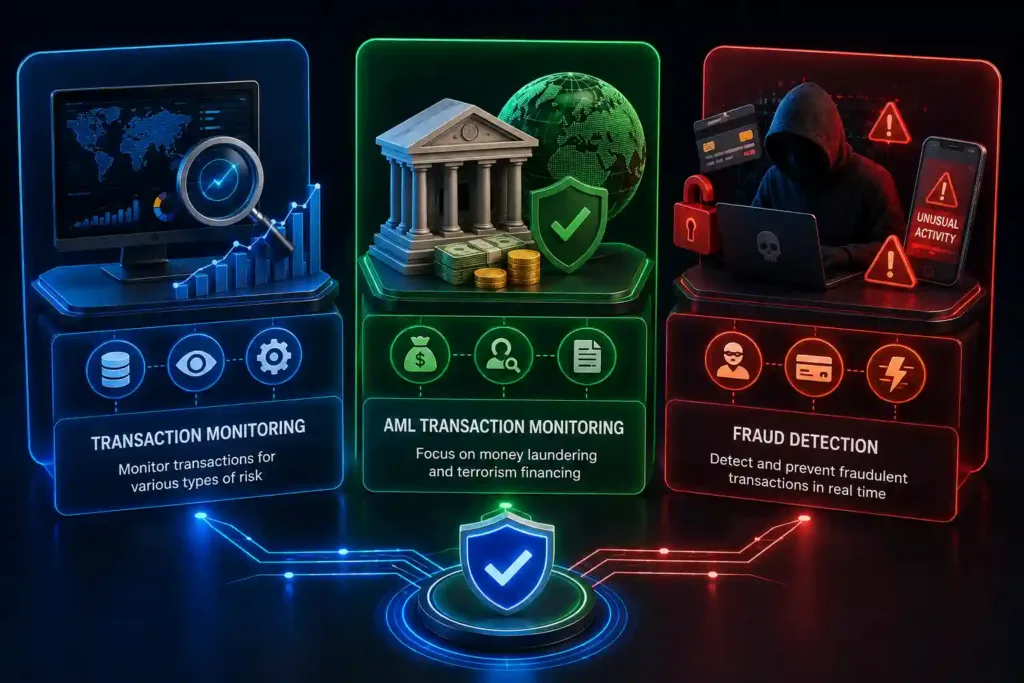
These three terms get used loosely and interchangeably, which causes real confusion. Here’s the actual distinction.
Transaction monitoring is the umbrella term. It’s the general practice of reviewing transactions for risk, regardless of what kind of risk.
AML transaction monitoring is transaction monitoring applied specifically to money laundering and terrorism financing, usually because a regulator requires it. It comes with formal obligations, like filing Suspicious Activity Reports.
Fraud detection overlaps heavily with transaction monitoring but is focused on a different threat: someone using stolen credentials, a compromised card, or account takeover to steal money directly, rather than trying to clean dirty money. Fraud detection often needs to act faster, sometimes blocking a transaction in real time, since the goal is prevention, not just reporting.
In practice, a mature institution runs all three as overlapping layers rather than picking one.
Suspicious Transaction Detection: What Actually Gets Flagged
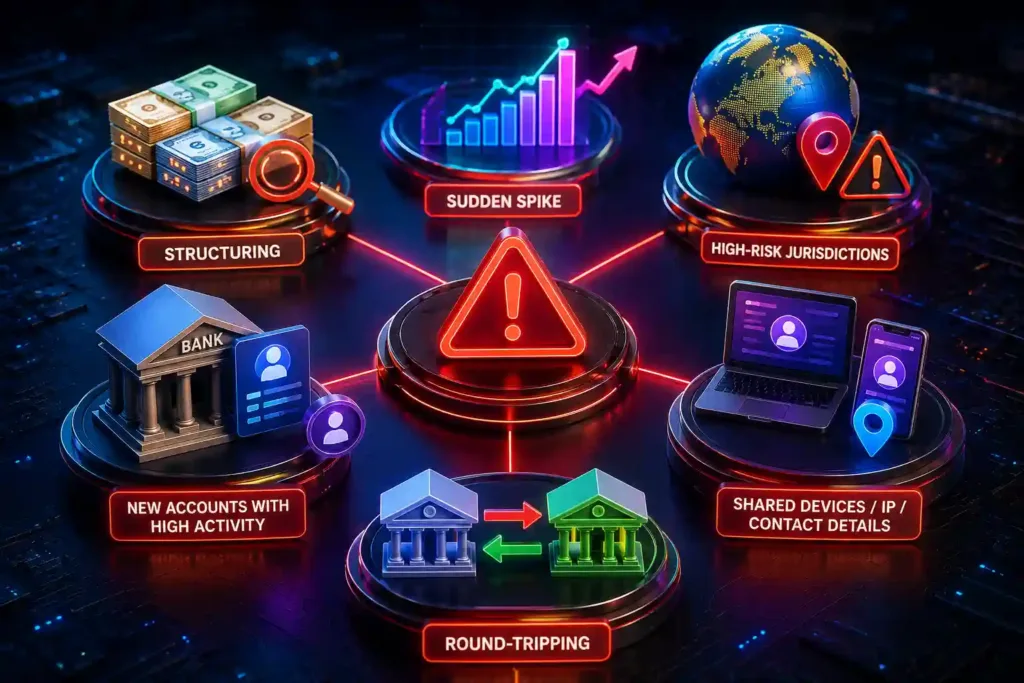
“Suspicious” doesn’t mean illegal on its own. It means the activity doesn’t match what’s expected and needs a human to make that call. Common triggers across industries include:
- Transactions structured just under reporting thresholds
- A sudden spike in transaction frequency or value with no clear reason
- Payments to or from high-risk jurisdictions
- New accounts moving unusually large sums shortly after opening
- Multiple accounts showing the same device, IP address, or contact details
- Round-tripping, where funds move out and come back through a different route
None of these automatically mean something illegal happened. That’s the point of having an analyst review the alert instead of an automatic block. Good transaction monitoring is designed to separate genuine risk from ordinary behaviour that just happens to look unusual on paper.
Who Actually Uses Transaction Monitoring
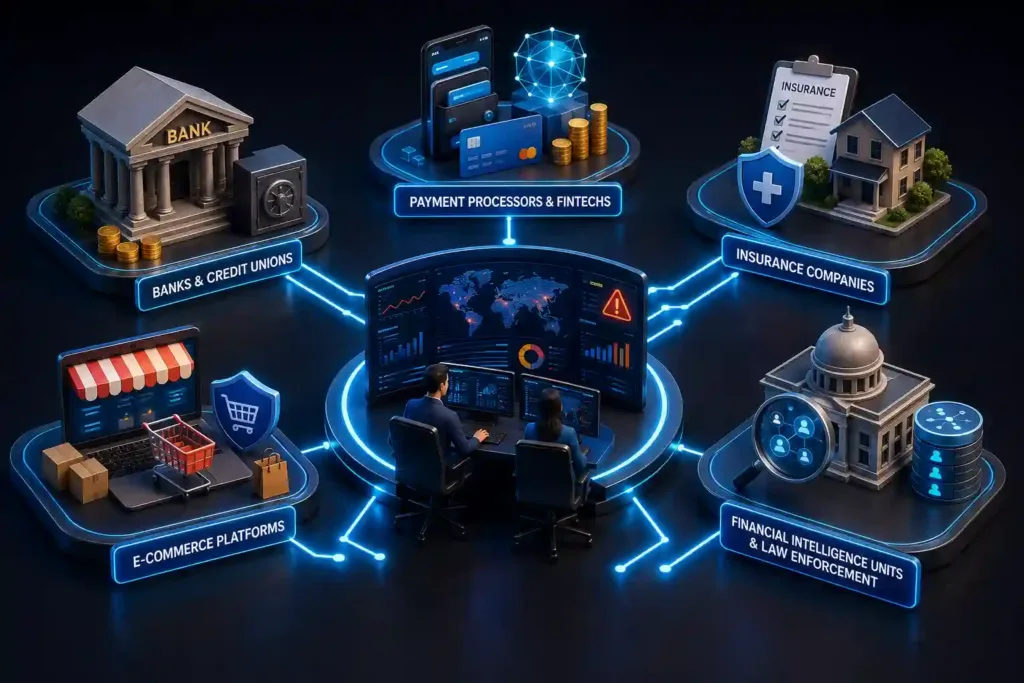
It’s not just banks. Any organization handling money at scale typically needs some form of it:
- Banks and credit unions, largely for regulatory compliance
- Payment processors and fintechs, for both fraud and compliance
- Insurance companies, to catch claims fraud
- E-commerce platforms, to manage chargeback and payment fraud risk
- Financial intelligence units and law enforcement, working with data from regulated institutions to trace illicit flows across accounts and jurisdictions
The specific triggers and regulatory obligations differ by sector, but the underlying discipline, watch the transaction, compare it to what’s expected, flag what doesn’t fit is the same everywhere.
Where This Is Headed
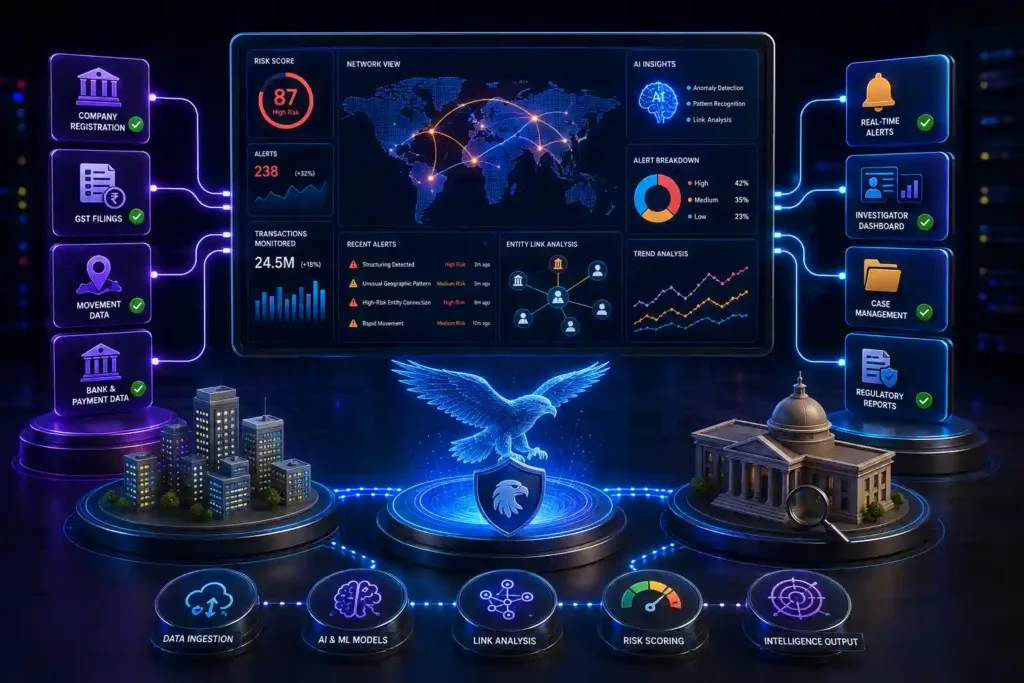
Transaction monitoring is moving away from static, rules-only systems toward models that understand context: a customer’s actual behaviour, their network of connections, and patterns that span multiple accounts rather than single transactions in isolation. This is part of why institutions are increasingly pairing rule-based engines with AI models and link analysis rather than relying on either alone.
At Innefu Labs, this is the layer our financial intelligence platform, Prophecy Eagle I, is built for. It cross-references transaction data with company registration records, GST filings, and movement data to surface patterns that a single-source system would miss entirely, then generates real-time alerts investigators can actually act on.
FAQs
1. Is transaction monitoring the same as fraud detection?
No. They overlap, but fraud detection focuses on stopping theft through stolen credentials or account takeover, often in real time, while transaction monitoring is the broader practice that also covers money laundering, sanctions risk, and other financial crime.
2. Is transaction monitoring only required for banks?
No. Banks have the strictest regulatory obligations around it, but fintechs, payment processors, insurers, and ecommerce platforms all use some form of transaction monitoring to manage their own risk, even where it isn’t legally mandated.
3. What triggers a transaction monitoring alert?
Alerts are usually triggered by a rule being broken (like a threshold), a deviation from a customer’s typical behaviour, or a connection to a high-risk entity, jurisdiction, or watchlist.
4. Does a flagged transaction mean something illegal happened?
No. A flag means the activity looked unusual enough to warrant a closer look. Most flagged transactions turn out to be legitimate once an analyst reviews them.
5. What’s the difference between transaction monitoring and AML monitoring?
AML monitoring is transaction monitoring applied specifically to money laundering and terrorism financing, with formal regulatory reporting obligations attached. Transaction monitoring is the broader practice that AML sits under.
6. How is AI changing transaction monitoring?
AI allows systems to build a behavioural baseline for each customer and flag meaningful deviations from it, rather than relying only on fixed thresholds. It also helps spot patterns across networks of accounts that rule-based systems typically miss.