
They never broke any rule, never missed a filing deadline, never failed verification, or ever triggered a system-wide alert. On paper, they were compliant. And yet, over the course of a single financial cycle, more than ₹5,700 crore in suspicious Input Tax Credit moved through a web of entities that did not appear connected to one another.
No one firm held the full exposure. No single return looked explosive. No isolated dashboard showed panic. Because this wasn’t reckless fraud. It was engineered normalcy: over 1,500 GSTINs, five detection layers, and one coordinated network, uncovered by Prophecy Eagle I, Innefu’s sovereign AI-native Financial Intelligence Fusion platform.
At first, nothing seemed extraordinary. Registrations were clean. Returns were timely. E-way bills were present. HSN codes aligned. Everything the system was designed to check existed. But compliance is built on one silent assumption: identity is real and consistent. This assumption was the first crack.
The Identity Layer
When Prophecy Eagle I applied cross-identity correlation across registration records, a pattern surfaced that no compliance check was built to catch. The same face appeared across 50+ GSTINs distributed across 18 different zones within a single month. The following month, 60+ facial overlaps spanned 20 zones.
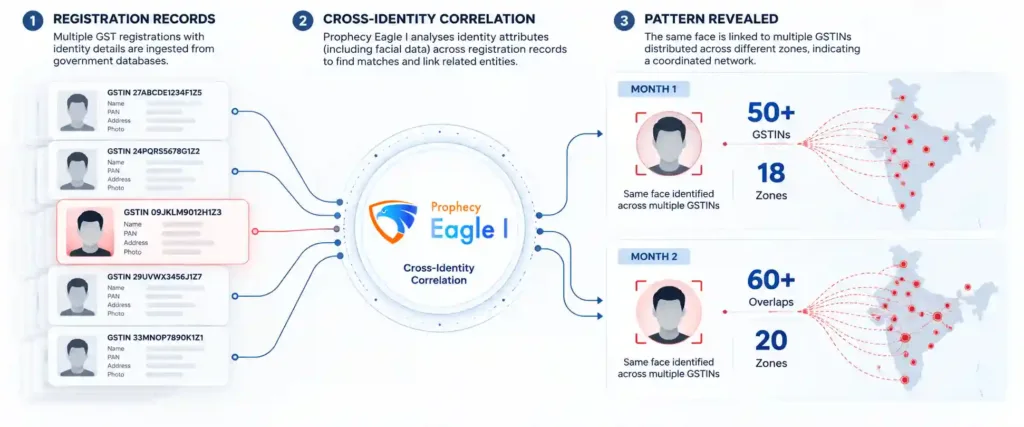
Elsewhere, a single PAN number was associated with multiple facial identities. Individually, each registration passed scrutiny. Documents were valid. Photographs were uploaded. Approvals were granted.
But when Prophecy Eagle I applied cross-zone identity correlation, isolated compliance turned into distributed manipulation. Identity wasn’t duplicated accidentally. It was scaled deliberately. And once identity can be multiplied, so can credit.
Velocity Without Substance
The next shift was speed. Newly registered entities began passing significant outward Input Tax Credit almost immediately after activation. In April, more than 100 GSTINs were identified transmitting suspicious credit. By May, ~140 entities had routed over ₹127 crore. In July, activity spiked to more than 1,300 active GSTINs, with over ₹125 crore in suspicious Input Tax Credit movement during a compressed window.
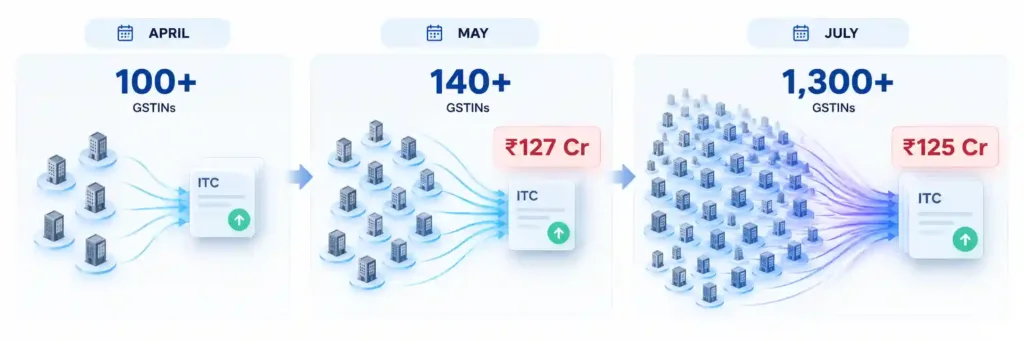
There was no commercial buildup. No corresponding inward movement proportional to outward credit. Traditional systems look for excess; Eagle I detected imbalance. By correlating registration data, GSTR-1 filings, GSTR-3B summaries, and e-way bill flows, the platform surfaced a structural anomaly: entities were passing credit without economic gravity. They were not operating businesses. They were transmission nodes, and they were coordinated.
The Slow Accumulators
Not all risk moved quickly. Some accumulated quietly. Between March and July, multiple GSTINs showed Net Input Tax Credit exceeding ₹1 crore per entity, with inward-outward utilisation ratios that diverged steadily over time. In one month alone, 92 active GSTINs carried over ₹72 crore in suspicious exposure.
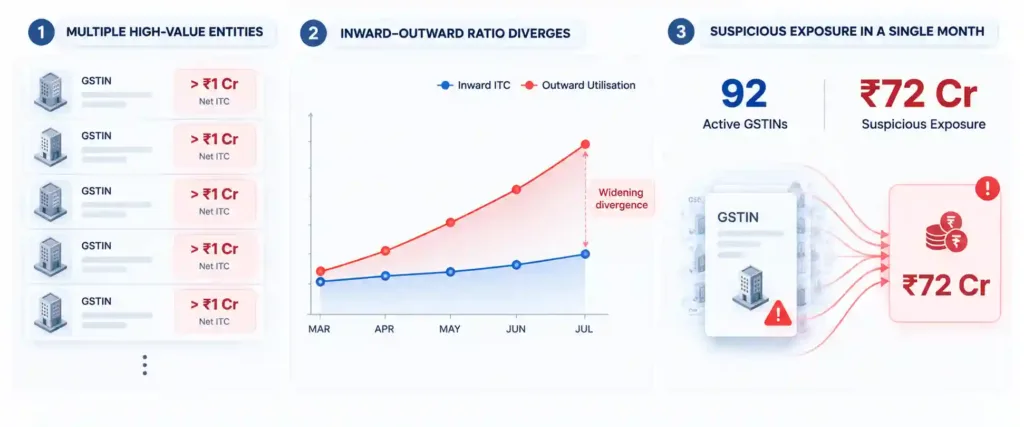
Nothing spiked dramatically. Nothing breached thresholds. Each filing passed in isolation. But Eagle I’s longitudinal behavioural modelling didn’t look for one-time violations; it looked for trajectory. Credits were building without natural utilisation patterns. The gap between declared liability and actual business activity widened month after month. Fraud wasn’t hiding in anomalies. It was hiding in consistency.
Mapping the Network
Then the picture expanded. When knowledge graph analysis was applied across the full dataset, isolated firms transformed into a structured web. Across one reporting cycle, 1,555 active GSTINs were identified, carrying ~₹5,700 crore in suspect Input Tax Credit exposure, each GSTIN with a tax impact exceeding ₹50 lakh.
Shared digital identifiers emerged. Common contact details repeated across jurisdictions. Transaction timing aligned with unnatural precision. Credits flowed outward from one cluster and reappeared downstream in another.
No single entity appeared dominant. Together, they formed a machine. Fraud had evolved from misreporting to architecture, and architecture becomes visible only when relationships are mapped, not when numbers are reviewed. Eagle I did not see ~1,500 separate firms. It saw a coordinated financial organism.
The Circular Trade Loops
Then came the loops. Commodity codes began repeating across chains: A → B → C → A. Same HSN. Same pattern. Same sequencing. In one commodity cluster alone, circular trade exposure reached ~₹3,700 crore. Additional clusters revealed exposure of ₹272 crore, ₹394 crore, ₹174 crore, and ₹78 crore, all moving through repeated HSN combinations.
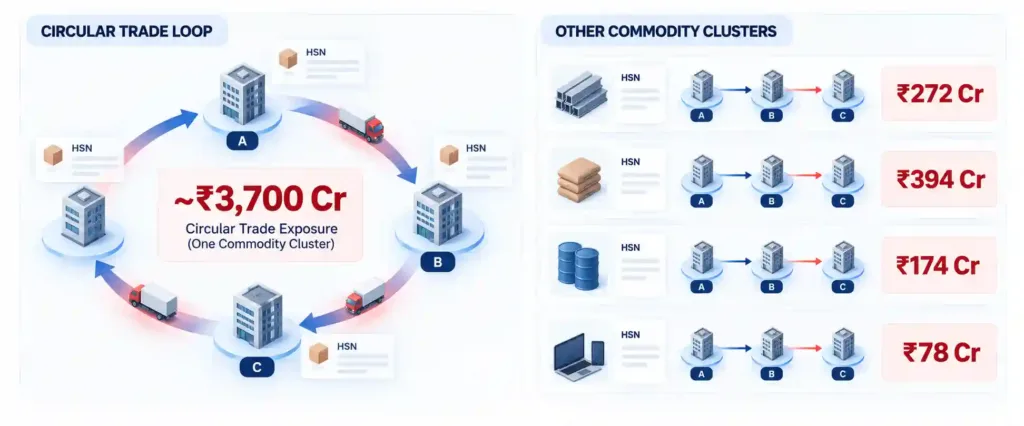
On paper, goods moved. Invoices matched. Returns reconciled. But relational mapping revealed something else: value returned to origin points, legitimised through circulation.
Circular trade does not necessarily remove money from the system. It manufactures eligibility. Traditional linear analysis sees movement. Eagle I’s graph intelligence saw recursion, and recursion revealed intent.
Beyond Tax: Market Distortion
The network extended further than tax. In a commodity case involving regulated material pricing, supply chains were traced forward to Buyer Level-4 and backward to origin nodes. Unit price deviations surfaced below expected thresholds. Composition ratios diverged from industry norms. Certain upstream entities showed “nil initiators” across multiple levels of tracing.
Over a five-month span, dozens of suspect GSTINs surfaced in a supply chain where pricing patterns and routing behaviour contradicted policy objectives. This was no longer isolated Input Tax Credit manipulation. It was economic distortion. Subsidised flows were being redirected. Market competition was being skewed. Documentation remained compliant because systems were verifying declarations. Eagle I was verifying behaviour.
Convergence
The defining moment did not come from an alert. It came from convergence, registration records, GSTR-1 and GSTR-3B data, e-way movement trails, HSN commodity mapping, facial recognition outputs, geospatial signals, and transaction timelines, fused into a unified intelligence environment.
Disconnected fragments aligned. Shared identities surfaced across states. Circular loops revealed structural repetition. Synthetic firm clusters became visible as coordinated entry points. Accumulation nodes emerged as credit reservoirs.
The “isolated cases” disappeared. What remained was a distributed system operating inside compliance thresholds. The network had always existed. It simply operated between systems.
Fraud hid between systems. Prophecy Eagle I made the connections visible.
If financial crime in your jurisdiction is growing more coordinated, more fragmented, and harder to trace through isolated dashboards, the question is no longer whether the data exists. It is whether it is allowed to connect.
See how a sovereign, AI-native Financial Intelligence Fusion Centre transforms investigation from reactive detection to structural clarity. Request a Demo today.