A crime is registered in India every five seconds. In 2023 alone, police recorded over 62 lakh cognizable offences, nearly 30% of IPC cases were still pending investigation at year-end, and the conviction rate sat at just 54%. Source: NCRB Crime in India 2023.
That gap between crimes reported and crimes solved is exactly the problem AI in policing is being built to close. Not by replacing officers. By giving a stretched, understaffed force the ability to process more data, spot more patterns, and act faster than a purely manual system ever could.
This blog breaks down what AI in policing actually means, where it is genuinely working, where it has failed, and what any DG-rank officer or procurement committee evaluating these tools in 2026 needs to know before signing off on one.
What Does “AI in Policing” Actually Mean
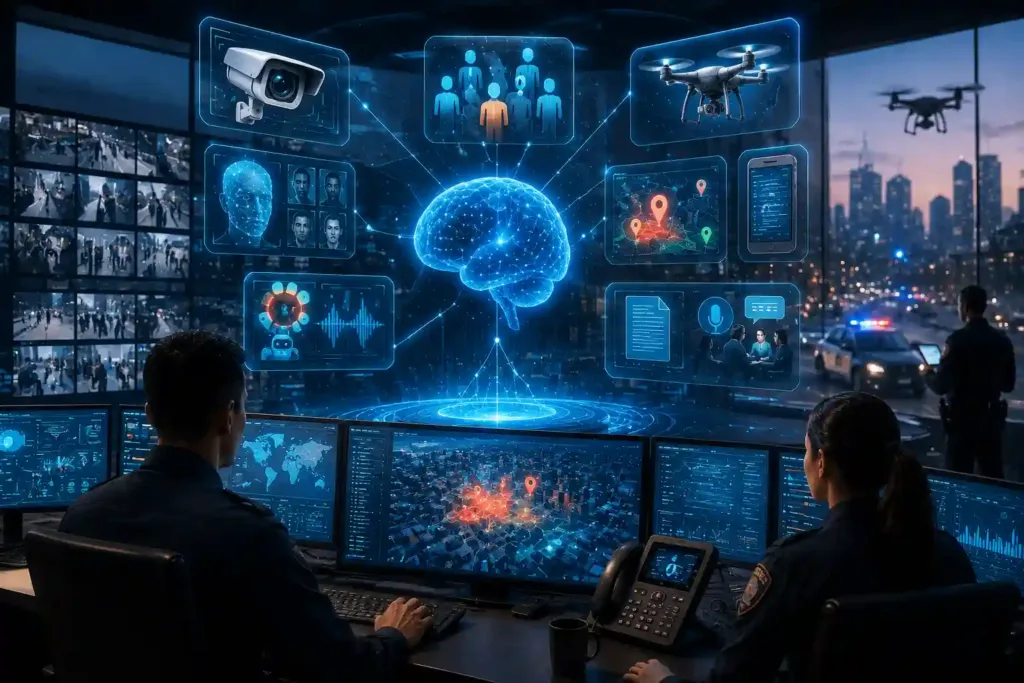
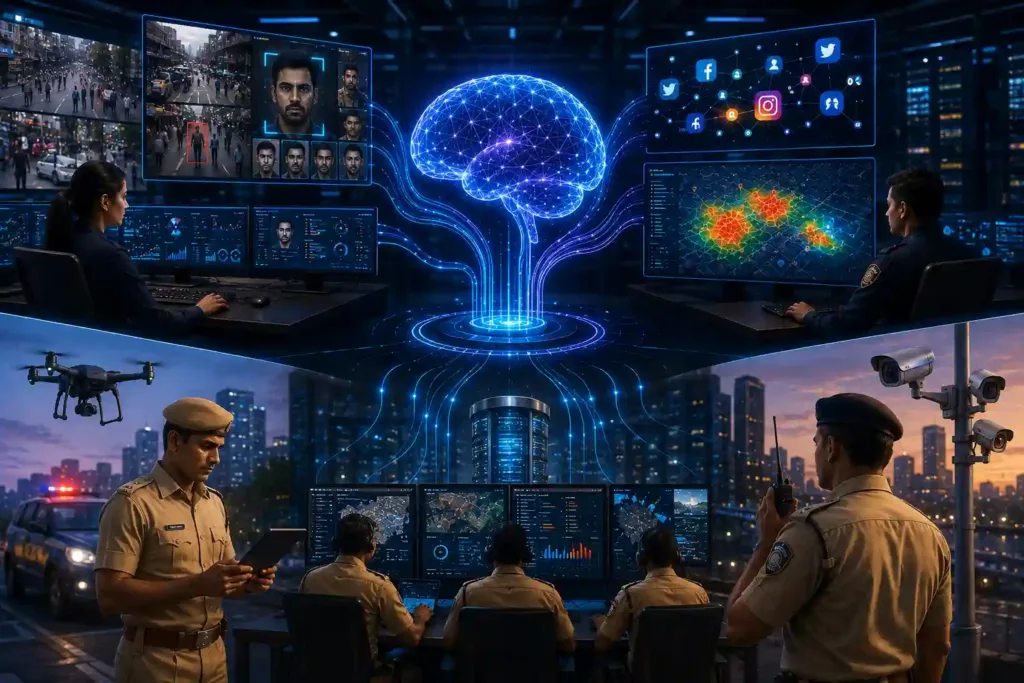
AI in policing is not one product. It is a cluster of distinct capabilities, each solving a narrow operational problem:
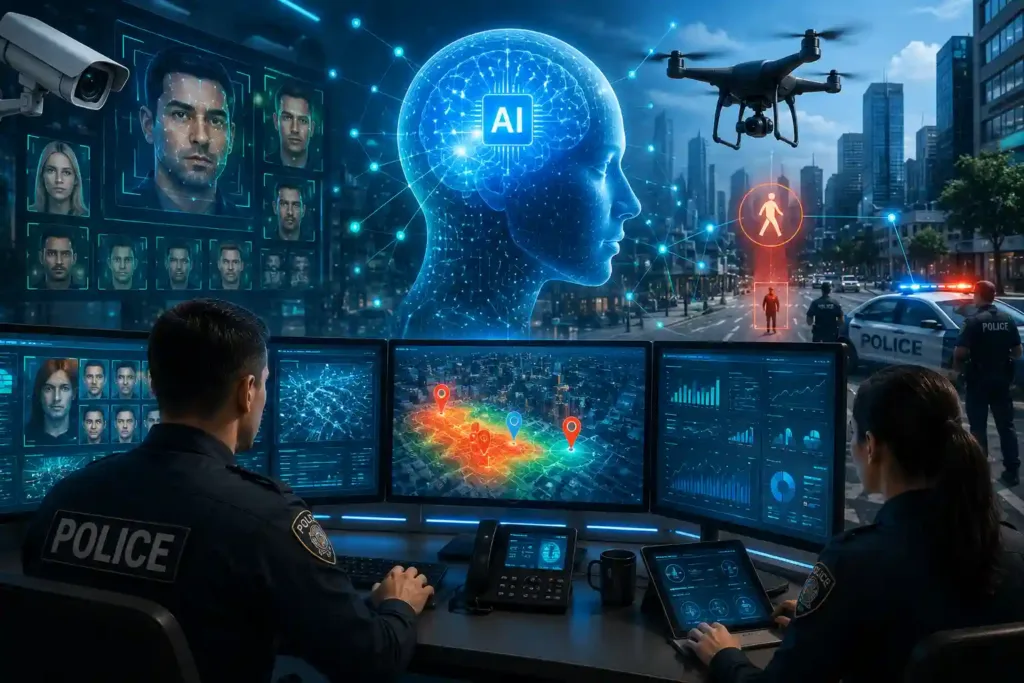
- Predictive analytics that forecast where and when crime is statistically more likely to occur, often visualised as real-time heatmaps, so patrol strength can be allocated accordingly.
- Video and facial recognition analytics that process CCTV, drone, and body-camera feeds in real time to flag suspects, weapons, or abnormal crowd behaviour, and cross-reference matches against existing records to build instant suspect profiles.
- Open-source intelligence (OSINT) tools that monitor social media, messaging platforms, and the deep and dark web for threats, propaganda, and organised criminal activity.
- Intelligence fusion platforms that pull data from disconnected police databases, forensics reports, call records, and financial data into one correlated view, increasingly query-able in plain language rather than through rigid database interfaces.
- Natural language and speech-to-text tools that convert field reports, interrogations, and evidence into structured, searchable data, including handwritten FIRs, scanned records, and regional-language documents.
- Agentic case-building tools that read and correlate evidence across FIRs, witness statements, and forensic reports to draft structured chargesheets, cross-check witness accounts for contradictions, and increasingly use a second AI agent to stress-test the case the way opposing counsel would, before it ever reaches court.
- Citizen-facing and emergency response AI, like chatbots that answer procedural questions and systems that transcribe and classify emergency helpline calls in real time, so officers spend less time on routine queries and triage.
Key Applications of AI in Policing
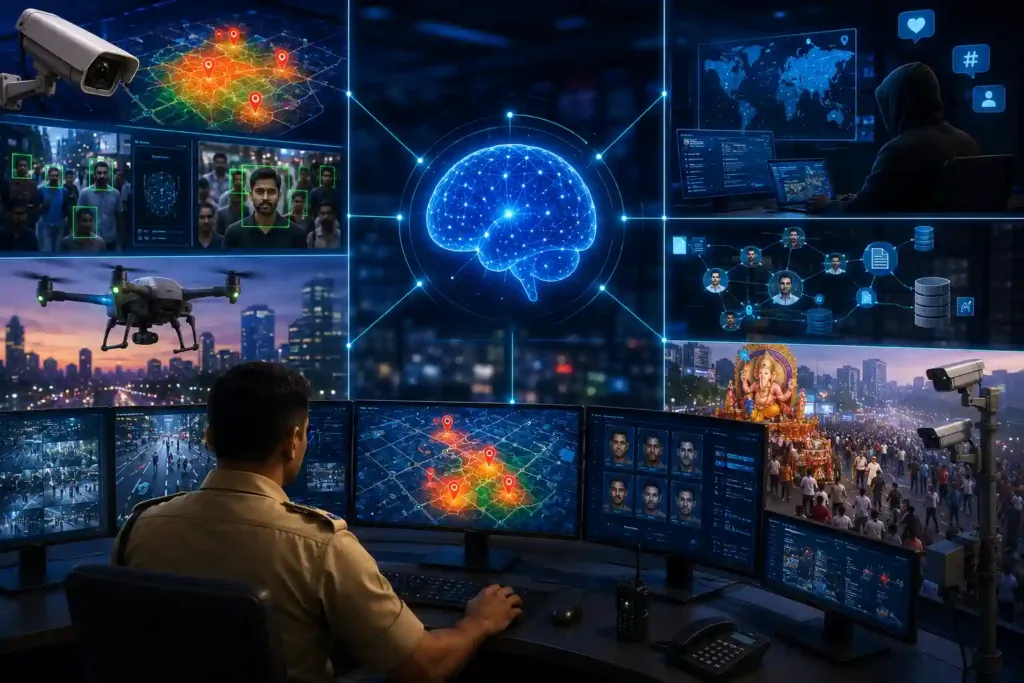
- Predictive Policing
Machine learning models analyse historical crime data, emergency call volumes, and sometimes socio-demographic data to forecast crime hotspots and optimise where patrols are deployed. This is the single most searched, most debated, and most misunderstood application in the category, so it gets its own section below.
- Facial Recognition and Video Analytics
CCTV networks, body-worn cameras, dashcams, and drones generate more footage than any human team can review manually. AI video analytics automates that review, flagging faces, weapons, abandoned objects, loitering, or unusual crowd density in real time instead of after the fact.
Accuracy in these systems is not a fixed number, it depends on face angle, lighting, distance, and occlusion. Independent testing consistently shows accuracy is not evenly distributed across capture conditions, which is exactly why field-tested, India-trained models matter more than lab benchmarks.
- Open-Source Intelligence (OSINT)
Modern unrest, radicalisation, and organised crime coordination increasingly happen on public and semi-public platforms before they happen on the street. OSINT tools monitor social media, messaging apps, and news sources to help police predict events like protests before they escalate, and trace the origin of misinformation or propaganda after an incident.
- Intelligence Fusion and Case Correlation
Most Indian police departments still work across siloed systems: CCTNS for FIRs, separate forensics databases, separate call detail records. A criminal arrested in one district often has no visible link to a similar arrest in another district six months later, even when the modus operandi matches. AI-powered fusion platforms correlate this data automatically, surfacing connections an investigator would otherwise have to find by manually cross-referencing dozens of systems.
- Crowd and Event Management
During Ganesh Chaturthi 2025, Mumbai Police used an AI-based control room with roughly 10,000 networked CCTV cameras and drones to track processions and estimate crowd size in real time, while Pune Police generated over 8 lakh alerts and flagged around 250 individuals with past criminal records during the same festival period. Source: SFLC.in, 2026.
Predictive Policing Through AI: How It Works, and Where It Breaks
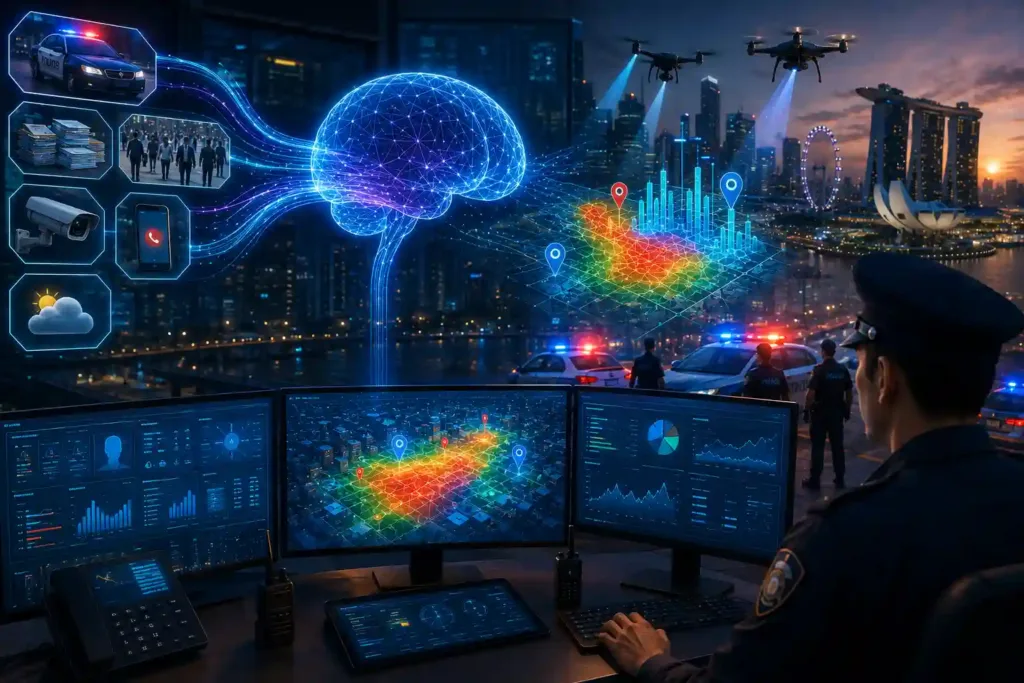
How it works: The system ingests historical crime records, emergency call data, and sometimes environmental or socio-demographic variables, then outputs a risk score for specific locations or time windows. Field commanders use that score to decide where to allocate limited patrol strength.
Where it has worked: Singapore’s police force has used AI across surveillance, crowd management, and predictive analytics as part of a broader smart-nation strategy, with reported crime reductions in specific pilot zones. Source: Deloitte, Surveillance and Predictive Policing Through AI.
Where This is Heading in India
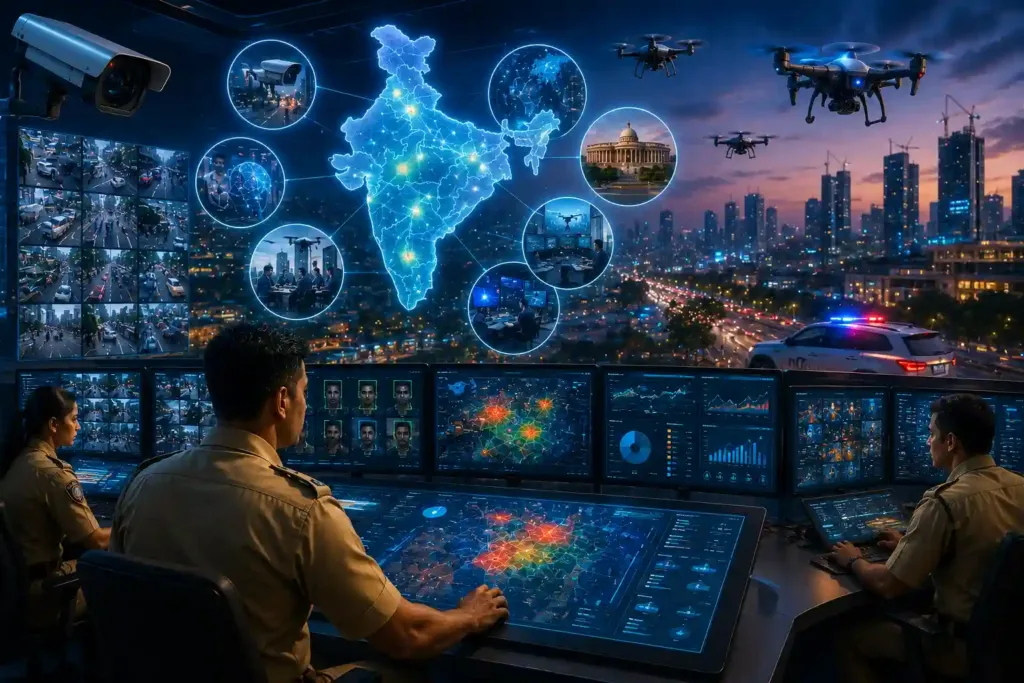
The trajectory is clear even if the pace varies by state. The Ministry of Law and Justice confirmed integration of AI in crime detection, surveillance, and criminal investigation as a policy direction in early 2025. The Safe City Project continues to expand as the umbrella programme funding much of this infrastructure, particularly for women’s and children’s safety. CISF has proposed integrating roughly 1.5 lakh CCTV cameras into a fusion centre linked with NATGRID for airport security. Hyderabad, Delhi, Mumbai, Pune, and Odisha have all expanded AI use across surveillance, crime analysis, and cyber investigation through 2025 and into 2026. Source: The Hindu
The direction of travel is toward integration, not isolated pilots. Departments that are still running facial recognition, OSINT, and case management as separate, disconnected tools are already behind agencies that have moved to a fused intelligence approach.
How Innefu Approaches This
This is a pattern we see repeatedly across the state police and central law enforcement organisations we work with: individual AI tools get piloted in isolation, generate impressive point results, and then stall because there’s no single platform correlating what each tool is finding. A state police force we’ve worked with, for example, needed facial recognition that could hold up in real field conditions, not lab demos, and needed it to plug into existing criminal databases rather than run as a standalone system.
That combination, models trained on Indian datasets and demonstrated field accuracy, running through a mobile application usable during patrols, is what actually moved the needle on ground-level verification and arrests, rather than the facial recognition capability alone.
That’s the thinking behind how we’ve built out our own portfolio: AI Vision for real-time video and facial recognition analytics trained specifically on Indian datasets, Innsight for OSINT and social media monitoring that helps departments predict and trace unrest before and after it happens, and Prophecy Alethia, our intelligence fusion and predictive policing platform that correlates CCTNS, call data, forensics, and OSINT into one operational view instead of a dozen disconnected logins.
As an NeGD-empanelled AI solutions provider to Government of India ministries, our deployments are built for on-premise, air-gapped environments where data never has to leave the department’s own infrastructure, which matters more with every new data protection rule that comes into force.