
Here’s something every experienced investigator knows, even if they don’t always say it out loud: the answer to most networked crimes is sitting inside the Call Data Records. It was there the whole time. The challenge was never the absence of information, it was the time it took to find it.
Think about what a CDR actually contains. Every call made and received. Every SMS. The towers the phone pinged. The time stamps. The duration. The IMEI number of the device that made the call, which matters enormously when someone swaps SIM cards thinking that clears their trail. A few weeks of CDR data from a suspect’s phone, combined with the CDRs of their known associates, contains more investigative intelligence than most officers can process in a month of manual review.
That is precisely the problem.
The Moment Every Investigator Recognises

You’ve requested the CDRs. They’ve arrived, finally, and they’re sitting in a spreadsheet with forty thousand rows. You have five suspects. Each of them has two or three phone numbers. Some of those numbers have changed mid-investigation. You need to know who spoke to whom, when, and from where. You need to find the common contact, the coordinator, who doesn’t show up in any witness statement but whose number keeps appearing between the key players at critical moments.
And you need this picture by tomorrow morning, because the operation window is tonight.
It’s the operational reality of almost every networked crime investigation in India. Kidnapping. Narcotics. Organised financial fraud. Terror modules. Human trafficking rings. The crime crosses districts, the evidence crosses databases, and the pressure crosses everyone’s desk simultaneously.
Manual CDR analysis in this environment doesn’t just slow things down. It introduces risk, the risk of a missed connection, a misread timestamp, a common contact buried in row 31,847 that nobody got to before the window closed.
What’s Actually Happening When a Network Operates Across CDRs

Here’s the thing about organised crime networks. They know investigators pull CDRs. So they adapt.
Burner phones get used for a few days, then discarded. Multiple SIM cards rotate across the same device, which is why IMEI tracking matters so much. The kingpin rarely calls the street-level operatives directly; there’s a buffer layer, a coordinator, whose job is to keep the command structure insulated from any single arrest. Communication clusters happen in short windows, a flurry of calls in the 30 minutes before a handoff, then silence.
All of this is visible in CDR data. None of it is visible without the right analysis.
When you’re looking at raw call records manually, you’re reading rows. What you need to be reading is a network. There’s a fundamental difference between the two, and it’s the difference between an investigation that takes weeks and one that breaks in hours.
What CDR Analysis Software Actually Does, and Why It Matters
Let’s get concrete about what a tool like Intelelinx, built by Innefu Labs specifically for investigative use, actually changes about how you work a CDR-heavy case.
You See the Network, Not the Spreadsheet
The most immediately impactful thing is the visual link analysis. Instead of reading rows of call data, you’re looking at a graph, each person a node, each call a connection, the frequency and timing of those connections visible at a glance.
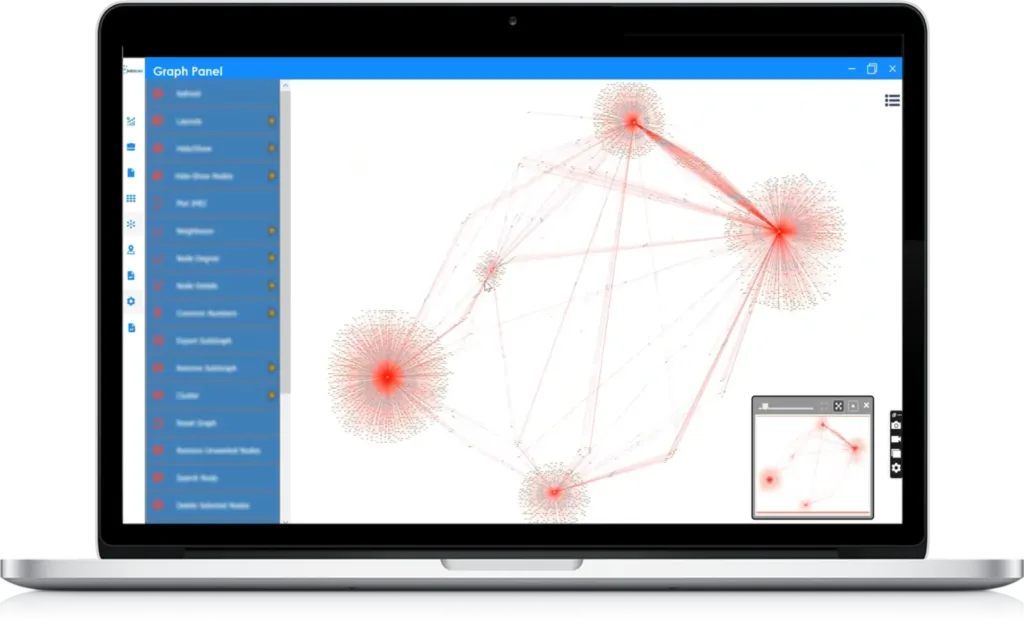
What would have required an analyst to manually cross-reference five suspects’ CDRs and draw a connection diagram on a whiteboard, a process that takes days and still produces an incomplete picture, now happens automatically. The software maps every connection across every number you’ve loaded. The coordinator who’s insulating the network leadership from street-level operations? They show up as the hub with connections running in all directions. They stand out. They didn’t stand out in a spreadsheet.
This changes the investigative tempo completely. You stop looking for a needle in a haystack. You start reading a map.
You Track Movement, Not Just Calls
Tower data in CDRs tells you where a phone was when a call was made. That sounds simple. But when you’re tracking five suspects across a three-week period, each of them generating hundreds of location data points, the picture is complex.
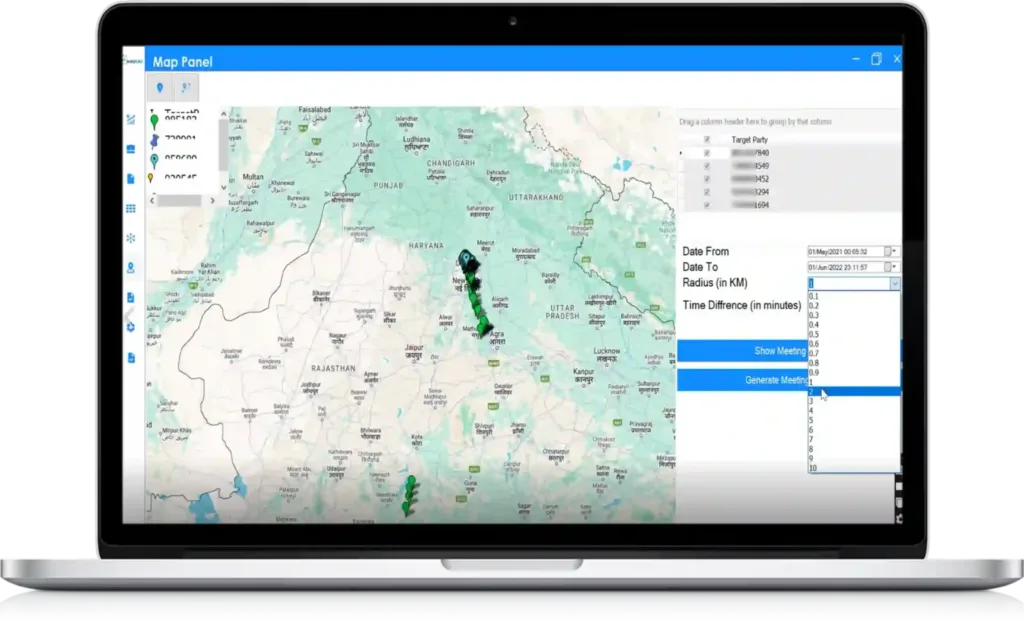
Intelelinx integrates geospatial mapping directly, plotting a suspect’s movement over time on a live map, revealing travel routes, meeting locations, and patterns of movement that tell you where they go before they do something and where they go after. The meeting that happened at a specific location at 11 PM on a Tuesday, shared by two suspects whose CDRs you’re examining, becomes visible as a common location ping at the same time. A coincidence becomes a data point. Multiple coincidences become a pattern.
This is particularly valuable in narcotics investigations and kidnapping cases where movement tracking is central to building the operational picture. You can overlay the timeline of the crime against the movement data and see, precisely, who was where at the moment that matters.
One Device, Multiple SIM Cards, No Longer a Shield
Here’s a tactic investigators encounter constantly. A suspect uses multiple SIM cards on the same physical device, cycling through them to avoid pattern detection. They think because the number changes, they’ve broken the trail.
The IMEI number doesn’t change. The device is the same. Intelelinx’s IMEI and multi-number analysis links multiple SIM cards to the same physical device, connecting communication records that would otherwise appear to belong to different unrelated individuals. What looked like five independent phone numbers turns out to be two devices. The suspect who seemed to disappear after swapping their SIM reappears clearly in the investigation.
The Common Contact Nobody Mentioned
Here’s a scenario. You have a kidnapping case. Three individuals in custody. None of them names a fourth person. But across their combined CDRs, there’s a number that appears in communications with all three of them in the 48 hours before the incident, and then goes silent. No calls after.
In a manual analysis, finding that number requires someone to look at all three CDRs simultaneously, cross-reference the contacts, and identify the overlap. It’s the kind of analysis that gets described as a breakthrough when someone has the time to do it properly. With Intelelinx, it’s a standard query result. The common contact surfaces automatically in the link analysis graph, the node that connects multiple suspects, and it surfaces in minutes rather than days.
That number becomes your lead. Sometimes it becomes your case.
Handling Multiple Devices at Investigative Scale
Real-world investigations don’t involve one suspect and one phone number. A multi-district narcotics operation might generate CDRs across forty numbers, fifteen devices, and three states. Loading, cleaning, and processing that data manually is not just slow, it’s error-prone in ways that matter in court.
Intelelinx handles multi-number, multi-device analysis as a core function, not an edge case. Investigators can load CDRs from multiple sources simultaneously, apply preset import formats that eliminate manual data preparation steps, and run analysis across the entire dataset. The platform is built for investigative scale, the kind where the volume of data would otherwise require a team of analysts working in parallel for days to produce what the software returns in hours.
Not Just Criminal Cases

It’s worth noting that CDR analysis isn’t limited to criminal investigations. The same capability applies in different contexts where communication patterns are the evidence trail.
In corporate investigations, insider threats, unauthorised data sharing, collusion between employees and external parties, CDRs and communication records reveal what internal email logs can miss. An employee coordinating with a competitor over a personal phone number doesn’t appear in the corporate email system. They appear in CDR analysis.
In fraud investigations, particularly coordinated financial fraud involving multiple mule accounts and SIM-based OTP interception, CDR analysis maps the communication network that sits behind the transaction trail. The financial fraud investigation tells you what happened. The CDR analysis tells you who coordinated it and how.
And in national security contexts, link analysis across large-scale communication datasets, identifying the connective tissue between individuals across a surveillance operation, is the kind of intelligence work that determines threat assessment timelines.
The “Half the Time” Reality

The blog title promises half the time. Let’s be honest about what that means.
The time compression in CDR-intensive investigations doesn’t come from one dramatic shortcut. It comes from removing the manual steps at each stage: data cleaning and import (hours to minutes), cross-referencing multiple suspects’ records (days to hours), building the link graph (whiteboard sessions to automated output), and identifying key patterns like common contacts and movement clusters (analyst intuition to algorithm result).
Each of those compressions is real and individually significant. Combined across a complex investigation, the difference between weeks and days, or between days and hours in a time-critical operation, is not an exaggeration. It is what investigators who have worked cases before and after deploying this kind of tool consistently describe.
The other part of the “half the time” reality is accuracy. Manual analysis under time pressure produces errors. Missed connections. Misread timestamps. Confirmation bias toward the suspects you already have in mind. Automated analysis processes the full dataset without fatigue, without skipping the 31,847th row, and without the selective attention that human pattern recognition imposes on complex data. You get a more complete picture, faster.
Frequently Asked Questions
1. What is CDR analysis and how is it used in criminal investigations?
CDR (Call Detail Record) analysis is the process of examining communication data, calls made and received, SMS records, tower location pings, and device identifiers, to establish patterns, relationships, and movements relevant to an investigation. In criminal investigations, CDR analysis is used to map communication networks between suspects, track physical movements through tower data, identify common contacts linking multiple suspects, and trace device usage across SIM card changes. CDR data is among the most reliable forms of digital evidence in networked crime investigations because it captures objective facts about communication that are difficult to alter retroactively.
2. What is the difference between manual CDR analysis and AI-powered CDR analysis tools?
Manual CDR analysis requires investigators to work through raw call record data in spreadsheet format, cross-referencing multiple suspects’ records, building connection diagrams by hand, and identifying patterns through direct inspection. This process takes days to weeks on complex cases and introduces risk of missed connections and analyst error. AI-powered CDR analysis tools like Intelelinx automate the cross-referencing, produce visual link graphs that map the network automatically, integrate geospatial data to plot movement, and surface patterns like common contacts and IMEI-linked devices as standard outputs. The analytical work that would take a team of investigators days is available in hours, with greater completeness and accuracy.
3. How does IMEI tracking work in CDR analysis investigations?
Every mobile device has a unique IMEI (International Mobile Equipment Identity) number that does not change when a SIM card is changed. CDR records include IMEI data alongside the phone number used. In CDR analysis, IMEI tracking allows investigators to link multiple SIM cards, and therefore multiple apparently different phone numbers, to the same physical device. This defeats the common operational security tactic of rotating SIM cards to break the communication trail. When a suspect cycles through multiple numbers on the same device, IMEI-based analysis connects those numbers and reveals continuity in their communication pattern regardless of the number changes.
4. How does link analysis in CDR software help find criminal networks?
Visual link analysis converts raw CDR data into a network graph where each individual or number is a node and each communication event is a connection between nodes. The graph makes structural features of the network immediately visible, who is the central coordinator, which individuals form a tight communication cluster, which numbers appear as bridges between otherwise separate groups. In networked crime investigations, the coordinator who insulates leadership from operational members shows up as a hub in the network graph despite not appearing in witness statements. Common contacts between multiple suspects, who might otherwise only become apparent after weeks of manual cross-referencing, surface within minutes of running the analysis.
5. What types of investigations benefit most from CDR analysis software?
CDR analysis software is most impactful in investigations where communication networks are central to the crime structure. These include kidnapping and ransom operations (where coordination across multiple perpetrators leaves a communication trail), organised narcotics trafficking (where distribution networks communicate around logistics and handoffs), organised financial fraud (where mule accounts and SIM-based OTP interception create traceable communication patterns), terror module investigations (where the network structure is the primary intelligence target), and corporate insider threat cases (where personal device communications bypass corporate monitoring systems).
6. Can CDR analysis software handle multi-district or multi-state investigations?
Yes. CDR data from multiple jurisdictions can be loaded into a single analysis environment, and the link analysis, geospatial mapping, and IMEI tracking functions operate across the full dataset regardless of the geographic origin of individual records. This is particularly significant for organised crime investigations where the network deliberately spans jurisdictions. The analysis does not recognise state boundaries, it analyses communication patterns, and if those patterns connect individuals across multiple states, the connection surfaces in the output as clearly as if they were in the same district.