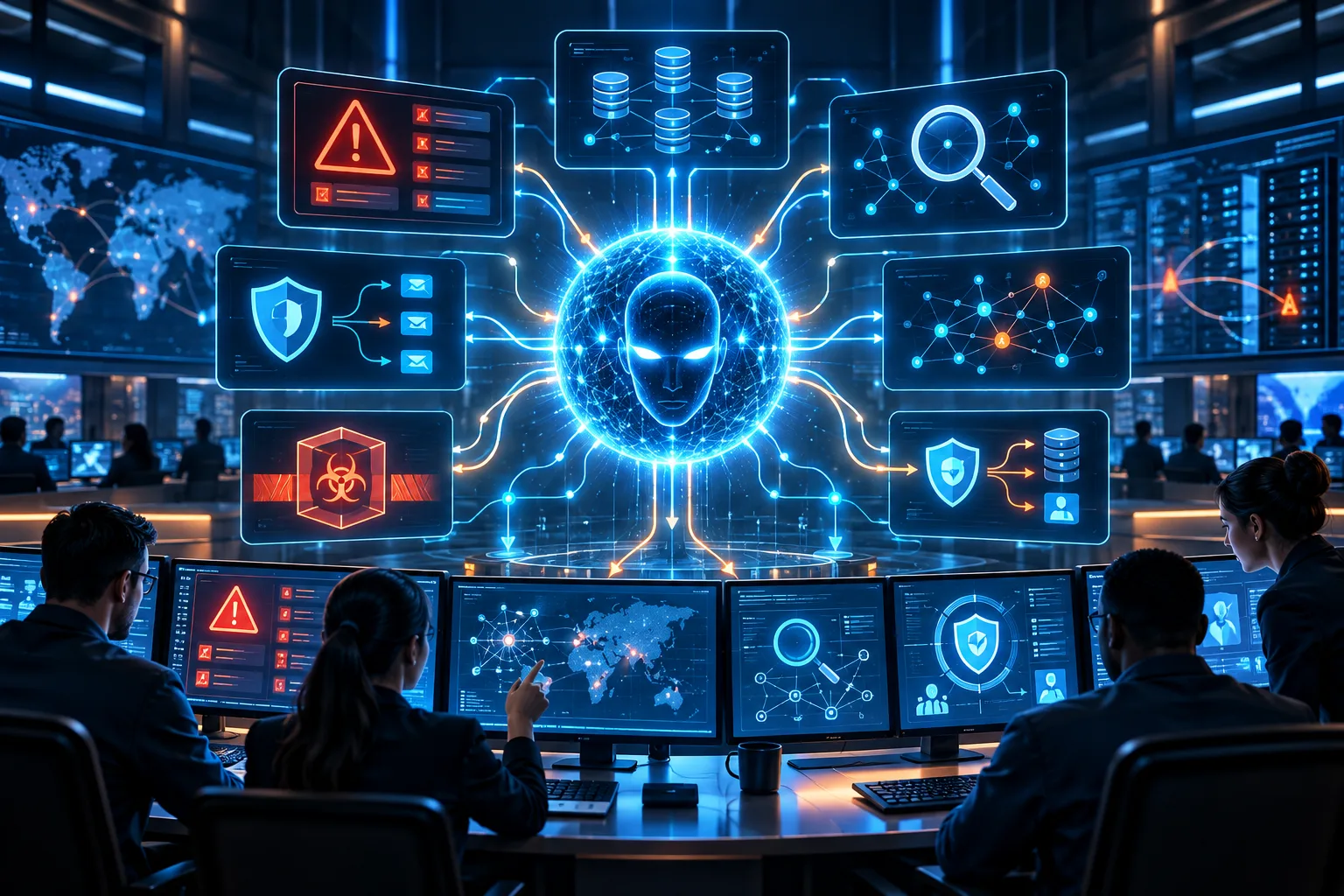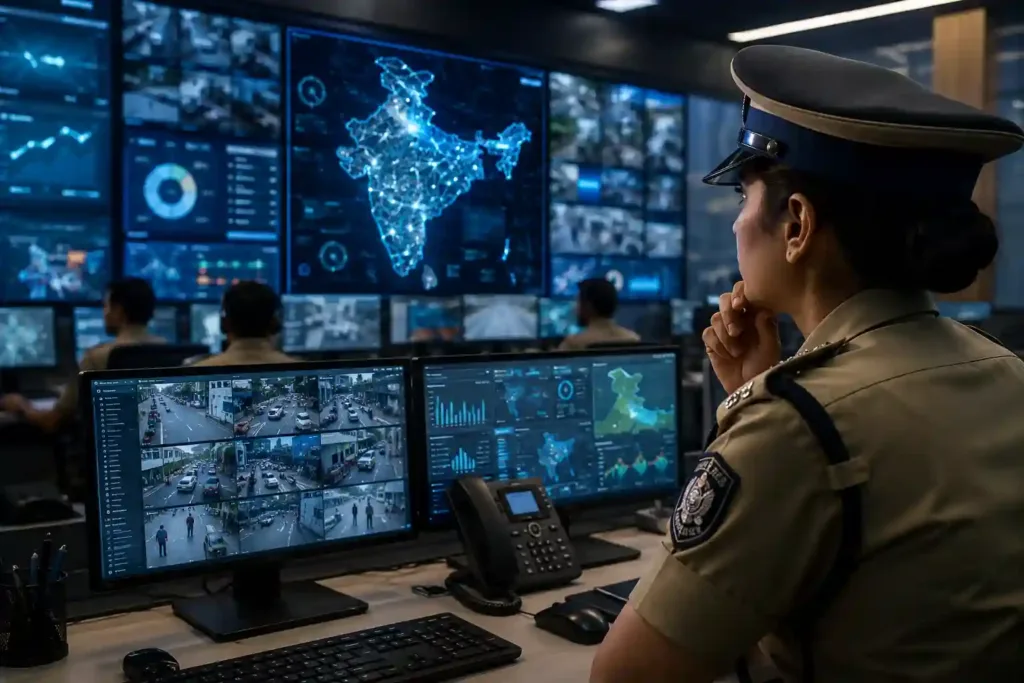
India adds roughly 2,000 new criminal cases to its police records every single day – NCRB. The force strength responding to them has not grown at anywhere near the same rate. Meanwhile, the data available to investigators, call records, CCTV footage, forensics reports, social media posts, court records, FIRs, has exploded into an unmanageable volume that no human team can process at the speed crime demands.
The result is a system under pressure. Cases pile up. Leads go cold. Force deployments are reactive. Criminals exploit the gaps between districts, between databases, and between shifts.
Predictive policing was supposed to change this. But in most implementations, it remained a concept rather than a capability, because the prerequisite wasn’t AI, it was fusion. You cannot predict what you cannot see, and most Indian police departments were looking at fragments rather than the full picture.
That is changing. AI-powered Intelligence Fusion Centres are now operational across multiple Indian states and central agencies, and the results offer a clear signal of what modern policing can look like when data works for officers instead of the other way around.
The Real Problem Isn’t a Lack of Data, It’s a Lack of Connection
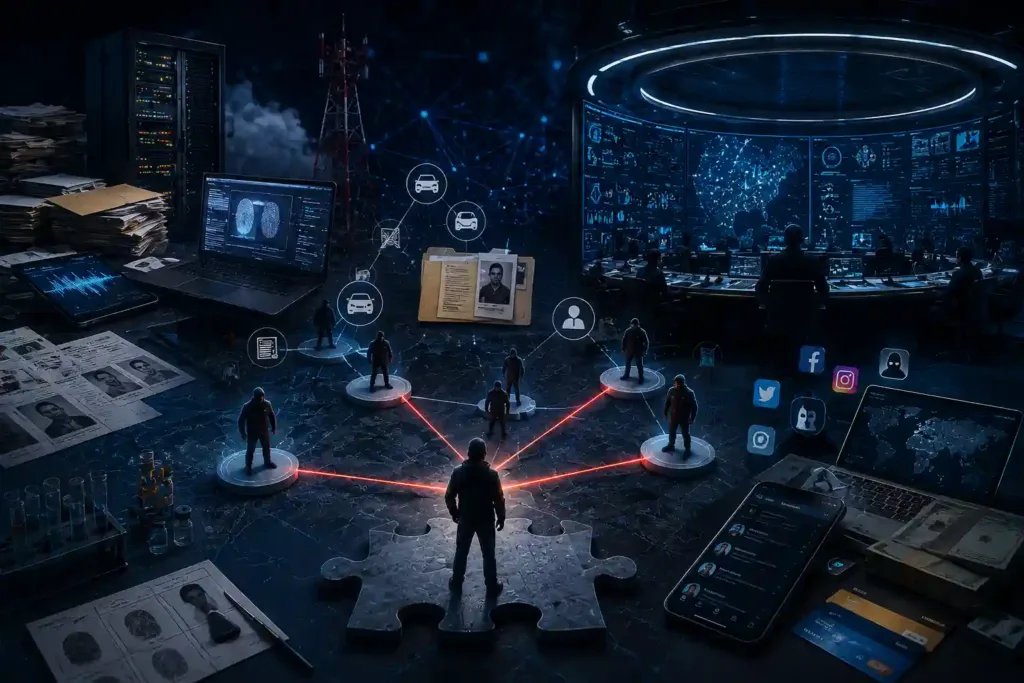
Talk to any senior officer managing a district, and you will hear a version of the same frustration: the information exists, but it is scattered.
CCTNS holds FIR records. The Dial 112 system captures emergency calls. VAAHAN has vehicle data. Forensics labs hold DNA and fingerprints. Banks have transaction trails. Telecom providers have CDR data. Open sources, social media, news, the dark web, generate continuous intelligence signals.
None of these talk to each other by default.
So when a narcotic peddler is arrested in one district, the evidence collected, mobile phone data, financial transactions, associate networks, sits in isolation. Three months later, when a related arrest happens 400 kilometres away, no one makes the connection. The middle layer of the ring walks free.
This is not a failure of individual officers. It is a structural problem. And it is one that AI-powered Intelligence Fusion Centres are purpose-built to solve.
What is an Intelligence Fusion Centre?
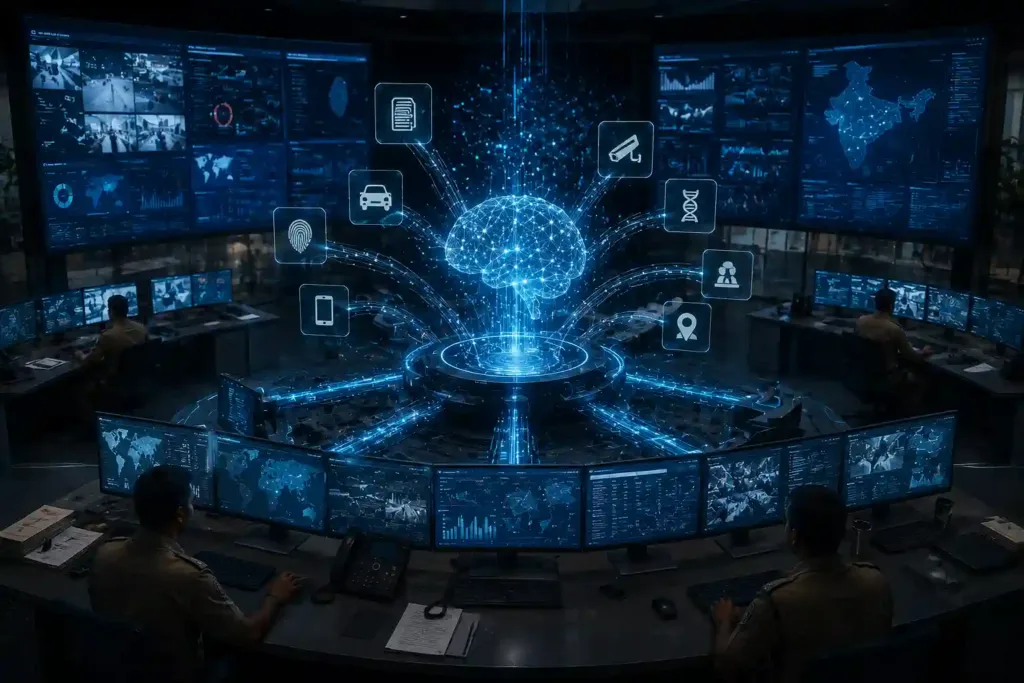
An Intelligence Fusion Centre (IFC) is a unified platform that pulls data from multiple independent sources, structured databases, unstructured documents, live feeds, and external intelligence, into a single integrated environment where AI can analyse it in real time.
The difference between a data warehouse and a fusion centre is significant. A warehouse stores data. A fusion centre works on it, continuously correlating, flagging anomalies, building entity profiles, generating alerts, and surfacing predictive signals that no manual process would catch in time.
In the policing context, a modern IFC typically integrates:
- Crime record systems (CCTNS and equivalents)
- Emergency call systems (Dial 112)
- Transport and vehicle databases (VAAHAN)
- Forensics data (DNA, fingerprints, digital device evidence)
- OSINT feeds (social media, news, dark web)
- GIS and geospatial data
- Financial intelligence (when available under legal framework)
- And more…
The AI layer then processes this combined dataset to identify crime patterns, flag high-risk individuals, predict event hotspots, and generate investigative leads, automatically, continuously, and without depending on any single officer’s memory or availability.
How AI Makes Predictive Policing Actually Work
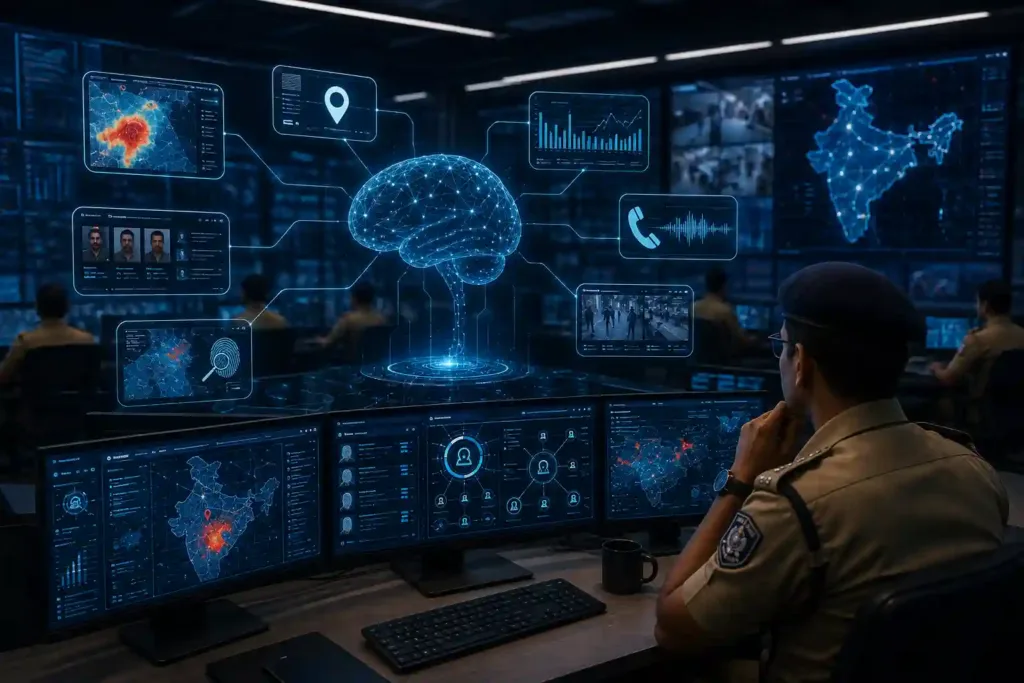
The word “predictive policing” gets misused often. Let’s be specific about what it means in practice.
Crime hotspot forecasting
AI models trained on historical crime data, emergency call density, seasonal patterns, and location profiles can identify which areas are likely to see elevated crime activity over the next 7 days. This is not guesswork, it is pattern recognition applied to large datasets. Senior officers can then deploy forces accordingly, moving from reactive deployment to proactive coverage.
Habitual criminal profiling
The system automatically tracks known offenders, where they were last seen, whether they are currently on bail, what their network of associates looks like, and whether their behaviour patterns match any recent criminal activity. A single query at the station level surfaces this in seconds.
Cross-district correlation of evidence
Forensics data, mobile device data, and financial transaction records from different districts are analysed together. Common contacts, shared locations, overlapping financial flows, these connections emerge automatically rather than depending on manual cross-referencing.
Emergency call intelligence
The system monitors whether emergency call volumes are increasing in specific areas, near temples, mosques, marketplaces, or other sensitive locations, and generates alerts before situations escalate. It tracks the conversion rate of calls to FIRs and flags anomalies.
Modus operandi matching
When a new crime occurs, the system automatically searches historical records for similar patterns of operation, same method, same area, same time window, and surfaces the most likely suspects based on known criminal profiles.
What Real Deployments Are Showing in India
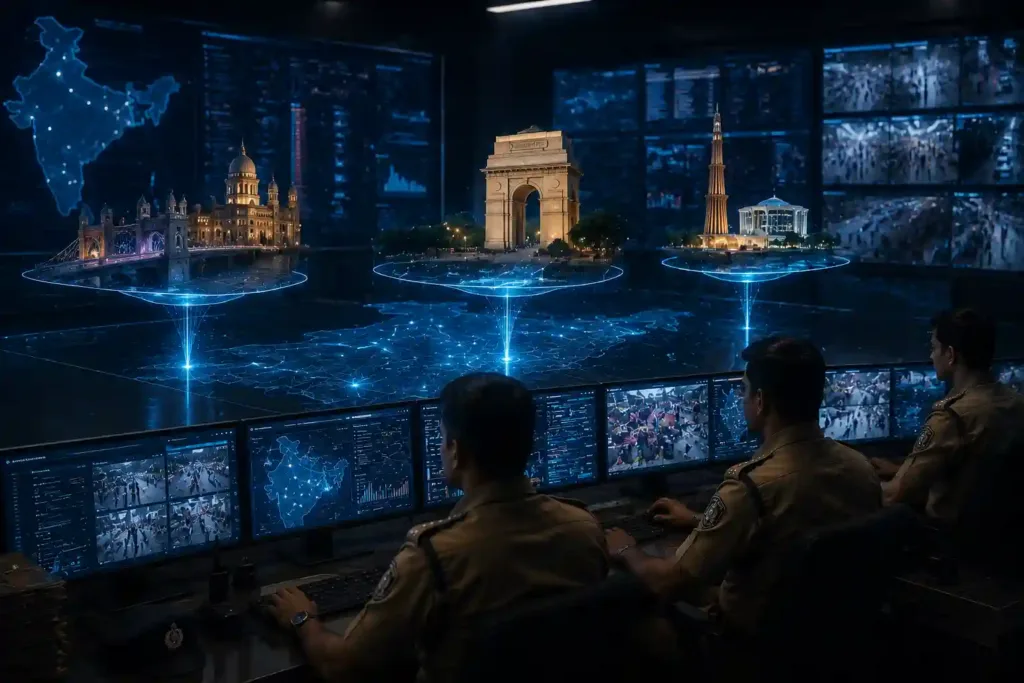
Theory matters less than evidence. Here is what Indian deployments have demonstrated.
Ahmedabad Safe City, Gujarat Police
In 2023, Gujarat Police deployed an AI-powered Intelligence Fusion Centre in Ahmedabad integrating data from eight distinct sources: CCTNS, Dial 112, VAAHAN, and forensics data alongside unstructured intelligence from incident reports.
The platform delivered active crime forecasting, identified vulnerable geographies in advance, and enabled real-time criminal profiling across the city. Officers at every level, from beat constables to senior officers, now work from a shared intelligence picture rather than isolated data.
Delhi Police, AI Vision Deployment
Delhi Police’s use of AI video analytics connected to an intelligence backbone produced one of the most-cited results in the country: 3,000 missing children identified in just 4 days. The deployment was covered by BBC and multiple national media. The same system has since been used for criminal identification at public events including Republic Day surveillance.
Chandigarh CenCops
A comprehensive intelligence fusion and predictive policing deployment for Chandigarh Police was inaugurated by the Union Home Minister, a marker of the national-level recognition this approach is receiving.
The pattern across these deployments is consistent: when data from multiple sources is fused and AI is applied to it, investigators surface leads faster, deployments become smarter, and outcomes improve measurably.
The 6 Core Capabilities That Define a Modern Intelligence Fusion Centre
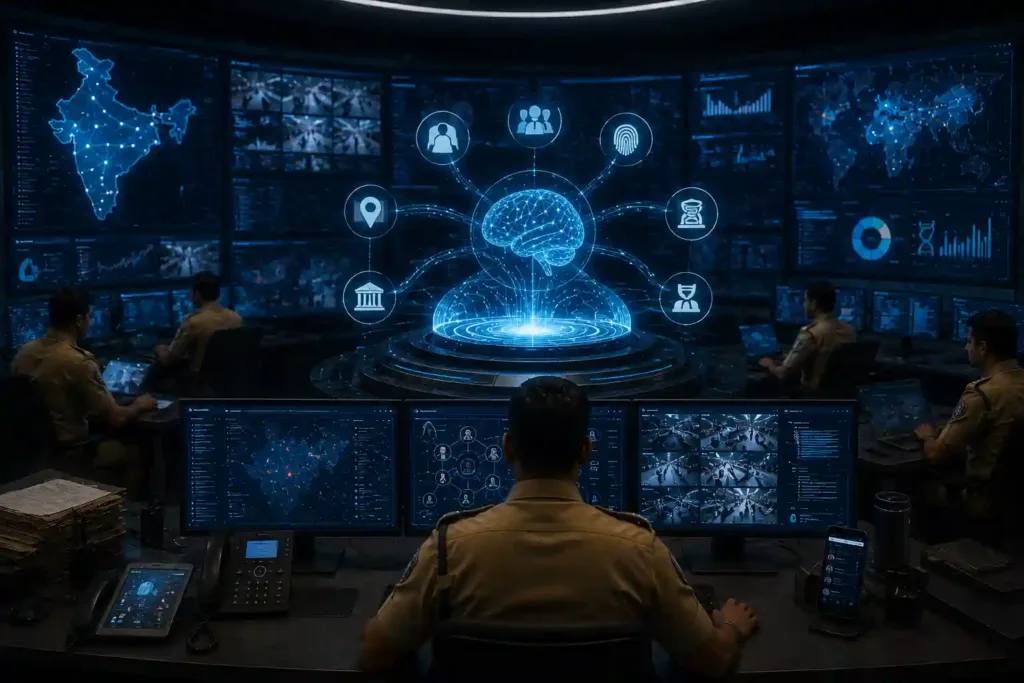
If you are evaluating an IFC for your department, these are the capabilities that separate a genuine platform from a rebranded dashboard.
1. Multi-source data integration with automatic correlation
The platform should ingest data from all relevant systems, not just the ones that are convenient, and automatically identify connections across them without manual tagging.
2. AI-powered criminal profiling at a click
An officer should be able to pull a complete 360-degree profile of any individual, criminal history, associates, locations, financial links, social media presence, in a single query. If this requires 15 steps across multiple databases, the platform has not solved the problem.
3. Predictive event modelling with GIS visualisation
Crime forecasting needs to be spatially rendered. Officers work in geography. Alerts and predictions should appear on live maps that show which areas need attention and why, with the underlying data accessible.
4. Forensics data integration under the Bhartiya Nyaya Samhita framework
The BNS now mandates forensic collection for every arrest. A modern IFC must be built to ingest, index, and correlate forensics data, not treat it as a separate workflow. DNA, fingerprints, and digital device evidence should feed the same analytical engine as CDRs and FIRs.
5. Institutional memory,search that does not depend on who remembers what
Officers rotate. Knowledge disappears with transfers. A fusion centre should function as the department’s permanent memory, every intelligence report, every case note, every historical incident searchable in seconds regardless of when it was recorded or who filed it.
6. Role-based dashboards for every level of the hierarchy
A DGP needs trend-level visibility across the state. A district SP needs granular data on their jurisdiction. A beat officer needs alerts and profiles on their phone. The platform must serve each level appropriately, not force everyone to work with the same interface.
Frequently Asked Questions
1. What is predictive policing and how does it work in India?
Predictive policing uses AI and machine learning to analyse historical crime data, emergency call patterns, geographic information, and criminal profiles to forecast where crimes are likely to occur and who is likely to be involved. In India, this involves integrating data from systems like CCTNS (Crime and Criminal Tracking Network and Systems), Dial 112 emergency records, and forensics databases into a unified intelligence platform. The AI then surfaces patterns, rising crime in specific areas, high-risk individuals on bail, repeat offenders matching new crime profiles, that officers can act on before incidents escalate.
2. What is an Intelligence Fusion Centre and how is it different from a regular police database?
A regular police database stores records. An Intelligence Fusion Centre continuously correlates data from multiple independent databases in real time, applies AI to identify hidden connections, and generates actionable intelligence automatically. The critical difference is that a fusion centre does not require manual cross-referencing, the system finds the connections. For example, evidence collected from two arrests in different districts will be automatically cross-correlated to surface shared contacts, locations, or financial links.
3. Which Indian police departments are using AI for predictive policing?
Several major deployments are now operational. Gujarat Police integrated an AI-powered Intelligence Fusion Centre in Ahmedabad covering eight data sources. Delhi Police has used AI video analytics to identify missing persons and criminals at public events. Chandigarh Police’s CenCops platform was inaugurated at the national level. The National Investigation Agency operates a National Terrorism Data Fusion Centre. Multiple state police departments and central agencies have adopted intelligence fusion capabilities in the past three years.
4. How does AI help with criminal investigations across district boundaries?
Networked crimes like drug trafficking, human trafficking, and organised theft are deliberately designed to cross jurisdictions to exploit the gaps between police units. AI-powered forensics and intelligence platforms correlate evidence across districts automatically, matching fingerprints, phone contacts, financial transactions, and behavioural patterns regardless of where each piece was collected. This turns isolated arrests into network-level investigations.
5. What does the Bhartiya Nyaya Samhita mean for AI adoption in Indian policing?
The BNS mandates forensic investigation for every arrested individual, which significantly increases the volume of forensic data being collected across India. This makes AI-powered data integration not just useful but necessary, no manual system can cross-reference the scale of forensics data the BNS framework is generating. Departments that have already deployed intelligence fusion platforms are better positioned to extract investigative value from this data.
6. How long does it take to deploy an AI-powered Intelligence Fusion Centre for a police department?
Deployment timelines depend on the number of data sources being integrated, data quality, and infrastructure. In practice, initial deployment for a state police department, integrating core systems like CCTNS and Dial 112, typically takes three to six months, with additional data sources added progressively. The platforms designed specifically for Indian law enforcement agencies handle data migration, multilingual processing, and integration with government systems as part of deployment.