Agentic AI in incident response means AI systems that can independently triage alerts, pull forensic evidence, and recommend or take containment action, rather than just flagging anomalies for a human to investigate. For Indian enterprises, this matters less as a buzzword and more as a math problem: CERT-In gives you six hours to report a qualifying incident; RBI-regulated banks now report through the DAKSH platform on the same six-hour clock, and most security teams simply don’t have the headcount to hit that window on manual process alone.
This piece looks at what agentic AI can realistically do inside an enterprise IR workflow today, where the hype gets ahead of the substance, and where Indian organisations can actually start.
Key Takeaways
- CERT-In’s six-hour reporting mandate and RBI’s DAKSH-based framework put a hard clock on Indian incident response that manual triage struggles to meet
- Agentic AI differs from a rules-based SOC alert or a chatbot copilot in that it can act across a sequence of steps (detect, investigate, correlate, recommend) with limited human prompting at each stage
- The realistic near-term use of agentic AI in Indian enterprises is narrow and task-specific: automated evidence collection and first-pass compromise analysis, not autonomous incident closure
- Gartner has named agentic AI oversight its top cybersecurity trend for 2026 and explicitly warned buyers about “agent washing”, vendors relabelling ordinary automation as agentic
- Tools like RapiDFIR show what a working version of this looks like today: an endpoint agent that can be remotely activated on alert, pull forensic data to a private cloud, and run automated compromise analysis, cutting out the wait for a forensic team to physically reach the site
- Human sign-off on containment actions remains non-negotiable for regulated Indian sectors; agentic AI should compress the investigation timeline, not replace the decision-maker
The clock Indian enterprises are actually running against

Before getting into what AI can do, it’s worth being honest about the deadline it needs to help you meet.
CERT-In’s 2022 directions require body corporates, service providers, intermediaries, and data centres to report specified categories of cyber incidents within six hours of noticing them, not six hours of finishing an investigation. The trigger is awareness, not resolution. Miss that window and Section 70B of the IT Act carries penal consequences.
Banks face a parallel obligation. RBI’s cybersecurity framework has required incident reporting within two to six hours of detection since 2016, and the framework effective in 2026 formalises reporting through the DAKSH platform on the same six-hour timeline, with detailed baseline controls across areas like access control, logging, and patch management. A bank that has never actually filed through DAKSH before an incident hits is trying to learn the platform and meet the clock at the same time.
Now put that against what it actually costs to find and understand a breach. IBM’s 2026 Cost of a Data Breach Report puts the average total cost of a breach in India at roughly INR 25.5 crore, up close to 16 percent over the previous year, with organisations that had little to no security automation taking well over 200 days on average to identify and contain an incident.
Only around a third of surveyed Indian organisations reported extensive use of AI and security automation at all. That gap, between a six-hour regulatory clock and a multi-month real-world investigation timeline, is the actual problem agentic AI is being pitched to solve.
Agentic AI versus what most SOCs already have

It’s worth separating three things that get lumped together under “AI security”.
Rules-based alerting flags a deviation from a baseline and hands it to an analyst. This has existed in SIEM tooling for over a decade and isn’t agentic in any sense.
Copilot-style AI summarises an alert, suggests a next step, or drafts a report, but a human drives every action. Useful, but still fundamentally a human-paced workflow with AI assistance bolted on.
Agentic AI is meant to chain steps together with less human prompting at each one. Given an alert, it investigates related logs, correlates it against known indicators, decides whether the alert warrants escalation, and either recommends or executes a contained response, all before a human necessarily looks at it.
Gartner named agentic AI oversight the number one cybersecurity trend for 2026, which tells you two things at once: the technology is real enough to reshape how SOCs operate, and it’s moving fast enough that governance hasn’t caught up. Gartner’s own analysts have flagged “agent washing”, vendors describing ordinary automation as an autonomous agent because the label sells, as a genuine buyer risk right now. If you’re evaluating anything pitched to you as agentic AI for incident response, that’s the first question worth asking: what decision is this system actually making without me, versus what is it just summarising for me faster?
Where this fits into an actual IR workflow
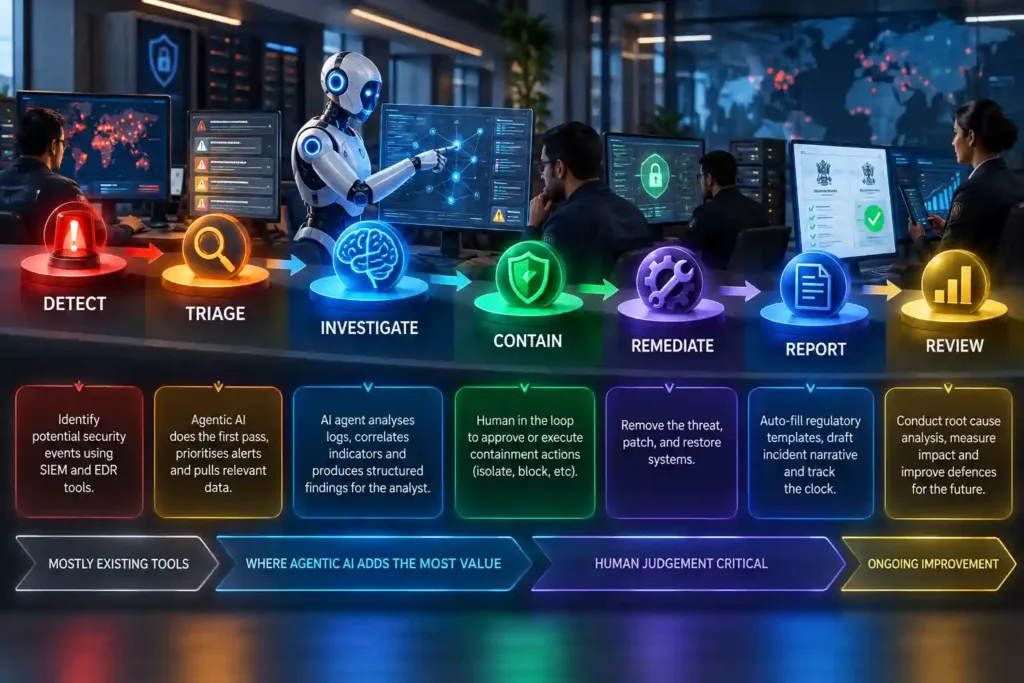
Strip away the marketing, and an incident response workflow has a fairly fixed shape: detect, triage, investigate, contain, remediate, report, and review. Agentic AI’s realistic contribution today is concentrated in the middle of that chain, not the ends.
Detection
Detection still mostly belongs to existing SIEM and EDR tooling. Agentic AI isn’t replacing your detection layer.
Triage and investigation
Triage and investigation is where the labour cost has traditionally been highest and where agentic approaches show the clearest gains. Instead of an analyst manually pulling logs, checking whether a flagged device is actually compromised, and writing up findings, an agent can do the first pass: pull the relevant data, run it against known compromise patterns, and hand a human analyst a structured finding instead of a raw alert. This is also where the CERT-In and RBI clocks are won or lost. The six hours doesn’t start when your investigation concludes, it starts when the alert fires.
Containment
Containment is where most Indian regulated entities should keep a human explicitly in the loop, at least for now. RBI’s own audit expectations around incident response call for documented root cause analysis, clear escalation paths, and evidence traceability. That’s a governance requirement as much as a technical one, and it’s exactly what Gartner’s warning about accountability is pointing at: when an AI system misranks or mishandles an incident, the accountability sits with the organisation that deployed it, not the model.
Reporting
Reporting is a narrower, more mechanical task, pre-filling regulatory templates, drafting the incident narrative, tracking the clock, that agentic AI genuinely helps with even without full autonomy elsewhere in the chain.
What this looks like in practice today

This is where the gap between the Gartner-level conversation about multi-agent SOC platforms and what an Indian enterprise can actually deploy this year gets real.
A useful, working example of automation compressing exactly the part of the workflow that costs the most time is the traditional model of digital forensics itself. When an alert fires at a branch office or a regional facility, the standard approach has been to send a trained forensic team to the site, image the affected device’s hard drive, and analyse it, often only to discover the alert was a false positive. That round trip, dispatch, travel, on-site imaging analysis is where days get lost, and it’s also expensive to run for every alert regardless of whether it turns out to be real.
RapiDFIR, Innefu’s digital forensics incident response toolkit, is built around removing that round trip specifically. An endpoint agent sits on the organisation’s own devices. When an alert comes in, an admin can remotely activate the agent on that specific device, which pulls the relevant forensic data back to a private cloud environment without anyone travelling anywhere.
FAQs
1. Is agentic AI the same as an AI-powered SIEM?
No. A SIEM with AI-assisted alerting still hands the decision to a human at every step. Agentic AI is defined by acting across multiple steps of a workflow with reduced human prompting in between, which is a meaningfully higher bar most current SIEM add-ons don’t clear.
2. Does CERT-In’s six-hour rule apply to all Indian companies?
It applies to specified categories of cyber incidents (severe intrusions, ransomware, DDoS, and similar) for body corporates, intermediaries, service providers, and data centres operating in India. The reporting clock starts from when the incident is noticed, not when the investigation is complete.
3. Can AI fully replace a forensic investigator for compliance purposes?
Not for regulated Indian sectors today. RBI’s audit expectations around root cause analysis and escalation documentation assume human accountability for the final call, even where AI has automated the data collection and first-pass analysis.
4. What’s the realistic first step for an Indian enterprise wanting to use agentic AI in IR?
Start with the highest-cost manual bottleneck in your current process; for most organisations this is evidence collection and first-pass compromise analysis, and automate that specific step before evaluating anything marketed as a full agentic SOC platform.