Manual reconciliation inside India’s GST enforcement machinery, matching return filings against e-way bills, FASTag movement records, bank data, and company registration details by hand, is not just slow. It is a major reason why detected tax evasion so often outpaces what gets recovered and why genuine fraud cases quietly go cold before anyone acts on them.
This piece looks at what that gap costs in practice, based on CAG audit findings and parliamentary data, and at how AI-based data fusion is starting to close it.
Key Takeaways
- GST has no system-based invoice matching mechanism, CAG’s 2025 audit confirms, a structural gap enabling undetected ITC mismatches.
- Audit Commissionerates ran ~33% short-staffed in FY23, with Inspector and Deputy/Assistant Commissioner vacancies up to 49% and 61%.
- Range Officers in CAG’s sampled Commissionerates had no access to GSTR-4A, so entire categories of mismatches went unchecked.
- FY21-25 GST evasion detection hit Rs 7.08 lakh crore, but FY23 internal audit recovered just 18% of the short-levy found.
- E-way bill volumes now exceed 14 crore a month, still reconciled against GST and FASTag data largely by hand.
- GSTN’s MIS automation roadmap and fusion tools like Prophecy Eagle I mark the shift from manual matching to computational correlation.
What “manual reconciliation” actually means inside a tax department

Outside the enforcement world, GST reconciliation usually means a business matching its purchase register against GSTR-2A or 2B to claim input tax credit correctly. That is a real problem, but it is not the one this piece is about.
Inside CBIC’s field formations, the reconciliation burden looks different. A Range Officer investigating a suspicious taxpayer has to manually cross-check figures across several disconnected systems: GSTR-3B against GSTR-2A for ITC mismatches, GSTR-1 against GSTR-3B for undischarged liability, e-way bill records against declared outward supplies to catch suppression, and increasingly, FASTag toll data and company registration and directorship records to establish whether the goods behind an invoice ever actually moved or whether the entity issuing it is a real business at all. Source: Taxgarden
CAG’s audit report on GST oversight, tabled in Parliament, makes an important structural point: the GST framework was built without a system that automatically matches supplier-uploaded invoices against recipient claims.
Without that mechanism, incorrect input tax credit, including credit availed through deliberate manipulation, can go undetected until someone manually pulls the relevant threads together. That manual thread-pulling is the hidden cost this piece is about.
It doesn’t show up as a line item anywhere. It shows up as cases that never get selected for audit, evidence that arrives too late, and fraud that gets detected on paper but never gets acted on before the statutory clock runs out.
The scale problem: too much data, too few hands
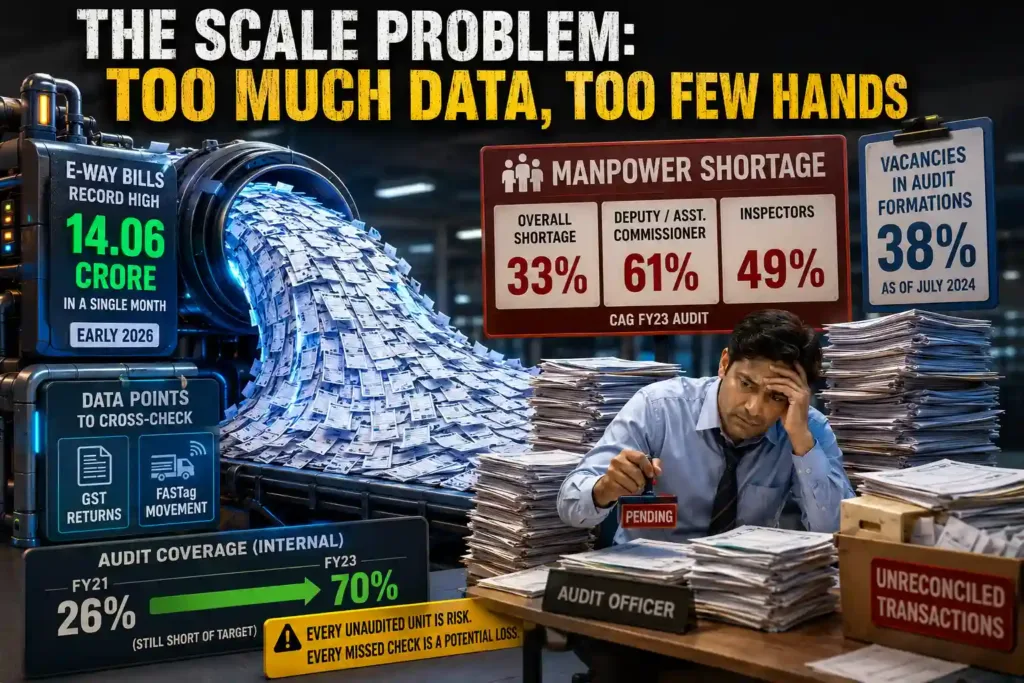
The volume flowing through India’s GST data systems has grown far faster than the workforce reconciling it.
E-way bill generation touched a record 14.06 crore in a single month in early 2026, part of a run of successive monthly highs since the September 2025 GST rate rationalisation, source: BusinessLine. Every one of those e-way bills is, in principle, a data point that should be cross-checked against the GST return it corresponds to, and against FASTag movement data to confirm the goods actually travelled.
Meanwhile, the workforce meant to do that checking has not kept pace. CAG’s FY23 audit found a 33% manpower shortage across Audit Commissionerates, with the gap rising to 61 percent at the Deputy or Assistant Commissioner rank and 49% among Inspectors, the very ranks that carry out reconciliation work. As of July 2024, 38% of positions across CBIC’s audit formations remained vacant.
The direct consequence shows up in audit coverage. In FY23, the Department managed an internal audit on 70% of planned GST units, an improvement on the 26% covered in FY21 but still short of target, source: Rediff. Every unplanned or unaudited unit is a set of transactions nobody manually reconciled that year.
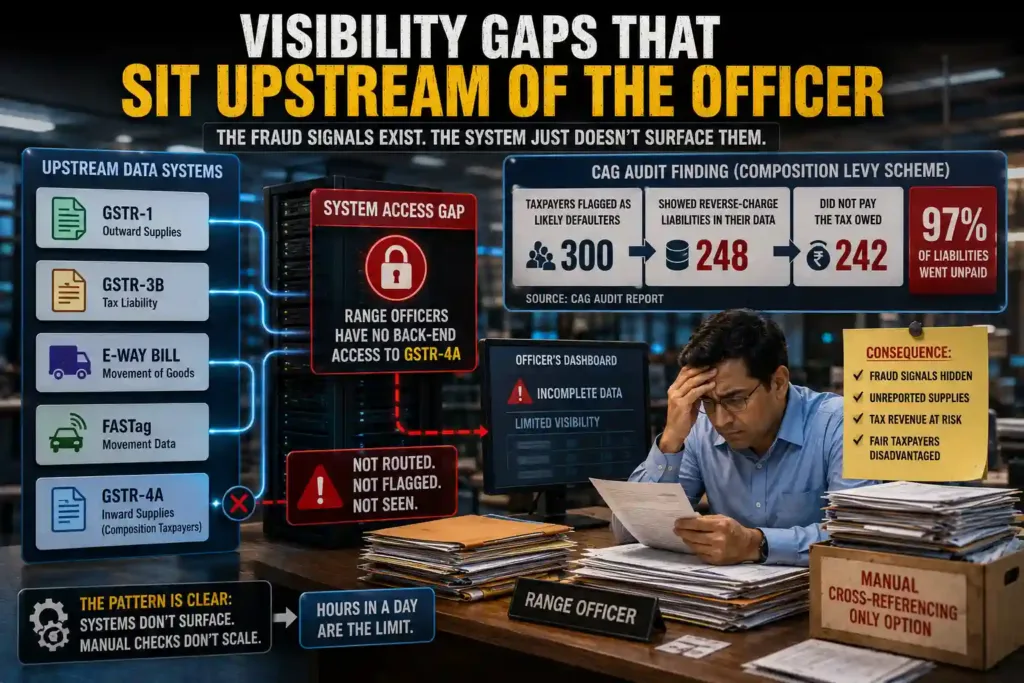
A less obvious but equally important problem is that the officers working these cases often don’t have the data in front of them to begin with, not because of anything they did, but because of how the back-end systems were built.
CAG’s audit of the Composition Levy Scheme found that Range Officers in all ten sampled Commissionerates had no back-end access to GSTR-4A, the return that would let them spot reverse-charge tax mismatches and unreported inward supplies. The scale of what that gap can hide is significant: of 300 taxpayers flagged as likely defaulters, 248 showed reverse-charge liabilities in their data, and 242 of those, or 97%, had simply not paid the tax owed. Source: CAG Audit Report. These weren’t cases officers overlooked. They were cases the system never routed to the right desk. CAG’s audit traced the gap directly to system access, not to any lapse on the officers’ part.
This is the pattern that recurs across CAG’s findings on GST oversight: the fraud signals exist in the data, but the systems officers work with weren’t built to surface those signals automatically, which leaves manual, ad hoc cross-referencing as the only way to catch them, and manual cross-referencing scales only as far as the hours in a day allow.
The cost shows up as detection without recovery

The clearest evidence of what this gap costs sits in the difference between what gets detected and what actually gets recovered.
Over five financial years (FY21 to FY25), CGST field officers detected roughly Rs 7.08 lakh crore in GST evasion across 91,370 cases, including close to Rs 1.79 lakh crore in fake ITC fraud spanning nearly 45,000 cases. Source: The Hindu. Voluntary recovery over the same period stood at just over Rs 1.29 lakh crore, a fraction of what was detected.
None of this reflects officers failing to find fraud. Fake ITC detections have risen sharply, from Rs 24,140 crore in FY23 to Rs 36,374 crore in FY24, and roughly Rs 58,772 crore in FY25 across 15,283 cases. Source: ETCFO. The detection engine is working.
What breaks down is everything that has to happen after detection: pulling together financial statements, ledgers, e-way bills, FASTag records, and ownership data fast enough and completely enough to make a case stick before it becomes time-barred, a risk CAG itself flagged when urging the Department to pursue over 2,300 pending inconsistencies before the statutory window closes.
How AI-based data fusion changes the equation
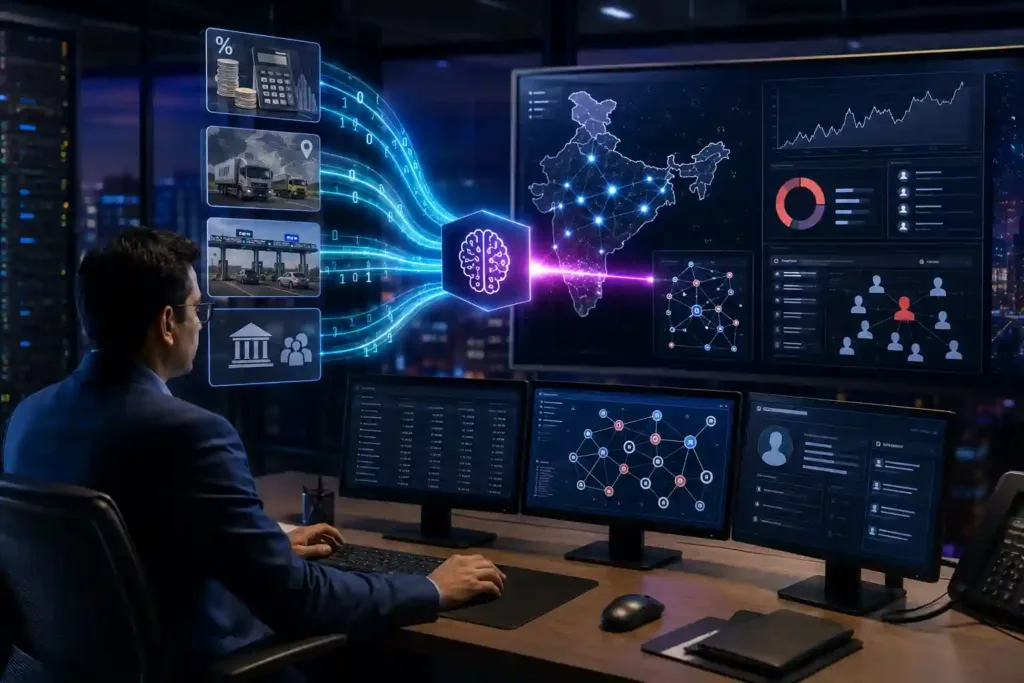
This is the specific problem that financial fusion platforms are built to address: taking data that currently lives in separate systems, GST transaction records, e-way bills, FASTag movement logs, and company registration and directorship databases, and correlating it computationally instead of leaving that correlation to whichever officer has the time and access to attempt it by hand.
Innefu’s Prophecy Eagle I, for instance, is built specifically for this kind of financial fusion work. It cross-references GST transaction data against e-way bill and FASTag records to check whether the goods behind an invoice genuinely moved, a check that matters directly for catching carousel fraud and fake invoicing, the same categories parliamentary data shows dominating fake ITC cases.
It also tracks company registration and directorship data to flag when one individual is linked to an unusual number of companies or PAN cards, a common signature of the shell entities increasingly behind organised ITC fraud.
Where today an investigator might spend days manually pulling GST filings, e-way bill logs, and company registration records into one view before a raid or an assessment, a fusion approach can surface the inconsistency first and let the officer spend their time on investigation and evidence-building instead of data assembly.
Learn more about AI-Powered Financial Intelligence Fusion Centre – Prophecy Eagle I
FAQ
1. What is manual reconciliation in the context of GST enforcement?
It refers to tax officers cross-checking data across separate, disconnected systems, such as GSTR-3B, GSTR-2A, e-way bills, FASTag records, and company registration databases, by hand, in the absence of a built-in system that automatically matches these sources against each other.
2. Why doesn’t GST have an automated invoice matching system already?
CAG’s audit report identifies this as an acknowledged structural gap in the GST framework, one the auditors say increases the risk of ITC mismatches and errors going undetected without a robust reconciliation mechanism.
3. How much GST evasion goes undetected because of manual reconciliation limits?
There’s no verified figure for evasion that goes entirely undetected, since by definition it doesn’t appear in official data. What is measurable is the recovery gap on evasion that is detected: CAG found FY23 internal audit recovery at only 18 percent of the short levy identified, and cases worth tens of thousands of crores stalled because records weren’t produced in time.
4. Is AI reconciliation the same as automated GST return filing software?
No. Consumer and business-side GST software, matching a company’s purchase register against GSTR-2A/2B, addresses a compliance problem for taxpayers. The reconciliation challenge covered here sits on the enforcement side: tax officers correlating GST, e-way bill, FASTag, and ownership data to detect and investigate fraud, which is a distinct data and workflow problem.
5. Does automating reconciliation replace tax officers?
No. It changes where officer time goes. Instead of manually assembling data from multiple systems before a case can even be evaluated, officers can spend that time on investigation, evidence verification, and the statutory processes that still require human judgment and authority.