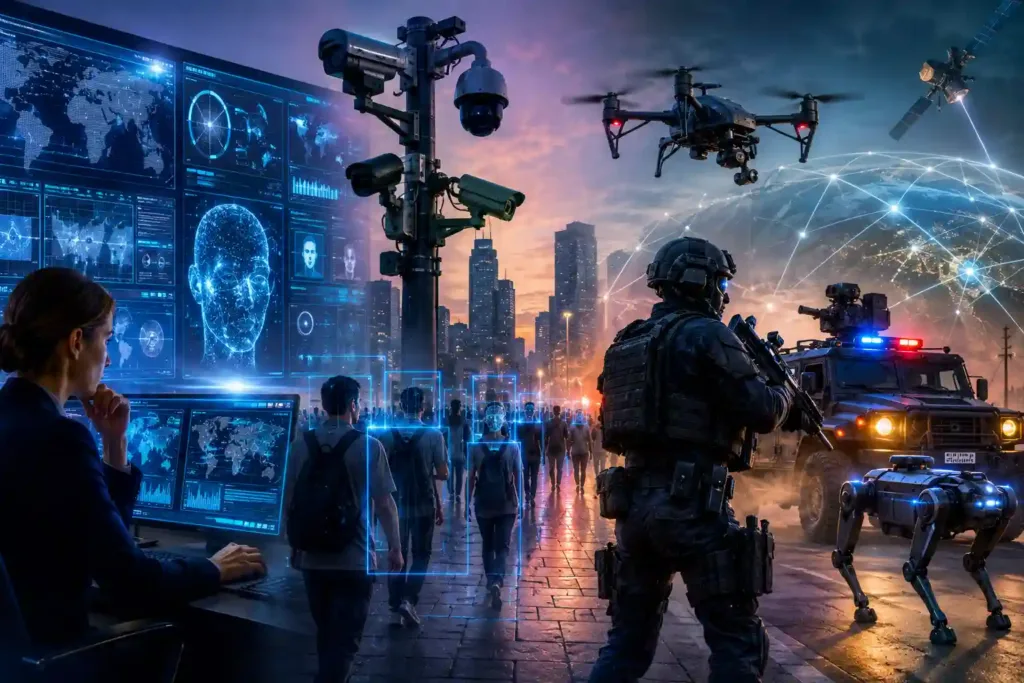
The story of AI in national security and law enforcement is, at its core, a story of compounding capability.
Each generation of AI technology has built on the foundation laid by the one before it. Each has delivered meaningful, documented operational outcomes, not as a stepping stone to something better, but as a genuine leap forward in its own right. And each has opened a door to the next set of possibilities that simply did not exist until that foundation was in place.
India’s national security and law enforcement agencies have been at the forefront of this evolution. The deployments of the past decade, intelligence fusion platforms, predictive policing systems, CDR analysis tools, and sovereign large language models have not just improved operations. They have redefined what is operationally possible and set the standard for how AI is adopted in high-stakes, data-sensitive environments.
That foundation is now making the next leap possible: agentic AI. Understanding what agentic AI is and why it is the natural evolution of everything that came before it is the purpose of this piece.
Generation One: AI That Sees What Humans Cannot

The first generation of AI in national security and law enforcement solved a problem that was structural and urgent: the volume of data available to investigators and analysts had grown beyond what any human team could process at the speed operations required.
CDR data from a single investigation ran to hundreds of thousands of rows. CCTV footage from a single location generated terabytes of video that no manual review team could watch in time to act. Intelligence reports, FIRs, forensics results, and open-source intelligence flowed in faster than any analyst could synthesise.
The first generation of AI addressed this directly. Machine learning models trained on historical crime data identified patterns that human analysts had not seen. Intelligence fusion platforms integrated data from multiple disconnected systems, CCTNS, Dial 112, VAAHAN, forensics databases and surfaced connections that would never have emerged from manual cross-referencing. CDR analysis tools converted weeks of spreadsheet work into network graphs produced in minutes. Video analytics platforms scanned thousands of camera feeds simultaneously, doing in seconds what a team of officers would need days to accomplish.
Generation Two: AI That Understands What Humans Ask

The first generation of AI was extraordinarily powerful at finding patterns in structured data. What it could not do was engage with the full complexity of how intelligence actually exists in the real world, in documents, in language, in context, in the institutional memory accumulated across years of operations.
The second generation addressed this. Large language models, trained on vast quantities of text and capable of understanding and generating language with genuine contextual sophistication, brought a new class of capability to the intelligence and national security context: the ability to work with knowledge the way analysts work with knowledge.
A sovereign LLM deployed within a classified environment can read a 600-page intelligence dossier and produce a structured summary in seconds. It can answer questions about the contents of an entire archive of historical reports, “What intelligence have we gathered on this network over the past three years?”, in plain language, without requiring the analyst to know which specific file to look in. It can translate documents from dozens of languages simultaneously, making foreign-language intelligence immediately accessible. It can search across the full institutional knowledge base of an organisation, surfacing connections and historical context that no individual officer could hold in their head.
Crucially, this capability can be delivered entirely within a secure, offline, air-gapped environment, with no data ever leaving the organisation’s perimeter, no connectivity to external servers, and no exposure to foreign legal jurisdiction. This was the specific challenge that sovereign LLMs solved for national security and intelligence applications: bringing the analytical power of modern AI to environments where that power previously seemed incompatible with the data sensitivity requirements.
The result was a second transformation. The experienced analyst who previously spent the majority of their time reading, translating, and manually cross-referencing could now spend that time on the judgement, contextualisation, and decision-making that only a human can do well. The AI handled the volume. The analyst handled the meaning.
Two generations of AI capability, each delivering real and documented operational value. Each building on the infrastructure, the data, and the institutional trust established by what came before.
Generation Three: AI That Acts on What It Knows

Every organisation that has deployed first- or second-generation AI in national security, law enforcement, or intelligence operations has experienced a version of the same next-level insight: the AI knows a great deal, finds connections that matter, and surfaces intelligence that is actionable, and then it waits.
It waits for the next query. It waits for the analyst to formulate the next question. It waits for the investigator to initiate the next step. It waits for someone to notice that the finding from query three, combined with the finding from query seven, means the investigation needs to go in a new direction.
This is not a criticism. This is simply an accurate description of the architecture, and it is the precise limitation that the third generation of AI is designed to transcend.
Agentic AI is AI that does not wait. It pursues objectives.
An agentic AI system is given a goal, not a query, not a prompt, but an objective, and it works toward that goal autonomously. It plans the sequence of steps required. It executes those steps, using whatever data sources and tools it has access to. It evaluates intermediate results and adapts its approach when the findings change the picture. It continues until the objective is achieved or a threshold for human review is reached. And at every stage, it maintains a complete, auditable record of what it did and why.
The shift from generation two to generation three is the shift from AI that helps humans investigate to AI that conducts investigations under human oversight.
This is Agentic AI. And it is what Innefu Labs’ Sarvagata AI platform delivers.
What Agentic AI Actually Does, Specifically, Not Abstractly

The most useful way to understand what agentic AI means in practice is through the operational scenarios it addresses directly.
Building a Court-Ready Chargesheet Autonomously
Consider what it currently takes to build a legally accurate, court-ready chargesheet. Evidence from FIRs must be correlated against witness statements. Call records must be integrated with forensics findings. The applicable sections of the relevant law must be correctly identified and applied. The entire document must be structured in the format required for legal proceedings.
This is painstaking, expert, time-consuming work, and errors matter in ways that directly affect case outcomes.
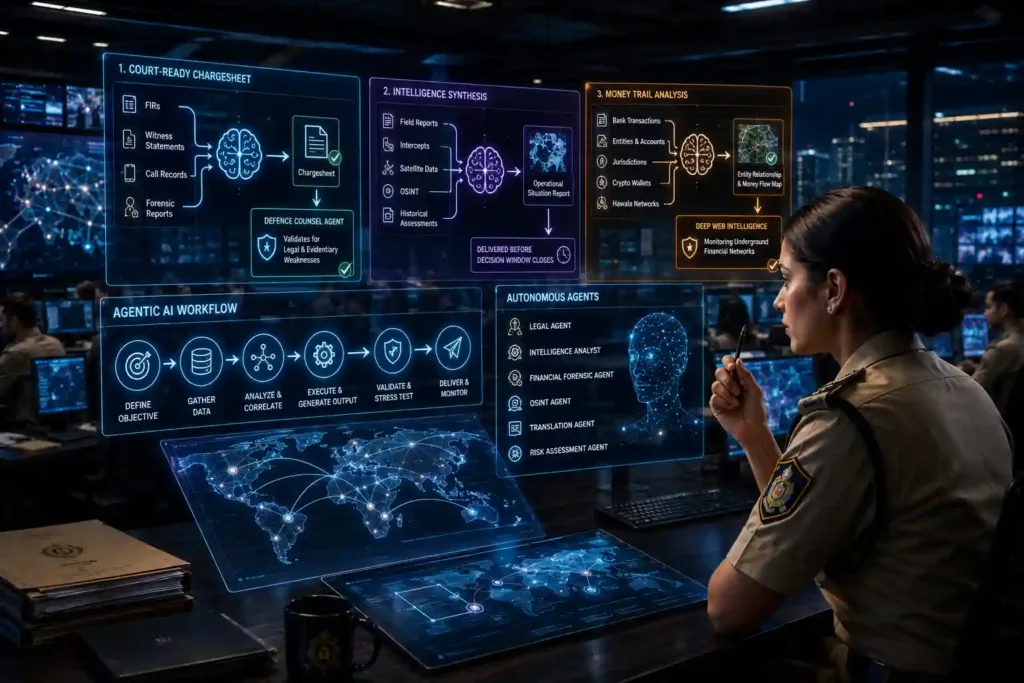
A Sarvagata AI agent assigned this task correlates evidence across FIRs, witness statements, call records, and forensic reports simultaneously, applying the correct legal sections and generating a complete, structured chargesheet automatically. A second agent, assigned the role of defence counsel, then independently stress-tests the chargesheet for evidentiary weaknesses and legal vulnerabilities before it ever reaches court.
Two agents, working in parallel, producing a document of higher quality than manual preparation under time pressure typically deliver it in a fraction of the time.
Synthesising Multi-Source Intelligence Into an Operational Brief
An intelligence briefing that brings together field reports, intercepts, satellite data, open-source intelligence, and historical assessments typically requires a team of analysts working across multiple systems, synthesising findings manually, and collaborating on a written output.
A Sarvagata AI agent ingests field reports, intercepts, and multi-source intelligence simultaneously, produces a complete and structured situation report, and delivers it before the decision window closes. The commander receives the full operational picture, backed by every available source, at the moment they need it, rather than hours after the relevant window has passed.
Tracing Money Trails Across Jurisdictions Automatically
Financial fraud investigations, GST fraud, shell company networks, hawala operations, and cryptocurrency trails require correlating transaction records across multiple entities, jurisdictions, and financial systems simultaneously. The analytical work is complex, the data volumes are large, and the connections between entities are deliberately obscured.
Sarvagata AI agents trace transactions across accounts, entities, and jurisdictions automatically, building complete entity relationship maps that show how money moved and where it went. Integrated with deep web intelligence, the system monitors hawala networks and underground financial communications continuously, surfacing intelligence that manual investigation at this scale cannot reach.
The Possibilities Don’t End Here
The scenarios above represent a fraction of what is possible. Sarvagata’s agentic framework is not a fixed set of capabilities; it is a platform on which any operational workflow can be built, automated, and executed autonomously. Every process your organisation repeats, every task that consumes analyst hours, and every investigation that moves at human pace today is a candidate.
The Architecture That Makes It Safe for This Context
Agentic AI in national security and law enforcement must meet requirements that commercial enterprise deployments do not face. The architecture of Sarvagata is built around these requirements specifically.
Sovereign and air-gapped by design
Sarvagata runs entirely on the deploying organisation’s hardware. No cloud dependency. No data leaves the boundary, ever. This is not a configuration option; it is the foundational architectural choice. Every component, including the reasoning model, the agent execution layer, the knowledge base, and the tool integrations, runs locally. The system is deployable in classified environments, including forward operating bases, secure intelligence facilities, and environments where external network connectivity is operationally prohibited.
Private knowledge ingestion with zero leakage
Organisations feed Sarvagata their most sensitive materials, case records, evidence files, legal documents, databases, and field reports, and those materials are indexed into a private knowledge base that exists entirely within the organisation’s boundary. Every format, every file type, structured data, unstructured documents, scanned records, and multilingual content are all indexed and made instantly query-able. Not a single byte leaves the perimeter.
Multi-agent coordination with human oversight
Sarvagata supports single agents or coordinated teams of agents, each assigned a specific role, persona, and task scope. Agents work in sequence or in parallel, collaborating and validating each other’s outputs. The chargesheet agent and the defence counsel agent working in parallel is an example of this; one produces, the other stress-tests. Human oversight is preserved at every stage through complete audit trails and defined escalation thresholds.
No telemetry, no external calls, no training on your data
The system generates no telemetry. It makes no external calls. It does not use the organisation’s data to train or improve models. Complete sovereignty is not a claim; it is a verifiable architectural fact of how the system is built.
Here’s the conclusion written specifically for the version you’ve finalised; it picks up the thread of the three-generation narrative from the opening and closes it cleanly:
The Evolution Continues

The first generation of AI gave organisations eyes, the ability to see patterns in data volumes no human team could process. The second gave it a voice, the ability to ask questions of that data in plain language and receive answers that previously required days of analyst effort. The third gives it hands, the ability to act on what it knows autonomously, continuously, and at a speed the threat environment now demands.
Each generation made the previous one more valuable. Each leap forward was possible only because the foundation before it was solid.
The organisations that adopted AI early in India’s national security and law enforcement landscape did not just gain operational advantages in that moment. They built the data infrastructure, the institutional confidence, and the governance maturity that makes agentic AI deployable today, not as an experiment, but as a production-grade operational capability.
Sarvagata AI is that capability. Sovereign. Air-gapped. Built for the environments where the stakes are too high for anything less.
Frequently Asked Questions
1. What is agentic AI in simple terms?
Agentic AI refers to AI systems that pursue complex goals autonomously, planning the steps required, executing those steps using available tools and data, adapting based on intermediate results, and completing multi-step workflows without requiring a human to initiate each step individually. Unlike query-response AI systems that answer when asked, an agentic AI system is given an objective and works toward it independently. The practical difference is significant: a conventional AI system helps analysts work faster; an agentic AI system can conduct investigations, produce reports, trace financial networks, and execute complex analytical workflows autonomously, with human officers reviewing and validating the outputs.
2. What is the difference between predictive AI and agentic AI in law enforcement?
Predictive AI identifies patterns and surfaces forecasts, crime hotspot predictions, risk scores, and network anomalies for human decision-making. It is an extraordinarily powerful analytical tool. Agentic AI extends this by not just identifying what needs attention but also pursuing the investigation autonomously. A predictive system tells an analyst where to look; an agentic system looks, investigates across multiple data sources, builds the evidentiary picture, and presents findings, advancing the investigation rather than just informing it. Both are valuable; they operate at different stages of the same intelligence and investigative pipeline.
3. How is agentic AI different from automation or RPA?
Traditional automation and Robotic Process Automation (RPA) follow predefined, fixed workflows; they execute the same steps in the same sequence every time. Agentic AI reasons about the task at hand, plans the appropriate sequence of steps based on the objective and intermediate findings, adapts when results change the picture, and handles ambiguity by making contextual decisions. An automation script processes a tax filing the same way every time. An agentic AI agent reads the filing, determines which aspects warrant deeper scrutiny based on the specific content, pursues those threads autonomously, and adjusts its approach based on what it finds. The intelligence is in the agent’s reasoning, not in the script.
4. Does agentic AI require internet connectivity to function in national security environments?
Sarvagata AI operates entirely on-premise, with no internet connectivity required and no external data calls. Every component runs locally: the language model, the agent execution layer, the knowledge base, and the tool integrations. This makes it deployable in air-gapped classified environments, forward operating bases, naval vessels, and secure intelligence facilities where external network connectivity is either unavailable or operationally prohibited. When network access is permitted and desired, Sarvagata’s integrated web search capability can supplement the offline system with real-time open-source intelligence.
5. What does ‘multi-agent’ mean, and why does it matter for complex investigations?
A multi-agent system deploys multiple AI agents simultaneously, each assigned a specific role and task scope, working in sequence or in parallel. In the context of a law enforcement investigation, this might mean one agent building the chargesheet from available evidence while a second agent independently stress-tests it for weaknesses, the way a senior officer might review a junior’s work, but simultaneously rather than sequentially. For intelligence synthesis, multiple agents might simultaneously process different source streams, field reports, intercepts, satellite data, and open-source intelligence and consolidate findings into a unified assessment. Multi-agent architecture allows complex, multi-faceted tasks to be completed faster and with greater quality assurance built in through agent-to-agent validation.
6. How does agentic AI maintain security and accountability in sensitive operations?
Sarvagata AI maintains complete audit trails of every action taken by every agent, including what data was accessed, what decisions were made, what outputs were generated, and at what timestamp. Agents operate within defined parameters: authorised data sources, approved action scope, and specified escalation thresholds beyond which human review is required before proceeding. No data leaves the organisation’s boundary at any stage. This governance architecture, bounded autonomy with complete auditability, is what makes agentic AI viable for the most sensitive national security and law enforcement applications.