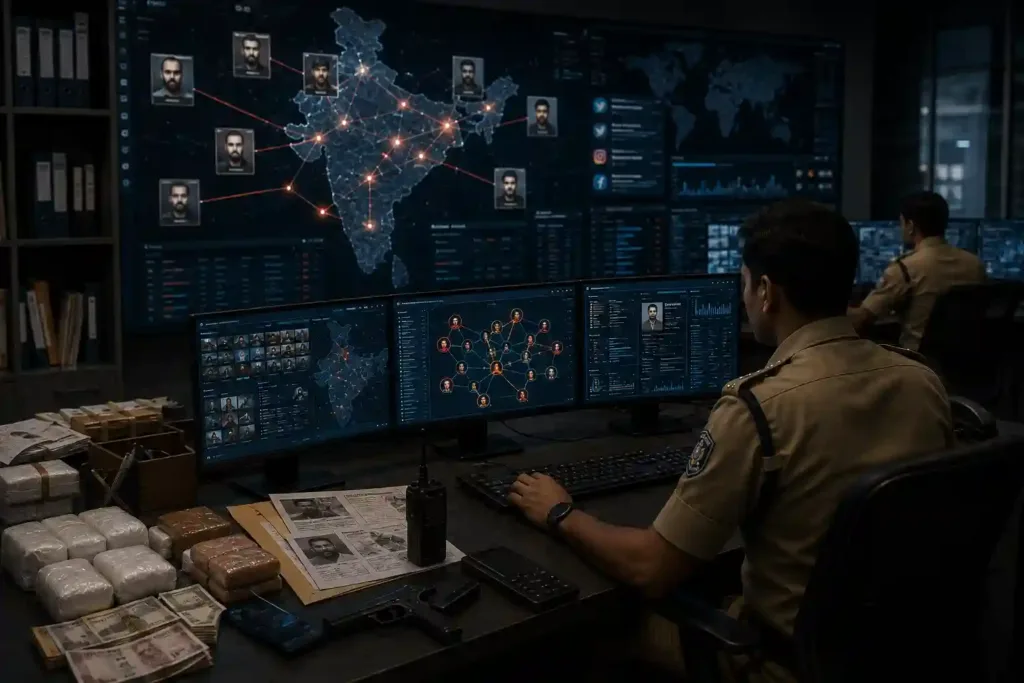
India sits between two of the world’s most prolific drug-producing regions. To the northwest lies the Golden Crescent: Afghanistan, Iran, Pakistan, the source of most of the heroin and opioids entering South Asia. To the northeast lies the Golden Triangle: Myanmar, Laos, Thailand, responsible for a significant portion of the methamphetamine and synthetic drugs moving through the subcontinent. India is not just a transit country. It is a destination.
But geography alone does not explain why tracking drug trafficking networks across Indian districts has remained so difficult for so long. The real challenge is structural, and understanding it is essential before understanding how OSINT is changing it.
Why Drug Networks Are Designed to Be Invisible
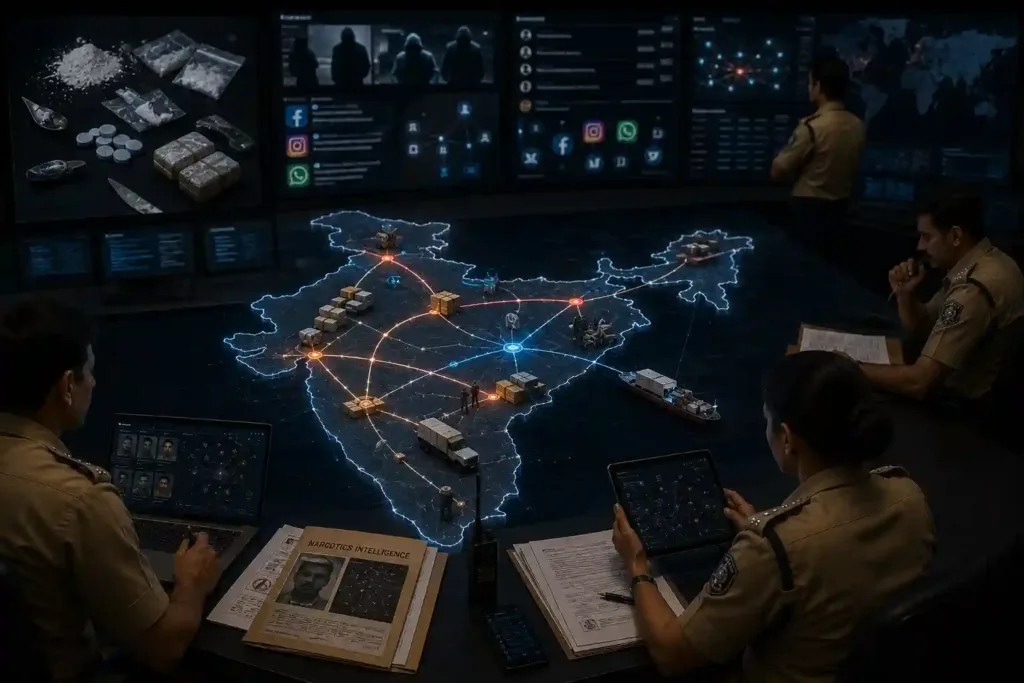
Modern drug trafficking operations are not run by individuals who carry contraband themselves. They are structured as distributed networks, deliberately fragmented across districts, states, and sometimes countries, so that the arrest of any one person cannot unravel the whole.
A typical multi-district narcotics operation might look like this: the financing happens in one city, the procurement in a border district, the transport through three intermediate handlers in different states, the storage in a location chosen specifically because it is outside the jurisdiction of any agency that has been tracking the network, and the street-level distribution managed by a fourth layer of operatives who have never met anyone above them in the chain.
This fragmentation is not accidental. It is operational security, engineered to exploit the fact that state police departments do not share intelligence in real time, that inter-agency coordination is slow and formal, and that building a case against the financial and organisational leadership of a network requires connecting dots across jurisdictions that rarely talk to each other.
Adding to this complexity: trafficking networks have moved a significant portion of their coordination online. Coded discussions happen on social media platforms in regional languages and dialects. Route changes are communicated through dark web forums. New recruits are identified and approached through encrypted channels. Logistics, shipments, prices, contacts, leave traces across the open web, the deep web, and the dark web simultaneously.
The intelligence is there. The question is whether law enforcement can find it before the shipment moves.
What OSINT Actually Means in a Law Enforcement Context

Open Source Intelligence (OSINT) is, at its most basic, the systematic collection and analysis of information that is publicly available, or available without direct interception. This includes:
- Surface web: Social media platforms, news sites, public databases, shipping records, company registrations, court filings
- Deep web: Forums, closed communities, subscription databases, archives not indexed by standard search engines
- Dark web: Anonymous marketplaces, encrypted forums, communications on TOR networks where illegal trade is openly discussed
The gap between OSINT as a concept and OSINT as an operational capability is enormous. An analyst doing manual OSINT, opening tabs, searching keywords, translating posts, copying data into a report, might process a few dozen sources in a day and miss the connection that was hidden in source number 200.
An AI-powered OSINT platform processes thousands of sources simultaneously, in multiple languages, with automatic keyword alerting, sentiment tracking, entity profiling, and network visualisation, and it does this continuously, not just when an analyst sits down at a workstation.
That difference, between manual OSINT and AI-powered OSINT, is where the operational impact lives.
How AI-Powered OSINT Tools Track Drug Networks Across Districts
Monitoring the Shift Before the Shipment Moves
Drug trafficking corridors are not fixed. They shift in response to enforcement pressure, route disruptions, and changes in the supply chain. A route that was active six months ago may be dormant today; a new one may have opened without any field intelligence being generated about it.
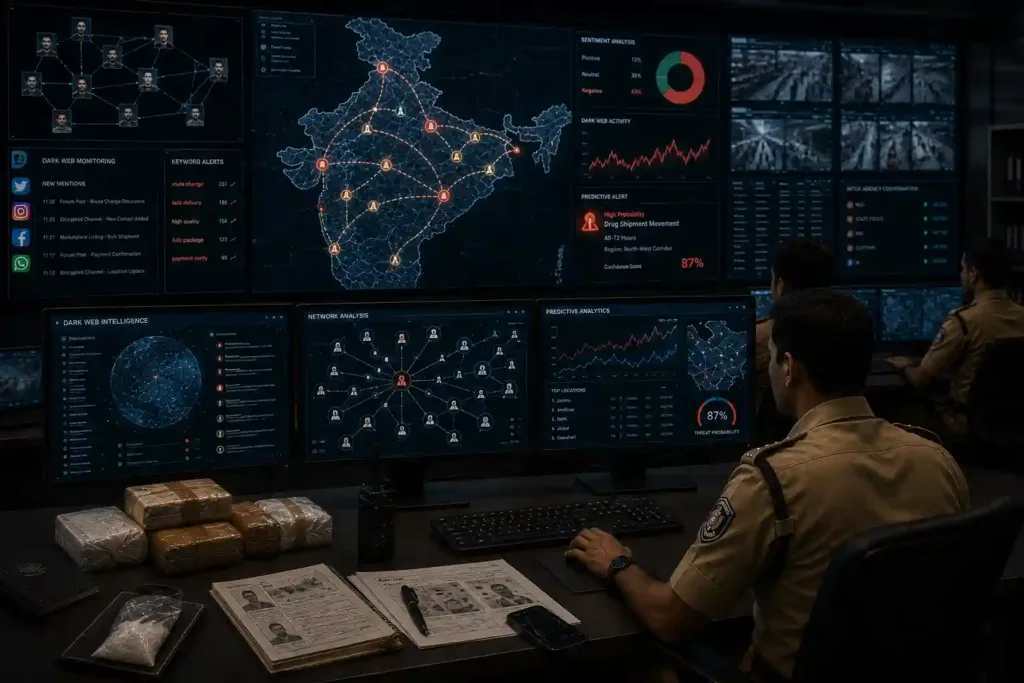
AI-powered OSINT platforms detect these shifts through continuous monitoring of open-source signals, changes in social sentiment in specific geographic areas, spikes in forum activity related to logistics and movement, unusual patterns in shipping or transport data, and coded language appearing in channels previously associated with trafficking activity.
The critical word is before. The value of OSINT in narcotics interdiction is not confirming what field units already suspect. It is surfacing a credible threat signal early enough that force deployment can be planned rather than improvised.
Innsight, Innefu Labs’ OSINT platform built for law enforcement and intelligence agencies, integrates data from the surface web, deep web, dark web, even RSS feeds, into a unified analytical environment. Its multilingual analysis capability, covering dozens of Indian and international languages, means that operational discussions happening in Pashto, Burmese, or regional dialects are surfaced alongside English-language intelligence, not lost in translation.
Building the Network Graph Before the Arrest
Every trafficking operation leaves a digital shadow. A phone number mentioned in a forum. A social media account using coded language tied to logistics. A financial reference on a dark web marketplace. An image posted to a public channel that contains metadata linking it to a specific location.
Individually, none of these signals mean much. Assembled, with entity relationships mapped, accounts cross-referenced, and timelines built, they reveal the structure of the network.
Innsight’s 360-degree profiling capability builds comprehensive profiles of individuals and organisations by pulling data from across all monitored sources and rendering the connections as a navigable network graph. Analysts can see who is connected to whom, through what channels, with what frequency, and identify which nodes in the network are central to operations versus which are peripheral.
This matters for cross-district investigations specifically because it allows agencies to work top-down, identifying the financiers and logistics coordinators who sit above the district-level operatives, rather than bottom-up, where each arrest leads only to the next person in line rather than to the network’s leadership.
Multilingual Dark Web Intelligence
A significant volume of trafficking coordination in South Asia happens in regional languages on dark web forums and encrypted channels. The operational value of dark web intelligence is almost entirely dependent on language coverage, intelligence in a language the analyst cannot read is not intelligence.
Innsight’s dark web aggregator and multilingual processing capability addresses this directly, surfacing discussions, marketplace listings, and forum activity in the languages actually used by trafficking networks operating in and through India, not just in English.
When a single coded phrase appeared in an obscure forum during an active monitoring operation, Innsight connected it to earlier discussions in the same linguistic register and, through link analysis, identified a dormant cluster of accounts tied to a specific movement. That connection, invisible in manual analysis, became the intelligence thread that shaped the entire operational response.
Predictive Analytics: From Signal to Operational Tempo
The most operationally significant capability of an AI-powered OSINT platform is not what it finds, it is when it finds it.
Innsight’s predictive analytics engine analyses converging signals, keyword spikes, sentiment shifts, forum activity patterns, image trends, and generates probability assessments for specific types of events in specific geographic areas over specific timeframes. This gives commanders something manual analysis cannot: lead time.
Lead time is what transforms law enforcement from reactive to anticipatory. With hours of actionable warning, force deployment can be planned, checkpoints positioned without tipping off couriers, and inter-agency coordination completed before the shipment moves, not after.
A Real Operation: The OSINT-Led Narcotics Interception
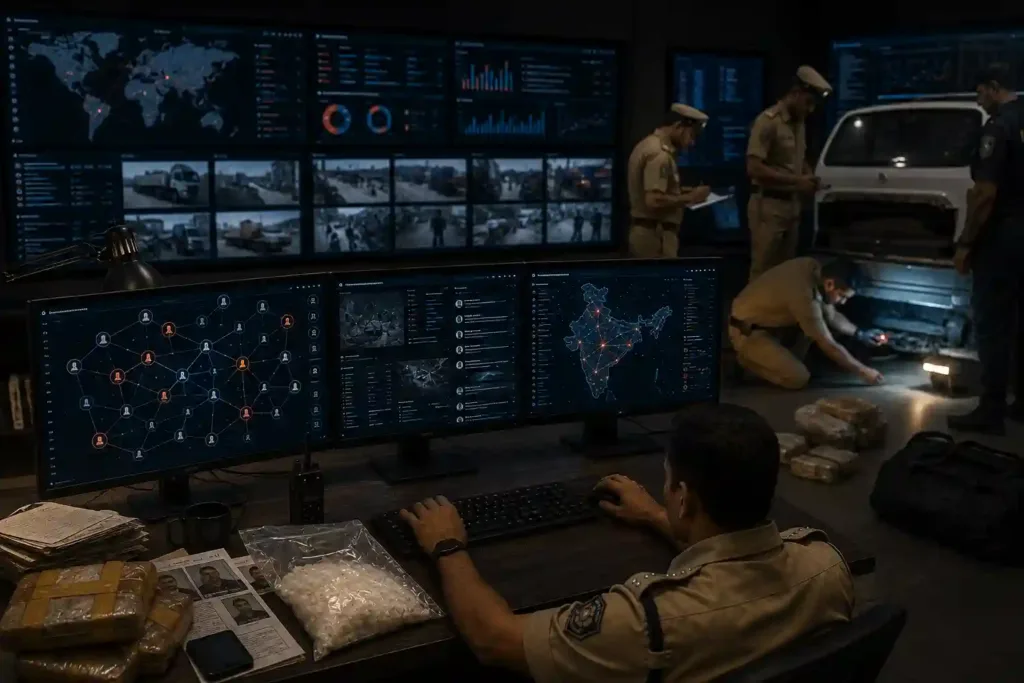
Innefu Labs has published a detailed account of an actual OSINT-led narcotics interdiction operation conducted using Innsight. Without reproducing the full narrative, the key operational sequence is worth understanding.
Drug trafficking routes in the area of operation had quietly shifted, a change that generated no field intelligence but did leave open-source signals: social posts in obscure languages, dark web forum mentions of packages moving east, shipping data showing anomalous night-time entries at a border outpost.
Innsight’s multilingual feeds and sentiment tracking surfaced these signals as a converging pattern. Analysts identified a high probability of bulk narcotics movement within a specific window. A single coded phrase on a dark web forum, when cross-referenced through Innsight’s link analysis, exposed a dormant cluster of accounts with clear operational significance.
Force deployment was optimised based on the intelligence picture, not deployed randomly across checkpoints, but positioned precisely where the converging signals pointed.
The result: a crores-worth narcotics haul intercepted before sunrise, with compartments welded into a vehicle’s undercarriage. More significantly, the post-interception intelligence, built from Innsight’s profiling of the digital network, identified the handlers and financiers behind the operation, turning a single seizure into the foundation for a broader investigation.
Access the full case: Turning Clues into Capture: A Real OSINT Story of Predictive Analysis and Situational Awareness
The Cross-District Problem OSINT Specifically Solves
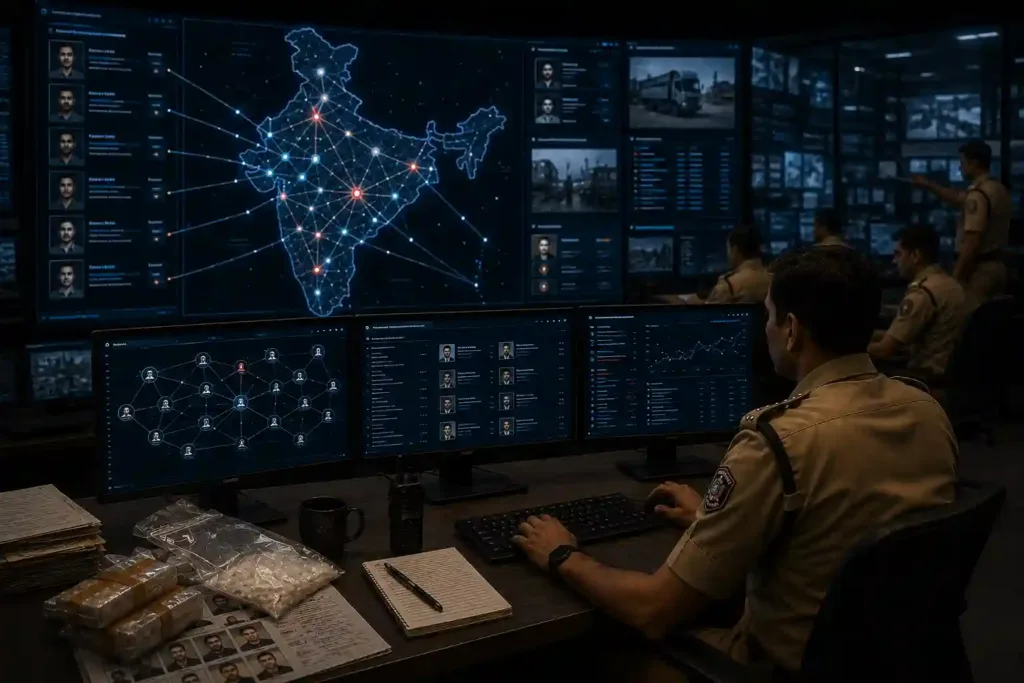
Traditional policing handles drug trafficking reactively: a seizure happens in District A, the investigation begins in District A, the case file lives in District A. The connection to a seizure in District B, made three months earlier, does not surface unless an officer in one district happens to know an officer in the other.
AI-powered OSINT works differently. The platform monitors continuously across geographies, not one district, not one state. A network graph built from open-source intelligence does not respect jurisdictional boundaries. The same social media accounts, dark web identifiers, and communication channels that appear in one district’s investigation appear in the platform’s intelligence picture regardless of which jurisdiction flagged them first.
This is the capability that makes cross-district tracking operationally real rather than aspirationally aspirational. The intelligence connection happens at the platform level, before formal inter-agency coordination is even required.
The Bottom Line
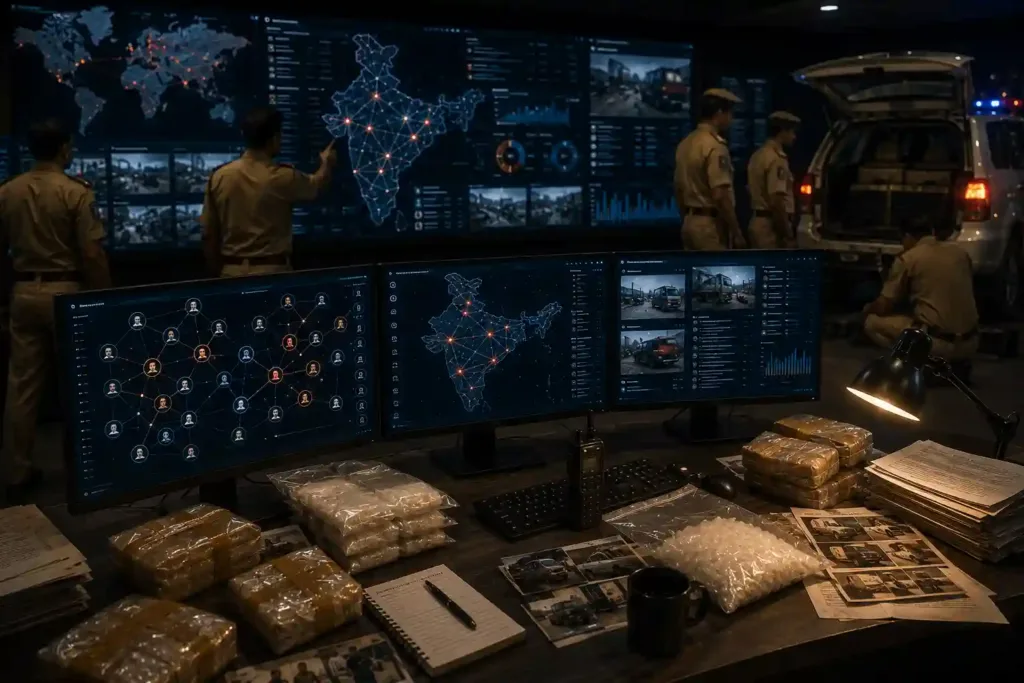
Drug trafficking networks have adapted to the modern intelligence environment. They fragment across jurisdictions, communicate in regional languages, use coded language on obscure platforms, and move routes precisely when enforcement pressure builds in one corridor.
Static, reactive policing cannot track a dynamic, adaptive network. OSINT can, because the intelligence the network generates, it generates continuously, across every platform it uses, in every geography it operates. An AI-powered OSINT platform follows the network, not the jurisdiction.
The narcotics interception documented by Innefu Labs was not the result of a tip-off, a lucky seizure, or an informant. It was the result of analysts reading a pattern that was hiding in plain sight, scattered across social posts, forum mentions, shipping data, and dark web discussions, and acting on it before the shipment moved.
That is what OSINT-led policing looks like when the platform is built for the operational reality of the job.
Frequently Asked Questions
1. What is OSINT and how is it used by police in India?
OSINT (Open Source Intelligence) refers to intelligence gathered from publicly available sources, social media, news, forums, shipping records, dark web marketplaces, and more. Indian law enforcement agencies use OSINT platforms to monitor threats in real time, build profiles of suspects and criminal networks, detect early warning signals of planned criminal activity, and gather evidence that can support investigations. Platforms like Innsight by Innefu Labs are specifically built for Indian law enforcement, with multilingual support, dark web integration, and 360-degree entity profiling.
2. How do OSINT tools track drug trafficking networks across districts?
Drug trafficking networks leave digital traces across multiple platforms, coded social media posts, dark web forum activity, logistics communications, financial references. AI-powered OSINT tools continuously monitor these sources, identify patterns, and map the network graph that connects individuals and accounts across geographic boundaries. Because the platform operates across all monitored sources simultaneously, connections between activity in different districts surface automatically, rather than depending on manual cross-referencing or inter-agency communication.
3. Can OSINT tools access the dark web legally?
Yes, monitoring and aggregating publicly accessible dark web content for law enforcement purposes is legally permissible within India’s applicable legal frameworks, when conducted by authorised agencies. OSINT platforms designed for law enforcement, like Innsight, include dark web aggregation capabilities that surface discussions, marketplace activity, and forum content in a structured format, while maintaining compliance with applicable Indian legal boundaries around data collection and use.
4. How does multilingual OSINT work for narcotics investigations?
Drug trafficking networks operating in and around India frequently communicate in regional languages and dialects, Pashto, Burmese, Dari, Punjabi, and others, precisely because they know most monitoring is in English. AI-powered multilingual OSINT tools analyse content across dozens of languages simultaneously, translating and contextualising posts, forum entries, and dark web discussions that would otherwise be invisible to analysts without language capability. This multilingual coverage is one of the most operationally significant differences between a purpose-built law enforcement OSINT tool and a generic commercial alternative.
5. What is 360-degree profiling in OSINT platforms?
360-degree profiling aggregates all available open-source data about an individual or organisation, social media presence, forum activity, images, associated accounts, financial references, location data, known associates, into a single unified profile. The AI engine identifies connections between data points that appear across different sources, building a comprehensive picture of the entity rather than isolated fragments. For drug trafficking investigations, this means being able to map the handlers, financiers, and logistics coordinators above the street-level operatives who are actually arrested.
6. How much advance warning can OSINT provide before a drug shipment moves?
This depends on the sophistication of the network and the volume of open-source signals it generates, but in documented operations, AI-powered OSINT platforms have surfaced credible threat signals 24 to 72 hours before a planned movement, sufficient time for force deployment to be planned and positioned. The predictive analytics engine works by identifying converging signals, sentiment spikes, keyword surges, unusual forum activity, that individually might not be significant but together form a recognisable pre-operational pattern.