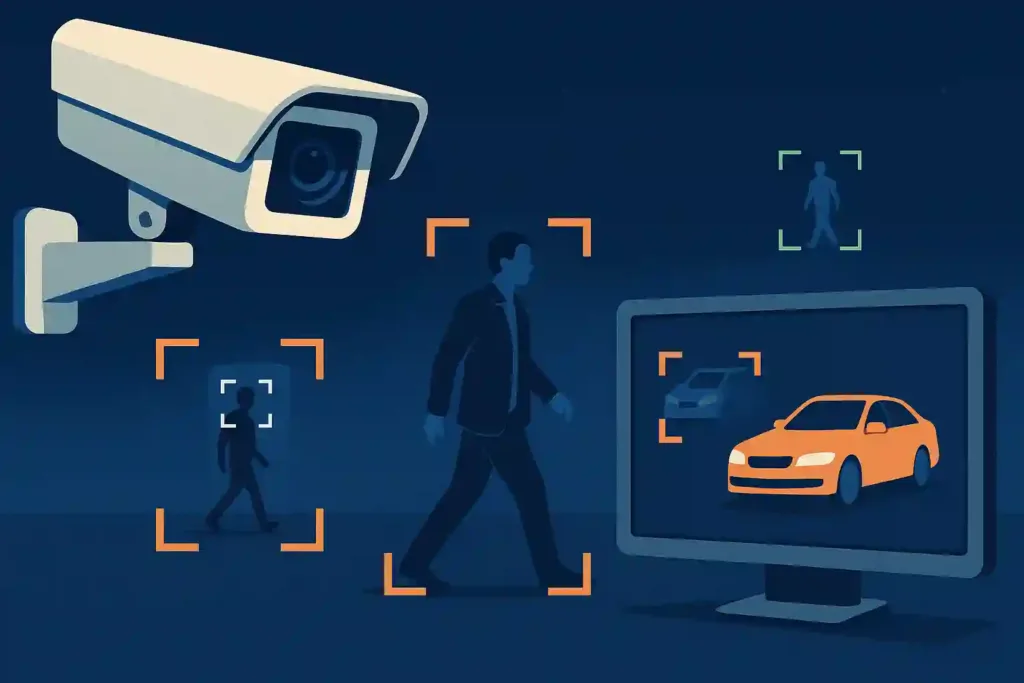
When you think of AI in surveillance, you often imagine facial recognition, anomaly detection, or predictive insights. But behind all of these capabilities lies a foundational technology: object tracking.
Object tracking is what allows systems to continuously follow a person, vehicle, or object across multiple frames, cameras, and environments. It’s the engine that transforms static CCTV feeds into real-time situational awareness.
In cities growing denser and threats becoming more dynamic, object tracking sits at the heart of intelligent CCTV, smart cities, and defence surveillance systems.
Key Takeaways
- Object tracking is essential for intelligent CCTV and real-time surveillance.
- It goes beyond detection to continuously follow objects across frames or cameras.
- Deep learning enables tracking even in occlusions, crowds, and low-light conditions.
- AI Vision and Prophecy platforms from Innefu bring industry-leading tracking and intelligence fusion.
- The future of tracking involves 3D modelling, multimodal fusion, and edge AI deployments.
What is Object Tracking (enabled by AI)?
Object tracking is the process of:
- Detecting an object in a video frame
- Assigning it an identity
- Continuously following it across time, frames, or multiple cameras
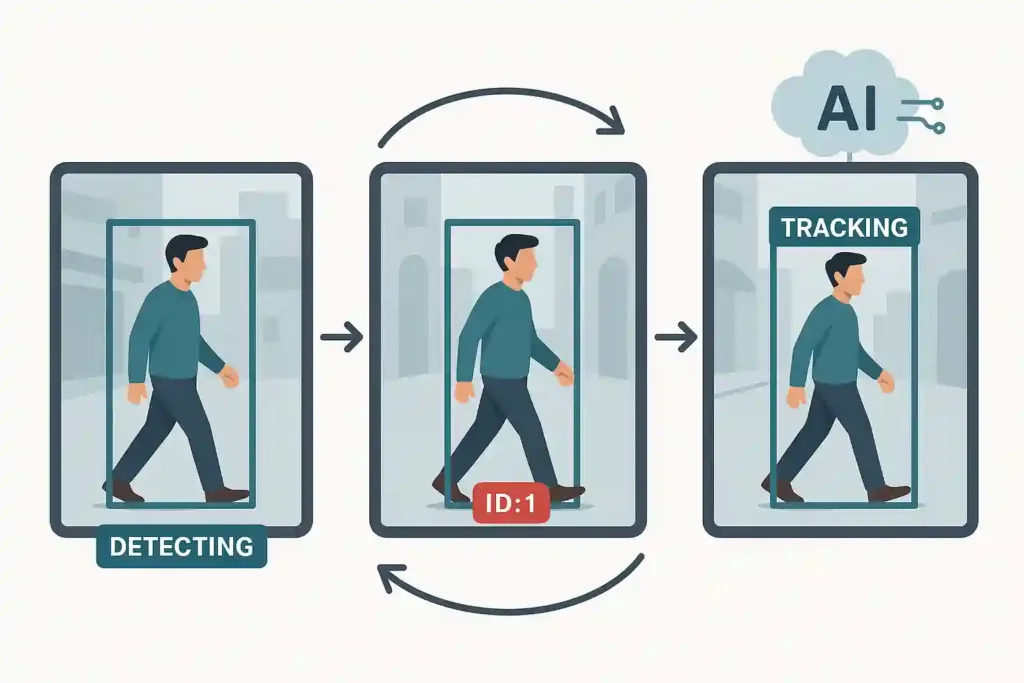
In simpler terms:
It answers “Where is this object now, and where does it move next?”
Unlike object detection (which detects objects fresh in each frame), object tracking preserves identity over time, giving surveillance systems the ability to:
- Follow a person walking across a market
- Track a suspicious vehicle entering and exiting a restricted zone
- Monitor crowd movement
- Understand object behaviour patterns
Tracking adds context, and context is what turns raw surveillance into intelligence.
Why Object Tracking Matters for Modern Security
Today’s CCTV systems receive massive amounts of data, far beyond what human operators can manually monitor. This leads to information overload, missed events, and slow incident response.
Object tracking solves this by enabling:
- Real-time monitoring of moving threats: Track suspicious movement automatically, without human intervention.
- Behaviour analysis & anomaly detection: Understanding movement patterns (loitering, running, vehicle wrong-way movement).
- Multi-camera continuity: Track a target seamlessly even if they go off-screen and appear on another camera — using techniques like ReID (Re-Identification).
- Reduced false alerts: By understanding motion and continuity, AI filters out irrelevant motion (e.g., shadows, animals, foliage).
This is why intelligent video platforms like Innefu’s AI Vision use object tracking as the backbone for:
- Person re-identification
- Vehicle analytics
- Crowd analytics
- Perimeter monitoring
- Intrusion detection
How Object Tracking Works: The AI Pipeline Explained
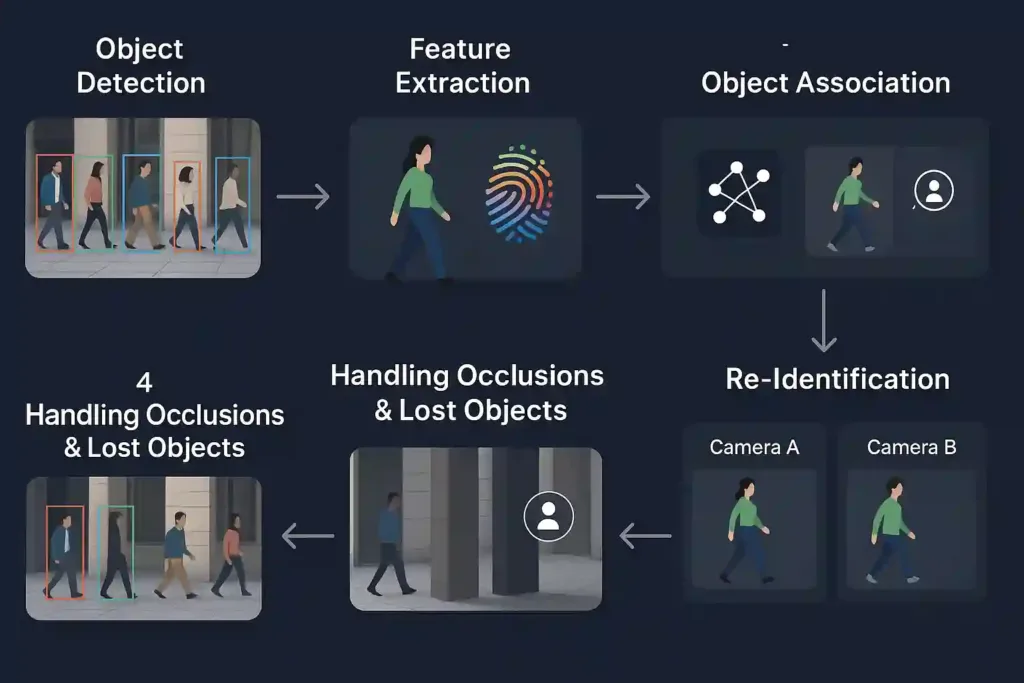
Object tracking systems generally follow a multi-step pipeline:
Step 1: Object Detection (First Frame)
The system first identifies all relevant objects in the frame. Modern AI uses deep learning algorithms such as:
- YOLO (You Only Look Once)
- Faster R-CNN
- SSD (Single Shot Detector)
These models output:
- Bounding boxes
- Class labels
- Confidence scores
This is the raw input for tracking.
Step 2: Feature Extraction
Each detected object is converted into a vector representation, capturing:
- Color patterns
- Shape
- Texture
- Movement cues
- Spatial features
Think of it as giving the object a digital fingerprint.
Step 3: Object Association (Identity Matching)
As the next frame arrives, the system tries to match each new detection to previously tracked objects. Popular algorithms include:
- Kalman Filter (Predictive Tracking): Predicts where an object will move next based on its past trajectory.
- DeepSORT (Deep Learning + Tracking): Combines motion prediction with appearance features.
- Optical Flow: Tracks pixel movement across frames.
- Siamese Networks: Used for single-object tracking using paired neural networks.
- ByteTrack: A recent tracker that excels at handling dense crowds.
Each method comes with different strengths: speed, accuracy, or robustness against occlusions.
Step 4: Handling Occlusions & Lost Objects
Real-world environments are messy:
- A person walks behind a pillar
- Cars overlap in traffic
- Lighting changes
- Camera angle shifts
AI trackers handle this using:
- Appearance similarity
- Motion prediction
- Re-entry logic (ReID) after objects reappear
- Trajectory continuation
This ensures identity consistency even in cluttered environments.
Step 5: Re-Identification (ReID) Across Multiple Cameras
This is the pinnacle of advanced object tracking. ReID ensures that:
➡️ The person who leaves Camera A
➡️ Is recognised again in Camera B
➡️ Even if lighting, angle, or distance change
AI achieves this using:
- Deep feature embedding
- Spatial-temporal modelling
- Person re-identification networks
Platforms like Innefu’s AI Vision use ReID to support:
- Multi-camera tracking
- Missing-person search
- Vehicle-of-interest tracking
- Border surveillance
Types of Object Tracking Models
Object tracking generally falls into two categories:
Single Object Tracking (SOT)
Tracks one object at a time – e.g., a drone following a moving target.
Algorithms:
- SiamFC
- ECO
- CSRT
Use Cases:
- Drone following
- Targeted military tracking
- Sports analytics
Multiple Object Tracking (MOT)
Tracks many objects simultaneously, essential for surveillance.
Popular algorithms:
- DeepSORT
- ByteTrack
- FairMOT
Use Cases:
- City surveillance
- Traffic analytics
- Retail footfall analytics
- Crowd management
Given India’s growing urban density, MOT is the backbone of large-scale smart city deployments.
Real-World Applications of Object Tracking
Object tracking is everywhere, though most people never notice it. Here are the most impactful domains:
Smart City Surveillance
- Tracking vehicles entering restricted zones
- Monitoring pedestrian movement
- Real-time crowd flow management
- Detecting anomalies (running, sudden congregation)
India’s Smart Cities Mission has increasingly adopted AI-based surveillance with multi-camera tracking.
Law Enforcement & Crime Prevention
Tracking supports:
- Suspect pursuit
- Crime scene reconstruction
- Vehicle tracing
- Pre-emptive crowd behaviour analysis
Systems like Innefu’s Prophecy Alethia and Prophecy Guardian support multi-format fusion of tracking data with CDRs, OSINT, and communication intelligence.
Border & Defence Surveillance
Object tracking is crucial for:
- Human intrusion detection
- Vehicle or UAV tracking
- Monitoring sensitive perimeters
- Coordinated threat response
In high-stakes national security missions, AI’s ability to track small, fast, distant objects becomes mission-critical.
Traffic Management & Road Safety
Tracking enables:
- Speed estimation
- Wrong-way detection
- Red-light violations
- Traffic flow optimisation
This reduces congestion and enhances road safety.
Retail, Manufacturing & Logistics
- Tracking shopper movement patterns
- Monitoring assets
- Tracking packages in warehouses
- Ensuring process compliance
Challenges in Object Tracking, and How AI Solves Them
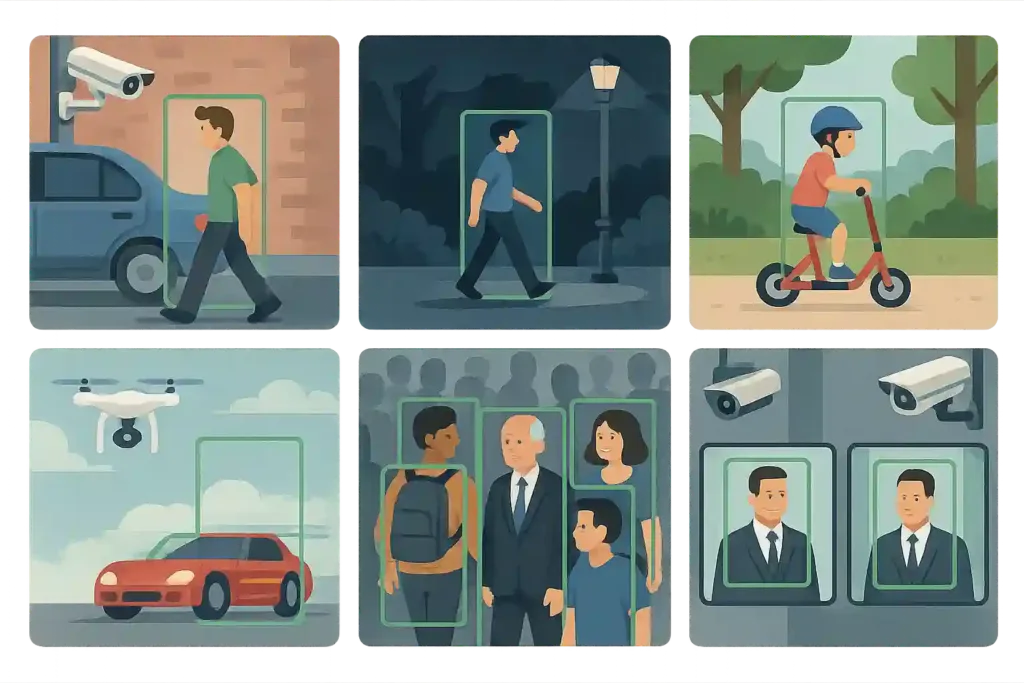
Surveillance is unpredictable. AI must overcome:
- Occlusion (objects getting blocked): AI uses trajectory prediction + ReID to keep identity intact.
- Lighting variations (day–night shift): Deep learning models trained on millions of images remain robust.
- Scale changes (objects moving closer/farther): AI systems continuously normalise bounding box dimensions.
- Fast-moving objects: High-FPS vision models track even drones or speeding vehicles.
- Crowded scenes: Modern MOT systems like ByteTrack maintain identity in dense crowds.
- Camera switching: Spatial-temporal ReID models maintain continuity across cameras.
These advancements make AI tracking reliable even in real-world chaos.
Conclusion: Object Tracking Is Quietly Powering the Future of Security
Every city, organisation, and defence agency is now dealing with rising complexity, larger datasets, and evolving threats.
Traditional surveillance simply cannot keep up.
Object tracking is the game-changer, giving AI the ability to:
- Follow
- Understand
- Predict
- Alert
And ultimately drive faster, more informed decision-making.
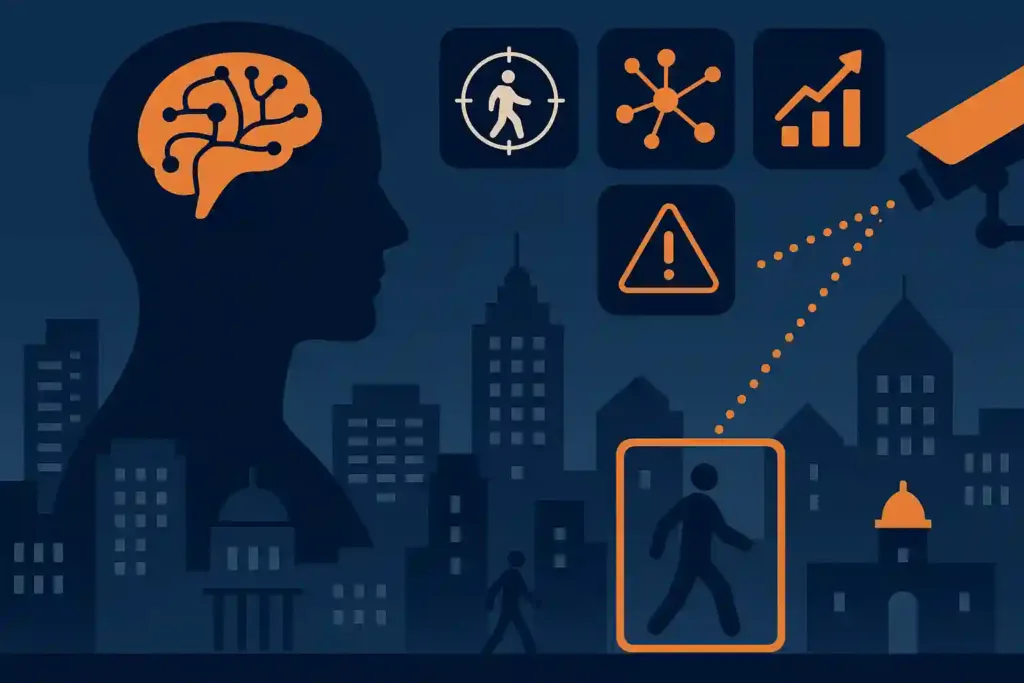
With solutions like Innefu’s AI Vision, object tracking is not just about identifying movement.
It’s about transforming video into actionable intelligence for safer cities, borders, and critical infrastructures.
Looking to integrate intelligent video analytics, multi-camera tracking, or AI-powered surveillance?
Talk to Innefu’s AI Vision team to see how advanced object tracking can transform your security operations.
FAQs – Frequently Asked Questions
1. What is object tracking in AI?
Object tracking is the process of detecting an object and continuously following it across video frames while preserving its identity.
2. How is object tracking different from object detection?
Detection finds objects in each frame; tracking maintains identity over time, enabling movement analysis and behavioural insights.
3. Which AI algorithms are used for object tracking?
Common trackers include DeepSORT, ByteTrack, Kalman Filters, Siamese networks, and optical flow methods.
4. What is ReID in video surveillance?
Re-identification (ReID) allows AI to recognise the same person or vehicle across multiple cameras, even with angle or lighting changes.
5. Why is object tracking important for intelligent CCTV?
It supports real-time monitoring, multi-camera continuity, behaviour analysis, intrusion detection, and threat response.
6. How does AI handle occlusions during tracking?
AI uses motion predictions, feature embeddings, and similarity matching to maintain identity even when objects are temporarily hidden.
7. What are the main challenges in object tracking?
Crowds, lighting variations, fast movement, occlusion, and camera switching — all addressed by modern deep-learning approaches.
8. Can AI track multiple objects at once?
Yes. Multiple Object Tracking (MOT) enables platforms like Innefu’s AI Vision to track many persons/vehicles simultaneously in real time.
9. Where is AI-powered object tracking used?
Smart cities, defence, border surveillance, law enforcement, traffic control, retail analytics, and manufacturing.
10. How does Innefu use object tracking in its solutions?
Innefu integrates tracking within its AI Vision and Prophecy analytics platforms to deliver real-time surveillance, intelligence fusion, and actionable insights.