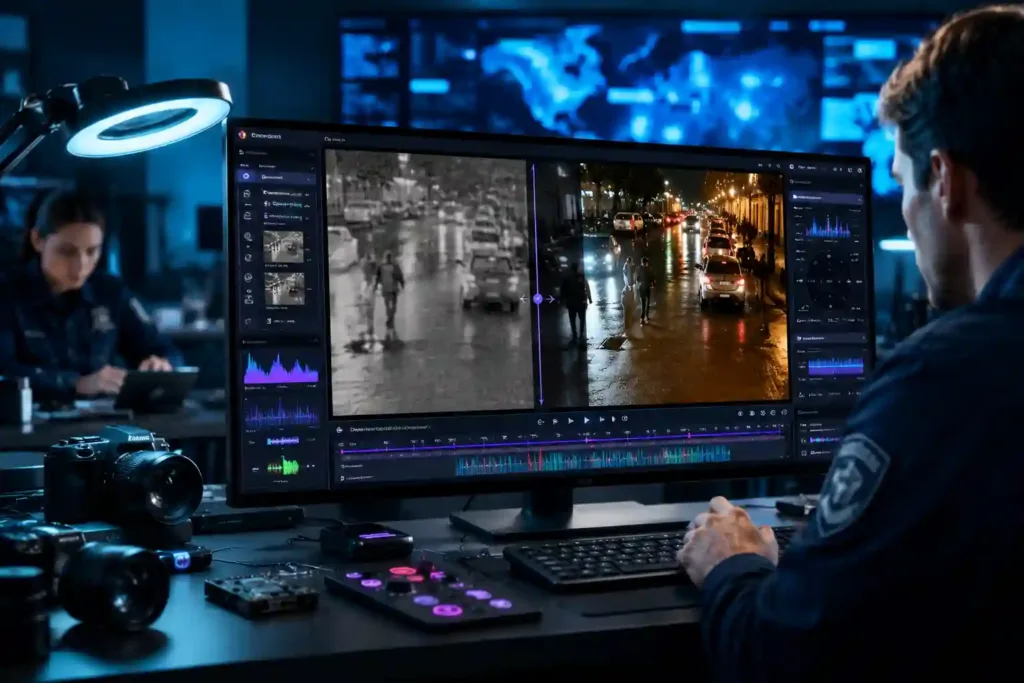
A suspect’s face is three pixels wide on a grainy CCTV frame. The number plate is half in shadow. The footage is the only lead in the case, and it has to hold up in court, not just look better on a screen. This is the moment forensic video enhancement software either earns its place in an investigation or gets quietly abandoned for being “just a filter.”
This guide is written for the people who have to make that call: forensic lab heads, police modernization officers, IT heads at law enforcement and defence agencies, and anyone evaluating enhancement tools for evidentiary use. It skips the marketing language and focuses on what the technology actually does, where it helps, where it can hurt a case, and what to check before you adopt it.
Key Takeaways
- Forensic video enhancement clarifies existing evidence. It does not add information that was not captured, and any tool claiming otherwise should be treated with caution.
- The most common enhancement operations are deblurring, contrast and brightness correction, noise removal, smoothing, and sharpening, each suited to a different footage problem.
- Enhancement used as evidence must be documented and repeatable. Standards bodies such as SWGDE and NIST’s OSAC program specifically call out the need for transparent, reproducible enhancement workflows for courtroom admissibility.
- AI based tools can process footage faster and handle harder conditions such as low light or long-distance CCTV, but speed should never come at the cost of an auditable process.
- When evaluating software, weigh accuracy, chain of custody support, batch processing, data residency, and integration with your existing case management setup, not just the enhancement filters on offer.
Why CCTV and Field Footage Needs Enhancement in the First Place
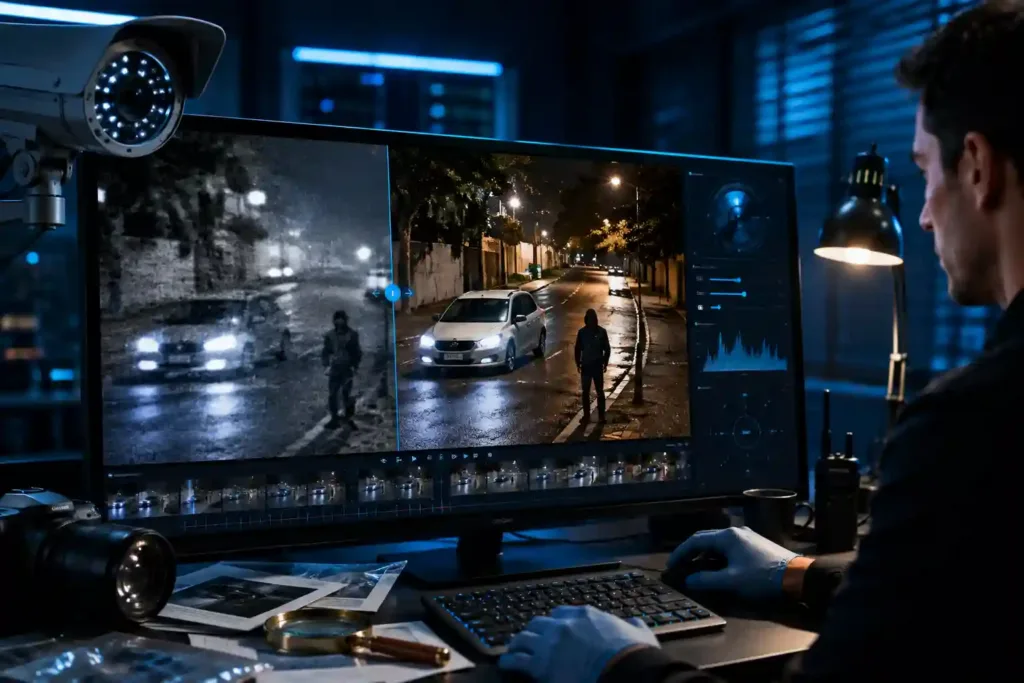
Most surveillance footage was never recorded with forensic analysis in mind. Cameras are mounted for wide area coverage, not close-ups. Bandwidth and storage limits push agencies toward heavy compression. Nighttime footage is often underexposed. Add motion blur from a moving vehicle or a shaky handheld recording, and the result is footage that technically exists but is not usable as is.
For an investigator, that gap between “the footage exists” and “the footage is usable” is where cases stall. Enhancement software exists to close that gap, recovering detail that is present in the data but not visible to the eye without processing.
The Core Enhancement Techniques, and When Each One Matters
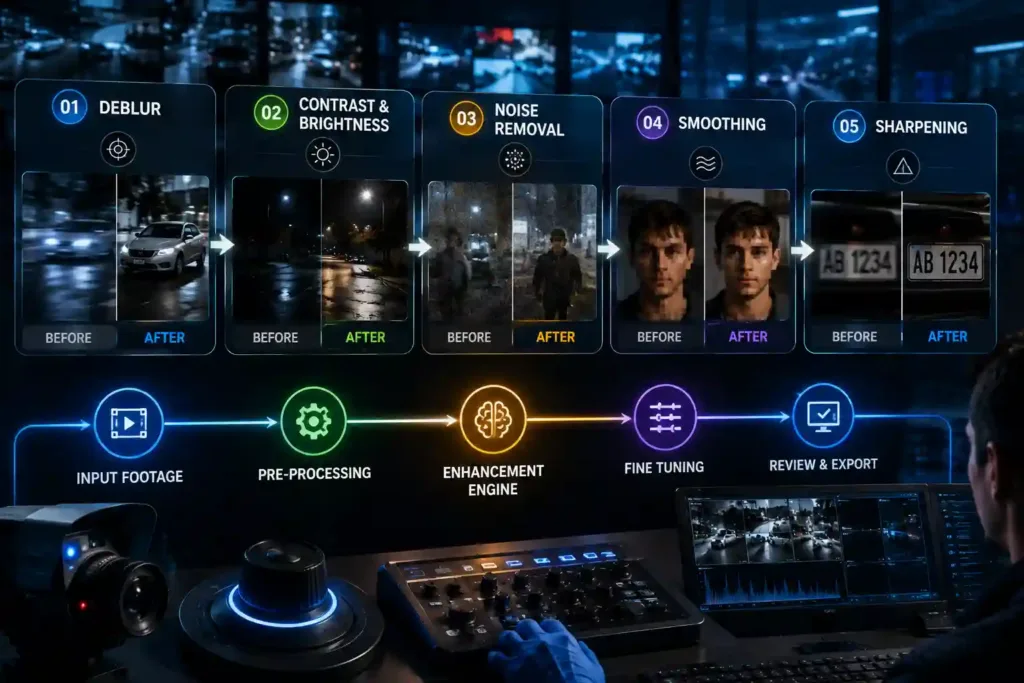
Not every clip needs the same treatment. Understanding what each tool actually does helps a team pick the right operation instead of running every filter and hoping something sticks.
Deblur
Removes motion blur and out-of-focus blur so edges and features become distinguishable again. Useful for a vehicle in motion, a face turning mid-frame, or footage from a camera with a slow shutter in low light.
Contrast and Brightness Adjustment
Rebalances underexposed or overexposed footage so that detail hidden in shadows or blown out highlights becomes visible. This is often the first step applied to nighttime CCTV footage before any other enhancement.
Noise Removal
Strips out the grain and static that low-quality sensors or heavy video compression introduce, without which sharpening or deblurring can end up amplifying noise instead of detail.
Smoothing
Reduces harsh pixelation and digital artifacting, typically applied before sharpening so that the sharpening step enhances real edges rather than compression blocks.
Sharpening
Emphasizes edges to make text, faces, and object boundaries more distinct. Usually the final step is applied after noise has already been cleared out.
In practice, a single piece of evidence often needs two or three of these applied in sequence, in a specific order, which is why the workflow matters as much as the individual filter.
The Part Most Vendors Skip: Admissibility
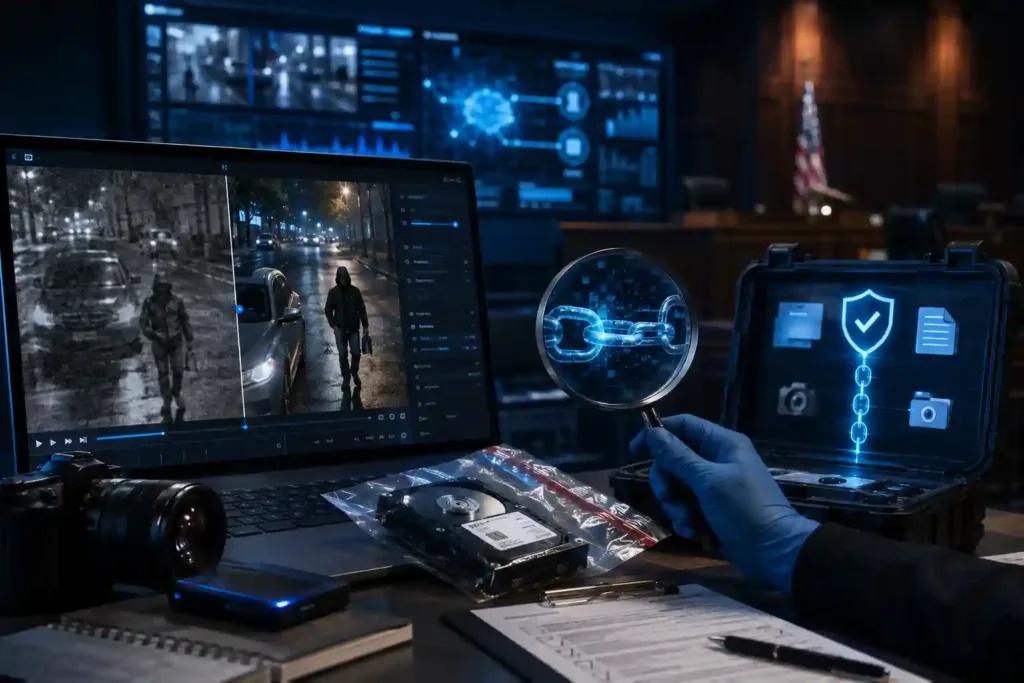
This is the section that separates a tool built for casual photo touch-ups from one built for forensic use.
Enhanced footage submitted as evidence has to survive scrutiny in court. Standards bodies including the Scientific Working Group on Digital Evidence (SWGDE) and NIST’s Organization of Scientific Area Committees (OSAC) have published guidance specifically because enhancement, if undocumented, can be challenged as manipulation of evidence rather than clarification of it. NIST’s own research on forensic image enhancement notes that many forensic laboratories have historically avoided enhancement software altogether due to the lack of standardized, quantifiable methods for validating the results.
What this means practically for a procurement or evaluation decision:
- The software should preserve the original file untouched and work on a working copy, maintaining a clear chain of custody.
- Every enhancement step applied should be logged automatically, not reconstructed manually after the fact.
- The output should be reproducible. Running the same enhancement on the same source file should give the same result every time.
- The tool should be able to generate a report suitable for disclosure to opposing counsel or presentation in court, not just a cleaned-up video file.
A tool that produces a great-looking image but no audit trail creates more risk than it solves.
Where AI Changes the Equation
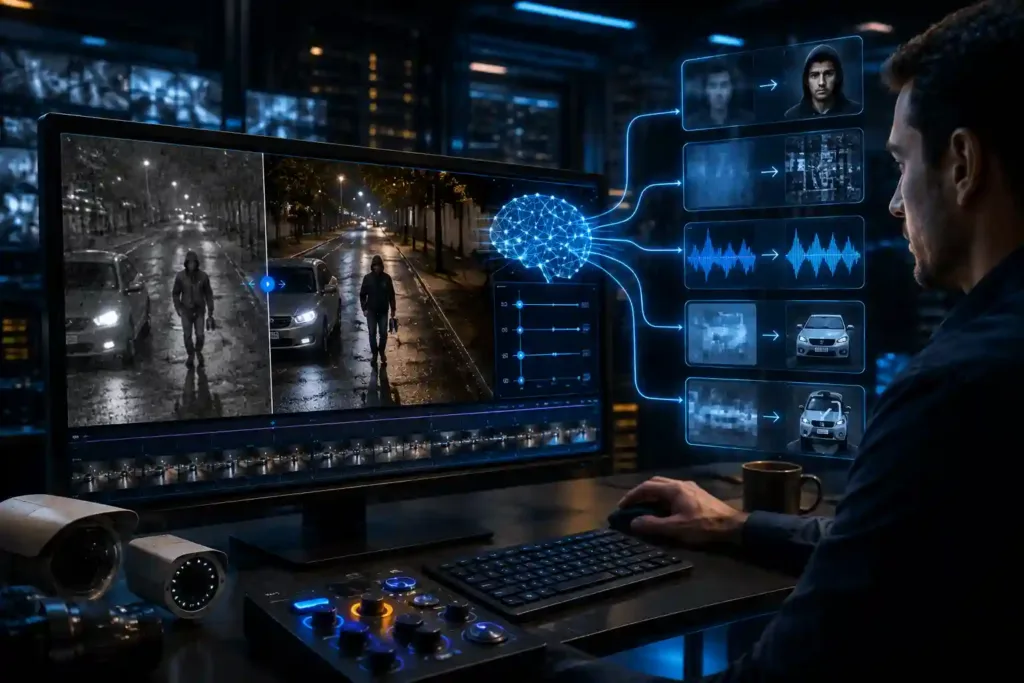
Traditional enhancement relied heavily on manual, frame-by-frame adjustment by a trained analyst. AI based enhancement tools use trained models to apply the right correction automatically, which matters in two specific situations law enforcement teams deal with constantly:
Volume. A single case can involve hours of CCTV footage from multiple cameras and formats. Manual frame-by-frame correction does not scale to that volume within investigation timelines.
Difficult conditions. Long-range traffic camera footage, poorly lit indoor recordings, and heavily compressed DVR exports are exactly the conditions where rule-based filters struggle and trained models tend to perform better because they have learned what real detail looks like versus noise.
Innefu’s AI Vision platform applies this approach to exactly these scenarios, including defence, police, and traffic surveillance footage, combining automated deblur, contrast correction, noise removal, smoothing, and sharpening into a single workflow built for investigative use rather than casual editing.
The trade-off to watch for: automation should speed up the analyst’s work, not replace their judgment on what the final output means. Any AI enhancement claim worth adopting should still leave the analyst in control of the process and able to explain each step taken.
What to Actually Evaluate Before Adopting Enhancement Software
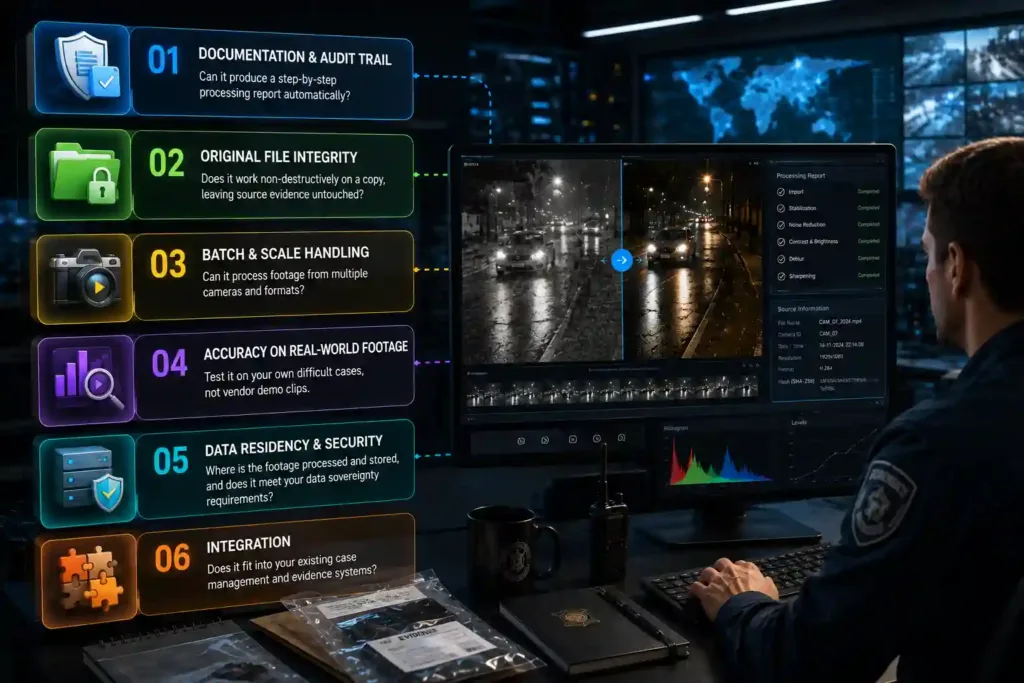
When comparing tools, go beyond the filter list and check:
- Documentation and audit trail. Can it produce a step-by-step processing report automatically?
- Original file integrity. Does it work non-destructively on a copy, leaving source evidence untouched?
- Batch and scale handling. Can it process footage from multiple cameras and formats without manual reformatting each time?
- Accuracy on real-world footage. Test it on your own difficult cases, not vendor demo clips, before deciding.
- Data residency and security. For government and law enforcement use, where is the footage processed and stored, and does that meet your agency’s data sovereignty requirements?
- Integration. Does it fit into your existing case management and evidence handling systems, or does it create a separate silo?
FAQ
1. Does video enhancement software add detail that was not in the original footage?
No, legitimate forensic enhancement clarifies information already present in the data. It adjusts brightness, contrast, noise, and blur to make existing detail more visible. It does not invent pixels or reconstruct a face from nothing, and any tool that claims to do so should not be used for evidentiary purposes.
2. Is enhanced CCTV footage admissible in court?
It can be, provided the process is documented, reproducible, and applied to a working copy while preserving the original file. Courts and standards bodies focus on whether the enhancement process is transparent and scientifically sound, not simply whether the final image looks clearer.
3. How is AI based enhancement different from traditional enhancement software?
Traditional enhancement typically requires an analyst to manually adjust filters frame by frame. AI based tools apply trained models to detect and correct issues like blur, noise, and poor contrast automatically, which speeds up processing on high volumes of footage and can perform better on genuinely difficult footage such as low light or long range CCTV.
4. What footage benefits most from enhancement?
Underexposed nighttime recordings, motion blurred footage from moving subjects or vehicles, long distance CCTV where faces or plates are small in frame, and heavily compressed DVR exports are the most common cases where enhancement makes a meaningful difference.
5. What should a law enforcement agency look for beyond the enhancement filters themselves?
An audit trail for every processing step, non-destructive handling of original evidence, reproducibility of results, and compatibility with existing evidence management workflows. These matter as much as the quality of the enhancement itself once the footage needs to hold up in an investigation or in court.
If your team is evaluating enhancement tools for real casework, it is worth seeing how a purpose built platform handles your actual footage rather than a demo reel. Schedule a demo of Innefu’s AI Vision to test it against your own difficult cases, or explore Innefu’s facial recognition and investigation solutions and Innefu’s law enforcement technology suite for the wider toolset built around this workflow.