
India’s police forces are short by roughly 5.3 lakh personnel against sanctioned strength, and the country’s actual police-population ratio has long trailed the United Nations-recommended benchmark of 222 per lakh population. If you lead a police department, a state home department, or a public safety modernization project, that gap is not an abstract statistic; it’s the reason your officers are stretched across too many beats, too many FIRs, and too many hotspots at once.
Predictive policing exists to close part of that gap. It won’t add a single constable to your sanctioned strength, but it can help you deploy the ones you have where and when they’re actually needed. This guide breaks down what predictive policing really does, where it’s already working in Indian states, what it can’t do, and what to evaluate before you bring it into your department.
Key Takeaways
- Predictive policing uses historical crime, incident, and call data to forecast where and when crimes are more likely to occur and to flag people, places, or victims at elevated risk, not to predict specific individuals will commit a specific crime.
- Its core value for resource-constrained forces is deployment efficiency: putting limited personnel and patrol assets where the data shows they matter most, rather than spreading them thin.
- Indian states are already using it; Delhi Police’s CMAPS, Punjab’s AI system, and systems in Telangana and Jharkhand are among the deployed examples.
- It is not a replacement for policing judgment. Research consistently finds predictive tools work best as a decision-support layer for trained officers, not an autonomous decision-maker.
- Data quality and governance determine outcomes. A model is only as reliable as the data and oversight behind it; this should shape how you select and implement a platform, not just whether you adopt one.
What Predictive Policing Actually Means
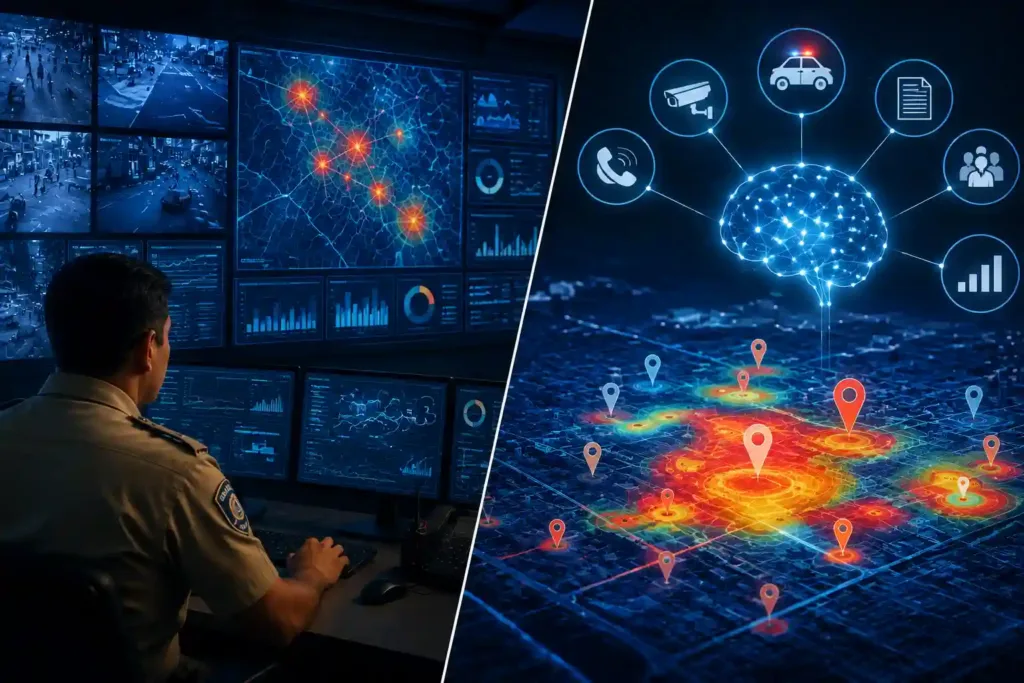
Predictive policing is the practice of applying data analysis and statistical modeling to law enforcement records, crime reports, dispatch and helpline data, and geographic and time-of-day patterns to anticipate where police attention is most likely to be needed. The U.S. National Institute of Justice, which has funded much of the foundational research in this area, describes it as taking data from disparate sources, analyzing it, and using the results to anticipate, prevent, and respond more effectively to future crime.
It’s worth being precise about what this is not: a system that names a future offender before they act. RAND Corporation’s widely cited operational guide for police departments is direct about this limitation: predictive methods are not a crystal ball, but they can enhance proactive policing and improve intervention strategies. That distinction matters when you’re setting expectations with your command staff, your state government, or the public.
The Four Things Predictive Models Actually Forecast
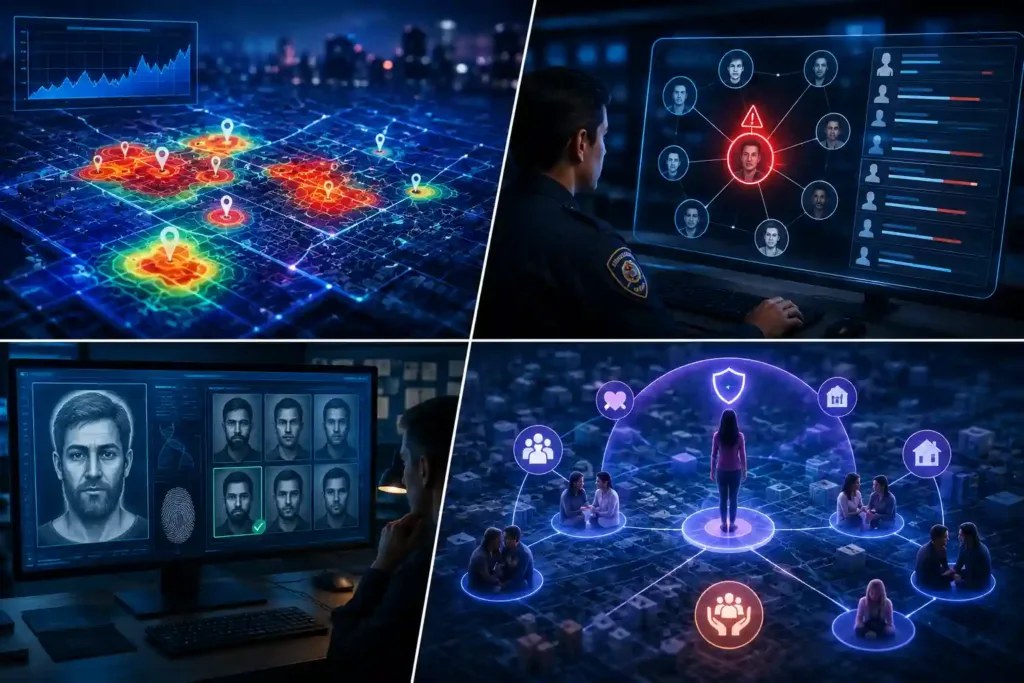
RAND’s research, developed for the National Institute of Justice, groups predictive policing applications into four categories: methods for predicting crimes, predicting offenders, predicting perpetrators’ identities, and predicting victims of crime. In practice, this looks like:
- Crime forecasting: identifying locations and time windows with elevated probability of specific crime types, using hotspot mapping, risk-terrain modeling, and regression analysis.
- Offender-risk flagging: surfacing individuals whose historical pattern of contact with police correlates with a higher likelihood of future offending for targeted, supervised intervention.
- Identity resolution: matching crime-scene evidence and behavioral patterns against existing records to narrow a suspect pool in ongoing investigations.
- Victim-risk identification: flagging people or groups, for example, those with a history of domestic violence complaints, who face elevated risk, so outreach and protective resources can reach them earlier.
What This Means for Your Department

Every officer-hour gets used more deliberately
This is the single biggest pain point predictive policing addresses for under-strength forces. When PRS Legislative Research analyzed Bureau of Police Research and Development data, it found that state police forces carried roughly 24% vacancies as of January 2016, leaving an actual strength of about 137 police per lakh population against a sanctioned figure of 181, both well short of the UN-recommended 222 per lakh. More recent BPRD figures show the shortfall persisting: by 2022, sanctioned posts had risen to 26.8 lakh, but vacancies still stood at roughly 5.95 lakh, even as the vacancy rate had edged down from 25% to 22%.
Hotspot mapping and risk-terrain analysis let you match patrol density to actual demand instead of dividing officers evenly across beats that don’t carry equal risk. Analysts writing for AMU’s criminal justice program note this shows up directly in resource efficiency, aiding decision-making and the more efficient distribution of funds and personnel</cite>.
Investigations move faster with the data you already have
Most departments already sit on years of FIR records, call logs, and case files. Predictive analytics platforms exist largely to make that legacy data usable in real time, cross-referencing crime-scene details against historical records to narrow suspect pools, a function AMU’s overview describes as helping investigators narrow down potential suspects, identify similar crime patterns, and identify places where future crimes are most likely to occur.
Officers shift from reactive to proactive posture
AMU’s summary of the research literature frames this as one of the field’s core advantages: predictive policing shifts the focus of law enforcement departments toward crime prevention rather than reaction, while also supporting violence prevention by identifying high-risk individuals for targeted intervention such as monitoring, social services, or community outreach, not enforcement action alone.
Decisions get easier to justify internally and publicly
A recurring theme across the academic literature is that structured, evidence-based deployment decisions are more defensible than ad hoc ones. A review published in the International Journal of Public Administration notes general agreement that predictive analytics can help law enforcement in their strategic and tactical planning and how they deploy resources. For a department answering to a state home ministry or a public increasingly asking why patrols are where they are, that evidentiary basis is itself a form of institutional protection.
Predictive Policing in India: Where It’s Already Running
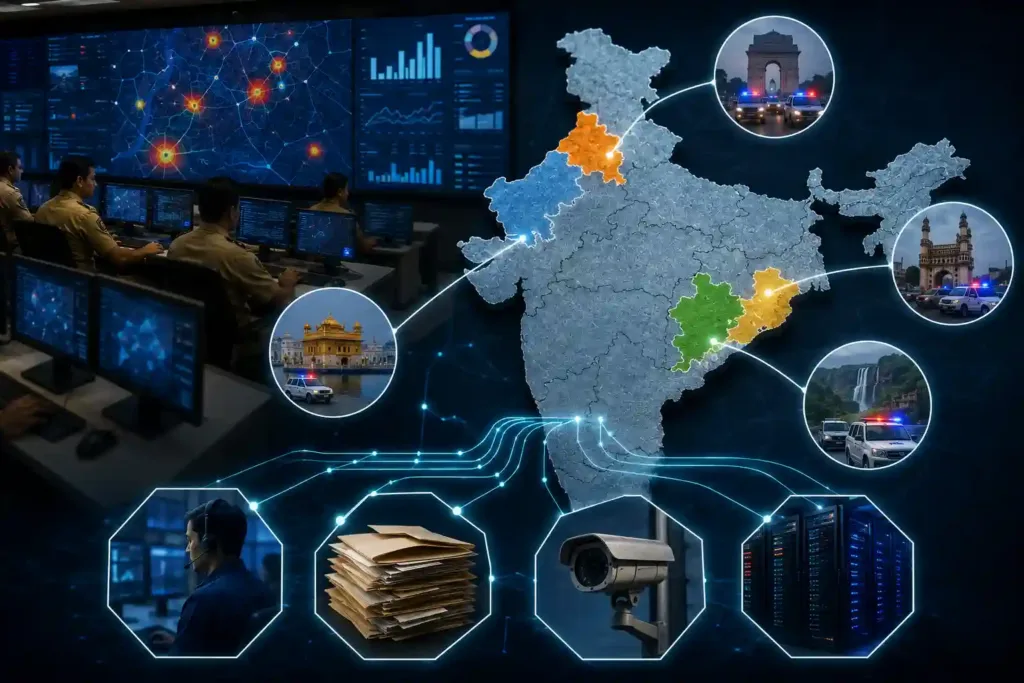
This isn’t a hypothetical for Indian law enforcement; several states have moved from pilot to deployment.
- Delhi Police’s CMAPS (Crime Mapping, Analytics, and Predictive System), announced in 2015, pulls real-time data from the city’s police helpline to identify criminal hotspots across the city. The system was also built to rank police districts, define police station-level boundaries, and generate law-and-order hotspot reporting.
- Punjab, Telangana, and Jharkhand have each built out their own predictive policing capabilities, according to research published by LSE’s Human Rights blog, which notes that Delhi, Telangana, and Jharkhand already had full-fledged predictive policing systems well before other states began piloting the approach.
- Punjab’s AI System (PAIS) has been recognized with a Smart Policing award, one indicator that state-level predictive tools are being evaluated favorably even as adoption spreads unevenly across the country.
The pattern across these deployments is consistent: departments layer predictive analytics on top of infrastructure they already operate, helpline data, FIR databases, and CCTNS records, rather than replacing existing systems.
What Predictive Policing Cannot Do and Why That Matters for Implementation
A responsible evaluation of any predictive platform has to be honest about its limits, because the limits should shape how you deploy it, not whether you consider it at all.
It reflects the data it’s trained on. If historical enforcement data over-represents certain areas or communities due to past patrol patterns, a model trained on that data can reproduce the same skew. Legal researchers writing on this topic caution that crime databases document law enforcement’s response to reported situations rather than an objective, complete record of all crime that occurs, which is precisely why data governance, human review, and periodic bias audits need to be built into deployment, not bolted on afterward.
Empirical evidence on outcomes is still developing. A 2019 literature review in the International Journal of Public Administration found that most evaluation studies test whether intended outcomes were achieved without systematically checking for unintended or adverse effects, a gap the authors flag as needing more rigorous field research.
It supports officer judgment; it doesn’t replace it. Every credible operational framework, including RAND’s, treats predictive output as one input into a human decision, not a standalone verdict. Departments that get the most value tend to be the ones that train officers to use predictive flags as a starting point for investigation, not a conclusion.
None of this is an argument against adoption; it’s an argument for choosing a platform and an implementation process that builds in oversight, auditability, and human sign-off from day one.
What to Look for in a Predictive Policing Platform
If your department is evaluating vendors, a few questions tend to separate genuinely useful platforms from dashboards that look impressive in a demo:
- Does it work with your existing data? CCTNS records, FIR databases, helpline logs, and CCTV feeds are usually already there; the platform should ingest and unify them, not require you to rebuild your data infrastructure.
- Can your analysts see how a prediction was generated? Black-box outputs are hard to defend in court, to a review board, or to the public. Look for explainability, not just a risk score.
- Does it support multiple prediction types, or only hotspot mapping? Departments with investigation backlogs benefit from suspect-matching and identity-resolution capabilities as much as from spatial forecasting.
- What’s the vendor’s track record with government and law enforcement deployments specifically, as opposed to commercial analytics use cases with very different data and accountability requirements?
- Is there a clear audit and oversight layer for flagged individuals or locations so use stays within your department’s legal and procedural boundaries?
Innefu Labs’ predictive analytics platform, Prophecy, was built around these questions, unifying structured and unstructured data from multiple law enforcement sources into a single system for crime forecasting, suspect identification, and resource planning. It’s worth reviewing alongside our broader crime and criminal data analytics solutions and facial recognition and identity verification tools if your department is building out a fuller technology stack rather than adopting point solutions.
FAQ
1. Is predictive policing the same as facial recognition or CCTV surveillance?
No. Facial recognition and CCTV are data-collection tools that can feed into a predictive system, but predictive policing itself is the analytical layer that turns collected data, from any source, into forecasts about crime patterns, risk locations, or investigative leads.
2. Does predictive policing replace the need for more police personnel?
No. It’s a force-multiplier for the personnel you have, not a substitute for closing sanctioned-strength vacancies. Departments get the most value from it precisely because officer time is limited and needs to be allocated deliberately.
3. How much historical data does a department need before predictive policing is useful?
There’s no fixed threshold, but most operational deployments, including Delhi’s CMAPS, build on data departments already collect through helplines, FIRs, and CCTNS, rather than requiring new data collection from scratch.
4. Is predictive policing legal to use in India?
Predictive policing tools are already deployed by several state police forces in India. As with any law enforcement technology, use should stay within existing legal frameworks governing data collection, privacy, and due process, and departments should build internal oversight and audit processes around any flagged output.
5. What’s the difference between predictive policing and intelligence-led policing?
Intelligence-led policing is the broader strategic approach of using intelligence to guide operations. Predictive policing is often described as its data-driven evolution, applying statistical and analytical techniques to that intelligence to generate forward-looking forecasts rather than only after-the-fact analysis.
Evaluating predictive analytics for your department or agency? Schedule a demo of Innefu’s Prophecy platform to see how it works with the data systems you already run.