
Your CFO wants a number before approving next year’s security spend. Here is one: the global average cost of a data breach just hit $4.99 million, a 12% jump and a record high, according to IBM’s 2026 Cost of a Data Breach Report. In India, that number is INR 25.5 crore, up nearly 16% from last year.
Those figures are not abstractions. They are the direct result of decisions made (or delayed) by security and IT leaders, months before an incident ever happens. If you are building a budget justification, briefing your board, or simply trying to understand where your organization stands, this guide breaks down what a cyber attack actually costs, where that cost comes from, and what measurably reduces it.
Key Takeaways
- The global average cost of a data breach reached $4.99 million in 2026, a 12% year-over-year increase and the highest ever recorded.
- In India, average breach costs hit INR 25.5 crore in 2026, up 15.9% from the previous year, with financial services facing the highest costs at INR 40.9 crore.
- AI-driven attacks rose 56% year-over-year, and 26% of malicious breaches in India in 2026 involved AI-generated attack techniques.
- Organizations using AI and automation extensively in their security operations saved an average of $1.93 million per breach compared to those using none.
- Phishing remains the most common initial attack vector, in India and globally.
- The financial impact of a breach extends well past the incident itself: detection, notification, regulatory penalties, and lost business often outweigh the immediate remediation cost.
What “Cyber Security Impact” Actually Means for a Business

Cyber security is often framed as an IT problem. For the leaders who have to answer for a breach, it is a business continuity problem, a legal exposure problem, and a trust problem, all at once.
A single successful attack touches nearly every part of an organization: finance (through fraud or ransom demands), legal (through regulatory reporting obligations), operations (through downtime), and the board (through the questions that follow). Understanding the full scope of impact is what makes a security budget defensible.
The Real Financial Cost of a Cyber Attack in 2026

Global costs are rising, not falling
For the first time in five years, breach costs had briefly declined in 2025. That trend reversed sharply in 2026. IBM’s latest research puts the global average cost of a data breach at $4.99 million, driven by higher detection, escalation, and lost business costs. AI-driven attacks, including deepfake impersonation and AI-enabled malware, increased 56% year-over-year.
India’s breach costs are climbing faster than the global average
India recorded its highest-ever average breach cost in 2026: INR 25.5 crore, a 15.9% rise over the previous year. The average breach in India now compromises around 39,500 records. Financial services organizations face the steepest costs, at INR 40.9 crore per breach, followed by technology and communications firms.
Nearly a quarter of malicious breaches in India in 2026 involved AI-generated attack techniques, and phishing (including voice and SMS phishing) remains the single most common way attackers get in.
Where the money actually goes
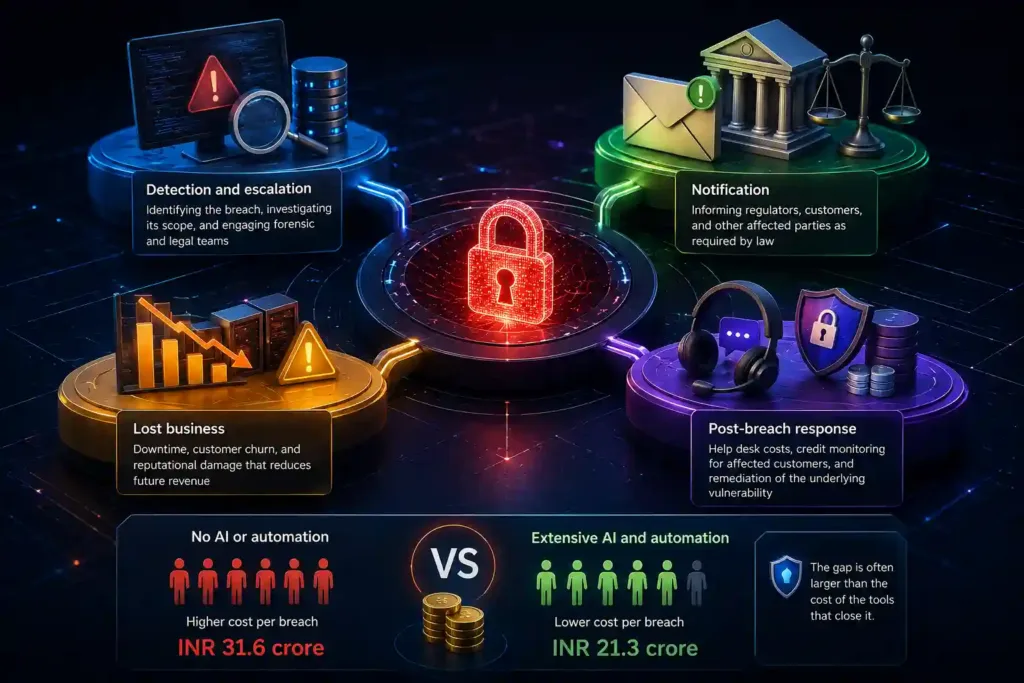
A breach rarely shows up as one lump cost. It is spread across several buckets:
- Detection and escalation: identifying the breach, investigating its scope, and engaging forensic and legal teams
- Notification: informing regulators, customers, and other affected parties as required by law
- Lost business: downtime, customer churn, and reputational damage that reduces future revenue
- Post-breach response: help desk costs, credit monitoring for affected customers, and remediation of the underlying vulnerability
Organizations with no AI or automation in their security operations paid nearly 50% more per breach in India than those using it extensively, INR 31.6 crore compared to INR 21.3 crore. That gap alone is often larger than the cost of the tools that close it.
Beyond the Balance Sheet: The Costs That Don’t Show Up in a Single Line Item

Reputation and customer trust
Trust takes years to build and one incident to damage. Customers who lose confidence in how their data is handled do not always leave loudly, they simply stop renewing, stop referring, and move to a competitor. For B2B and BFSI organizations especially, a breach disclosure can affect deals already in the pipeline.
Regulatory and legal exposure
With India’s Digital Personal Data Protection (DPDP) Act now shaping how organizations must handle and report on personal data, non-compliance during or after a breach is a separate and compounding cost. Regulators are not only assessing whether a breach happened, but whether reasonable security measures were in place before it did.
Operational disruption
Ransomware and destructive attacks do not just steal data, they can halt production lines, freeze transaction systems, and lock internal teams out of the tools they need to work. For manufacturing, BFSI, and critical infrastructure operators, this operational cost often exceeds the financial one.
Why Attackers Are Increasingly Targeting AI Systems

As enterprises adopt AI and automation faster than they adopt governance for it, attackers have noticed. IBM’s 2026 research found that breaches involving AI model inversion, where an attacker reconstructs sensitive training data from a model’s outputs, carry an average cost of $6 million globally. Shadow AI, meaning employees using unsanctioned AI tools without security oversight, added INR 1.79 crore to the average cost of a breach in India where it was present.
This matters for IT leaders because it means the attack surface has quietly expanded. Access controls and governance policies written for traditional IT systems often do not extend to the AI tools your teams are already using.
How to Actually Reduce Breach Risk and Cost
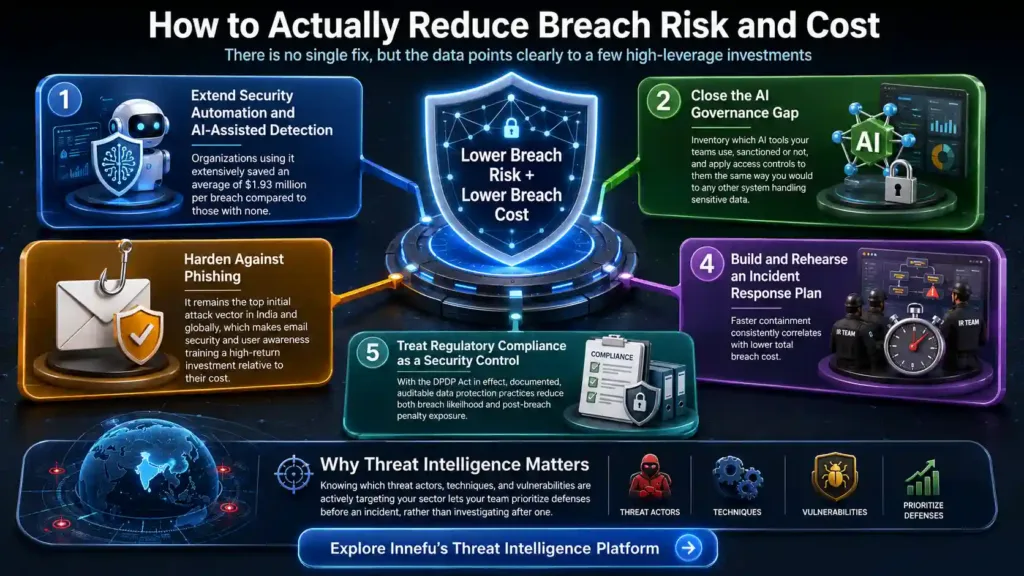
There is no single fix, but the data points clearly to a few high-leverage investments:
- Extend security automation and AI-assisted detection. Organizations using it extensively saved an average of $1.93 million per breach compared to those with none.
- Close the AI governance gap. Inventory which AI tools your teams use, sanctioned or not, and apply access controls to them the same way you would to any other system handling sensitive data.
- Harden against phishing specifically. It remains the top initial attack vector in India and globally, which makes email security and user awareness training a high-return investment relative to their cost.
- Build (and rehearse) an incident response plan. Faster containment consistently correlates with lower total breach cost.
- Treat regulatory compliance as a security control, not a checkbox. With the DPDP Act in effect, documented, auditable data protection practices reduce both breach likelihood and post-breach penalty exposure.
Threat intelligence plays a direct role in several of these. Knowing which threat actors, techniques, and vulnerabilities are actively targeting your sector lets your team prioritize defenses before an incident, rather than investigating after one. [Explore Innefu’s Threat Intelligence Platform] for a closer look at how this works in practice.
Building an Incident Response Plan That Actually Holds Up
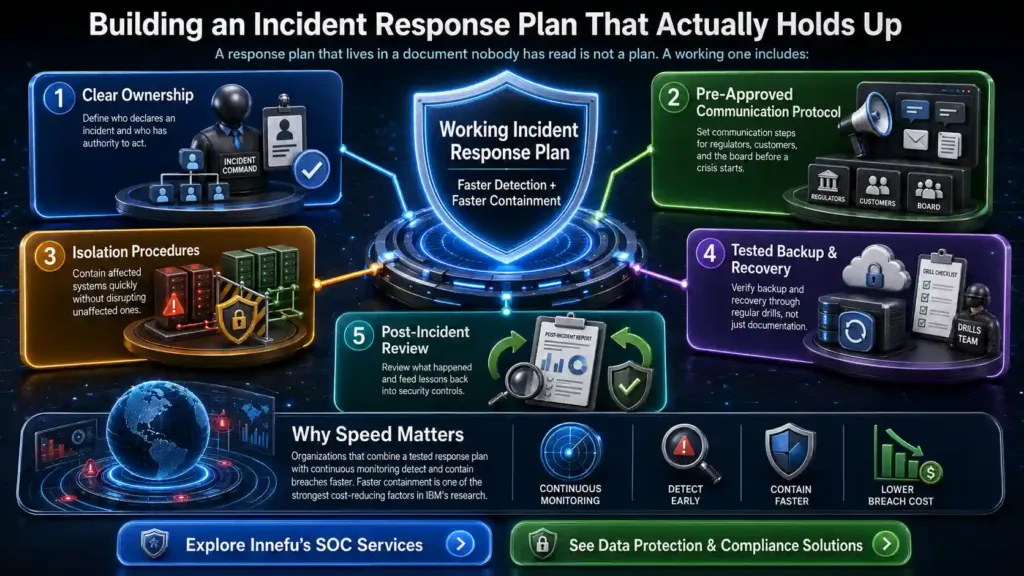
A response plan that lives in a document nobody has read is not a plan. A working one includes:
- Clear ownership: who declares an incident, and who has authority to act
- A pre-approved communication protocol for regulators, customers, and the board
- Isolation procedures to contain affected systems without disrupting unaffected ones
- A tested backup and recovery process, verified through regular drills, not just documented
- A post-incident review process that feeds back into your security controls
Organizations that combine a tested response plan with continuous monitoring detect and contain breaches faster, and faster containment is one of the strongest cost-reducing factors in every year of IBM’s research. [Learn about Innefu’s Security Operations Center (SOC) services] if you need help building or running this capability. For organizations specifically navigating DPDP compliance alongside their security roadmap, [see Innefu’s data protection and compliance solutions].
Frequently Asked Questions
1. What is the average cost of a data breach in 2026?
Globally, the average cost of a data breach reached $4.99 million in 2026, a 12% increase over the previous year and a record high, according to IBM’s Cost of a Data Breach Report. In India, the average cost was INR 25.5 crore, up 15.9% year-over-year.
2. Which industries face the highest cyber attack costs in India?
Financial services organizations recorded the highest average breach cost in India in 2026, at INR 40.9 crore, followed by technology and communications firms.
3. What is the most common way attackers breach an organization?
Phishing, including voice and SMS phishing, remains the most common initial attack vector in India and globally.
4. Does using AI and automation in security actually reduce breach costs?
Yes. Organizations that used AI and security automation extensively saved an average of $1.93 million per breach globally compared to organizations using none, and the gap was similarly large in India.
5. How does the DPDP Act affect breach costs for Indian businesses?
The Digital Personal Data Protection Act requires organizations to demonstrate reasonable security practices around personal data. Non-compliance discovered during or after a breach adds regulatory and legal costs on top of the direct breach cost, making documented, auditable data protection practices a financial as well as legal priority.
6. What is shadow AI and why does it matter for security budgets?
Shadow AI refers to employees using AI tools that have not been sanctioned or secured by the organization’s IT or security team. It expands the attack surface in ways traditional access controls do not cover, and it measurably increases breach costs where present.
If you are assessing where your organization stands against these numbers, or want a clearer picture of the threats actively targeting your sector, Innefu’s team can walk you through a threat assessment tailored to your industry. It is a practical starting point before the next budget cycle, not after an incident forces the conversation.