
When investigators search for information online, the results returned by Google or another conventional search engine represent only a part of what is available on the internet.
Some information is openly published and indexed. Other information sits behind a login, subscription or specialised database and cannot be discovered through a normal search. There is also a smaller category of online services that operates through specialised networks and requires dedicated software or configurations to access.
These environments are commonly described as the surface web, deep web and dark web.
The terms are often used interchangeably, but they mean different things. More importantly, each presents a different set of opportunities and challenges for investigators, intelligence teams and security professionals.
The key question is not simply, “Can this information be found online?”
It is: Where does the information exist, how can it be accessed appropriately, how reliable is it, and how does it connect with information from other sources?
Surface Web, Deep Web and Dark Web: What’s the Difference?
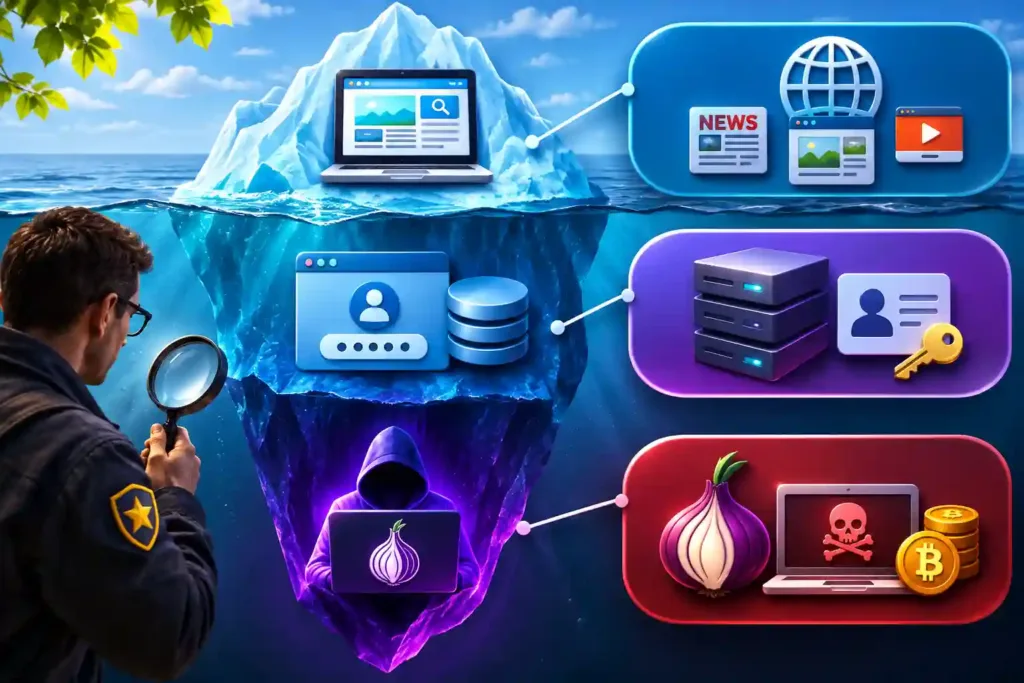
At a basic level, the three terms describe different types of online information and how easily that information can be discovered.
| Surface Web | Deep Web | Dark Web | |
|---|---|---|---|
| What it means | Public web content that can generally be indexed by search engines | Online content that is not normally indexed by conventional search engines | A subset of the deep web operating through specialised networks |
| Examples | News websites, public portals, blogs, public webpages | Private portals, subscription databases, online accounts, specialised systems | Onion services and other services operating on specialised networks |
| Typical access | Standard browser and search engine | May require login, subscription or authorised access | Requires specialised network access or software |
| Investigation value | Publicly available information and open-source signals | Information contained within restricted or specialised systems | Information and activity that may not be visible through conventional web searches |
| Key challenge | Volume, relevance and verification | Access, context and integration | Discovery, attribution, verification and preservation |
The important distinction is that the deep web is not the same thing as the dark web.
The deep web includes a huge amount of completely ordinary information. Your email inbox, online banking account, private company portal and many subscription databases all fall into the broad category of information that conventional search engines cannot freely index.
The dark web is a much smaller subset involving specialised networks and services.
What is the Surface Web?

The surface web, sometimes called the open web or clear web, is the part of the internet that is publicly accessible and generally discoverable through conventional search engines. News websites, public government portals, company websites, public social media posts, blogs, forums and publicly available reports are all examples.
For investigators, the surface web is often the starting point for research. A search about an individual, organisation, event or location may reveal information across dozens of different sources. A government notification might establish a date. A news report might provide context. A public company page might reveal an association. A public social media post could provide another piece of information.
The challenge is that useful information is rarely presented in one convenient place. An investigator may have to compare multiple sources, determine whether they refer to the same entity and establish whether the information is current and reliable. This is where OSINT becomes more than simply “searching Google”.
Also Read: Complete guide to OSINT
Why the Surface Web Still Matters

There is sometimes an assumption that serious investigations require access to hidden or specialised parts of the internet. That is not necessarily the case.
A significant amount of relevant information is already publicly available. The difficulty is that it may be spread across different websites, platforms, languages and formats. For example, information about an organisation could be distributed across its website, news coverage, public filings, social media accounts, industry publications and other publicly accessible sources.
Individually, each source may reveal very little. When properly correlated, however, they can provide a much more useful picture. This makes source verification and cross-source analysis just as important as the initial search.
What is the Deep Web?

The deep web broadly refers to online content that conventional search engines do not index or cannot freely crawl. That definition sounds more mysterious than it really is. Most people use the deep web every day.
An email account is part of the deep web. So is an online banking portal. A subscription-based research database, private customer portal or internal enterprise application may also contain deep-web information.
The common characteristic is not that the information is illegal or secret. It is that the information is not openly indexed and searchable through conventional search engines. For investigators, this creates a different challenge from surface-web research. Instead of asking only, “What can I find through a search engine?”, the question becomes: “What relevant information may exist within specialised or restricted information environments, and what legitimate access is available to it?”
This distinction is particularly important for intelligence teams working with multiple sources. Information may exist across subscription platforms, specialised databases, gated information systems and other sources that sit outside conventional web search.
Why Deep-Web Information Can Be Valuable

The value of deep-web information often comes from the additional context it can provide. A public source may tell an investigator that an event happened. A specialised database might provide additional information about an organisation, transaction, asset or entity associated with that event.
The two sources become more useful when they can be examined together. This is also where the distinction between data access and intelligence analysis becomes important. Accessing another source does not automatically produce better intelligence. The information still needs to be understood, correlated and evaluated.
What Can Investigators Access From Each Layer?

The practical difference between these three environments becomes clearer when we look at the kinds of information an investigator may encounter.
Surface web
Investigators may encounter:
- Public websites
- News reports
- Public social media content
- Public company information
- Government portals
- Research reports
- Public forums
- Open databases
The main challenge is usually finding relevant information among a very large volume of publicly available content.
Deep web
Investigators may encounter information within:
- Subscription databases
- Private portals
- Authenticated services
- Specialised information platforms
- Enterprise systems
- Database-driven services
- Other restricted or non-indexed sources
The challenge is more about access, permissions, context and integration.
Dark web
Investigators may encounter:
- Specialised forums
- Onion services
- Publicly accessible discussions
- Marketplace listings
- Threat-related conversations
- References to exposed information
The challenges can include discovery, source attribution, authenticity, volatility and preservation.
The Real Challenge is Not Finding Information. It is Connecting It.

This is where online investigations become considerably more complex. Imagine that an investigator finds a particular username in a public online discussion. On its own, that username may have limited value.
The same identifier may then appear in another source. Perhaps there is a related public profile, a reference in a specialised database, or another online record associated with the same entity. The investigator now has a different problem. Are these actually the same person or organisation?
This is an entity resolution problem. The same challenge applies to organisations, websites, email addresses, phone numbers, images, locations and other identifiers. Investigators may need to examine several attributes and determine whether seemingly separate pieces of information actually relate to the same entity.
This is one reason why modern intelligence platforms are moving beyond simple source collection towards correlation and analysis.
Why Multi-Source Intelligence Matters

The surface web, deep web and dark web should not be viewed as three completely separate intelligence silos. The value often comes from combining information from different environments.
A public source may provide the initial lead. A specialised database may provide additional context. Another source may help establish whether the entities mentioned in both records are connected.
The objective is not to collect as much information as possible. It is to determine which information is relevant, how different data points relate to each other, and whether the resulting picture can be independently verified.
Also read: Understanding Multi-Source Intelligence: ELINT, IMINT, OSINT, HUMINT and Beyond
This becomes particularly important as investigations become more data-intensive. An analyst who has to search every source independently may spend significant time switching between systems, manually comparing results and trying to maintain context. A unified analytical environment can reduce some of this fragmentation by bringing multiple intelligence sources together.
Deep Web Does Not Mean “Secret Information”

This is one misconception worth clearing up. The term “deep web” describes how information is accessed and indexed, not how sensitive or secret it is. A subscription research database can be part of the deep web. So can a private employee portal. So can an online banking account. None of those are inherently suspicious.
Similarly, the fact that a source is publicly available does not automatically make everything published there accurate. The surface web can contain misinformation, outdated information, impersonation accounts and manipulated media.
In other words, visibility and reliability are two different things. This is a critical distinction for investigators.
What Makes Dark-Web Intelligence More Challenging?

Dark-web investigations introduce several additional challenges. One is discovery. Information available through specialised networks may not appear in conventional search results.
Another is attribution. An online username does not automatically establish the identity of the person behind it. There is also the question of authenticity. A post, listing or claim may be deliberately misleading.
Then there is volatility. Online services can disappear or change, meaning that information available during one investigation may not remain accessible indefinitely. This makes documentation and preservation important when information may become relevant to a formal investigation.
The same principle applies beyond the dark web. Online information can change or disappear regardless of where it was originally published.
The Importance of Verification

Finding information online is only the beginning. Before treating an online finding as reliable intelligence, investigators need to consider where it came from, whether the source can be trusted, whether the information can be corroborated and whether the entities involved have been correctly identified.
For example, two accounts with similar names may belong to completely different people. A photograph may have been published years before the event with which it is now associated. A website may reproduce information from another source without independent verification.
Cross-checking therefore matters. A useful investigative process is to ask:
- Where did this information originate?
- Who is behind the source?
- When was it published or collected?
- Can the claim be corroborated independently?
- Does the information actually relate to the entity being investigated?
- Has the relevant information been documented and preserved appropriately?
These questions are useful whether the information comes from a public website, a subscription database or a specialised online environment.
Language Creates Another Layer of Complexity

Online investigations in India have another challenge: language diversity. Information may appear in English, Hindi or another Indian language. It may also appear in Romanised forms, abbreviations, alternate spellings or combinations of multiple languages.
The same individual, organisation or location may therefore appear differently across different sources. An investigator searching for only one spelling may miss relevant information. This is why multilingual search, translation, transliteration and entity resolution are increasingly important capabilities in modern OSINT and intelligence workflows.
The issue becomes even more important when information from different regions or international sources needs to be analysed together.
From Data Collection to Intelligence Analysis

The difference between a collection platform and an intelligence platform becomes clearer here.
Collecting information answers one question:
- What information is available?
Intelligence analysis asks several more:
- What does it mean?
- How does it relate to other information?
- Is the connection genuine?
- Is there a pattern?
- Has the information changed over time?
- What can be independently verified?
This is why features such as semantic search, timelines, alerts and correlation can be valuable.
Can AI Help With Deep-Web and Dark-Web Intelligence?

AI can help analysts deal with the scale and complexity of online information, particularly when multiple sources need to be searched, compared and correlated. Depending on the platform and its data sources, AI can assist with activities such as semantic search, entity identification, relationship analysis, summarisation, alerts and trend analysis.
In a deep-web intelligence environment, this can be particularly useful because relevant information may be distributed across multiple sources rather than sitting in one searchable database. Deep Web Fusion’s feature overview, for example, describes AI-assisted semantic search, multi-source intelligence, timelines and alerts within a common analytical environment. But AI should support analysts, not replace their judgement.
An algorithm can identify a potential relationship between two entities. An investigator still needs to assess whether that relationship is meaningful and whether the underlying information is reliable. This distinction is particularly important when intelligence findings may influence an investigation or subsequent decision-making.
Surface Web vs Deep Web vs Dark Web: Key Takeaways

The surface web, deep web and dark web are often treated as mysterious or interchangeable terms. They are neither.
The surface web consists largely of publicly accessible information that conventional search engines can index.
The deep web consists broadly of information that conventional search engines cannot normally index, including private accounts, subscription databases and specialised systems.
The dark web is a smaller subset of the deep web that operates through specialised networks and services.
For investigators, however, the distinction is only the starting point.
The more important challenge is understanding what information exists across these environments, how different sources relate to each other, how identities can be verified and how useful signals can be separated from unreliable information.
That is why modern intelligence workflows increasingly focus on data fusion and analysis, rather than simply collecting more sources.
Conclusion

The internet that investigators can see through a conventional search engine is only part of the larger information environment.
The surface web provides a vast amount of publicly accessible information. The deep web contains information that sits outside conventional search indexing, including specialised databases, subscription services and private systems. The dark web represents a smaller set of specialised networks and services that operate differently from the conventional web.
For investigators, knowing these definitions is useful, but it is only the beginning. The bigger challenge is connecting information across sources and determining what that information actually tells us.
An isolated webpage, database record or online post may provide only a small clue. When relevant information from different sources can be searched, correlated, placed in context and analysed together, those individual clues can become a much more useful intelligence picture.
That is ultimately the role of modern deep-web intelligence platforms. The objective is not simply to look beyond the surface web. It is to help analysts bring fragmented information together and turn it into something they can understand and act upon.
Innefu’s Deep Web Fusion is built around this principle, combining information from multiple intelligence sources with AI-powered correlation, semantic search, timelines and alerts to provide analysts with a more unified environment for intelligence analysis. The web may have different layers, but for investigators, the real objective remains the same: find the relevant signal, understand its context and connect it to the bigger picture.
Frequently Asked Questions
1. Is the deep web the same as the dark web?
No. The deep web broadly refers to online content that is not indexed by conventional search engines. The dark web is a smaller subset that operates through specialised networks.
2. Is the deep web illegal?
No. Much of the deep web consists of completely ordinary services such as email accounts, online banking, private portals and subscription databases. The legality depends on the activity and the information involved, not simply on whether a source is part of the deep web.
3. Is the dark web illegal?
The technology itself is not inherently illegal. Specialised networks such as Tor also have legitimate privacy-preserving uses. Particular activities conducted through them may, of course, be unlawful.
4. What can investigators find on the dark web?
Depending on the investigation and the sources available, investigators may encounter discussions, listings, references to exposed information, threat-related content and other activity that is not visible through conventional web searches.
5. Can AI analyse the deep web?
AI can assist with analysing information from multiple sources, including semantic search, correlation, entity analysis, summarisation, alerts and timelines. The exact capabilities depend on the platform and the sources it is authorised and technically able to access.
6. Is information found online automatically usable as evidence?
No. Finding information online does not automatically establish its authenticity, provenance, identity or evidentiary value. Investigators need to consider the circumstances of collection, verification, preservation and the applicable legal requirements.