
For investigators working in India, the bigger challenge is that the same person, place, organisation, event or keyword can appear in several languages, scripts and spellings across the open web. A name may be written in Devanagari on one platform, Romanised on another and abbreviated or misspelled somewhere else. A Hindi post may contain English technical terms. A regional-language post may refer to a place using a local spelling that does not match its English equivalent.
If an investigation searches for only one spelling or one language, relevant information can be missed before analysis even begins.
This makes multilingual OSINT a combination of language identification, transliteration, translation, search expansion, entity matching and contextual analysis.
Key takeaways
- Transliteration converts text between scripts while attempting to retain pronunciation. Translation changes the language and meaning.
- Searching only the English spelling of a name can miss relevant regional-language content.
- Names and places are particularly difficult because transliteration is not always one-to-one.
- Romanized Hindi and other Indian languages create an additional challenge because people often write regional languages using Latin characters.
- Translation can help analysts understand content, but the original-language material should remain available for context and review.
- Multilingual entity resolution is critical when the same person or organisation appears under different spellings.
- AI can make multilingual OSINT considerably faster, but analysts still need to validate important findings against the original content.
- For Indian law enforcement and intelligence teams, multilingual capability should be evaluated as an end-to-end investigative workflow, not simply as a translation feature.
Why language is an OSINT problem in India

India’s digital information environment is inherently multilingual. A single investigation can involve Hindi, English, Marathi, Bengali, Tamil, Telugu, Gujarati, Punjabi, Malayalam, Kannada, Urdu or other languages. It can also involve people switching between languages within the same post or conversation.
That creates a problem that does not exist to the same extent in a monolingual search environment. Consider a simple example. An investigator is researching an event involving a person named Rahul Sharma. The same individual might appear online as:
- Rahul Sharma
- राहुल शर्मा
- Rahul Sarma
- Raahul Sharma
- Rahul Sh.
- R. Sharma
- Rahul Sharma Ji
- A username that bears no obvious resemblance to the person’s name
Now add location. A place could appear as:
- Lucknow
- लखनऊ
- Lakhnau
- Lucknow City
- स्थानीय shorthand used by people in the area
The investigator is no longer searching for one keyword. They are searching for a family of representations of the same underlying entity. That is where multilingual OSINT becomes an intelligence problem rather than a translation problem.
Translation and transliteration are not the same thing

This distinction is fundamental.
Translation
Translation converts meaning from one language into another. For example: “पुलिस ने जांच शुरू की“ could be translated into: “The police have started an investigation.”
Transliteration
Transliteration converts text from one script into another while attempting to preserve pronunciation. For example: “दिल्ली” → “Dilli” The output is still essentially the same word, but written using a different script.
This matters enormously in OSINT because an investigator may encounter the same name or place in both forms.
Why this matters for search
Suppose an investigator searches only for: “दिल्ली” They may miss: Delhi, Dilli, Dilli NCR or a Romanized variation used by an individual on social media.
Conversely, searching only for Delhi can miss content written entirely in Devanagari. So multilingual OSINT needs to answer two different questions: “What does this content mean?” and “How else might the same information have been written?”
The second question is where transliteration becomes particularly valuable.
The hidden challenge: Romanized Indian languages
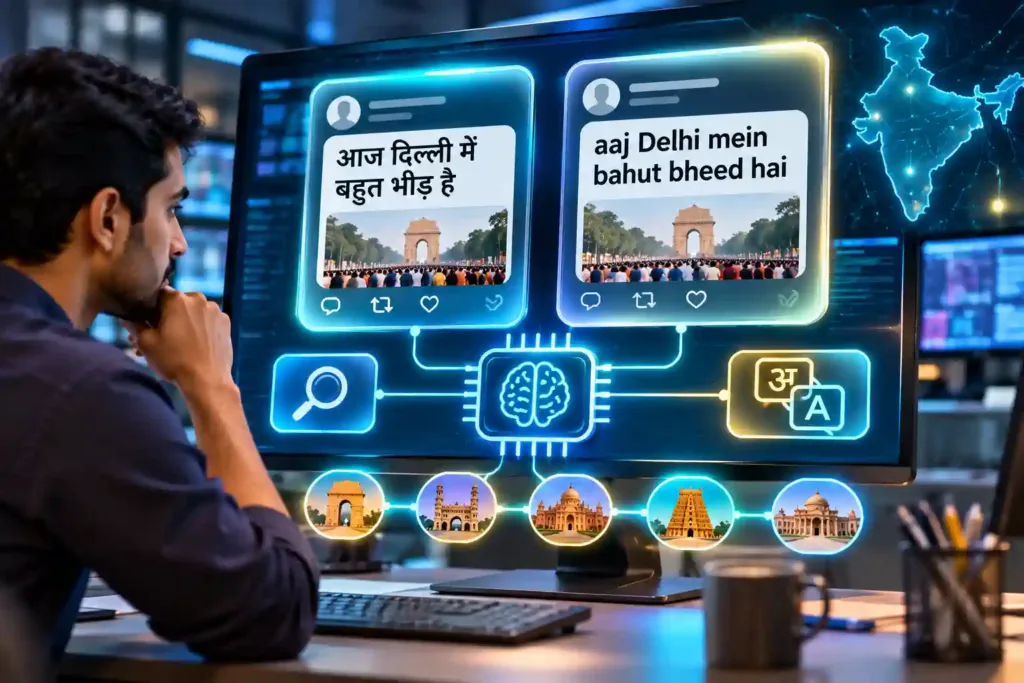
One of the most interesting problems in Indian-language OSINT is that users do not always write Indian languages using Indian scripts. Hindi is a simple example. A user might write: “आज दिल्ली में बहुत भीड़ है” or: “aaj Delhi mein bahut bheed hai” The second version is not English. It is Hindi written using the Roman alphabet.
This creates a problem for systems that assume: Latin script = English. It is not. The same phenomenon can occur across other Indian languages, particularly in informal digital communication.
For OSINT, this means language detection should ideally answer not only: “Which language is this?” but also: “Is this language being written in its native script or in Roman characters?” That distinction can determine whether an investigation finds the content at all.
The hidden challenge: Romanized Indian languages

Imagine an investigator is monitoring public discussion around a major event in a city. The English-language search produces hundreds of posts and news reports. It looks comprehensive. Then someone searches the relevant Hindi terms and finds a completely different set of conversations.
The issue is not necessarily that the English search was wrong. It was incomplete. Regional-language content can contain:
- Local terminology
- Local names
- Informal descriptions
- Place-specific references
- Community-specific expressions
- Alternative spellings
- Information that never appears in English-language media
The same applies to news. A local-language publication may report an event before national English-language outlets pick it up. A regional social account may use a local name for a person or location that does not appear in English search results.
This is why multilingual OSINT should be treated as coverage expansion. Translation helps the analyst understand the information. Multilingual search helps the analyst find the information in the first place.
1. Names are harder than ordinary words

Names create one of the biggest challenges in multilingual OSINT. A normal dictionary word often has an established translation or transliteration. A person’s name does not necessarily behave that way.
Some variations may be harmless spelling differences. Others may refer to completely different people. This means a search engine or OSINT platform should not automatically assume: similar spelling = same person. Instead, name variations should generate potential matches that can then be assessed using additional context.
Useful corroborating signals may include:
- Location
- Organisation
- Profession
- Publicly associated accounts
- Dates
- Known aliases
- Associated entities
- Photographs
- Publicly stated affiliations
This turns transliteration from a simple language function into an entity-resolution problem.
2. Place names create another layer of complexity
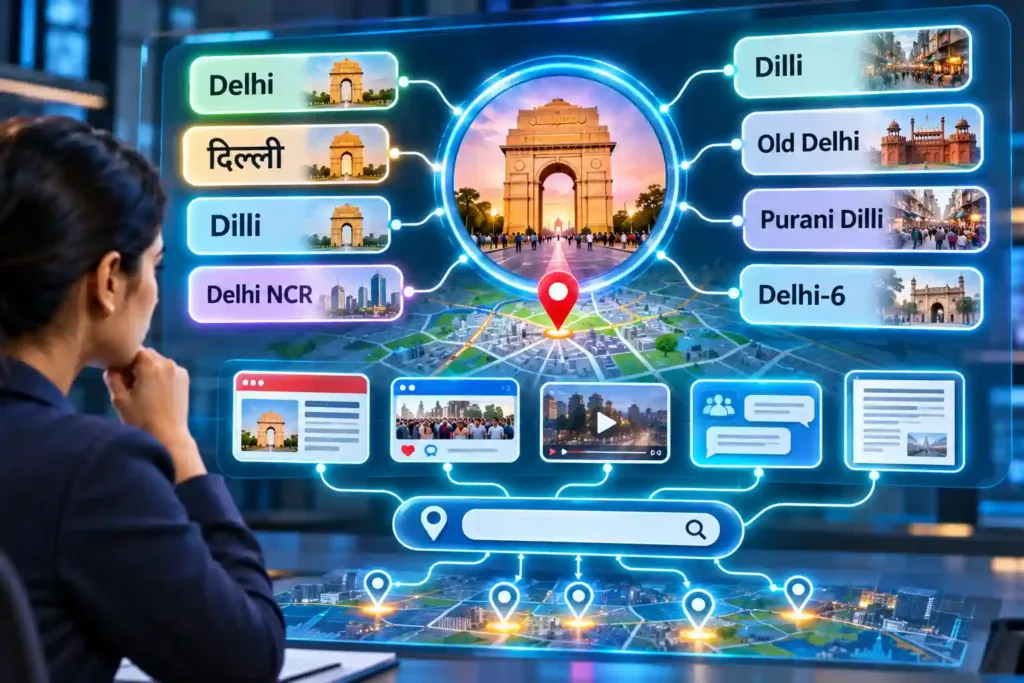
Place names can vary even more. A location may have:
- An official English spelling
- A local-language spelling
- A Romanized local spelling
- Historical spellings
- Common abbreviations
- Informal local names
An investigation focused on a particular location therefore needs to account for these variations. This is especially relevant when analysing local news, social media or event-related conversations. For example, a local user may refer to a neighbourhood by a shortened name that is rarely used in official English-language sources.
A search system that understands only formal place names may miss the surrounding conversation.
3. Search terms themselves need multilingual expansion

A strong multilingual OSINT workflow does not simply translate the original keyword once. It expands the search vocabulary. Suppose the investigation concerns a particular public event.
The analyst may need: English keyword → Hindi equivalent → Romanized Hindi → regional-language equivalent → local spelling → abbreviation → related terminology
This can be particularly useful for:
- Event names
- Places
- Organisations
- Public figures
- Industry terminology
- Local expressions
- Emerging events
The objective is not to generate hundreds of irrelevant variants. It is to build a controlled search vocabulary that improves recall without overwhelming the analyst with noise.
4. Transliteration can introduce ambiguity
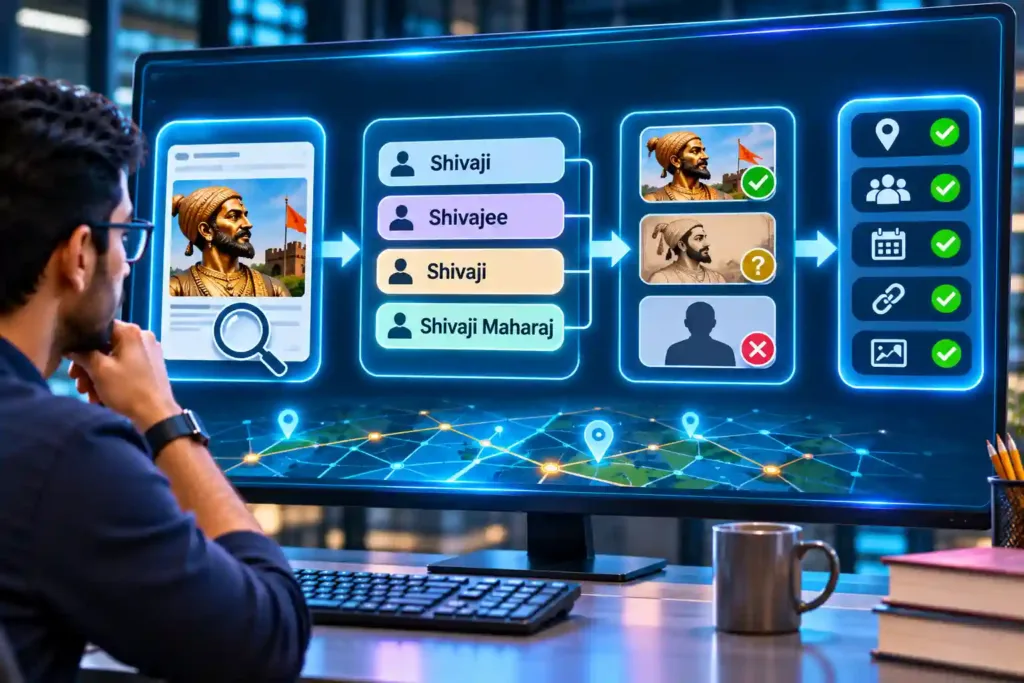
Transliteration is powerful, but it is not magic. Indian languages contain sounds and spelling conventions that do not always map neatly onto English letters. A single word can therefore have multiple reasonable Romanized representations.
For example, a name might appear as: Shivaji, Shivajee, Shivaji, Shivaji Maharaj
Depending on context, these may or may not refer to the same entity. This is why an OSINT system should avoid treating transliteration as a simple one-to-one conversion.
A better approach is: Original text → transliteration variants → candidate matches → contextual verification
The analyst remains responsible for determining whether the candidates actually refer to the same entity.
5. Code-switching makes automated analysis harder

Indian digital conversations frequently mix languages. A post might look like: “Kal meeting Delhi office mein hai, please confirm.”
The sentence contains English and Hindi, but a human reader understands it immediately. A language-processing system may need to identify the individual components correctly before it can classify, translate or analyse the content.
Code-switching becomes even more challenging when the content includes:
- Names
- Slang
- Abbreviations
- Technical terminology
- Local expressions
- English words commonly used in Indian-language conversations
This is one reason multilingual OSINT should not be evaluated simply by asking: “How many languages does the platform support?”
A better question is: “How well does it handle the way Indians actually communicate online?”
6. Context can be lost during translation
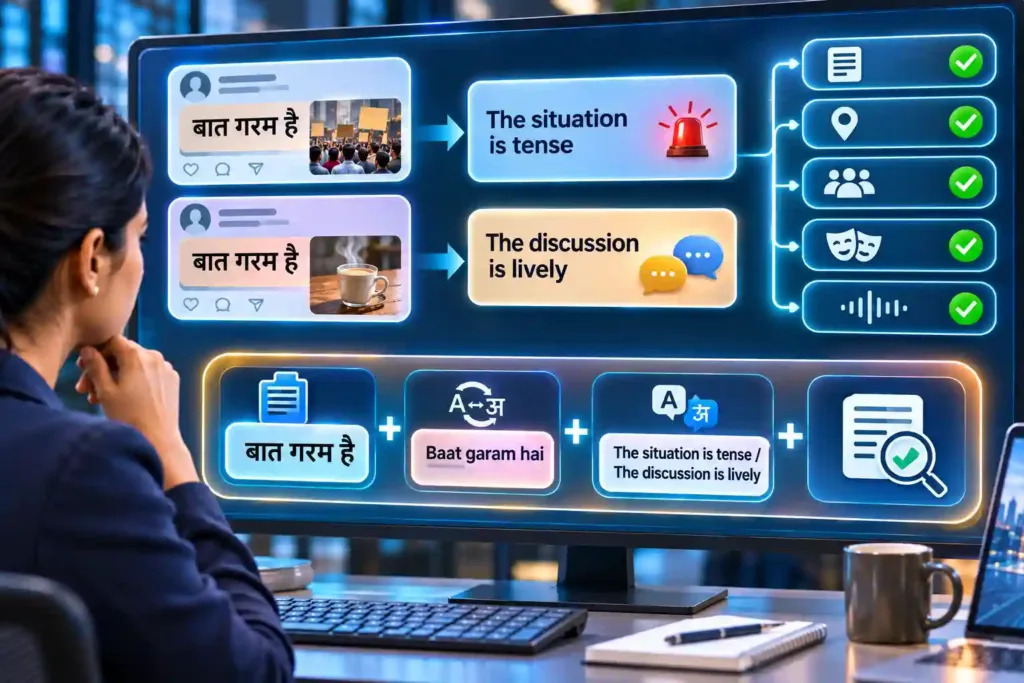
Translation is extremely useful for analysts who do not speak the source language. But translation can remove context. A word may have multiple meanings depending on:
- Sentence structure
- Region
- Community
- Slang
- Cultural context
- Tone
- Intended audience
An automated translation may produce a grammatically reasonable English sentence while missing an important local meaning. For this reason, an effective multilingual workflow should ideally preserve:
Original content + detected language + transliteration where useful + translated interpretation
rather than replacing the original content with a translated version. The translated text helps the analyst work quickly. The original text provides the reference point for verification.
7. Search and analysis are two different language problems

This distinction is worth making explicit.
During search
The objective is to find as much relevant material as possible. This requires:
- Language variants
- Transliteration
- Alternate spellings
- Romanized text
- Local terminology
- Multilingual keywords
During analysis
The objective is to understand what the material means and how it relates to other information. This requires:
- Language identification
- Translation
- Contextual interpretation
- Entity extraction
- Entity resolution
- Sentiment or narrative analysis
- Cross-language correlation
These are related but different capabilities. A platform can be excellent at translation and still perform poorly at multilingual search. That is an important distinction when evaluating OSINT technology.
8. Cross-language entity resolution is where multilingual OSINT gets really useful

Consider an investigation involving a company. One source identifies it in English. Another source mentions the organisation in Hindi. A third source uses a shortened name. A fourth source contains the founder’s name in Romanized Hindi.
Individually, these may look like unrelated pieces of information. A multilingual OSINT system can help bring them into the same analytical environment.
The workflow becomes: Language detection → Translation/transliteration → Entity extraction → Entity matching → Relationship analysis → Human verification
This is where multilingual capability starts producing intelligence value rather than simply making content easier to read.
What a good multilingual OSINT workflow looks like
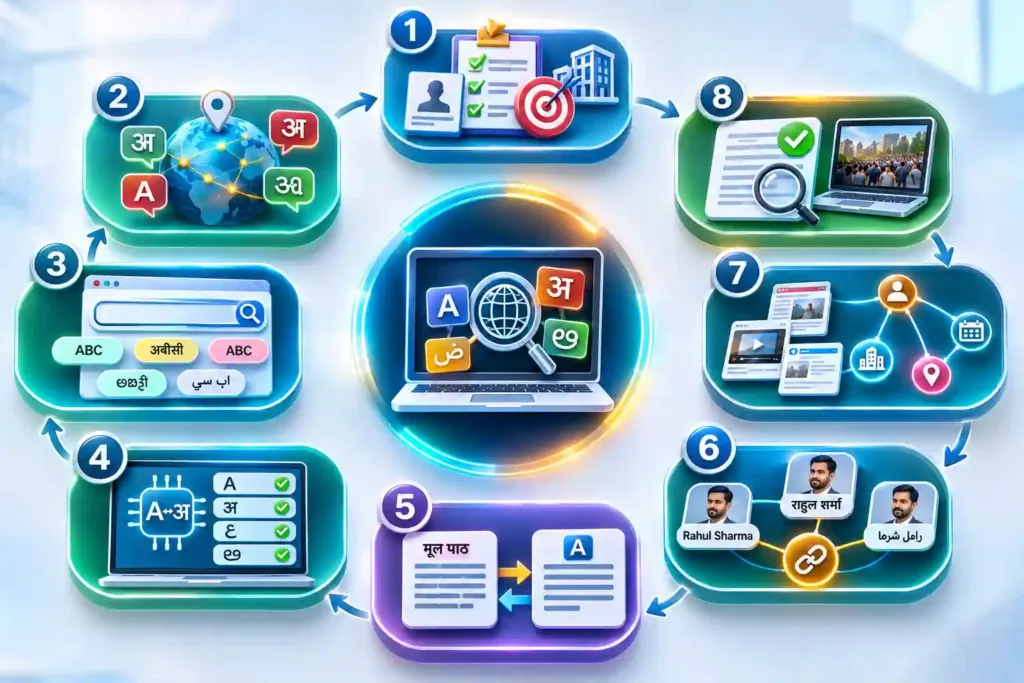
A practical workflow for investigators can be structured into eight stages.
- Define the intelligence requirement
Determine what person, organisation, event, location or topic is being investigated.
- Identify known language environments
Ask where relevant information is likely to appear and which languages or scripts are commonly used there.
- Build search variants
Create native-script, English, Romanized and relevant local-language versions of important keywords.
- Detect language automatically
Where large volumes of content are involved, automated language identification can reduce manual sorting.
- Translate without discarding the original
Use translation to accelerate comprehension while retaining the original source for context and review.
- Resolve entities across languages
Determine whether different spellings, scripts or names refer to the same person, organisation or place.
- Correlate information
Connect relevant content across languages, platforms and time periods.
- Verify important findings
Return to the original material before treating an important analytical conclusion as established.
This creates a much more robust multilingual investigation than simply putting foreign-language content through a translation engine.
What multilingual OSINT should help an investigator answer
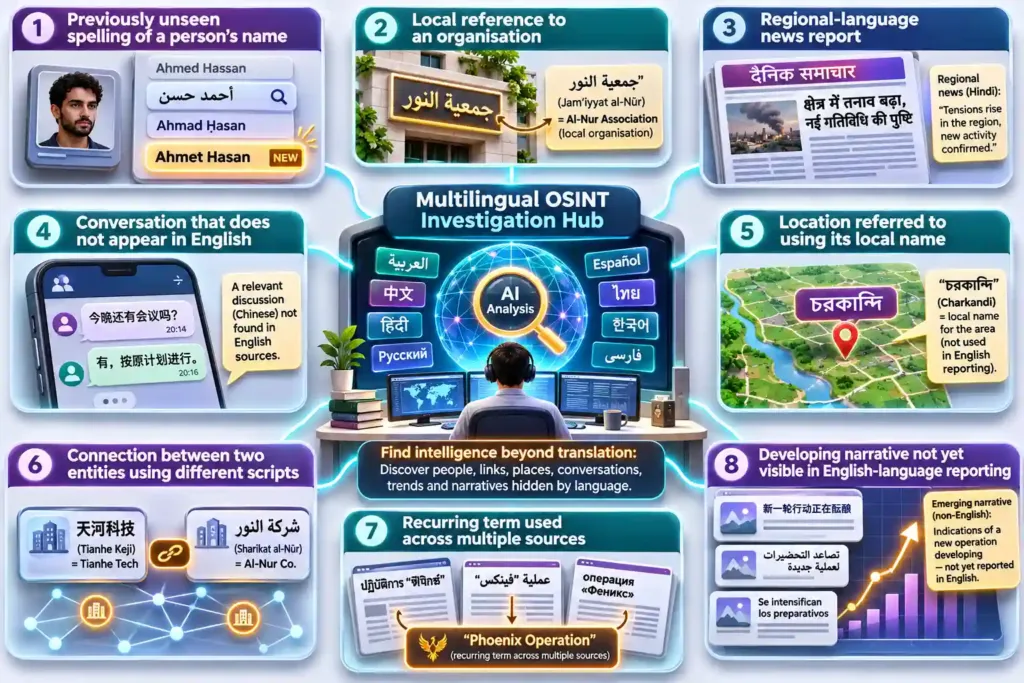
The objective is ultimately not: “Can I translate this post?”
It is: “Does this information add something to my investigation that I would have missed because of language?”
That could mean discovering:
- A previously unseen spelling of a person’s name
- A local reference to an organisation
- A regional-language news report
- A conversation that does not appear in English
- A location referred to using its local name
- A connection between two entities using different scripts
- A recurring term used across multiple sources
- A developing narrative that has not yet appeared in English-language reporting
How AI can improve multilingual OSINT
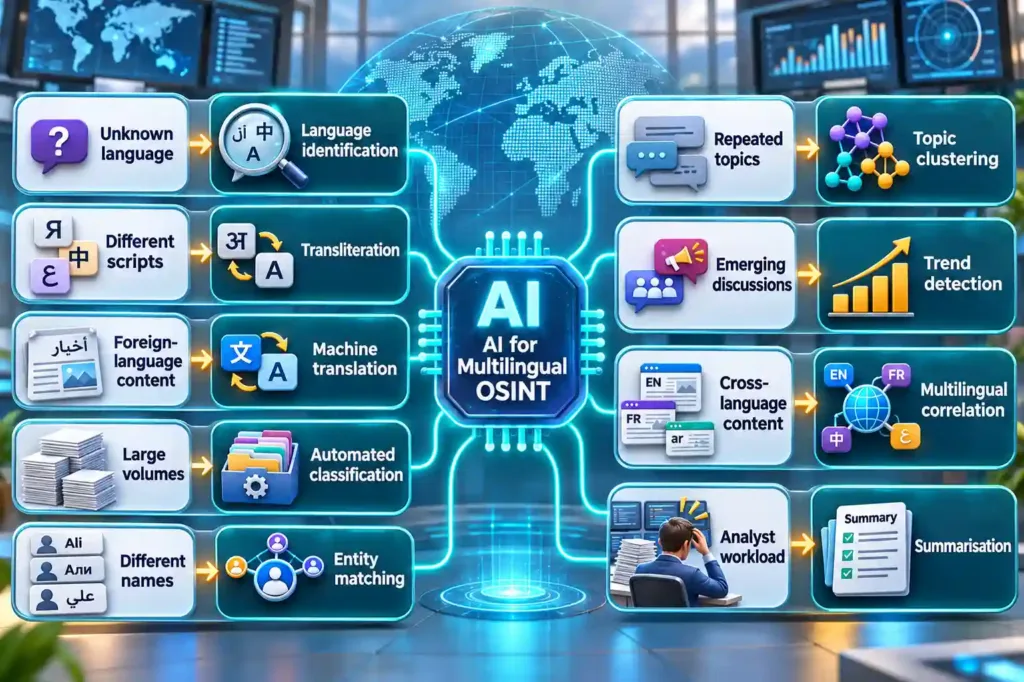
The scale of online information makes manual translation impractical for many investigations. AI can assist by automating several repetitive stages:
| Challenge | AI-assisted capability |
|---|---|
| Unknown language | Language identification |
| Different scripts | Transliteration |
| Foreign-language content | Machine translation |
| Large volumes | Automated classification |
| Different names | Entity matching |
| Repeated topics | Topic clustering |
| Emerging discussions | Trend detection |
| Cross-language content | Multilingual correlation |
| Analyst workload | Summarisation |
The direction is clear: multilingual technology is moving beyond simple translation toward systems that can understand and connect information across languages.
Conclusion

Multilingual OSINT is often described as translation. It is much more than that. For Indian investigators, the challenge begins before translation. It starts with finding information across different languages, scripts, spellings and forms of communication.
A name may appear in Hindi in one source and Romanized Hindi in another. A location may have several spellings. A social media post may switch between Hindi and English. A local news report may contain information that never appears in English-language coverage.
A useful multilingual OSINT workflow therefore needs to combine: Language identification → Search expansion → Transliteration → Translation → Entity resolution → Cross-language correlation → Verification
AI can automate significant parts of this process, reducing repetitive work and allowing analysts to examine information across a much broader linguistic landscape. But translation alone is not intelligence.
The real value comes when information discovered in different languages can be connected, contextualised and analysed as part of the same investigation.
For agencies operating across India’s diverse digital environment, that is the difference between an OSINT system that can translate information and one that can actually help investigators see more of the information that matters.
Frequently Asked Questions
1. What is multilingual OSINT?
Multilingual OSINT is the collection, search, processing and analysis of publicly available information across multiple languages and scripts. It includes capabilities such as language identification, translation, transliteration, multilingual search and cross-language entity resolution.
2. What is the difference between translation and transliteration?
Translation changes the language while preserving meaning. Transliteration changes the script while attempting to preserve pronunciation. For example, Hindi written as “दिल्ली” can be transliterated as “Dilli”, while translating it produces “Delhi”.
3. Why is transliteration important for OSINT?
Transliteration helps investigators discover information when the same name, location or keyword appears in different scripts. It is particularly useful in India, where people may write Indian languages using both native scripts and Roman characters.
4. What is Romanized Hindi?
Romanized Hindi is Hindi written using the Latin alphabet rather than Devanagari. For example, “आप कहाँ जा रहे हैं?” may appear online as “aap kahan ja rahe hain?” This can create challenges for systems that identify languages primarily from script.
5. Can AI translate regional Indian languages for OSINT?
Yes. AI-based language technologies can support translation, transliteration, language identification and other multilingual processing tasks. India’s BHASHINI ecosystem and AI4Bharat’s research are examples of ongoing work in this area. Bhashini
6. Is translation enough for multilingual OSINT?
No. Translation helps analysts understand content, but multilingual OSINT also needs search expansion, transliteration, spelling-variant handling, entity resolution and cross-language correlation.
7. How can investigators avoid missing regional-language information?
Investigators should search using native-language terms, English equivalents, Romanized variants, alternate spellings and relevant local terminology. Where possible, multilingual search and automated language identification can reduce manual effort.
8. What is cross-language entity resolution?
It is the process of determining whether references appearing in different languages or scripts refer to the same person, organisation, place or other entity. Additional identifiers and contextual evidence should be used before treating two references as the same entity.