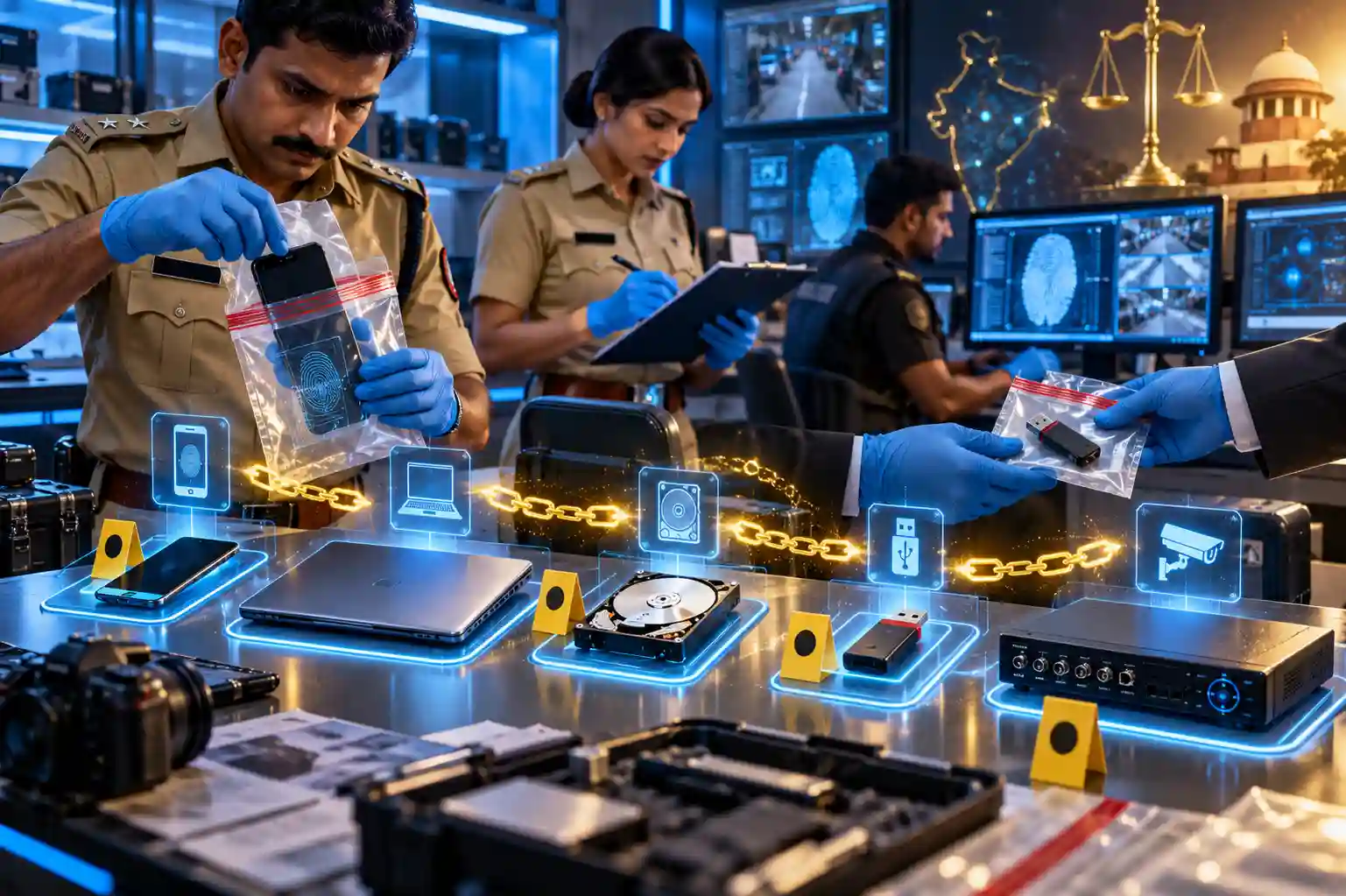
CCTNS, or Crime and Criminal Tracking Network & Systems, is India’s nationwide digital policing platform designed to connect police stations, digitise police processes and make crime and criminal information searchable and shareable across jurisdictions.
The project began in 2009 with the objective of linking police stations through a common application for investigation, data analytics, policy-making and citizen services. Ministry of Home Affairs
As of 1 February 2026, all 17,798 police stations in India were using CCTNS, according to the Ministry of Home Affairs. Police stations can search crime, criminal and property-related information at the National Data Centre, while standardised investigation forms and master codes are used to improve consistency across states and Union Territories. Ministry of Home Affairs
But the next stage is already being developed.
CCTNS 2.0 is being designed as a more modern, cloud-supported, mobile-friendly and interoperable system, with capabilities including multilingual speech-to-text, geospatial analysis, improved citizen services, inter-state Zero FIR transfer, dashboards, AI/ML and NLP-based analytics, integration with government databases, and more automated data exchange. Ministry of Home Affairs
The bigger shift is therefore from digitised police records to a more connected, intelligent and workflow-oriented policing platform.
Key takeaways
- CCTNS started in 2009 to connect police stations through a common digital platform.
- Its purpose goes beyond FIR digitisation. It supports investigation, crime analytics, policy-making and citizen services.
- As of 1 February 2026, all 17,798 police stations were using CCTNS.
- CCTNS data is replicated from State Data Centres to the National Data Centre in near real time, with national search capabilities for police stations.
- CCTNS is now part of the larger ICJS ecosystem, which connects police, courts, prisons, prosecution and forensic systems.
- CCTNS already supports capabilities such as criminal network link analysis, missing-person and vehicle alerts, photo matching and integration with other government databases.
- CCTNS 2.0 is under development, not something that should be described as fully deployed nationwide today.
- The proposed upgrade includes cloud deployment, microservices, mobile interfaces, Bhashini-based language capabilities, GIS, AI/ML, NLP, automated data fetching and broader integrations.
- The biggest challenge will not be simply installing the new technology. Data quality, adoption, interoperability, cybersecurity, training and workflow redesign will determine how much value police forces actually get from it.
What is CCTNS?
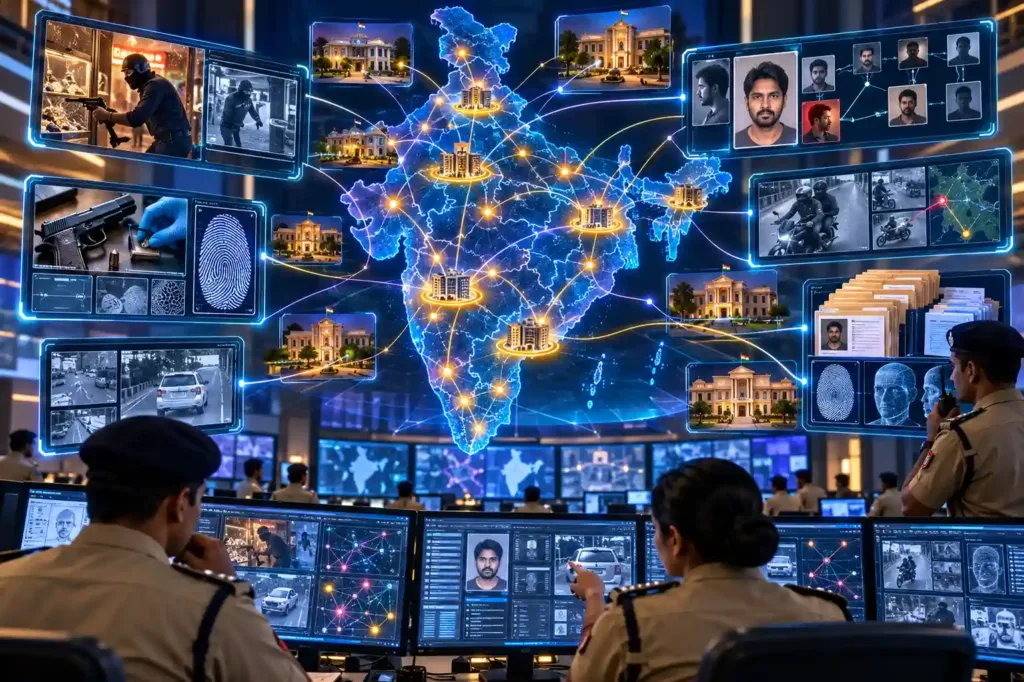
CCTNS stands for Crime and Criminal Tracking Network & Systems. It is a national-level initiative of the Government of India intended to digitise and connect police processes and crime-related information.
The project was started in 2009, with an approved outlay of ₹2,000 crore, with the objective of interlinking police stations through a common application. The intended uses included investigation, data analytics, research, policy-making and citizen services. Ministry of Home Affairs
In simple terms, CCTNS was created to solve a basic problem: Police information should not remain trapped inside individual police stations, districts or disconnected records.
Consider a hypothetical investigation. A robbery takes place in District A.
The suspect may have:
- previous cases in District B
- a vehicle registered in District C
- an associate who appears in another state’s records
- an earlier complaint involving a similar modus operandi
- a property or criminal record elsewhere
If investigators have to manually approach every jurisdiction to discover these connections, valuable time can be lost. A connected information system can make these relationships much easier to identify. That is the fundamental idea behind CCTNS.
What does CCTNS actually do?

CCTNS is sometimes described simply as a police database. That description is too narrow. It is better understood as a digital policing and information-sharing infrastructure that supports multiple police processes.
At the basic level, police-related information such as FIRs, chargesheets and other investigation-related records can be entered into the CCTNS application.
According to the MHA’s March 2026 parliamentary response, these records are entered at State Data Centres and replicated in near real time at the National Data Centre. Police stations have facilities to search crime, criminal and property-related information at the national level. Ministry of Home Affairs
The system also uses standardised Integrated Investigation Forms and master codes for items such as states, districts, police stations, Acts and sections. This is important because standardisation is what makes large-scale data comparison possible. Ministry of Home Affairs
CCTNS in a simple workflow
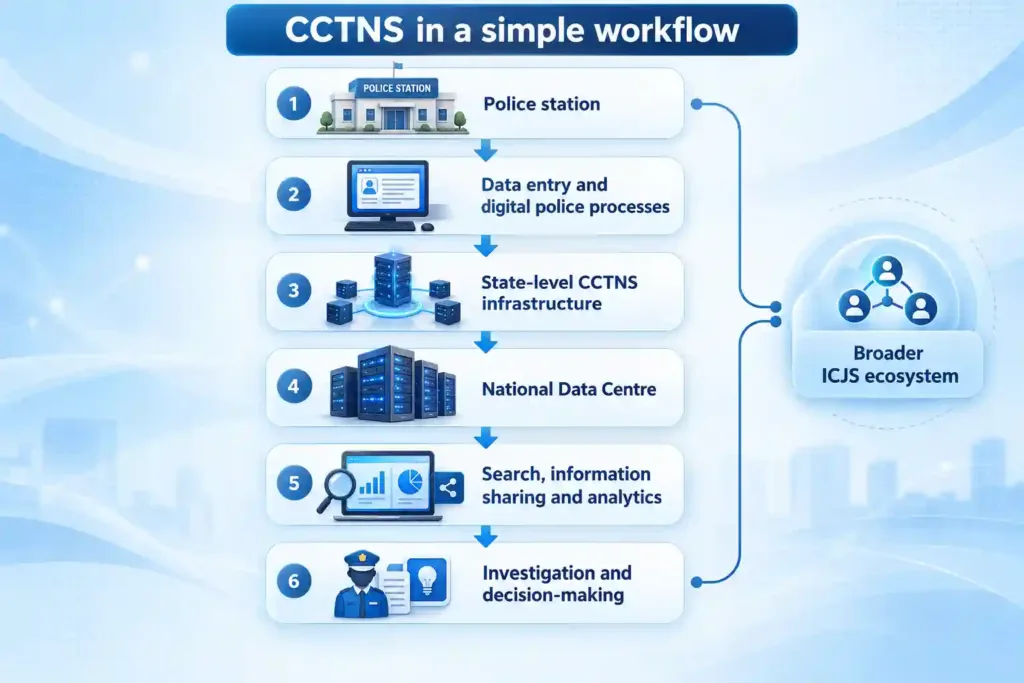
A simplified view looks like this:
Police station
↓
Data entry and digital police processes
↓
State-level CCTNS infrastructure
↓
National Data Centre
↓
Search, information sharing and analytics
↓
Investigation and decision-making
But CCTNS no longer exists in isolation. It increasingly operates within the broader ICJS ecosystem.
CCTNS vs ICJS: What is the difference?
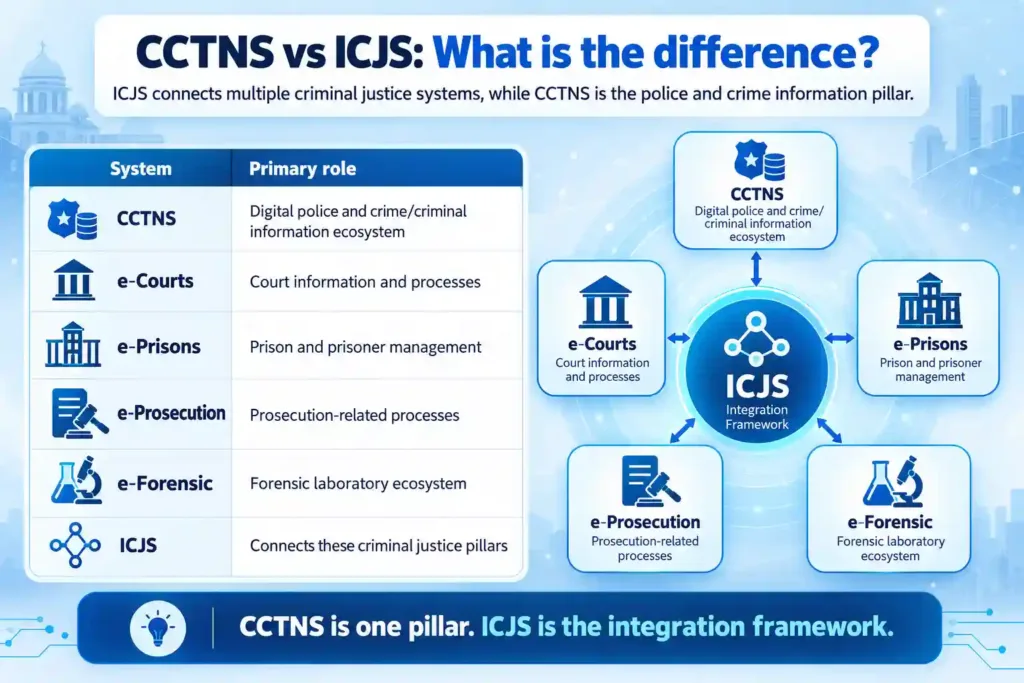
This is one of the most important distinctions to understand.
| System | Primary role |
|---|---|
| CCTNS | Digital police and crime/criminal information ecosystem |
| e-Courts | Court information and processes |
| e-Prisons | Prison and prisoner management |
| e-Prosecution | Prosecution-related processes |
| e-Forensic | Forensic laboratory ecosystem |
| ICJS | Connects these criminal justice pillars |
ICJS, or the Inter-Operable Criminal Justice System, is designed to integrate the major pillars of India’s criminal justice system. These include:
Police → Courts → Prisons → Prosecution → Forensics
The objective is often described by the government as “One Data Once Entry”, meaning information should ideally not have to be repeatedly entered into disconnected systems. Ministry of Home Affairs This distinction matters because CCTNS is essentially the police-side foundation, while ICJS is the broader interoperability layer connecting the criminal justice ecosystem.
What can police already do through CCTNS and ICJS?
The current ecosystem is considerably more advanced than basic FIR digitisation. The Ministry of Home Affairs lists several capabilities that have been added around CCTNS and ICJS.
National-level information search
Police stations have facilities to search crime, criminal and property-related information available through the National Data Centre. This matters particularly when an investigation crosses district or state boundaries.
Criminal network link analysis
A Criminal Network Link Analysis module has been developed under ICJS. The objective is to help investigators understand relationships between people, cases and other entities rather than looking at individual records in isolation.
Missing person and vehicle alerts
National-level automated alert services can generate alerts when missing or found persons and vehicles match relevant records.
Automated photo matching
NCRB’s UNIFY application uses machine learning to help police search photographs of missing persons, criminals and unidentified dead bodies against the national image repository in CCTNS.
Integration with other government databases
The ICJS platform provides access to information from several government databases, including systems relating to:
- Arms licences
- Missing children
- Cybercrime
- Immigration and foreigners
- Vehicles and driving licences
- Railway Protection Force
- CBI
- NIA
This illustrates an important evolution. CCTNS is increasingly becoming part of a larger intelligence and investigation data environment rather than operating as a standalone police application.
Why does CCTNS still need a 2.0?
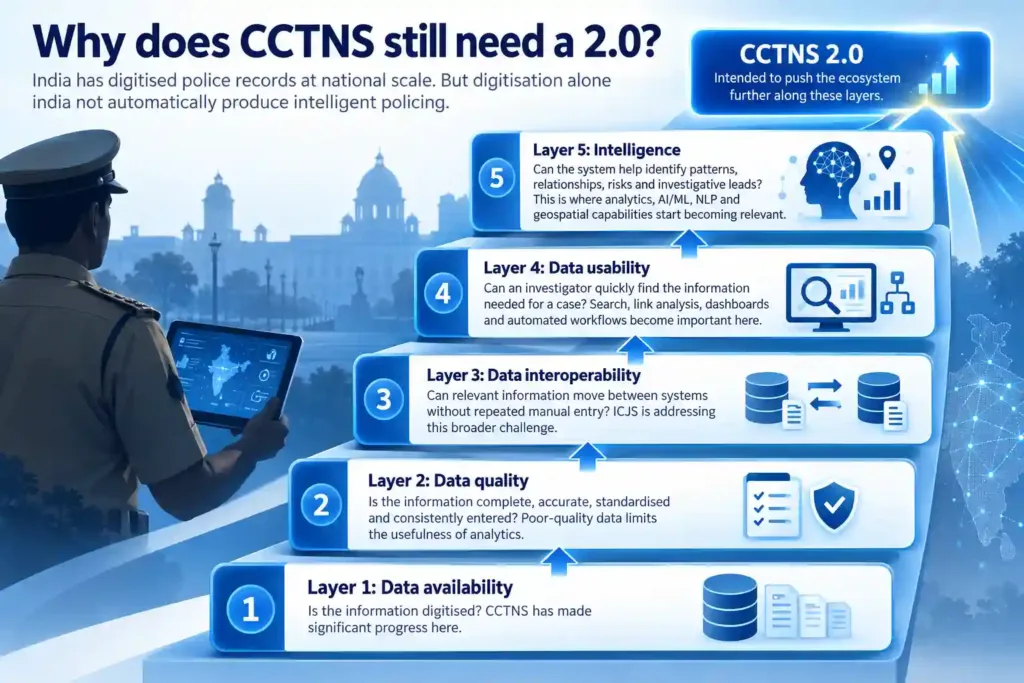
This is where the topic becomes interesting. India has already digitised police records at national scale. But digitisation alone does not automatically produce intelligent policing. There are several layers to the problem.
Layer 1: Data availability
Is the information digitised? CCTNS has made significant progress here.
Layer 2: Data quality
Is the information complete, accurate, standardised and consistently entered? This remains critical because poor-quality data limits the usefulness of analytics.
Layer 3: Data interoperability
Can relevant information move between systems without repeated manual entry? ICJS is addressing this broader challenge.
Layer 4: Data usability
Can an investigator quickly find the information needed for a case? Search, link analysis, dashboards and automated workflows become important here.
Layer 5: Intelligence
Can the system help identify patterns, relationships, risks and investigative leads? This is where analytics, AI/ML, NLP and geospatial capabilities start becoming relevant.
CCTNS 2.0 is intended to push the ecosystem further along these layers.
What is CCTNS 2.0?
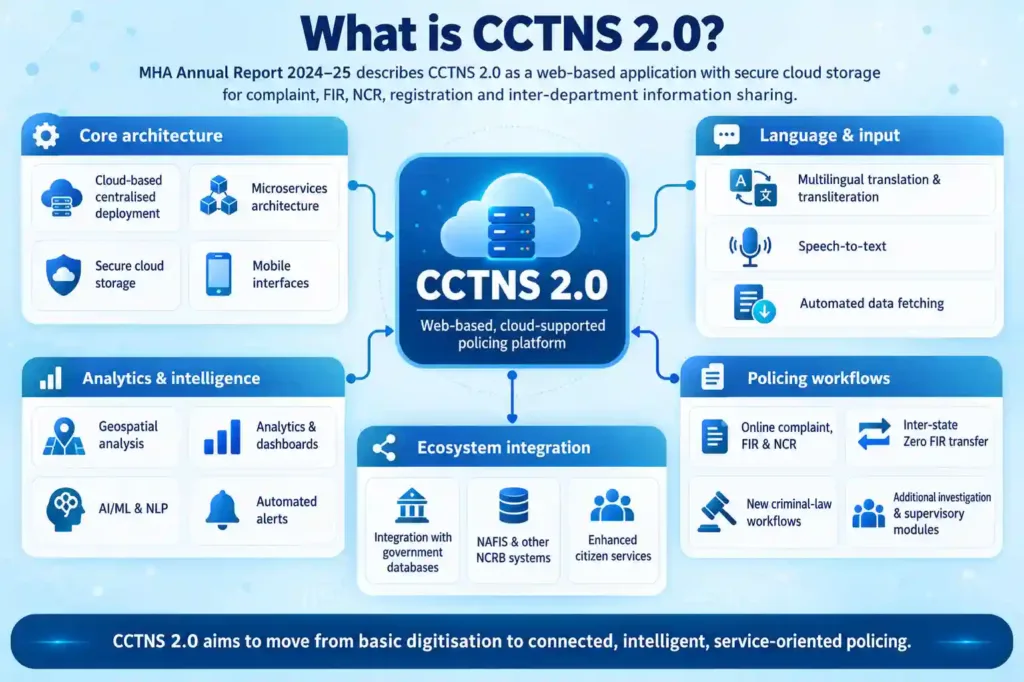
According to the MHA’s Annual Report 2024-25, development of CCTNS 2.0 is underway. The report describes it as a web-based application supported by secure cloud storage, intended to facilitate online complaint, FIR, NCR and other registration and information-sharing processes across departments. Ministry of Home Affairs
The proposed architecture includes:
- Cloud-based centralised deployment
- Microservices architecture
- Mobile interfaces
- Multilingual translation and transliteration
- Speech-to-text
- Geospatial analysis
- Enhanced citizen services
- Inter-state Zero FIR transfer
- New criminal-law workflows
- Automated alerts
- Analytics and dashboards
- AI/ML and NLP
- Integration with government databases
- NAFIS and other NCRB systems
- Automated data fetching
- Additional investigation and supervisory modules
CCTNS 2.0: What could actually change?
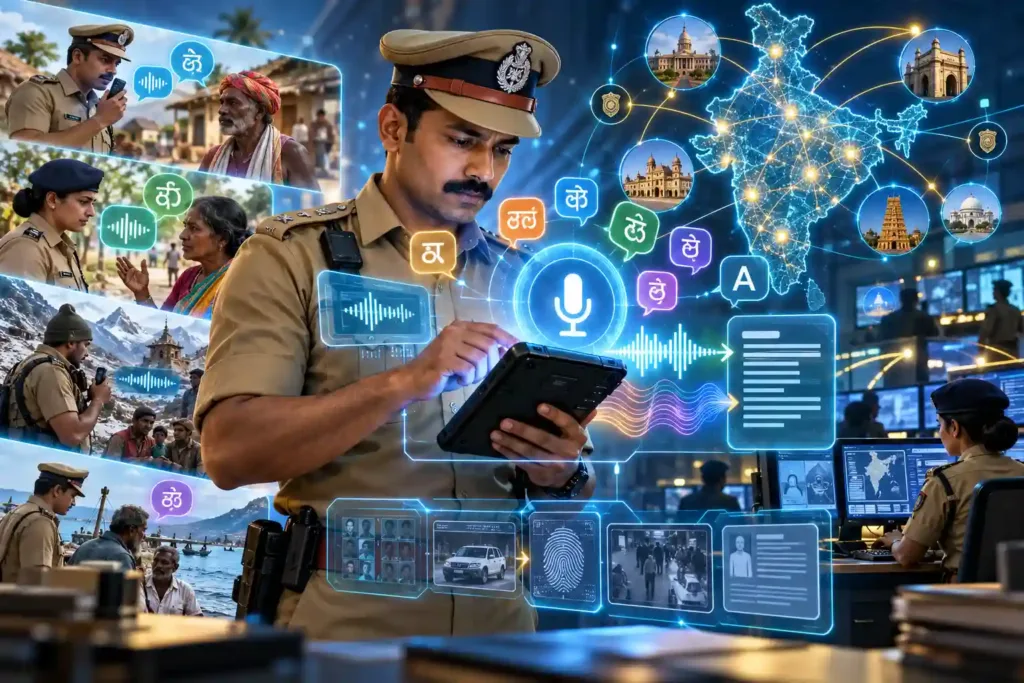
From desktop-centric systems to mobile-enabled policing
One of the proposed features is a mobile interface built around a microservices-based architecture. That could matter significantly for field officers. Police work does not happen entirely inside police stations.
Investigators operate at:
- crime scenes
- hospitals
- roads
- checkpoints
- residences
- courts
- other police stations
- remote locations
A more mobile-first architecture could allow relevant information and workflows to travel with the officer rather than requiring every task to return to a fixed workstation. The value is therefore not simply “having a mobile app.” It is reducing the distance between field activity and information systems.
Multilingual policing could become more practical
India’s policing environment is multilingual. CCTNS 2.0 proposes extensive use of translation, transliteration and speech-to-text softwares. Ministry of Home Affairs
This could have an important operational effect. An officer should not have to become an expert in English-language data entry to extract value from a national information system. Speech interfaces and language technologies could eventually make it easier to:
- capture information
- search records
- translate inputs
- generate reports
- interact with digital systems
This is particularly relevant when systems are used across states with different working languages.
Zero FIR transfers could become more seamless

The new criminal laws have increased the importance of processes that allow FIR-related workflows to operate across jurisdictional boundaries. CCTNS 2.0 is proposed to include inter-state transfer of Zero FIRs. Ministry of Home Affairs
That is more than a technical feature. It addresses a real operational requirement: The jurisdiction in which a person reports an incident does not always correspond neatly to the jurisdiction in which the offence occurred.
A connected workflow can reduce friction when a case needs to move between police jurisdictions.
GIS could become part of routine crime analysis

CCTNS 2.0 proposes geospatial analysis for mapping CCTNS data. Ministry of Home Affairs. This could help move crime analysis from tables and individual records toward spatial understanding. For example:
- Where are repeated incidents occurring?
- Which areas show emerging patterns?
- Are incidents clustering around particular locations?
- Are certain types of offences concentrated along particular routes?
- How does crime distribution change over time?
This is where CCTNS data can become useful for crime mapping, patrol planning and resource allocation. It also connects directly with the broader concept of data-driven and smart policing.
AI could move from separate pilots into the policing workflow
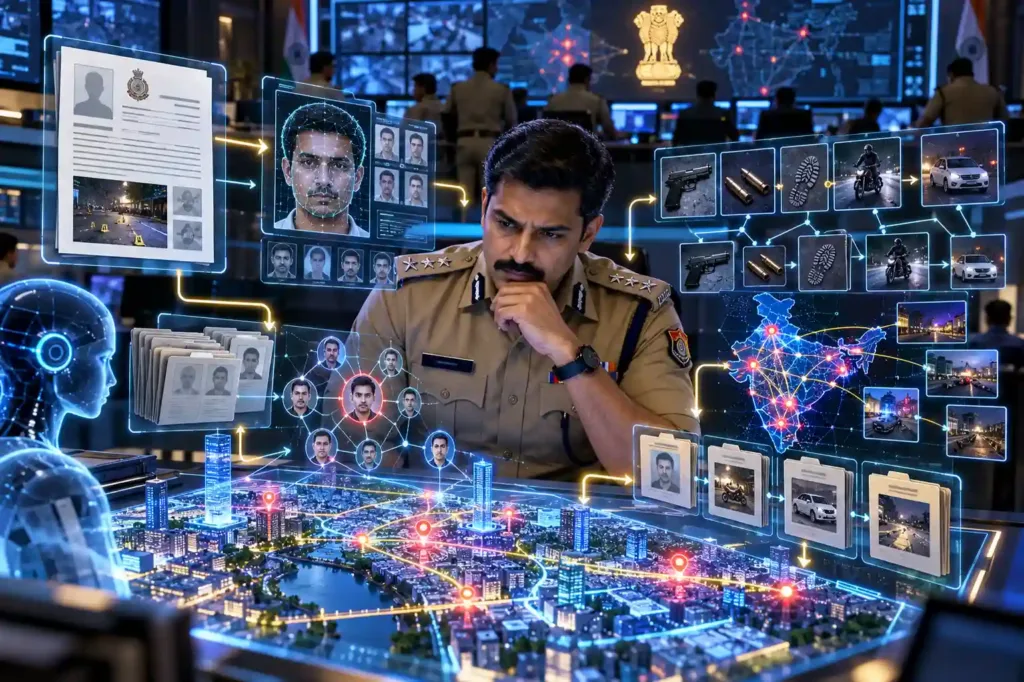
The MHA’s proposed CCTNS 2.0 capabilities explicitly include AI/ML and NLP for areas such as tracking history sheeters and identifying co-accused and modus operandi. Ministry of Home Affairs
This is significant. AI in policing becomes much more useful when it is connected to the underlying data and workflow rather than operating as an isolated demonstration. Consider a simplified investigation:
FIR
↓
Person identification
↓
Previous cases
↓
Known associates
↓
Common modus operandi
↓
Geographic patterns
↓
Related cases
↓
Investigator review
The potential of CCTNS 2.0 is to make more of these connections computationally accessible. But there is an important caveat. AI should surface investigative leads, not become an unquestioned substitute for police judgment.
A system identifying a possible association does not automatically establish guilt, culpability or evidentiary relevance. That distinction becomes increasingly important as AI enters criminal investigation workflows.
Less repetitive data entry

One of the more underrated proposed features is automatic fetching of information from other databases and applications. For police personnel, this could be more valuable than flashy AI features.
If information already exists in an authorised government system, repeatedly entering the same information into another application creates:
- duplicate work
- inconsistent records
- data-entry errors
- slower workflows
The proposed CCTNS 2.0 architecture aims to reduce this burden through greater system integration and automated data retrieval. This aligns closely with the broader ICJS principle of “One Data Once Entry.” Ministry of Home Affairs
7. More useful dashboards for senior officers
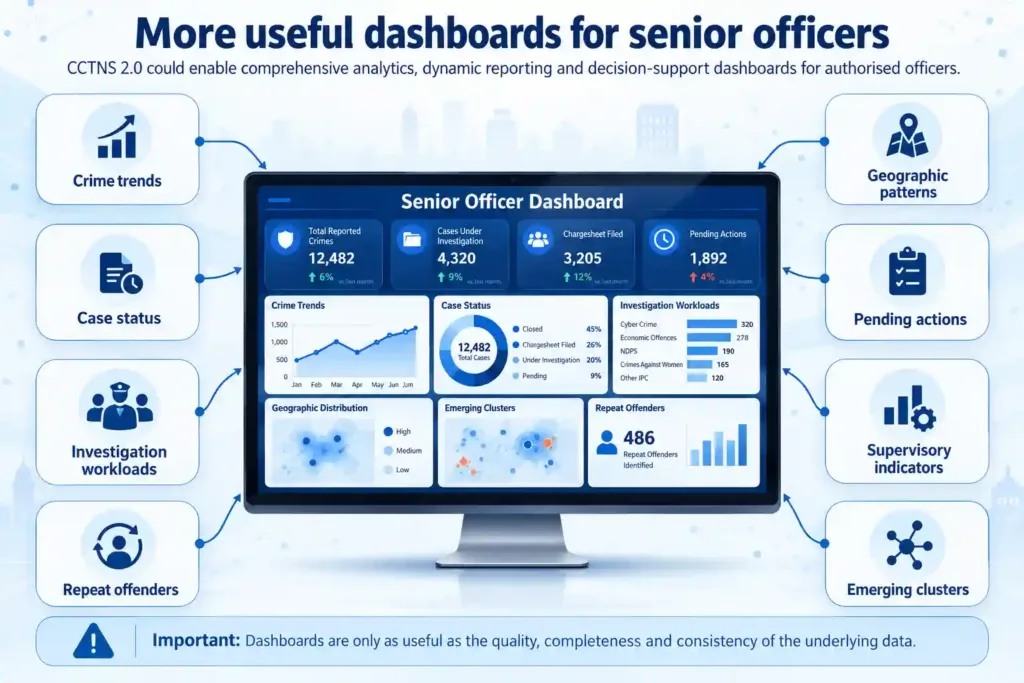
CCTNS 2.0 also proposes comprehensive analytics, dynamic reporting and dashboards. Ministry of Home Affairs. This could change how senior officers consume information. Instead of waiting for manually compiled reports, an authorised officer could potentially view:
- crime trends
- case status
- investigation workloads
- repeat offenders
- geographic patterns
- pending actions
- supervisory indicators
- emerging clusters
The important word here is potentially. A dashboard is only as good as the underlying data and the decisions it supports. A visually impressive dashboard filled with incomplete or inconsistently entered records does not create better policing.
CCTNS 2.0 is also about architecture
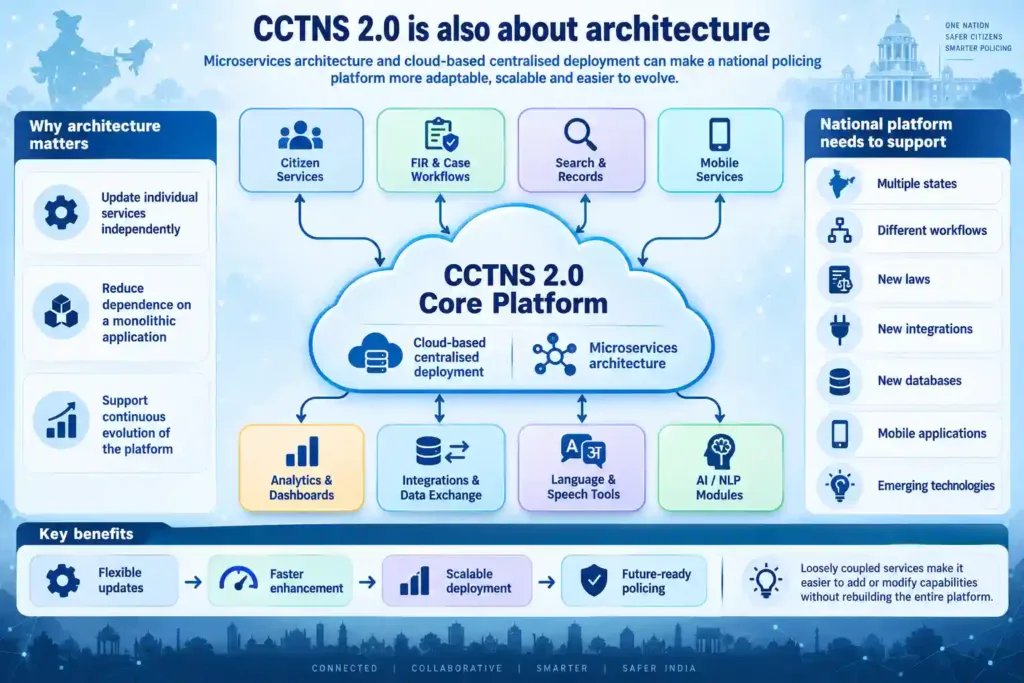
The proposed use of microservices architecture and cloud-based centralised deployment is not merely an IT upgrade. Ministry of Home Affairs
A loosely coupled architecture can make it easier to update individual services without rebuilding an entire monolithic application. That matters when a national platform has to support:
- multiple states
- different workflows
- new laws
- new integrations
- new databases
- mobile applications
- emerging technologies
CCTNS today vs CCTNS 2.0
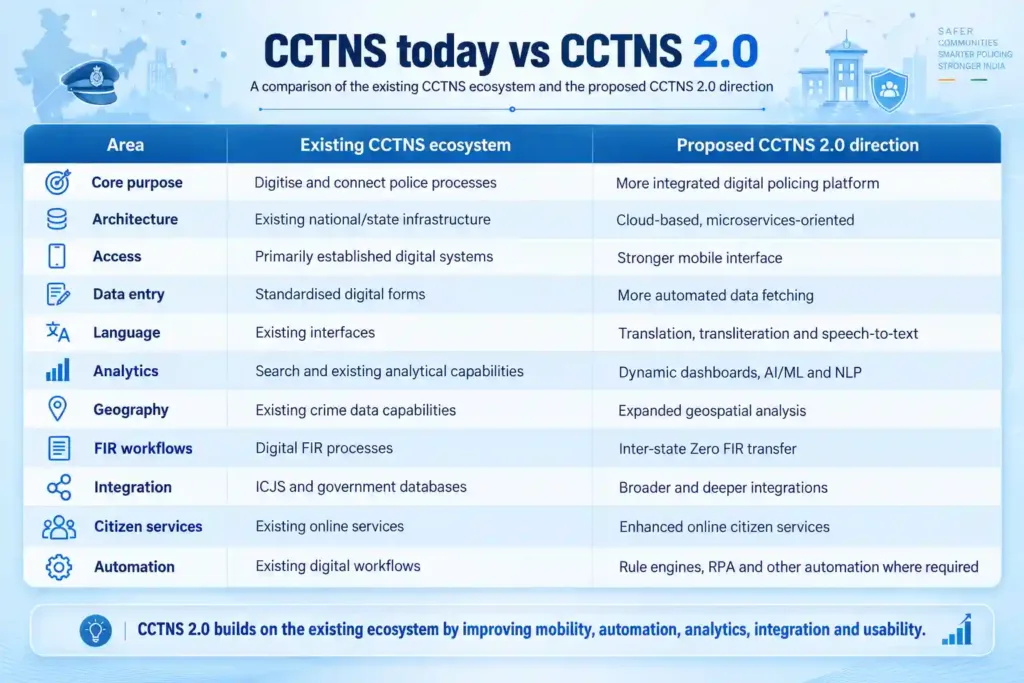
| Area | Existing CCTNS ecosystem | Proposed CCTNS 2.0 direction |
|---|---|---|
| Core purpose | Digitise and connect police processes | More integrated digital policing platform |
| Architecture | Existing national/state infrastructure | Cloud-based, microservices-oriented |
| Access | Primarily established digital systems | Stronger mobile interface |
| Data entry | Standardised digital forms | More automated data fetching |
| Language | Existing interfaces | Translation, transliteration and speech-to-text |
| Analytics | Search and existing analytical capabilities | Dynamic dashboards, AI/ML and NLP |
| Geography | Existing crime data capabilities | Expanded geospatial analysis |
| FIR workflows | Digital FIR processes | Inter-state Zero FIR transfer |
| Integration | ICJS and government databases | Broader and deeper integrations |
| Citizen services | Existing online services | Enhanced online citizen services |
| Automation | Existing digital workflows | Rule engines, RPA and other automation where required |
The important point is that CCTNS 2.0 is not replacing the purpose of CCTNS. It is intended to modernise how that purpose is delivered.
The data quality challenge
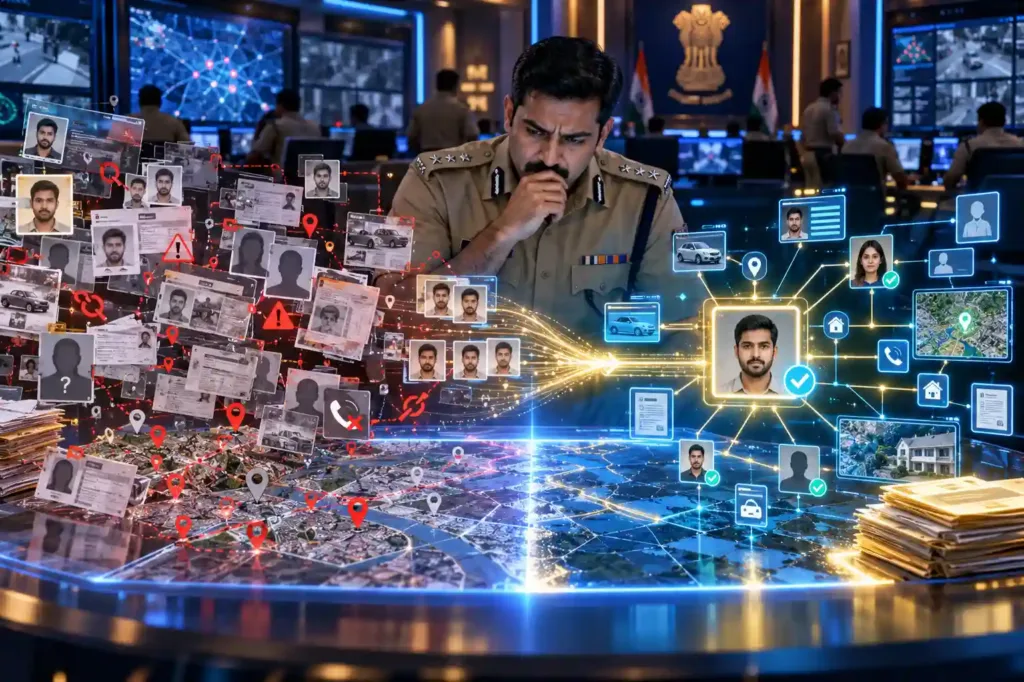
The government has already highlighted data quality as an important objective of ICJS. Its stated reforms include reducing errors in data entry and improving the quality and interoperability of information across police, prisons, prosecution, forensics and courts. Ministry of Home Affairs
For CCTNS 2.0, this becomes even more important. Imagine an investigator searching for connections between two cases. The system may have the correct records, but if:
- names are entered differently
- addresses are incomplete
- phone numbers are missing
- entities are duplicated
- case metadata is inconsistent
- locations are poorly captured
then the system may fail to identify a genuine relationship. This is why data standardisation, entity resolution and validation rules will become increasingly important alongside AI.
What CCTNS 2.0 could mean for Indian police forces

If implemented effectively, the biggest change may be cultural rather than technical. Police organisations could gradually move from:
Record-based policing to Information-enabled policing and then toward: Data-driven policing where appropriate. The progression looks something like this:
→ Paper records
→ Digitised records
→ Connected records
→ Searchable information
→ Cross-system intelligence
→ Analytics-assisted investigation
→ More proactive decision-making
CCTNS has already taken India a long way along this journey. CCTNS 2.0 is intended to push the infrastructure further.
Frequently Asked Questions
1. Is CCTNS the same as ICJS?
No. CCTNS is the police and crime information system, while ICJS is the broader framework designed to connect police, courts, prisons, prosecution and forensic systems. Ministry of Home Affairs
2. When was CCTNS started in India?
CCTNS was started in 2009. Its original objective was to interlink police stations through a common application for investigation, data analytics, research, policy-making and citizen services. Ministry of Home Affairs
3. How many police stations use CCTNS?
According to an MHA parliamentary response, all 17,798 police stations were using CCTNS as of 1 February 2026. Ministry of Home Affairs
4. Is CCTNS 2.0 operational across India?
It should not be described that way. The MHA’s 2024-25 Annual Report states that development of CCTNS 2.0 is under progress. Ministry of Home Affairs
5. What is new in CCTNS 2.0?
The proposed upgrade includes cloud-based deployment, microservices, mobile interfaces, Bhashini-based language capabilities, speech-to-text, GIS, enhanced citizen services, Zero FIR transfer, dashboards, AI/ML, NLP, government database integrations and automated data fetching. Ministry of Home Affairs
6. How does CCTNS help police investigations?
It provides digital access to crime, criminal and property-related information and supports investigation and analytics. The broader CCTNS/ICJS ecosystem also includes capabilities such as criminal network link analysis, automated matching alerts and photo matching. Ministry of Home Affairs
7. How is CCTNS connected to ICJS?
CCTNS represents the police component of the larger ICJS ecosystem. ICJS is intended to connect police with courts, prisons, prosecution and forensic systems. Ministry of Home Affairs
8. Will CCTNS 2.0 replace police officers or investigators?
No. The proposed capabilities are designed to improve information access, analytics and workflows. AI/ML and NLP can help identify patterns or relationships, but investigative decisions still require authorised human judgement, verification and legal processes.