
Indian banks reported 10,114 fraud cases worth ₹48,021 crore in FY26, according to the RBI’s latest annual report, a 46 percent jump in value over the previous year, even as the number of cases fell sharply. Source: The Hindu. That combination, fewer incidents, bigger losses, is the clearest signal yet that the nature of banking fraud in India has changed, and that the tools built to catch the old version of it are running out of road.
Key Takeaways
- FY26 bank fraud losses hit a three-year high in India, even as the number of cases dropped.
- The shift is structural: digital payment fraud fell sharply while advances (loan) fraud now accounts for 85 percent of total value.
- Rule-based fraud engines were built for the fraud pattern that’s shrinking, not the one that’s growing.
- AI-driven detection works by modeling behavior and networks, not just checking thresholds.
- Even the RBI is now deploying its own machine learning model to fight fraud, which tells you where this is headed.
The Fraud Problem Hasn’t Shrunk, It’s Moved

Look past the headline number and the RBI’s FY26 data tells a more specific story. Card and digital payment fraud, the category everyone associates with UPI scams and phishing links, collapsed from 13,332 cases worth ₹517 crore in FY25 to just 293 cases worth ₹29 crore in FY26. That’s a genuine win, and it reflects years of investment in real-time transaction scoring, device fingerprinting, and behavioural checks at the payment layer.
But advances, loans, credit lines, working capital facilities, told the opposite story. Fraud in this category jumped to 8,640 cases worth ₹40,774 crore, close to 85 percent of everything reported. Public sector banks alone absorbed ₹35,709 crore of it.
This is the part that should worry every risk officer, not the headline total. Fraud didn’t decline. It moved to the part of the bank that’s hardest to monitor in real time, and the part where the fraud itself is usually more sophisticated: shell companies, layered ownership, synthetic borrower profiles, and loan documentation that looks clean until someone checks it against a second data source.
Why Rule-Based Systems Can’t Keep Up Here

Most fraud detection built into Indian banking infrastructure over the last decade was designed around thresholds. Flag a transaction over a certain amount. Flag more than X transfers in a day. Flag a new account moving unusually large sums. This works reasonably well for payment fraud, where the fraud pattern is a single transaction or a short burst of them.
Loan fraud doesn’t work that way. A loan fraud ring doesn’t trip a threshold in one transaction, it’s built across dozens of legitimate-looking data points spread over months: a company registration here, a director appointment there, a GST filing that doesn’t match actual goods movement, an address shared with three other “unrelated” businesses. No single rule catches this, because no single rule is looking at all of it together.
This is exactly why the fraud has migrated to advances. It’s not that fraudsters got smarter about payments, it’s that they found the part of the bank still running on isolated, siloed checks.
What AI Fraud Detection Actually Changes
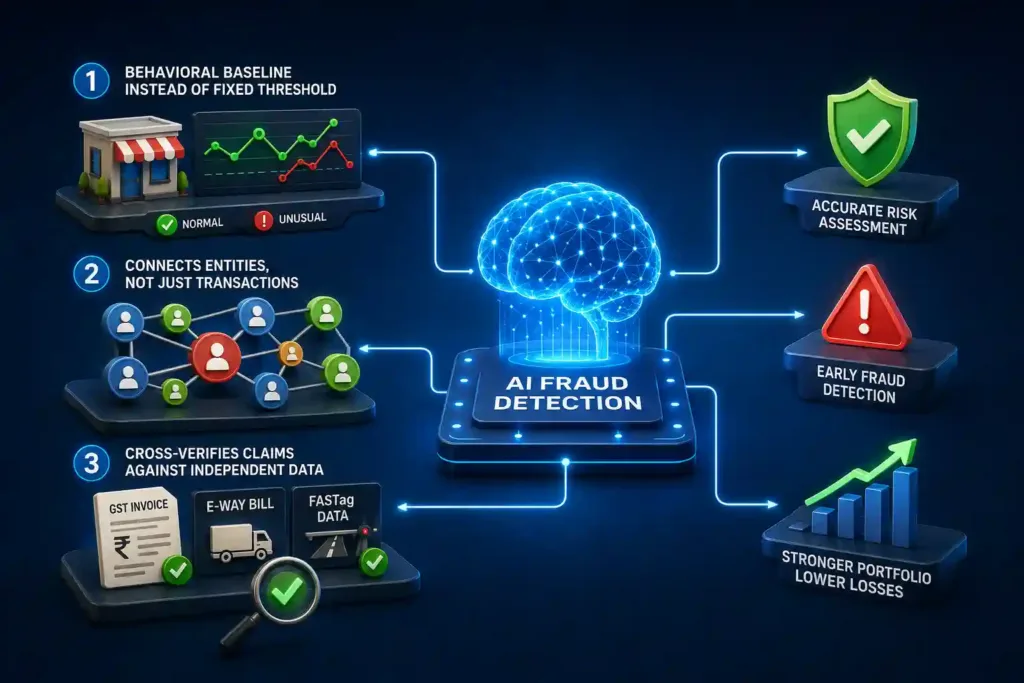
The useful version of “AI fraud detection” isn’t a black box that magically knows what’s suspicious. It changes three specific things that rule-based systems structurally can’t do well.
It builds a behavioral baseline instead of a fixed threshold
Instead of asking “is this transaction over ₹10 lakh,” it asks “is this unusual for this specific customer, this specific business, this specific industry peer group.” A ₹50 lakh disbursement might be routine for one borrower and a glaring outlier for another with an identical loan size.
It connects entities, not just transactions
This is where loan fraud actually gets caught. If the same individual is a director on twelve companies registered within months of each other, using different PAN numbers, that pattern is invisible to a transaction-level rule but obvious to a system built to resolve entities and map relationships across records.
It cross-verifies claims against independent data
A GST invoice claiming goods movement means very little on its own. Checked against E-way bill and FastTag data, a mismatch, invoicing without any corresponding physical movement of goods, becomes a strong, fairly unambiguous signal of fraud. This kind of cross-source verification is exactly the sort of thing manual review at scale simply can’t do, and simple rules engines were never built to do.
The RBI Itself is Betting on This

It’s worth noting that this isn’t just a vendor pitch. The RBI’s own FY26 annual report highlighted its focus on cyber-enabled fraud and money mule networks, and pointed specifically to MuleHunter.ai, a supervised machine learning model built by the RBI’s own Innovation Hub to identify mule accounts in near-real time. The regulator has also floated a Digital Payments Intelligence Platform to allow real-time, network-level sharing of suspicious transaction signals across banks and fintechs, rather than each institution defending its own silo.
When the regulator is building its own AI tooling because rule-based reporting isn’t fast enough, that’s a reasonably strong signal about where the rest of the industry needs to go.
What to Actually Look For in Fraud Detection Software India
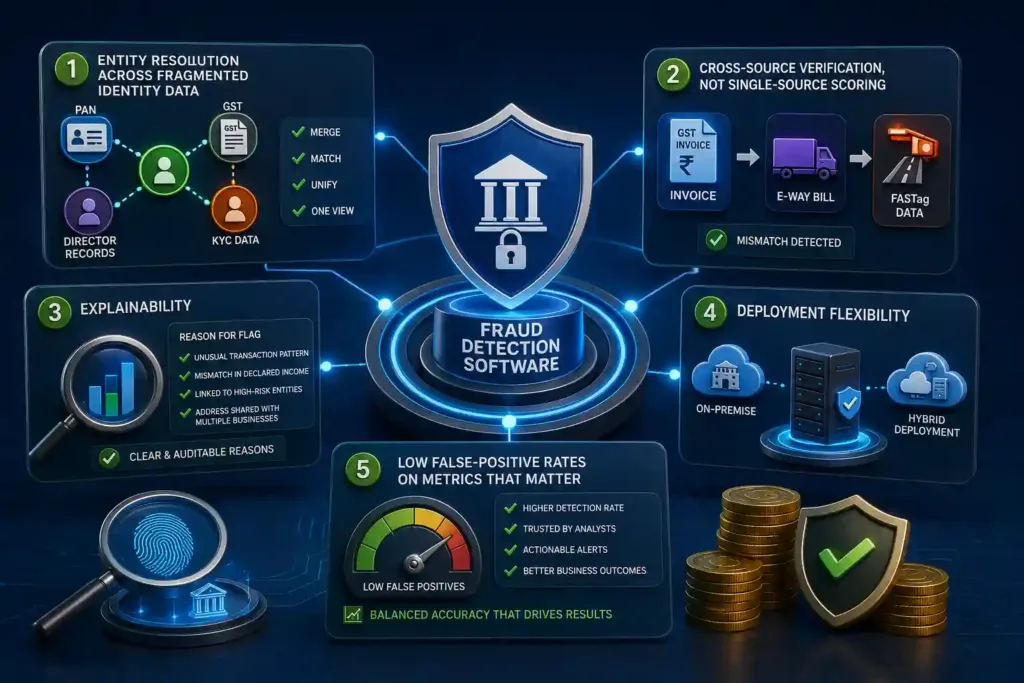
If you’re evaluating fraud detection software for an Indian banking or NBFC context specifically, a few things matter more here than they might elsewhere:
Entity resolution across fragmented identity data
PAN, GST registration, director records, and KYC data often don’t line up cleanly. Software that can’t merge these into a single view of “who is actually behind this” will miss most sophisticated loan fraud.
Cross-source verification, not single-source scoring
The strongest fraud signals in India right now come from checking one data source against another (GST against E-way bills, for instance), not from any single source in isolation.
Explainability
RBI audits and internal risk committees need to understand why a transaction or borrower was flagged. A model that can’t explain itself creates its own compliance problem.
Deployment flexibility
Given data localization expectations and the sensitivity of financial data, on-premise or hybrid deployment options matter more here than in less regulated markets.
Low false-positive rates on the metrics that matter to the business
Not just accuracy on paper. A system that flags too much gets ignored by analysts, which defeats the purpose.
Where Innefu Fits In
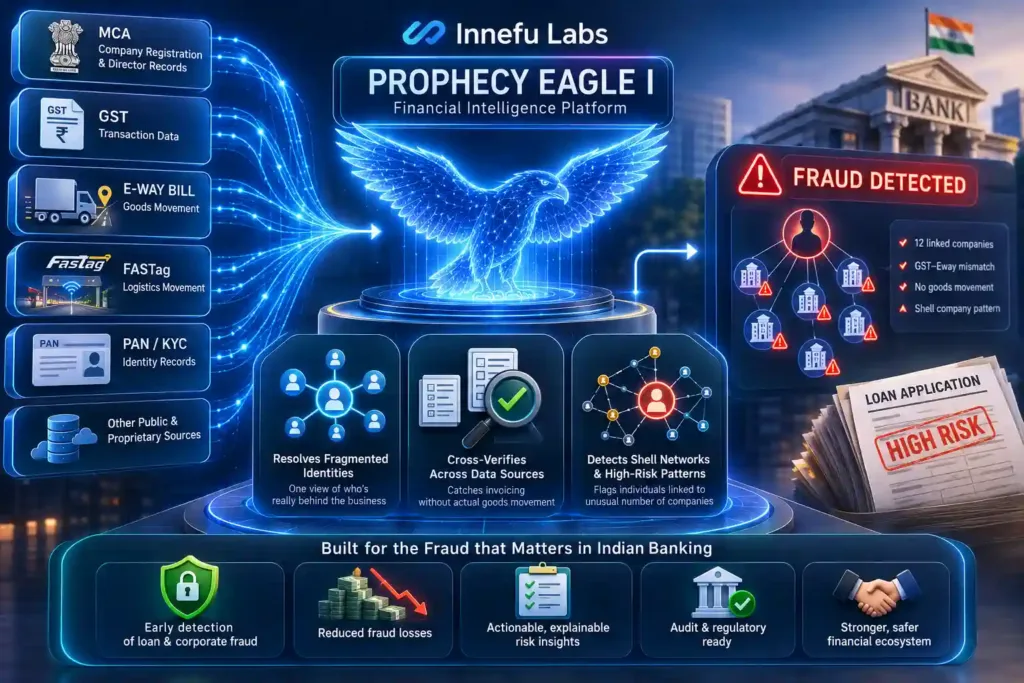
At Innefu Labs, this is the specific gap our financial intelligence platform, Prophecy Eagle I, is built to close. It resolves fragmented identities across company registration and director records, flags individuals linked to an unusual number of companies, and cross-verifies GST transaction data against E-way bill and FastTag movement records to catch the invoicing-without-goods pattern that sits at the center of most shell company and loan fraud schemes.
It’s built for exactly the kind of fraud that’s now driving 85 percent of reported losses in Indian banking, not the payment fraud that’s already being handled reasonably well.
FAQs
1. Why did bank fraud losses rise in India even as the number of cases fell?
Because the composition of fraud shifted. Digital payment fraud, which involves large volumes of smaller transactions, dropped sharply. Advances (loan) fraud, which involves fewer but far larger cases, now accounts for roughly 85 percent of total reported value.
2. How is AI fraud detection different from traditional rule-based systems?
Rule-based systems flag transactions that cross a fixed threshold. AI-driven systems build a behavioral baseline per customer, connect related entities across records, and can cross-verify claims against independent data sources, catching patterns that no single rule would trigger on its own.
3. Is AI fraud detection only useful for digital payment fraud?
No, and this is where a lot of the industry’s attention has been misplaced. Loan and advances fraud, which now represents the largest share of losses in India, benefits more from AI’s ability to resolve identities and map networks than from the transaction-level scoring most AI fraud tools were originally built for.
4. What should Indian banks prioritize when choosing fraud detection software?
Entity resolution across fragmented identity data, cross-source verification rather than single-source scoring, explainability for regulatory audits, flexible on-premise or hybrid deployment, and a genuinely low false-positive rate in practice, not just in vendor benchmarks.
5. Is machine learning fraud detection replacing human analysts in Indian banks?
No. It’s changing what analysts spend their time on, away from manually sifting low-value alerts and toward investigating the smaller number of genuinely high-risk cases the system surfaces. Final decisions on serious cases still require human judgment.