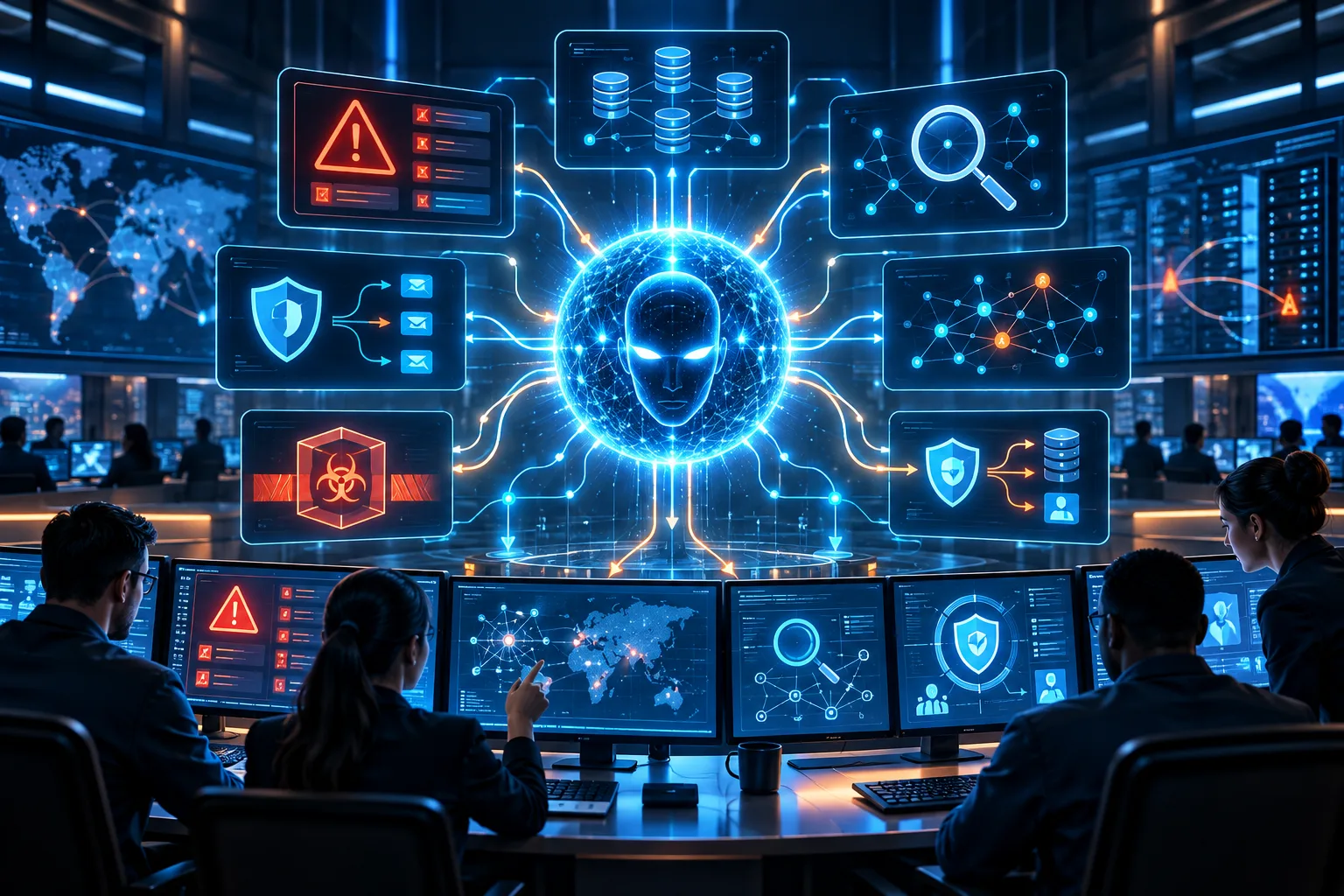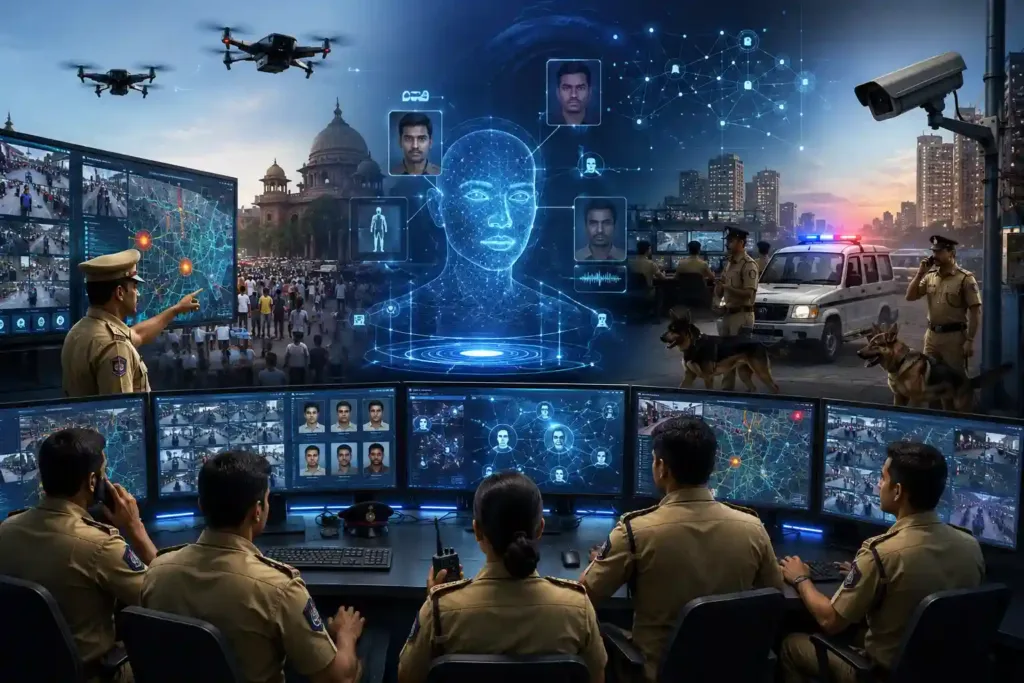
AI helps law enforcement agencies do five things faster and more accurately than manual methods ever could: identify a face from a blurry CCTV frame, correlate scattered data points (call records, past cases, bank transactions, forensic evidence) into one investigative view, monitor open digital sources for early warning signs of unrest or organized crime, analyze a compromised device without sending a forensic team on-site, and trace financial fraud through layers of shell entities. This is not about replacing an investigator’s judgment. It is about compressing work that used to take weeks into hours, so that judgment can act on complete information instead of partial guesswork.
This guide walks through how each of these actually works under the hood, not just what they’re called, so you understand the mechanics well enough to evaluate a solution properly. Wherever it’s useful, we’ve drawn on real deployments from Innefu Labs’ own work with Indian police and investigation agencies, since seeing how a capability performs in an actual case is worth more than any feature list.
The problem that makes all of this necessary
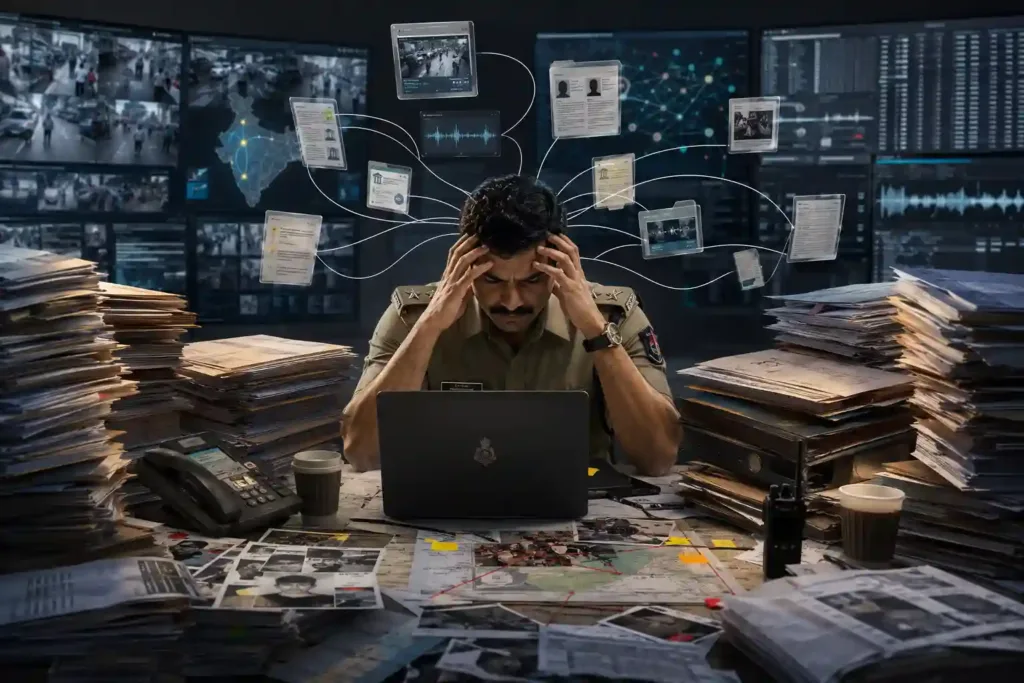
An investigator today isn’t short on information. They’re drowning in it. A single case can involve CCTV footage from a dozen cameras, call detail records running into thousands of rows, past case files, bank statements, and social media activity, all sitting in different systems that don’t talk to each other. Manually cross-referencing this is slow, and slow investigations mean evidence goes cold, suspects relocate, and money moves through accounts faster than paperwork can follow it.
India’s cybercrime numbers make this concrete. Financial losses to cyber fraud touched roughly ₹22,495 crore in 2025, according to Ministry of Home Affairs data, up 24 percent from the year before. That volume simply cannot be handled by adding more people to manual review. It requires tools that can process, correlate, and surface the right lead automatically, so a finite number of officers can act on it.
Facial recognition and video analytics: how it actually works
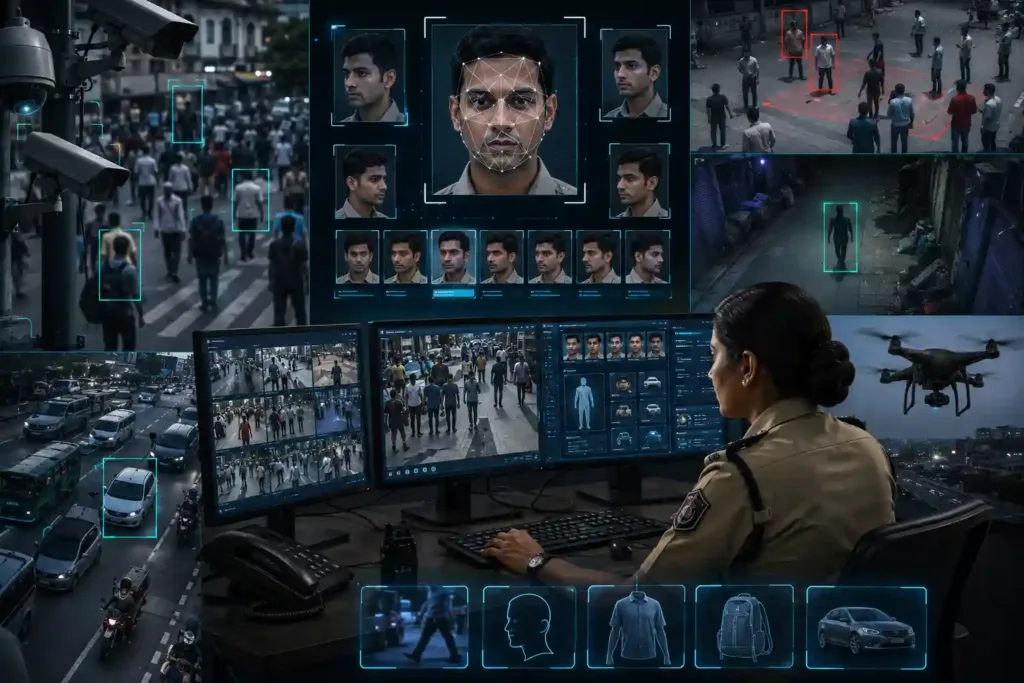
The quality of facial recognition depends heavily on two things: how well the underlying model was trained on the population it’s being used on, and how much footage the system can actually process in a useful time frame.
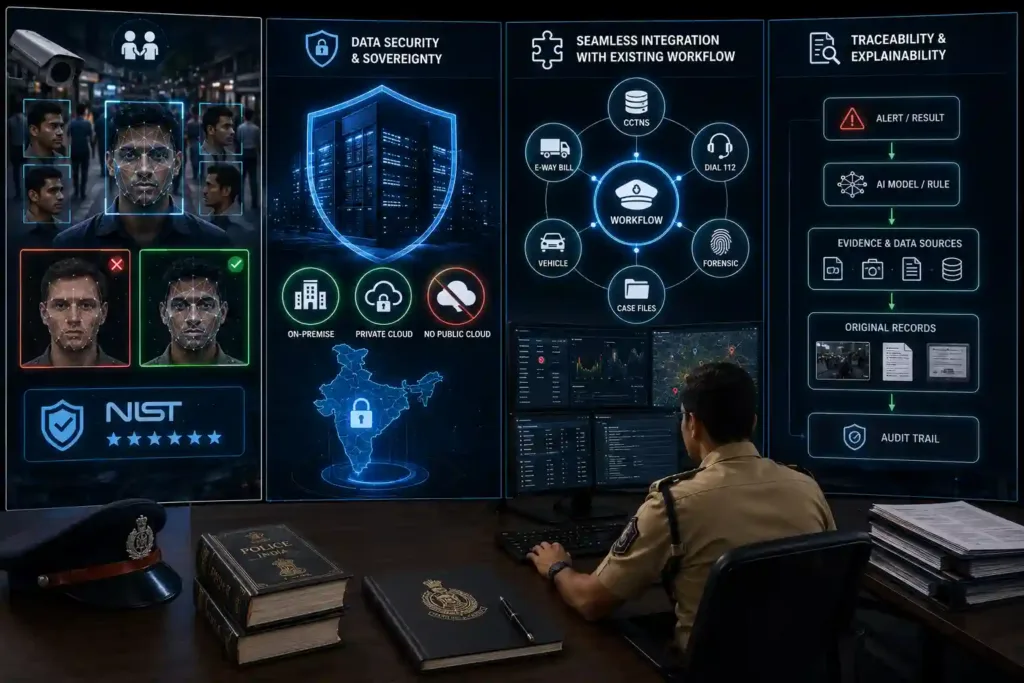
This is where a lot of generic, internationally-built facial recognition tools fall short for Indian deployments. A model trained primarily on Western datasets performs measurably worse on Indian faces, lighting conditions, and camera quality. Innefu’s AI Vision platform was built and trained specifically on Indian datasets for this reason, and it has been independently benchmarked at 99.7 percent accuracy on the NIST framework, the same certification standard used to evaluate facial recognition systems internationally.
Beyond just matching a face, AI Vision is built to handle the full video analytics problem: it ingests live feeds from CCTV, body-worn cameras, and drones simultaneously, flags real-time events like loitering, trespassing, crowd formation, or weapon detection, and lets an investigator search footage by attributes, such as a specific build, clothing, or a vehicle of a certain color and size, rather than scrubbing through hours of timestamps by hand.
Intelligence fusion and predictive policing: correlating what’s already there
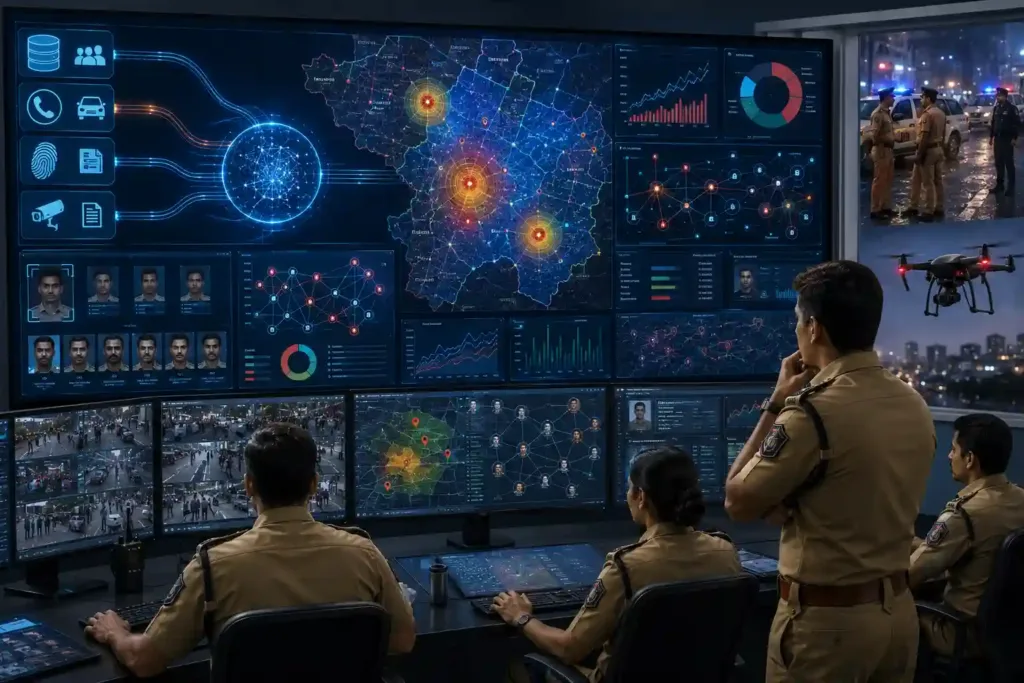
“Predictive policing” is a term that gets misunderstood. It doesn’t mean an algorithm tells officers who will commit a crime before they do it. What it actually means, in a working deployment, is statistical pattern analysis across historical crime data, emergency call volumes, and known offender records to estimate where and when incidents are more likely, so patrol resources can be positioned proactively rather than reactively.
The harder and more valuable problem underneath this is data fusion. In most police departments, CCTNS records, emergency call logs, vehicle registration data, forensic evidence, and case histories all sit in separate systems. An investigator trying to find a connection, say, whether a narcotics suspect arrested in one district shares a modus operandi with someone arrested in a different district six months earlier, has to manually search each system and hope they remember to check. Most of the time, that connection never gets made, simply because no one had the bandwidth to look.
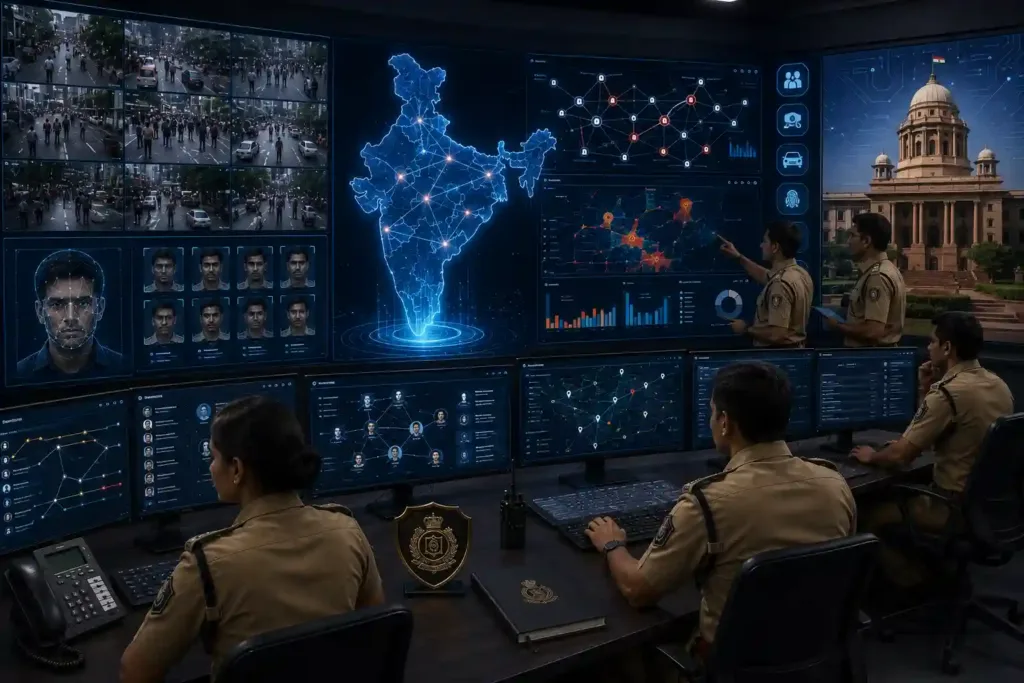
Innefu’s Prophecy Alethia platform addresses this by pulling data from multiple department systems into a single correlated Big Data environment, then layering an integrated GIS engine, criminal profiling tools, and trend dashboards on top. In one state deployment, the platform fused data from eight distinct sources, including CCTNS, the emergency dial service, and the vehicle registration database, along with unstructured incident reports, into one system. The result was measurable: faster crime forecasting, clearer identification of vulnerable areas within the city, and automated criminal profiling that used to take an analyst days to compile manually.
For senior officers, this also solves a visibility problem that has nothing to do with any single case. A police leadership team overseeing multiple districts needs to see, at a glance, whether a particular crime category is rising in a specific area, whether emergency call volumes are trending up, and which habitual offenders are currently out on bail. Without a fusion layer, that requires someone manually compiling reports from each station. With one, it’s a live dashboard.
Open source intelligence: monitoring what’s already public
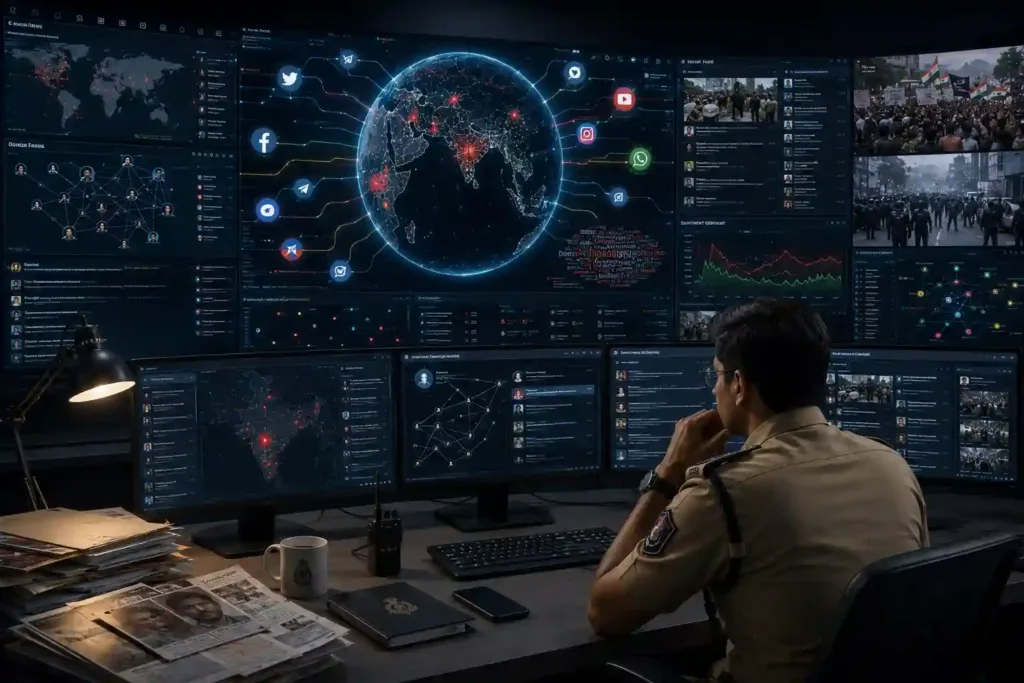
A significant share of organized crime activity, and nearly all public unrest, leaves a digital trail before it happens: recruitment posts, coordination on social apps, sentiment building on social media. Open source intelligence (OSINT) tools are built to monitor this trail across the web, including regional social platforms and over a thousand news sources, and turn it into something an analyst can act on.
Innefu’s Innsight platform is used by state police and investigation agencies for exactly this kind of monitoring: tracking illegal drug and arms trafficking networks, watching known gang activity, running sentiment analysis on how the public perceives law and order in a given area, and predicting the likelihood and scale of upcoming protests or rallies based on early online chatter. After an event, the same platform can trace how a piece of misinformation or a coordinated social media push originated, identifying the accounts and, where possible, the individuals and mobile numbers behind it.
The practical value for an investigator is speed and reach. Instead of manually monitoring dozens of social media platforms and forums, an officer can set an alert for a specific keyword or phrase and get notified the moment it appears anywhere in the monitored sources.
Call data and link analysis: turning phone records into a case
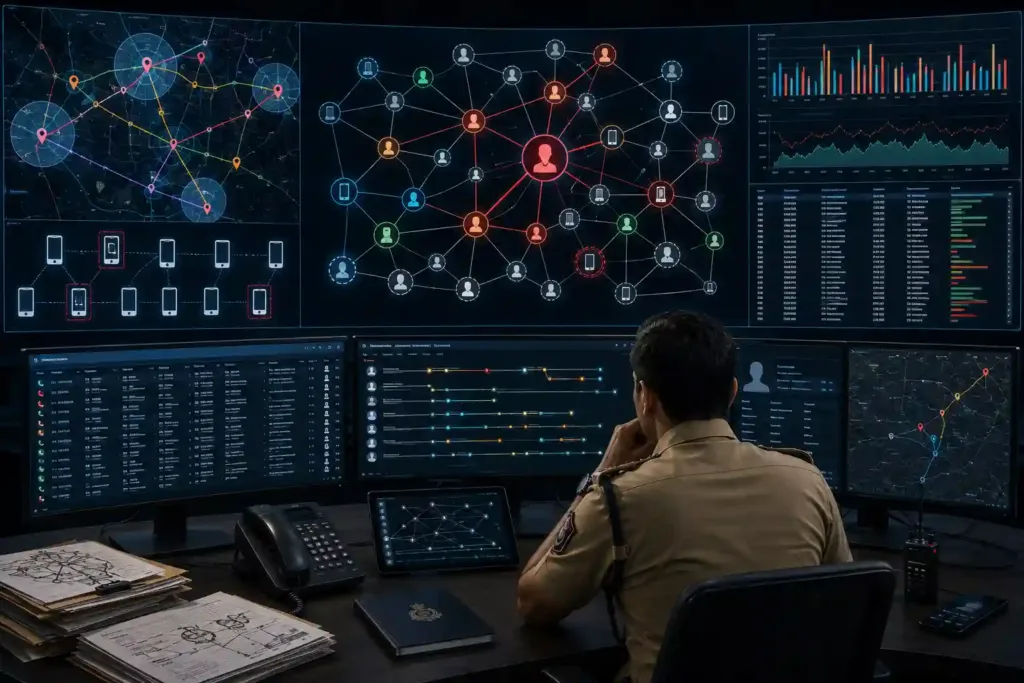
Call Detail Records (CDR) and IP Detail Records (IPDR) analysis is its own distinct discipline within an investigation, separate from digital forensics or facial recognition, and it solves a very specific problem: a high-profile case typically generates thousands of rows of call records across multiple suspects and devices, and finding the meaningful pattern in that data manually is close to impossible.
Innefu’s Intelelinx platform is built specifically for this. It maps suspect movements and communication patterns geospatially using integrated mapping, analyzes multiple phone numbers and IMEI numbers simultaneously to catch device-switching behavior, and generates a visual link analysis chart that shows who is connected to whom, and how strongly, across a communications network. What used to require an analyst manually tracing call patterns across a spreadsheet becomes a graph an investigator can read in minutes, surfacing the middle layer of a network (the coordinators between the low-level operators and the actual leadership) that’s usually the hardest part of a case to crack.
Digital forensics without dispatching a team
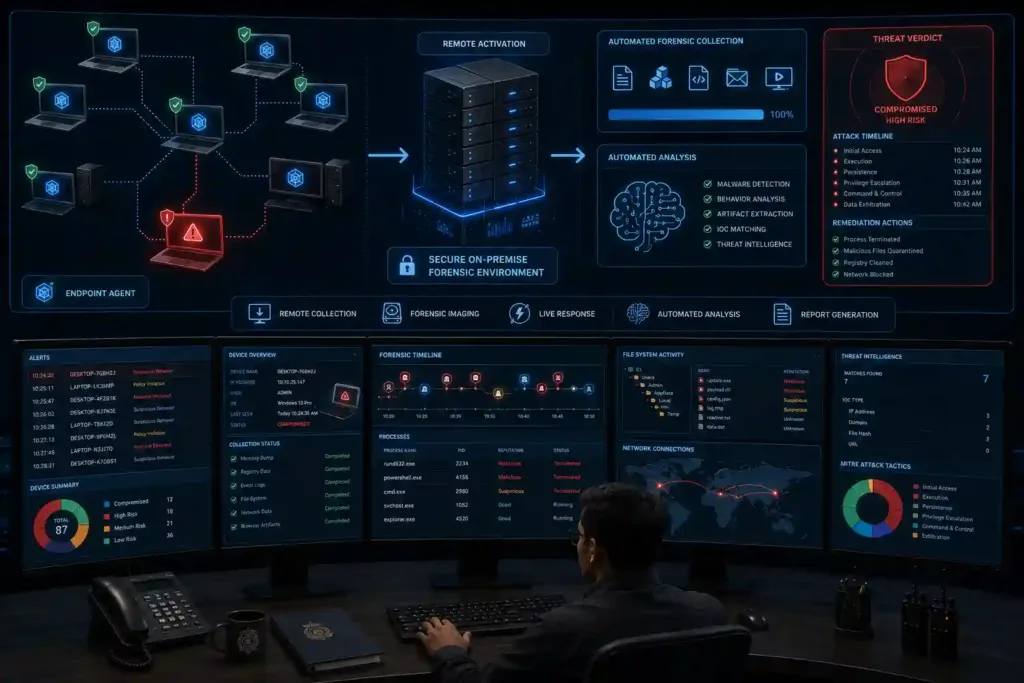
When a device on a government or enterprise network shows signs of compromise, the traditional response is to send a trained forensic examiner to the physical location, image the hard drive on-site, and carry that data back for analysis. For agencies with offices spread across multiple cities or districts, this is slow by design: the compromise might sit unaddressed for the days it takes a team to travel, and a large share of alerts turn out to be false positives anyway, meaning the trip was unnecessary in the first place.
RapiDFIR, Innefu’s remote digital forensics toolkit, removes the travel requirement entirely. A lightweight agent runs on every endpoint device. When an alert fires, an administrator remotely activates the agent on that specific device, which pulls the relevant forensic data into a private, on-premise environment automatically. From there, the platform’s analysis tools determine whether the device was actually compromised and, if so, how, without requiring a specialized forensic examiner to interpret raw data manually.
For a cybercrime cell or a large enterprise security team handling dozens of alerts a week, this is the difference between investigating every serious incident within hours and investigating one every few days because the forensic team can only be in one place at a time.
What separates a genuinely useful AI platform from a checkbox tool
Having built and deployed AI systems for Indian law enforcement agencies over multiple years, a few things consistently separate platforms that actually get used from ones that end up abandoned after the pilot:
- Training data has to reflect the population it’s used on: A facial recognition model benchmarked on international faces will underperform on Indian CCTV footage, regional lighting conditions, and camera quality. Accuracy claims should be backed by an independent standard, such as the NIST framework, not just a vendor’s internal testing.
- Data has to stay within the agency’s own environment: For sensitive investigative and citizen data, on-premise or private-cloud deployment isn’t a preference; it’s usually a hard requirement, and any platform that routes data through third-party public-cloud infrastructure should be evaluated with that in mind.
- The tool has to fit into an officer’s existing workflow, not create a new one: A platform that requires investigators to abandon CCTNS or maintain a parallel system will get used for a few months and then quietly stop being used. Integration matters more than any individual feature.
- Every output should be traceable back to its source data: Whether it’s a facial match, a flagged transaction, or a predicted hotspot, an investigator (and eventually a court) needs to be able to see exactly what evidence produced that result.
Innefu’s position in this space
Innefu Labs is empanelled by the National e-Governance Division (NeGD) under the Government of India as an AI solutions provider, a recognition that comes after government scrutiny of the platform’s capability and reliability. Across the products described in this guide, the common thread is the same: these are sovereign platforms, built as on-premise, India-trained systems designed to sit inside an agency’s existing investigative workflow.
Frequently asked questions
1. Does AI replace the need for field investigators?
No. Every capability described here, from facial matching to link analysis, is designed to surface a lead or a correlation faster so a human investigator can verify and act on it. The final decision, and the accountability for it, stays with the officer.
2. How accurate is AI-based facial recognition, really?
Accuracy depends entirely on the training data. A system benchmarked on an internationally recognized standard like NIST, using data representative of the population it’s deployed on, can reach accuracy in the high 99 percent range. A system trained on a mismatched dataset will perform noticeably worse in real conditions, even if it tests well in a vendor demo.
3. What’s the difference between OSINT, CDR analysis, and digital forensics?
OSINT monitors publicly available data, social media, forums, news, and open web sources, to gather intelligence before or after an event. CDR and IPDR analysis works specifically with call and internet data records to map communication patterns and relationships. Digital forensics examines a specific device or network to determine whether and how it was compromised. These are three distinct disciplines that solve different problems, even though they often work together on the same case.
4. Can a state police department or agency deploy this without sending data outside its own network?
Yes, this should be a baseline requirement, not an add-on. Innefu’s platforms are built for on-premise or private-cloud deployment specifically so that investigative and citizen data never has to leave an agency’s own controlled environment.
5. How does an agency get started evaluating an AI platform for its investigation teams?
Start with a clearly defined problem, whether that’s video backlog, financial fraud detection, or a CDR analysis bottleneck, rather than evaluating a generic “AI for policing” product. A focused pilot against a real, current caseload will show far more than a demo ever will.