
When Time Is the Most Critical Variable
In missing persons cases, time is not just a factor, it is the defining variable.
The first 24 to 72 hours often determine whether a case remains a search operation or escalates into a prolonged investigation. Whether it is a child who has not returned home, an elderly individual who has wandered away, or a suspected abduction, early response speed directly influences outcomes.
In tier-1 cities such as Mumbai, Delhi, or Bengaluru, the challenge intensifies:
- Dense populations
- High daily mobility
- Extensive transport networks
- Thousands of CCTV endpoints
- Large volumes of telecom activity
Urban complexity makes manual tracking increasingly difficult. Data relevant to a single case may exist across multiple systems, FIR databases, surveillance feeds, telecom records, transport logs, and field intelligence inputs.
The problem is not the absence of information. It is the delay in connecting it.
When investigators must manually review footage, cross-check phone numbers, or coordinate across districts, response time expands, precisely when it should compress.
This is where AI becomes critical, not as abstract technology, but as time compression infrastructure. By integrating fragmented data and surfacing actionable insights quickly, AI reduces correlation delays and accelerates operational decisions.
This blog explains how AI supports missing persons tracking, where it adds measurable value, and how police units can implement it responsibly.
Key Takeaways
1.Time Determines Outcomes: The first 24–72 hours are critical in missing persons investigations.
2. Data Fragmentation Slows Response: Information spread across systems delays actionable decisions.
3. AI Compresses Correlation Time: Integrated analytics convert scattered inputs into structured intelligence.
4. Visual Intelligence Accelerates Identification: Automated video analysis reduces manual footage review.
5. GeospatialModelingNarrows Search Zones: Risk mapping helps prioritize high-probability locations.
6. Communication Analysis Reveals Hidden Links: CDR mapping and network visualization strengthen suspect prioritization.
7. Coordination Becomes Structured and Measurable: Real-time alerts reduce inter-unit delays.
8. AI Augments, It Does Not Replace: Human judgment remains central to every operational decision.
The Operational Challenges in Missing Persons Cases
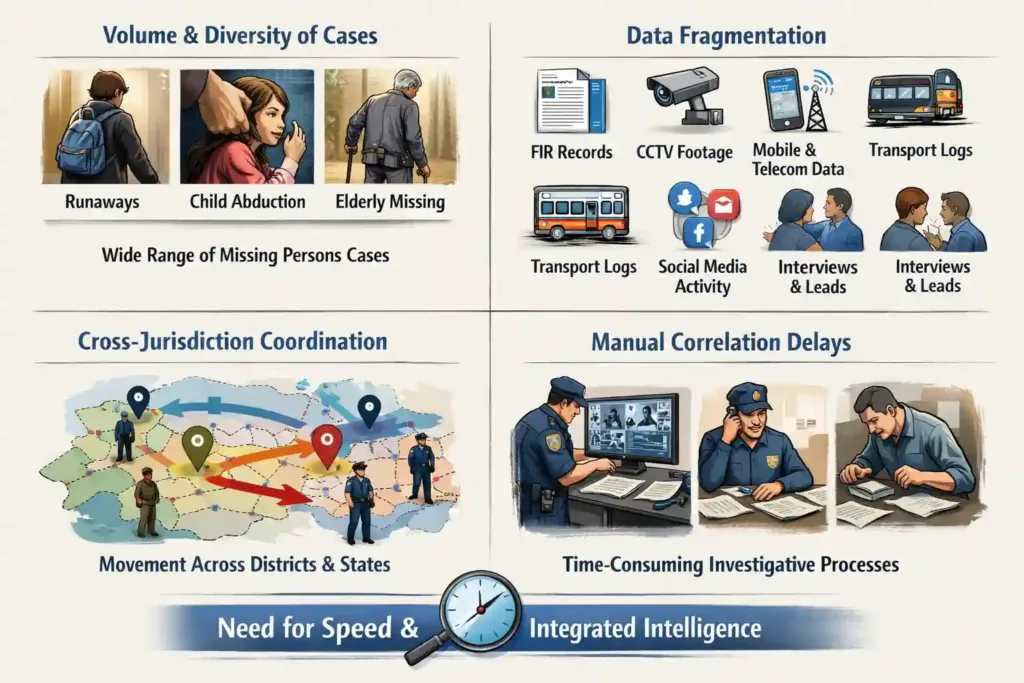
Missing persons investigations are complex because they combine urgency, emotional sensitivity, and multi-source intelligence requirements.
Volume & Diversity of Cases
Police departments handle a wide spectrum of missing persons cases, including:
- Runaways, often minors or young adults leaving home voluntarily
- Child abductions, high-priority, time-sensitive cases
- Elderly missing individuals, sometimes involving medical or cognitive risks
- Trafficking-linked cases, requiring coordinated and intelligence-led intervention
Each category demands a different investigative approach. However, all share a common need: rapid information consolidation.
Data Fragmentation
Information relevant to a missing persons case rarely resides in one place. It is typically dispersed across multiple systems:
- FIR records documenting the initial complaint
- CCTV networks across public and private infrastructure
- Mobile location data and telecom records
- Transportation logs (railways, buses, metro systems)
- Social media traces and digital activity indicators
- Interrogation inputs from associates or suspects
When these inputs remain siloed, officers must manually reconcile them, slowing investigative momentum.
Cross-Jurisdiction Coordination
In metropolitan ecosystems, individuals can cross district or state boundaries within hours.
Operational challenges include:
- Movement across district jurisdictions
- Inter-state travel
- Railway and bus corridor mobility
- Limited real-time coordination between units
Without structured data sharing, valuable time is lost in administrative coordination rather than search execution.
Manual Correlation Delays
Traditional investigative workflows rely heavily on manual effort. Officers often:
- Review CCTV footage frame by frame
- Cross-check Call Detail Records manually
- Contact multiple stations for updates
- Reconcile inconsistent information from different units
These processes are resource-intensive and strain already stretched investigation teams. While they reflect diligence and procedural rigor, they can extend response time in cases where hours matter.
The operational challenge is not capability, it is scalability and speed.
What Does AI-Based Missing Persons Tracking Mean?

AI-based missing persons tracking refers to the use of data integration, pattern recognition, facial recognition (where legally permitted), geospatial analysis, and risk modeling to accelerate identification, tracking, and recovery efforts.
It transforms fragmented case inputs into structured, actionable intelligence by:
- Aggregating multi-source data
- Detecting movement patterns
- Identifying high-probability search zones
- Linking communication networks
- Generating real-time alerts for field units
Importantly, AI does not replace investigators. It augments them.
AI systems:
- Support decision-making
- Surface insights from large datasets
- Reduce manual correlation time
- Operate within defined legal and governance frameworks
Human oversight remains central to every operational decision.
In missing persons investigations, AI’s role is clear: compress time, reduce uncertainty, and strengthen coordination, enabling law enforcement agencies to respond faster and more effectively when it matters most.
Step-by-Step: How AI Supports Missing Persons Investigations

In high-density cities, missing persons investigations require speed, coordination, and data clarity. This is where an integrated AI platform, combining intelligence fusion and advanced video analytics, becomes central.
With platforms such as AI vision, law enforcement agencies can transform scattered data into structured, time-sensitive intelligence.
Below is a practical, step-by-step operational flow.
Step 1: Unified Case Data Aggregation
Every missing persons case begins with foundational inputs. AI systems consolidate:
- FIR details
- Last seen location
- Phone number history
- Known associates and contact references
- Prior missing patterns, if any
Instead of officers manually pulling records from separate systems, an integrated intelligence layer centralizes this information into a single operational dashboard.
AI vision integrates these data inputs with visual intelligence feeds, ensuring that investigative context is unified from the outset.
Operational Benefit: Reduces initial correlation delay and establishes a structured search baseline.
Step 2: Geospatial Risk Mapping
Once core case data is consolidated, geospatial modeling begins.
AI vision analyzes:
- Last known location radius
- Likely travel corridors (roads, metro routes, bus lines)
- High-risk zones based on historical patterns
- Nearby transport hubs such as railway stations and terminals
Instead of searching across an entire metropolitan spread, officers receive prioritized geographic zones.
In densely populated cities, narrowing the search area within the first few hours significantly improves recovery probability.
Operational Benefit: Converts uncertainty into mapped priority zones.
Step 3: CCTV & Image-Based Matching (Where Applicable)
Urban environments are saturated with surveillance infrastructure. However, manual review is time-intensive.
AI vision enables:
- Automated face matching across distributed camera feeds (where legally permitted)
- Clothing attribute detection to track individuals based on appearance
- Movement tracking across time and locations
If a missing individual appears in multiple camera feeds, the system can reconstruct movement trails far faster than manual review.
Rather than reviewing hours of footage, investigators receive filtered, relevant visual matches.
Operational Benefit: Drastically reduces video review time and increases visual traceability.
Step 4: Communication & Contact Analysis
Movement patterns are often linked to communication behavior.
AI-driven analytics support:
- CDR linkage mapping
- Last active cell tower correlation
- Contact network prioritization
Instead of manually scanning large call datasets, investigators can visualize communication clusters and identify high-priority contacts.
When integrated with visual intelligence from AI vision, this creates a layered understanding of both movement and interaction patterns.
Operational Benefit: Accelerates suspect identification and narrows investigative focus.
Step 5: Alert Generation & Cross-Unit Coordination
Speed depends on coordination.
AI-enabled platforms support:
- Real-time alerts to nearby patrol units when potential matches are detected
- Inter-district notifications if the individual crosses jurisdictional boundaries
- Watchlist integration for transport hubs and sensitive locations
Instead of relying solely on manual phone calls between units, the system standardizes structured alerts.
In metropolitan ecosystems, this prevents response fragmentation.
Operational Benefit: Enables synchronized, data-backed field action.
Step 6: Continuous Update Loop
Missing persons investigations evolve rapidly.
AI systems refine outputs as new information emerges:
- Updated sightings adjust search radii
- New data inputs refine geospatial predictions
- Field officer confirmations improve model accuracy
AI vision continuously learns from case progression, ensuring the system adapts rather than remaining static.
Operational Benefit: Transforms the investigation into a dynamic intelligence cycle rather than a one-time analysis.
Why AI Vision Becomes Central in Missing Persons Tracking

In metropolitan investigations, visual intelligence often determines breakthrough moments.
AI vision serves as the visual analytics engine within the broader investigative ecosystem. It processes live CCTV feeds and recorded footage to detect faces, movement patterns, and contextual signals, enabling faster identification in time-sensitive cases.
Key capabilities relevant to missing persons investigations include:
- High-accuracy facial recognition across distributed camera networks (where legally permitted)
- Crowd behavior analysis to track individuals in high-footfall areas
- Object and incident detection to flag abandoned belongings or suspicious activity
- Real-time alert generation for immediate field response
- Mobile-based field verification tools supporting on-ground officers
In large-scale identification drives, AI vision has demonstrated the ability to match thousands of faces against extensive image databases within short operational windows, illustrating its scalability in high-pressure environments.
Rather than replacing investigators, AI vision reduces the time spent manually reviewing footage and strengthens cross-unit coordination through structured alerts and searchable visual intelligence.
In missing persons cases, this compression of visual correlation time can significantly improve early response effectiveness.
To conclude
In missing persons investigations, speed determines outcomes. The difference between early recovery and prolonged uncertainty often lies in how quickly fragmented information is converted into actionable intelligence.
AI-enabled platforms bring structure to urgency. By unifying case data, narrowing geospatial focus, accelerating video analysis, mapping communication networks, and synchronizing field coordination, they compress investigative timelines without replacing human judgment.
For metropolitan police units, AI-based missing persons tracking is not about automation, it is about strengthening response capability during the most critical hours, while operating within defined legal and governance frameworks.
Frequently Asked Questions (FAQ)
1. How does AI help in missing persons investigations?
AI integrates multi-source data, analyzes movement patterns, accelerates CCTV review, and prioritizes search zones to reduce response time.
2. Does AI track missing persons in real time?
AI does not autonomously track individuals. It processes available data and generates actionable insights to support investigators.
3. Is facial recognition necessary for missing persons tracking?
Facial recognition can assist in visual identification where legally permitted, but AI-based tracking can also rely on geospatial, communication, and behavioral analysis.
4. What data is typically used in AI-based missing persons systems?
Common inputs include FIR details, last seen location, phone records, CCTV footage, known associates, and historical case patterns.
5. Does AI replace investigators?
No. AI augments investigative workflows by reducing manual correlation time. Final decisions remain with law enforcement officers.
6. Can AI improve coordination across districts?
Yes. Structured alerts and shared dashboards help synchronize inter-district communication and reduce response fragmentation.
7. Is AI-based missing persons tracking compliant with legal frameworks?
When properly implemented, such systems operate under defined data governance policies, access controls, and human oversight mechanisms.