
Prediction Fails Without Context
Crimes, unrest, and security threats rarely emerge in isolation. They build gradually, through conversations, coordination, sentiment shifts, and visible behavioural cues long before they translate into formal incidents.
In many cases, the earliest warning signs never appear in police databases at all. They surface in the open: in public conversations, online narratives, community chatter, event-related discussions, or sudden shifts in digital behaviour. By the time these signals harden into official reports, the opportunity to intervene early may already be slipping away.
This is one of the core challenges facing modern predictive policing. While historical crime data and structured records remain essential, they reflect what has already happened. They struggle to capture what is actively forming.

Predictive policing, therefore, depends not just on analysing the past, but on understanding what is unfolding in real time, in the open. Without this context, prediction becomes delayed, incomplete, or reactive, limiting its ability to prevent escalation.
This is where Open-Source Intelligence (OSINT) becomes critical. OSINT provides the context layer that predictive systems need to move from retrospective analysis to true foresight. By capturing early, open-source signals and situational cues, OSINT enables predictive policing to operate with greater awareness, timeliness, and relevance, before risks cross the threshold into incidents.
Key Takeaways
- Predictive policing requires early context, not just historical crime data.
- OSINT acts as a leading indicator, revealing intent, coordination, and sentiment before incidents formalise.
- Open-source signals help improve place, time, and context-based foresight without intrusive measures.
- In crowd, event, and unrest scenarios, OSINT enables earlier, calmer, and more proportionate responses.
- Predictive accuracy improves when early behavioural signals complement structured policing data.
- OSINT is now a foundational layer for modern predictive policing, not an optional add-on.
The Blind Spots of Traditional Data in Predictive Policing
Traditional policing data has long been the backbone of crime analysis. Records such as FIRs, CDR, CCTNS entries, patrol logs, and emergency calls provide structured, verified information that is essential for accountability and investigation.
However, by their very nature, these datasets reflect what has already occurred.
They are created after an incident is reported, verified, and recorded. This makes them reliable, but also retrospective. In an environment where threats evolve rapidly, this time lag creates unavoidable blind spots.

Structured datasets often struggle to capture:
- Emerging narratives that shape behaviour before any offence takes place
- Social mobilisation, where coordination begins informally and openly
- Behavioural shifts that signal rising tension or intent but remain legally ambiguous
Many modern risks develop before they cross legal or procedural thresholds. At this stage, there may be no reportable offence, only signals that something is forming.
Consider a few common scenarios:
- Rumours escalating into unrest, spreading through public conversations before any physical disruption occurs
- Online coordination preceding physical gatherings, where intent and mobilisation are visible long before crowds assemble
- Narrative-driven mobilisation, where perception and emotion influence collective behaviour faster than formal systems can respond
None of these early indicators are easily captured by traditional crime records alone. Yet they often determine whether an incident can be prevented, or merely responded to.
This does not diminish the value of structured policing data. Instead, it highlights a critical reality: predictive policing needs visibility before incidents formalise. This is where OSINT becomes indispensable, filling the gap between emerging signals and official data, and enabling foresight where hindsight alone is not enough.
OSINT as the Earliest Signal Layer for Prediction

In predictive policing, timing is everything. The difference between prevention and response often lies in when a signal becomes visible.
OSINT functions as a leading indicator, not as confirmation data. It surfaces signals before they harden into incidents, reports, or statistics. This makes it the earliest layer where emerging risks can be observed and assessed.
In the open digital ecosystem, intent often surfaces before action. People discuss, react, align, and mobilise publicly, leaving behind behavioural traces that reveal momentum long before any formal violation occurs. Coordination begins in conversations. Sentiment shifts before it escalates into disruption.
This is why open digital behaviour is such a powerful predictor. It reflects pre-incident momentum: the build-up phase where perception, emotion, and influence shape outcomes.
OSINT captures this momentum by revealing:
- Conversations that signal rising interest, grievance, or urgency
- Narratives that frame events, amplify emotion, or legitimise action
- Mobilisation patterns, where participation begins to organise informally
- Influence dynamics, showing how certain voices or messages accelerate spread
Individually, these signals may appear harmless or inconclusive. Together, they provide context that structured records cannot yet offer. They show direction, not just data points.
This is the critical advantage OSINT brings to predictive policing. Predictive accuracy improves dramatically when models and decision-makers are informed by early behavioural signals, not just past incidents. By integrating what is unfolding in the open with what is already known, agencies gain foresight, enabling timely, proportionate action before risks become events.
How OSINT Strengthens Predictive Policing Outcomes
Predictive policing works best when it connects patterns, timing, and context. OSINT strengthens this process not by replacing existing data, but by adding layers of meaning that structured records alone cannot provide.
Rather than repeating predictive policing categories, it’s more useful to understand how OSINT enhances foresight across key dimensions of prediction.
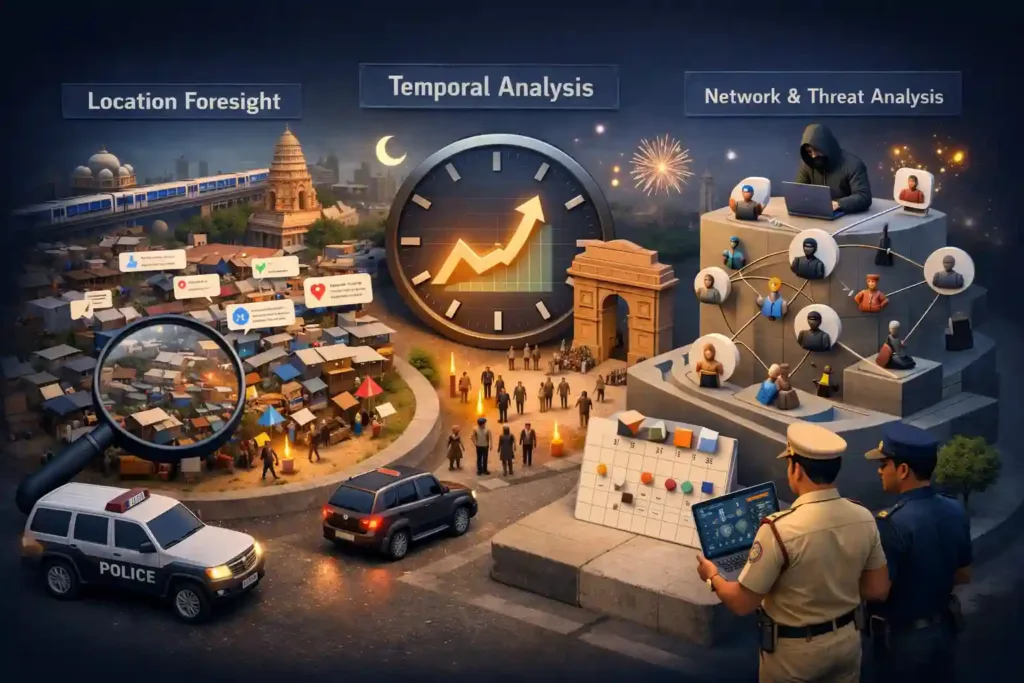
Improving Place-Based Foresight
Locations do not become high-risk in isolation. They are shaped by activity, perception, and collective behaviour, much of which becomes visible online before it manifests physically.
OSINT adds depth to location-based foresight by revealing:
- Online conversations tied to specific places, such as neighbourhoods, venues, or public spaces
- Geo-tagged narratives, where posts, images, or discussions reference precise locations
- Area-specific sentiment shifts, indicating rising tension, concern, or mobilisation around a place
This context helps agencies understand why a location may become sensitive, not just that it has a history of incidents. Place-based foresight becomes more precise when digital signals confirm growing attention or momentum around a specific area.
Enhancing Time-Based Anticipation
Timing is often the most underestimated factor in prediction. Many risks are not constant, they build, peak, and dissipate within narrow windows.
OSINT supports time-based anticipation by acting as a real-time behavioural clock:
- Conversation velocity: how fast discussions or mentions are increasing, often signals urgency
- Event build-up patterns: where interest intensifies before a planned or anticipated moment
- Distinguishing pre-event escalation from post-event noise: which helps avoid late or unnecessary responses
By analysing how quickly narratives gain traction, agencies can anticipate when escalation is most likely, not just where it might occur. This enables better prioritisation and earlier, calmer interventions.
Adding Context to Person and Network Risk
Modern threats are rarely individual in nature. They are influenced by networks, visibility, and amplification, all of which are observable in open digital spaces.
OSINT contributes context by highlighting:
- Open network behaviour, such as clustering, repeated interactions, or shared narratives
- Influence amplification, where certain voices accelerate reach and engagement
- Public coordination patterns, indicating informal organisation without crossing legal boundaries
This perspective avoids simplistic or individualised assumptions. Instead of focusing on “who” in isolation, OSINT helps decision-makers understand how influence and coordination evolve, supporting informed, proportionate responses.
Across place, time, and context, OSINT strengthens predictive policing by connecting signals early, before they become incidents. It allows prediction to move beyond static patterns and into dynamic awareness, where foresight is shaped by real-world behaviour unfolding in the open.
OSINT and Predictive Policing in Crowd, Event, and Unrest Scenarios
Crowd-related incidents rarely begin at the venue itself. They begin before people assemble, in conversations, narratives, and coordination that unfold in the open.

This is why OSINT is especially critical in crowd, event, and unrest scenarios. It provides visibility ahead of physical convergence, when risks are still forming and intervention options are widest.
Before a crowd gathers, OSINT can help detect:
- Mobilisation calls, where participation begins to organise informally
- Misinformation, which can amplify fear, urgency, or mistrust
- Trigger narratives, where specific messages or incidents gain emotional traction
These early signals often determine whether an event remains orderly or escalates unexpectedly. Without OSINT, agencies may only become aware once crowd density increases, leaving little room for measured response.
When integrated into predictive policing, OSINT enables agencies to:
- Prepare earlier, aligning plans with emerging realities rather than assumptions
- Respond proportionately, addressing risks locally without overreaction
- Avoid last-minute decision-making, which often leads to disruption rather than control
In event and crowd contexts, foresight is not about surveillance, it is about timing and restraint. OSINT supports interventions that are quieter, earlier, and more effective.
From Raw Signals to Decision-ready Intelligence
A common misconception is that OSINT is simply about monitoring social media or tracking online chatter. In practice, raw signals alone have limited predictive value.
Predictive policing benefits from OSINT only when those signals are transformed into decision-ready intelligence.

This transformation depends on:
- Correlation, where multiple signals reinforce a shared direction
- Trend confirmation, distinguishing sustained momentum from short-lived noise
- Contextual filtering, separating relevance from coincidence
Without these steps, open-source data can overwhelm rather than inform.
When properly contextualised, OSINT becomes a decision-support layer, not a stream of information. It helps commanders and planners focus attention where it matters most supporting:
- Preparedness, by identifying emerging risks early
- Prioritisation, by distinguishing credible escalation from background activity
- Scenario planning, by enabling agencies to anticipate multiple outcomes rather than a single forecast
In this role, OSINT does not replace judgement or experience. It sharpens them, ensuring predictive policing is guided by clarity, context, and foresight rather than volume alone.
Why Predictive Policing Without OSINT is No Longer Enough

The nature of modern threats has changed. They are faster, emerging and evolving in compressed timeframes. They are networked, shaped by collective behaviour rather than isolated actions. And they are increasingly narrative driven, influenced by perception, emotion, and amplification.
Crucially, these threats surface in the open first. Public conversations, shared narratives, and visible coordination often precede any formal incident or report. By the time traditional systems reflect a pattern, the opportunity for early intervention may already be narrowing.
Predictive policing must evolve in response to this reality. Relying solely on historical or structured data limits foresight to what has already crossed procedural thresholds. Without visibility into open-source signals, prediction risks becoming delayed or incomplete.
OSINT addresses this gap by providing continuous awareness of emerging dynamics. It’s foundational, not optional, a core layer that enables predictive systems to function with relevance and timeliness. And it is continuous, not episodic, offering insight into how risks develop over time rather than appearing suddenly.
In this context, predictive policing without OSINT is no longer sufficient for environments defined by speed, connectivity, and influence.
To Conclude: Prediction Begins in the Open
Prediction is most effective when it begins early. OSINT enables that shift, transforming predictive policing from hindsight-driven analysis to foresight-led decision-making.
By listening to what is unfolding in the open world, predictive policing becomes truly proactive. It gains the ability to anticipate change, respond proportionately, and act before risks escalate into incidents.

Agencies that integrate OSINT into their predictive frameworks gain critical advantages:
- Time, to prepare rather than react
- Clarity, to distinguish meaningful signals from noise
- Control, to manage risk without disruption
Modern predictive policing starts by seeing what others overlook.
FAQs – Frequently Asked Questions
1. Why is OSINT important for predictive policing?
OSINT provides early visibility into emerging behaviours, narratives, and coordination that often appear before incidents are recorded in traditional policing systems.
2. How does OSINT improve predictive accuracy?
By capturing early behavioural signals and contextual trends, OSINT helps predictive systems anticipate risks sooner and with greater relevance than historical data alone.
3. Does OSINT replace traditional crime data in predictive policing?
No. OSINT complements traditional data by adding context and early signals, strengthening predictive outcomes without replacing verified records.
4. How does OSINT help in crowd and event-related policing?
OSINT helps identify mobilisation patterns, misinformation, and trigger narratives before physical crowds form, enabling earlier preparation and proportionate responses.
5. Is OSINT used only during active incidents?
No. OSINT supports predictive policing continuously, before, during, and after incidents, helping agencies anticipate, monitor, and learn from evolving situations.
6. Does OSINT involvemonitoringprivate or restricted information?
No. OSINT relies exclusively on publicly available information collected and analysed within legal and ethical boundaries.