Intelligence Rarely Lives in One Format
Real-world investigations are rarely built on a single source of information.
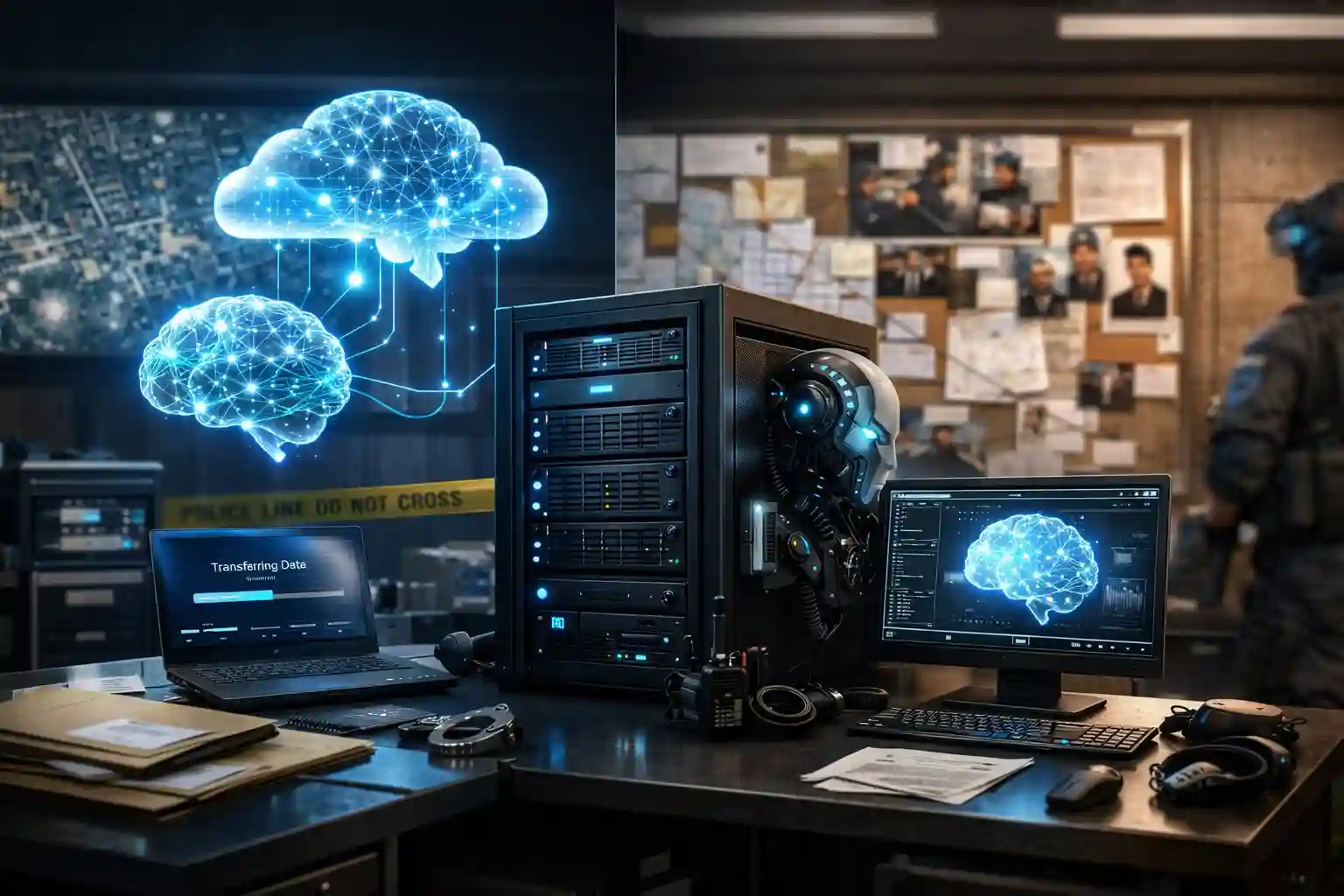
They unfold across reports and case files, audio recordings and intercepted communications, images and video, transactional records, and historical archives accumulated over time. Each piece carries partial truth. Intelligence emerges only when these fragments are connected.
Yet most organizations still treat each format as a separate problem to be processed independently.
Documents are read in one system. Audio is reviewed in another. Video is analysed elsewhere. Records sit in databases, often detached from the narrative they belong to. What should form a unified intelligence picture instead becomes scattered across tools, teams, and timelines.
Key Takeaways
- Intelligence rarely exists in a single format; it emerges across documents, audio, video, images, and records
- Siloed tools fragment investigations, even when each system works “as designed”
- Manual correlation relies on memory and time, making it fragile under scale and pressure
- Most investigation delays are invisible, showing up as rewrites, rechecks, and prolonged validation
- Multi-format intelligence analysis focuses on correlation, not just collection
- Unified intelligence environments preserve context and accelerate analysis without automating judgment
- As formats increase and timelines compress, integrated intelligence becomes mission-critical
The Siloed Tool Problem in Modern Investigations
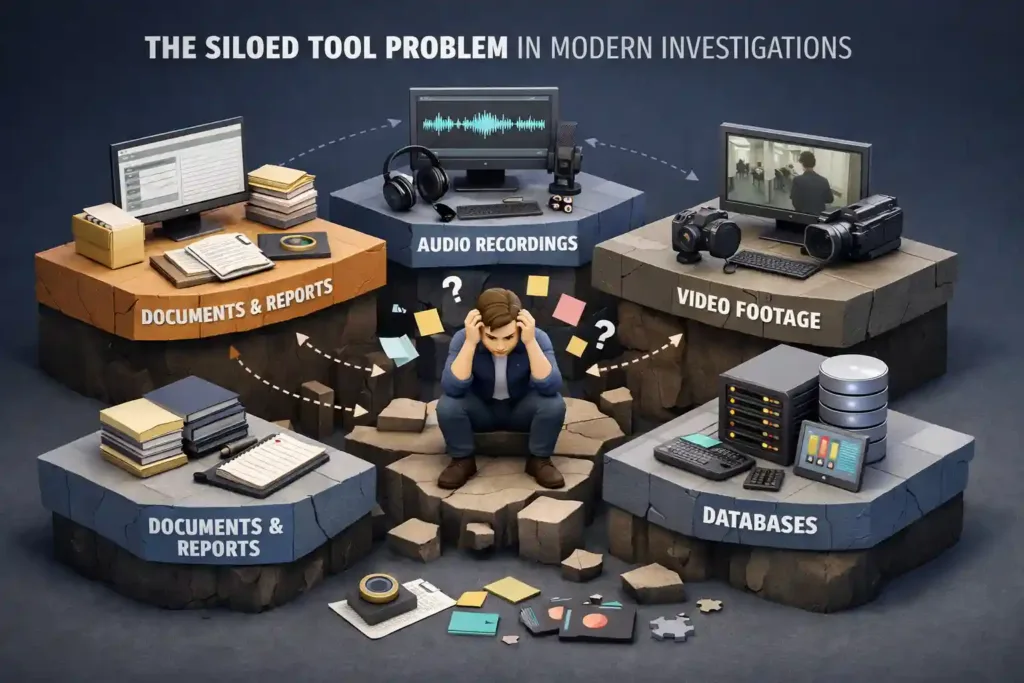
Most investigative environments today are built around format-specific tools.
Typically, there is:
- One system for documents and reports
- One for audio recordings and transcripts
- One for video footage
- One or more databases for records and structured data
Individually, these tools are often capable and mature. Each does its job well.
The problem emerges when an investigation spans all of them.
Investigators are forced to move manually between systems, cross-check findings from memory, and recreate context that no single tool is designed to preserve. The intelligence flow breaks, not because tools fail, but because they were never designed to work together.
This is the reality of intelligence data silos.
Information exists, but it is trapped inside disconnected intelligence systems. Insights must be assembled manually, under pressure, by people rather than by process. As volume grows and timelines compress, this fragmentation becomes harder to manage, and easier to miss.
The core issue is structural, not technical. Tools are optimized for formats, not for investigations.
Why Insights Rarely Exist Inside a Single Format
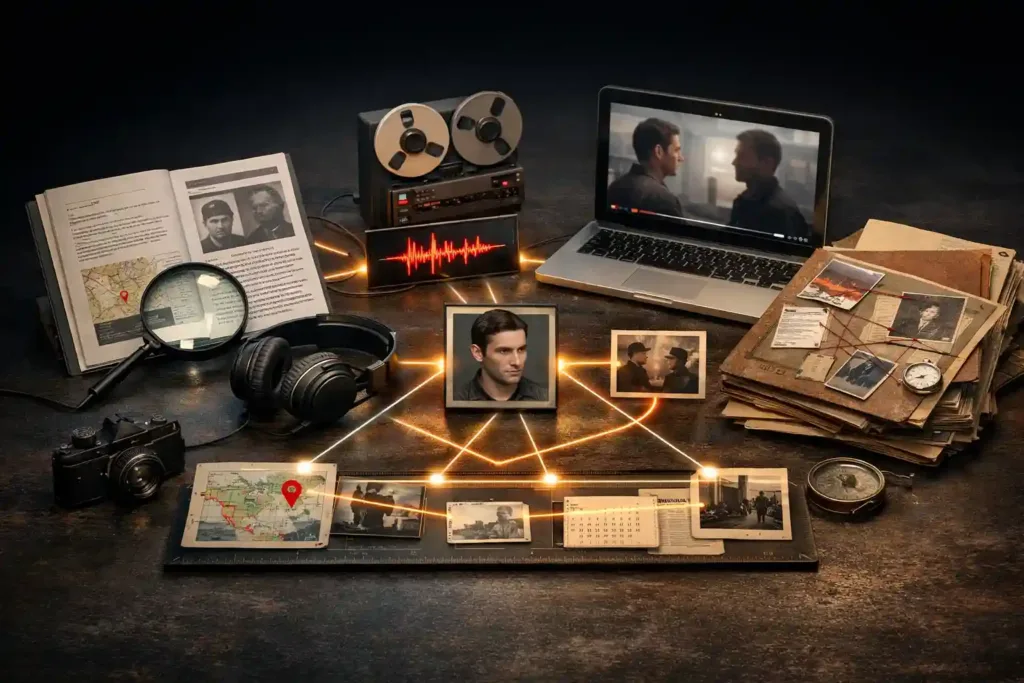
The most important intelligence insights almost never live inside one file, one recording, or one database entry.
They emerge between formats.
A name mentioned in a written report gains meaning when:
- The same name appears in an intercepted audio conversation,
- Matches a face identified in video footage,
- And aligns with a sequence of events found in historical records.
Individually, each data point may seem unremarkable. Together, they form intelligence.
This is why investigations depend so heavily on correlation. Meaning is created when relationships are established across people, events, timelines, and evidence types. When formats are analysed in isolation, those relationships remain invisible.
Intelligence, at its core, is relational.
It is not purely textual. Not purely visual. Not purely auditory.
It exists in the connections, connections that siloed tools are structurally incapable of revealing on their own.
The Fragility of Manual Correlation
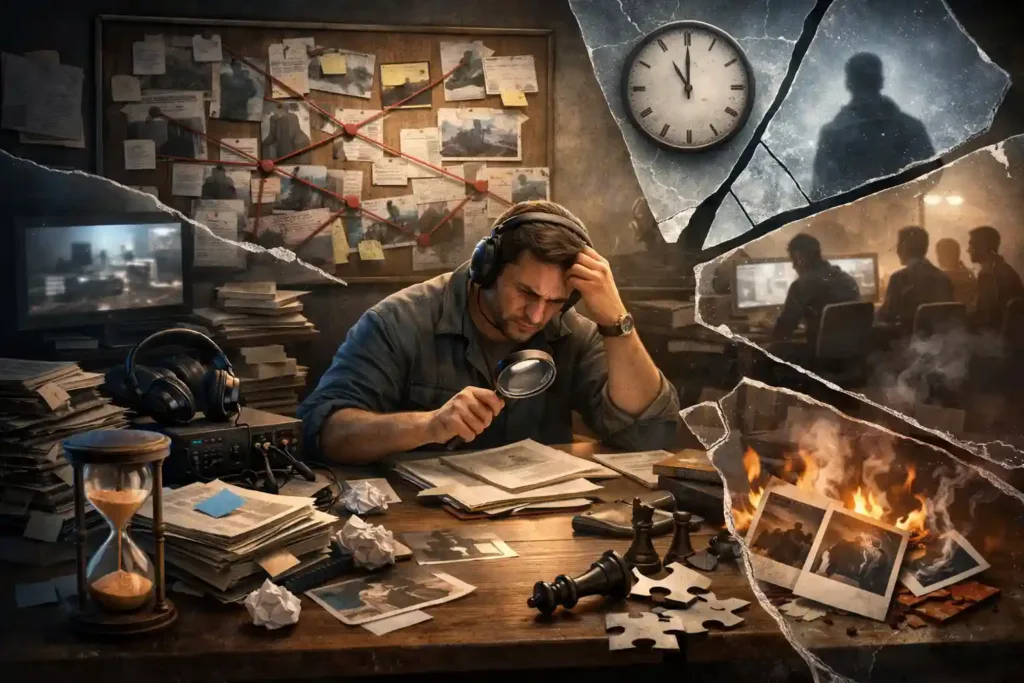
When systems do not connect intelligence, people are forced to do it instead.
Analysts read reports line by line. They listen to hours of audio. They watch footage repeatedly. They cross-check names, locations, and timelines across records.
This manual correlation becomes the glue that holds investigations together.
And for a time, it works.
But it relies heavily on human memory, available time, and individual expertise. The more complex the case, the more fragile this approach becomes.
Under volume and pressure, risks begin to surface.
Connections are missed simply because no one had the time to revisit a source. Patterns go unnoticed because related inputs were reviewed days or weeks apart. Confirmation bias creeps in as analysts subconsciously prioritise familiar signals.
Perhaps most critically, knowledge becomes tied to individuals rather than systems. When analysts rotate roles or teams change, context often leaves with them. New teams are forced to reconstruct intelligence that technically already exists.
Manual correlation works until scale, urgency, or continuity breaks it. And modern investigations almost always involve all three.
How Siloed Analysis Slows Investigations (Without Anyone Noticing)

One of the most dangerous aspects of siloed intelligence analysis is that it rarely looks like failure.
There are no system crashes. No obvious red flags. No alerts that say something went wrong. Instead, the cost appears quietly.
Briefings take longer to prepare. Reports are rewritten multiple times. Findings are revalidated again and again. Decisions are delayed with phrases like, “Let me check and revert.”
None of these signal a breakdown on their own.
But together, they form investigation workflow bottlenecks that compound over time.
Intelligence is technically available. But operationally inaccessible.
Information exists across systems, yet assembling it into a coherent view requires repeated manual effort. Every new question triggers another round of searching, reviewing, and cross-checking.
The result is not a lack of insight, but a slowdown in how quickly insight can be trusted and applied.
And in investigations, time lost rarely announces itself. It simply narrows options.
What “Multi-Format Intelligence Analysis” Actually Means
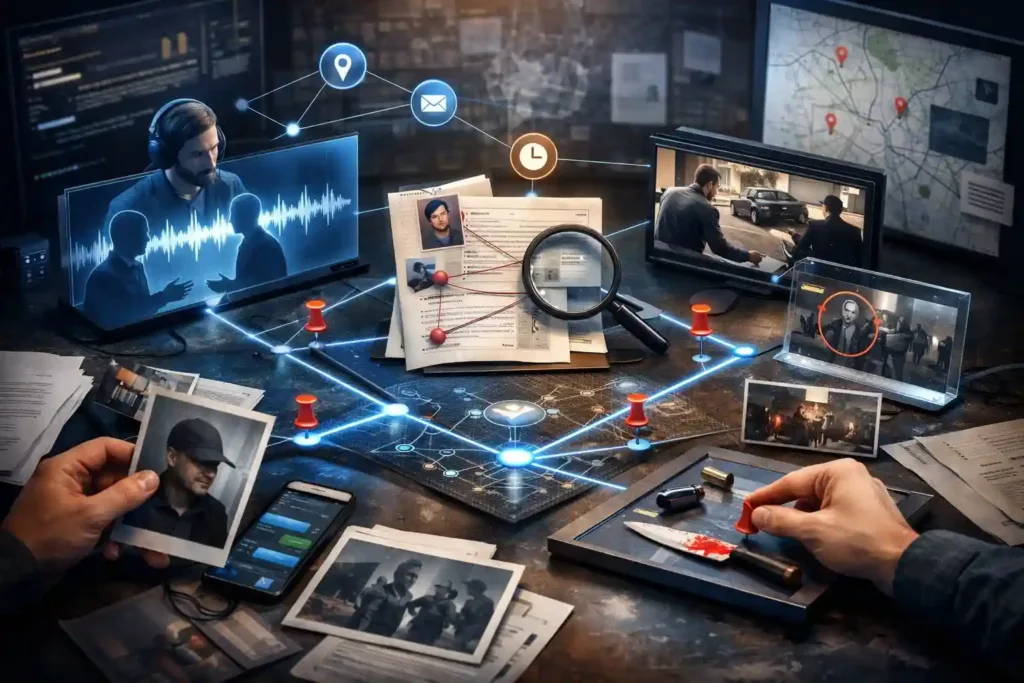
Multi-format intelligence analysis is often misunderstood.
It does not mean storing documents, audio, and video in the same repository. It does not mean attaching multiple files to a case record. Those are storage decisions, not intelligence decisions.
Multi-format intelligence analysis means treating every format as a first-class intelligence input, capable of contributing directly to insight.
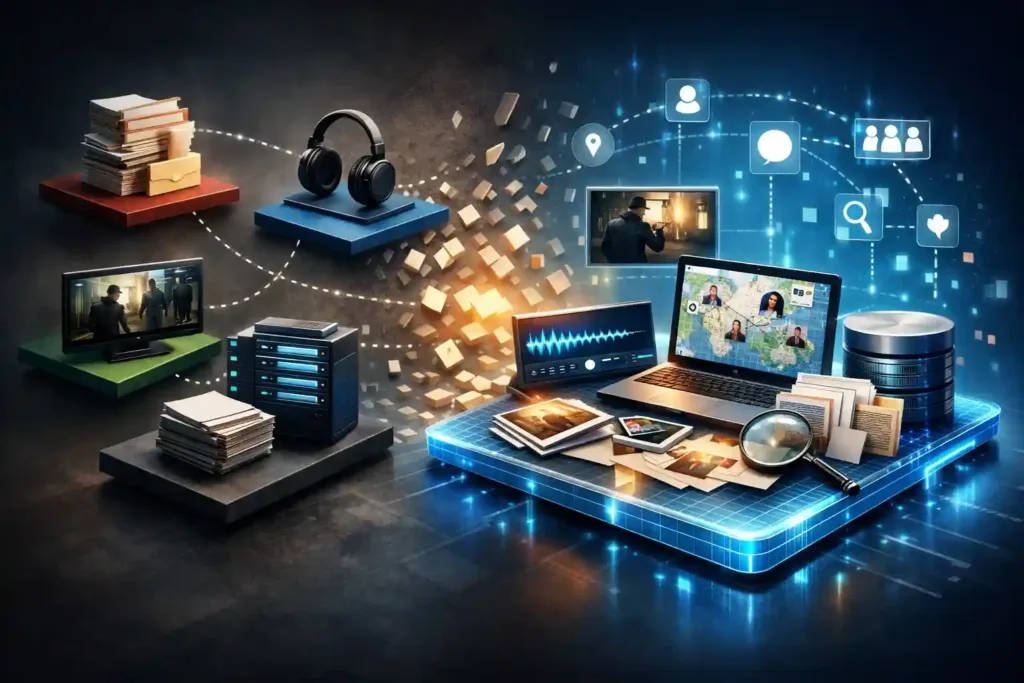
It enables analysts to form understanding across formats, not within them. A conversation in audio can inform the interpretation of a document. An image can validate or contradict a written report. A timeline can align events across records, footage, and communications.
Crucially, the relationships between people, events, timelines, and evidence types are preserved as intelligence evolves.
This is the defining distinction.
Multi-format analysis is not about collecting more information. It is about enabling correlation where intelligence actually emerges.
Multi-format analysis is about correlation, not collection.
From Tools to Intelligence Environments
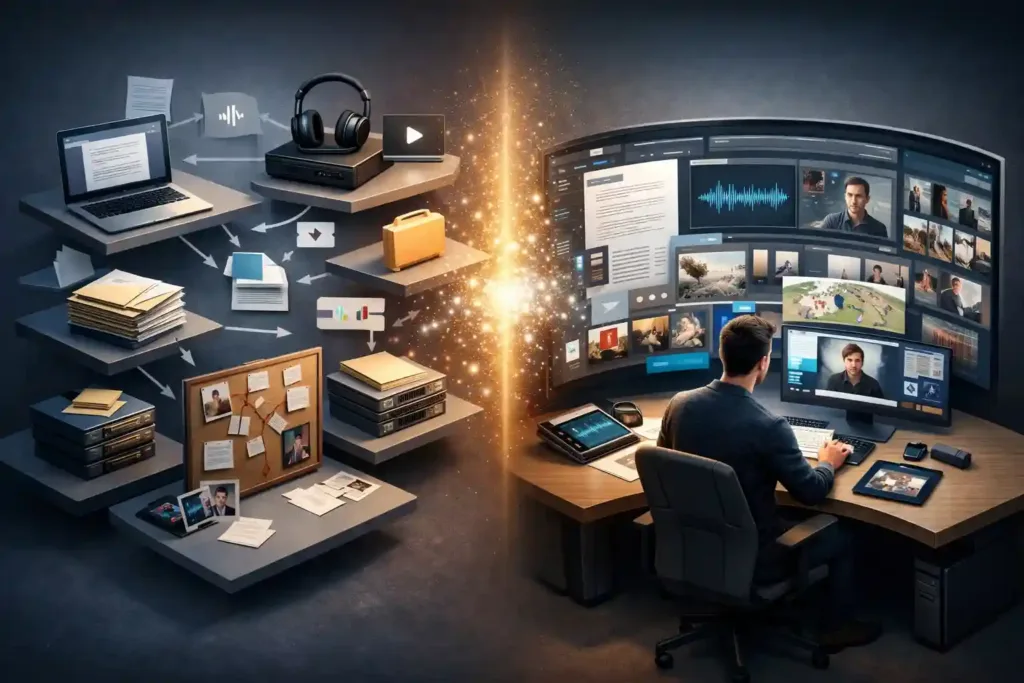
Most organizations did not design their intelligence systems. They accumulated them.
One tool for documents. Another for audio and transcripts. A separate system for video. Databases for records and case files.
Each tool performs its function well. Collectively, they fragment intelligence work.
This is why investigations often feel slower than they should. Intelligence work does not happen inside these tools—it happens between them.
The structural shift underway is a move away from format-specific tools toward unified intelligence environments.
In such environments, documents, audio, video, images, and records are not handled separately. They are worked on together, in one place, as part of the same analytical process.
Intelligence work happens directly on the information, not after it has been exported, prepared, or manually stitched together.
When formats are unified, intelligence work accelerates naturally, not because analysts work faster, but because the system stops getting in the way.
What Changes When Intelligence is Unified

The most visible change is not technical. It is behavioural.
Analysts spend less time searching for information and more time interpreting it. They stop switching between systems and start following lines of reasoning.
Connections surface earlier because related inputs are visible together. Those connections are easier to validate because sources remain accessible and contextual. Investigations retain continuity. New inputs extend existing understanding instead of resetting it. Context carries forward across time, teams, and evolving cases.
Importantly, judgment does not disappear. Human expertise remains central. Analysts still decide what matters, what is credible, and what action to recommend.
What changes is where context lives.
Instead of residing in individual memory or informal notes, context becomes systemic—preserved within the intelligence environment itself.
Why Multi-Format Intelligence is Now Mission Critical

The need for multi-format intelligence analysis is no longer theoretical.
Information volumes continue to grow. Intelligence inputs are increasingly rich: audio, video, imagery, and media alongside text. Operational timelines are compressing. And the cost of delay or misinterpretation is rising.
In this environment, silos are not just inefficient. They are dangerous. The more formats intelligence arrives in, the more fragile isolated analysis becomes. Each additional format increases the risk that insight will be delayed, overlooked, or reconstructed under pressure.
Multi-format intelligence analysis is no longer an optimisation. It is a requirement for keeping pace with reality.
Intelligence Lives Between the Data
Intelligence failures are rarely caused by missing tools. They occur when information cannot be connected in time. Documents, audio, video, images, and records may all exist. But without integration, they remain fragments.
In modern investigations, the most important insight is rarely found in a single file. It exists in the space between them.
And that is where intelligence must now be built.
FAQs – Frequently Asked Questions
1. What is multi-format intelligence analysis?
Multi-format intelligence analysis is the ability to analyze documents, audio, video, images, and records together—allowing insights to emerge across formats rather than within isolated systems.
2. Why do siloed intelligence tools slow investigations?
Because each tool handles only one format, analysts must manually connect insights across systems. This breaks workflow continuity and delays intelligence formation.
3. Can analysts not manually correlate information across formats?
They can, but manual correlation depends heavily on memory, time, and individual expertise, making it fragile at scale and under operational pressure.
4. What does it mean to treat every format as a “first-class intelligence input”?
It means documents, audio, video, images, and records are analyzed together, not attached as references or handled in separate workflows.
5. How is multi-format analysis different from unified data storage?
Unified storage centralizes files. Multi-format intelligence analysis enables correlation, context preservation, and insight formation across formats.
6. Does multi-format intelligence analysis automate investigations?
No. It supports analysts by preserving context and surfacing connections, while judgment and decision-making remain human.
7. Why is multi-format intelligence now mission-critical?
Because intelligence inputs are becoming richer, timelines are shrinking, and the cost of delayed or missed connections continues to rise.