The Forgotten Lessons of Intelligence
In the world of intelligence and defence, history often repeats itself, sometimes with devastating consequences. A smuggling route once uncovered can re-emerge years later, or a cyber-attack method once neutralized might resurface in a new disguise. Too often, agencies find themselves fighting old battles as if they were new, not because they lacked capability, but because they lacked memory.
This is the hidden challenge of modern intelligence work: valuable insights are lost when investigators retire, analysts are reassigned, or fragmented systems bury knowledge in silos. The result? Critical lessons are forgotten, patterns are missed, and response times suffer.
This is where institutional memory emerges as the new strategic asset. More than just storing data in archives, it’s about preserving the collective intelligence of an agency, the knowledge of what has worked, what has failed, and what signals to watch for.
For defence organisations, law enforcement agencies, and financial intelligence units, institutional memory can mean the difference between anticipating a threat and reacting too late. And in an era defined by sophisticated adversaries, cyber warfare, and globalised crime networks, the ability to “remember collectively” is not just an advantage – it’s a necessity.
What Is Institutional Memory in the Intelligence Context?
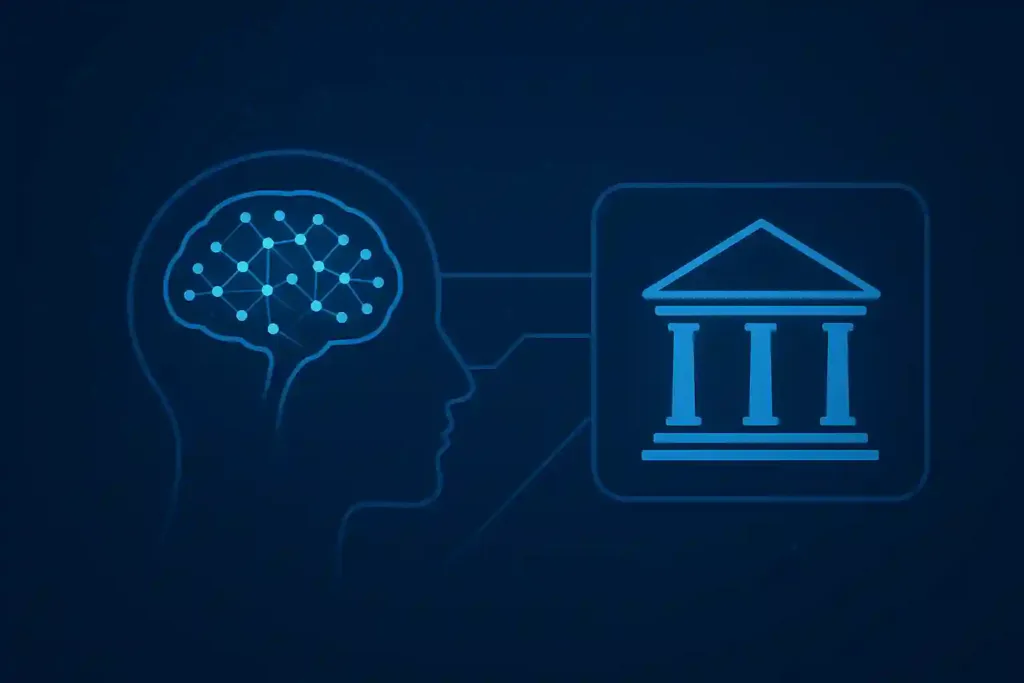
When most people think of “memory” in organisations, they imagine dusty archives, endless spreadsheets, or case files gathering in digital folders. But institutional memory in the intelligence context is something far deeper: it’s the ability of an organisation to remember, recall, and reuse knowledge across generations of analysts and missions.
Unlike raw data storage, institutional memory captures context – the “why” behind decisions, the subtle patterns that only emerge over time, and the lessons that shape future strategy.
Consider a few real-world examples:
Law Enforcement
A city police department investigating a new gang suddenly finds that their call data records (CDR) resemble the communication patterns of a network dismantled five years ago. Without institutional memory, those insights remain buried in case files. With it, investigators can instantly connect the dots.
Defence
In military cyber operations, an adversary might repeat a set of intrusion tactics years apart. Institutional memory allows analysts to recognise the pattern immediately, even if the personnel handling the case are entirely new.
Financial Intelligence
A suspicious transaction pattern flagged today might resemble a laundering scheme uncovered a decade earlier. Institutional memory transforms these fragments into long-term vigilance, giving financial intelligence units the power to spot recurrence across decades.
The difference is clear:
- Data storage = facts without meaning.
- Institutional memory = contextual intelligence that lives within the organisation and grows stronger over time.
This distinction is crucial because intelligence work isn’t just about what you know in the moment – it’s about remembering what has been learned before.
The Cost of Forgetting – Real-World Challenges
In intelligence, forgetting is expensive. Not because the data is gone, but because the context is lost. The lack of institutional memory creates vulnerabilities that adversaries exploit.
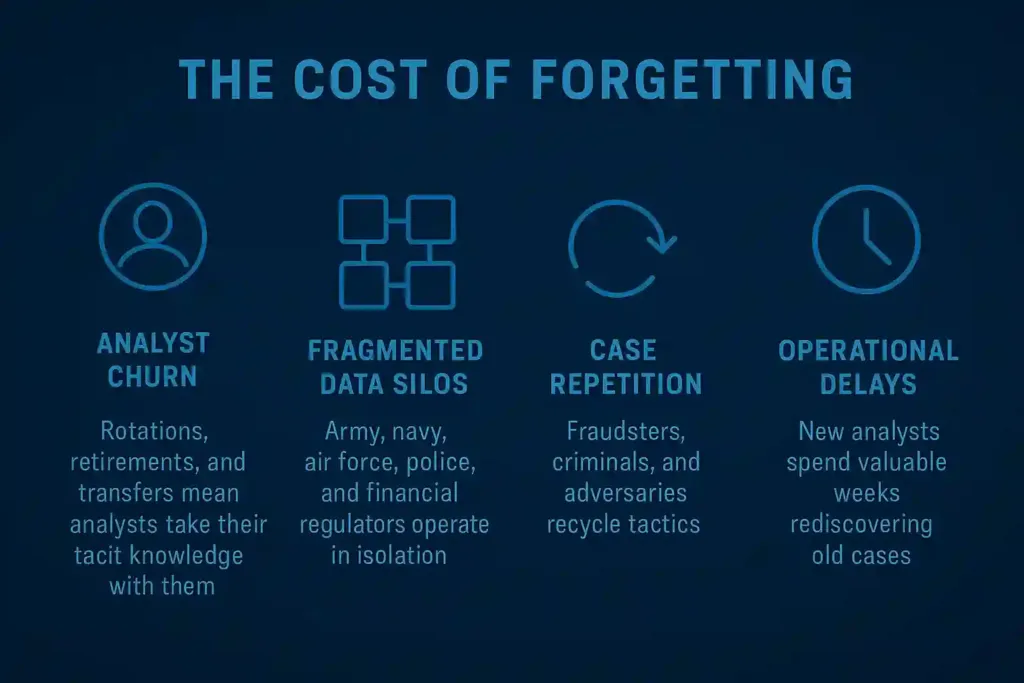
Analyst Churn
Rotations, retirements, and transfers mean analysts take their tacit knowledge with them. Critical lessons learned in one operation may never reach the next generation, forcing agencies to relearn the same insights from scratch.
Fragmented Data Silos
Army, navy, air force, police, and financial regulators often operate in parallel, each holding intelligence in isolation. Without fusion, patterns that span domains, such as funding, logistics, and movement – go unnoticed.
Case Repetition
Fraudsters, criminals, and adversaries recycle tactics. When prior intelligence isn’t connected, the same laundering method, smuggling route, or cyber exploit slips through again.
Operational Delays
New analysts spend valuable weeks rediscovering old cases, re-running link analyses, or repeating research. This slows down threat hunting, crime analytics, and predictive policing efforts, when speed is most critical.
From Memory to Mission Readiness – Why It’s Strategic
In the intelligence world, institutional memory is more than record-keeping — it’s a force multiplier. When agencies can instantly access, recall, and apply lessons from past operations, they transform from reactive responders into proactive defenders.
Faster Investigations
When past case files, link analyses, and surveillance insights are instantly retrievable, investigators don’t waste time reinventing the wheel. Weeks of analysis shrink into hours, accelerating responses to crimes, threats, and intrusions.
Predictive Policing & Predictive Defence
Institutional memory allows agencies to spot recurring crime or warfare patterns. Combined with AI-driven defence analytics, it supports crime prediction models that anticipate smuggling, fraud, or insurgent tactics before they unfold.
National Security Resilience
A strong memory safeguards against institutional amnesia. Even when analysts rotate out, the system remembers. This resilience ensures agencies maintain continuity in the face of changing personnel, shifting threats, and evolving adversaries.
Staying Ahead in the Global Security Landscape
Adversaries evolve fast, cyber attackers recycle old exploits, criminal groups shift geographies, state actors test new disinformation tactics. The only way to keep pace is for agencies to “remember collectively” across decades of data and operations.
👉 Institutional memory is not a passive archive. It’s the foundation of national security AI – turning yesterday’s lessons into today’s foresight and tomorrow’s mission readiness.
How AI Secures Institutional Memory for Agencies
The challenge with institutional memory isn’t the lack of data — it’s the inability to connect, recall, and use it effectively. Artificial Intelligence (AI) is the bridge from forgetting to foresight, ensuring intelligence agencies never lose the value of their accumulated knowledge.
Intelligence Fusion Across Silos
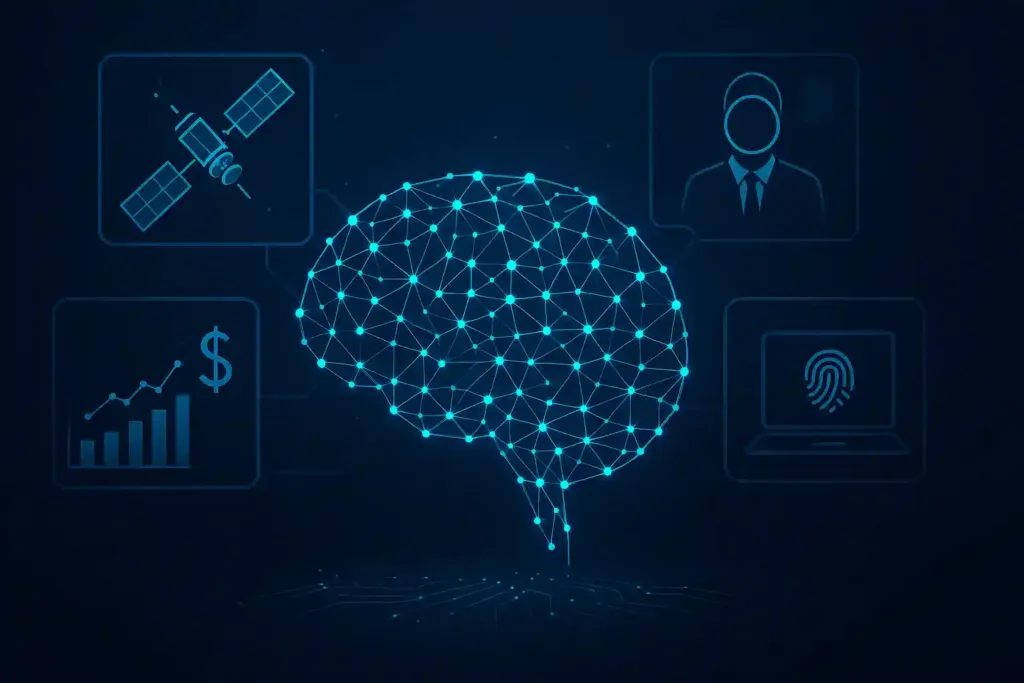
Modern intelligence fusion centres bring together data from disparate sources – signals intelligence, HUMINT, OSINT, and financial records. AI systems stitch these fragments into a unified, queryable fabric, eliminating the blind spots caused by data silos.
AI-Powered Recall
Traditional archives store data; AI surfaces insight. Algorithms detect patterns, linkages, and anomalies across decades of records. Whether it’s a fraud ring reusing shell companies or insurgents repeating past infiltration tactics, AI recalls the past instantly for present relevance.
Conversational LLM Interfaces (Air-Gapped)
Instead of combing through dashboards and reports, analysts can now “converse” with institutional memory:
- “Show me smuggling cases using drones in the last 5 years.”
- “Which cyber intrusions matched tactics from 2016?”
With on-premise, air-gapped LLMs, this capability is secure, ensuring that mission-critical intelligence never leaves defence networks.
Predictive Modelling
AI doesn’t just recall, it forecasts. By fusing historical memory with real-time streams, predictive analytics helps agencies anticipate adversary actions. This transforms institutional memory from a static archive into a strategic engine for mission readiness.
👉 With AI, institutional memory becomes living intelligence – constantly evolving, instantly accessible, and mission-focused.
Use Cases of Institutional Memory in Action
Defence Intelligence
- Identifying adversary troop movement patterns from decades of satellite and drone imagery.
- Preserving tactical learnings across operations so future commanders don’t “start from zero.”
- Defence Intelligence Fusion Centres, powered by platforms like Prophecy Guardian, act as institutional memory hubs, enabling multi-branch interoperability and air-gapped AI-driven recall.
Law Enforcement
- Criminal profiling software links past offender behaviours, MOs, and CDR data to new investigations.
- Crime hotspot mapping enriched by both live feeds and historical crime records.
- Predictive policing models strengthened by preserved insights from previous investigations.
Prophecy Alethia empowers law enforcement agencies to unify surveillance data, CDR analysis, facial recognition, and OSINT, ensuring that prior case knowledge directly informs future investigations.
Financial Intelligence
- AML transaction monitoring improves when historical laundering typologies are remembered and reapplied.
- Detecting fraud rings that recycle old entity structures, flagged by decades of linked financial intelligence.
- Strengthening FIUs and central banks with AI-driven institutional recall of past patterns.
Prophecy Eagle I serves as the institutional backbone for financial agencies, combining entity resolution, transaction monitoring, and link analysis to spot repeated laundering tactics.
Digital Forensics
- Every mobile device forensic and cyber forensics case becomes part of a growing repository.
- Investigators can instantly see “what worked before” in similar cases.
- Forensic analysis software, such as RapiDFIR, ensures case knowledge is never lost, embedding digital forensic learnings into future workflows for faster response and investigation.
👉 In every domain, institutional memory powered by AI, and safeguarded by Innefu’s platforms, ensures agencies don’t just respond, they anticipate. It bridges the past and present to create the predictive security advantage.
Conclusion – Institutional Memory as the Future of Intelligence
In an era where adversaries adapt faster than ever, institutional memory has emerged as the new strategic asset for intelligence agencies. It is not enough to store data, agencies must retain, recall, and operationalize knowledge across generations of analysts.
From detecting recurring fraud patterns to predicting adversary tactics, institutional memory ensures that no lesson is lost, no case is forgotten, and no opportunity for foresight is missed.
By embedding AI-driven intelligence fusion centres, predictive analytics, and conversational LLM interfaces into defence, law enforcement, financial intelligence, and forensic operations, organisations can transform memory into mission readiness.
With platforms like Prophecy Guardian, Prophecy Alethia, Prophecy Eagle I, and RapiDFIR, Innefu is enabling agencies worldwide to safeguard knowledge, preserve insights, and build predictive security capabilities for tomorrow’s challenges.
👉 The past doesn’t have to be forgotten – with AI, it becomes the blueprint for the future.
FAQs
Q1. What is institutional memory in intelligence agencies?
Institutional memory refers to an organisation’s ability to retain and recall knowledge across missions, analysts, and generations. In intelligence, this means connecting past cases, patterns, and tactics to present investigations or operations.
Q2. Why is institutional memory important for defence and law enforcement?
Without institutional memory, agencies risk repeating mistakes, missing recurring threat patterns, and wasting time rediscovering old insights. With it, they can accelerate investigations, strengthen predictive policing, and improve national security resilience.
Q3. How does AI help preserve institutional memory?
AI platforms unify fragmented data into intelligence fusion centres, use algorithms for pattern recognition, and enable LLM-powered recall of past cases. This ensures knowledge is not lost when analysts retire or rotate.
Q4. Can institutional memory improve financial intelligence and fraud detection?
Yes. Institutional memory allows AML monitoring systems to recall past laundering typologies and fraud ring structures. This helps detect criminals who recycle old tactics, strengthening financial security.
Q5. What role does digital forensics play in institutional memory?
Every cyber forensics and mobile device forensic investigation contributes to an ever-growing repository of investigative knowledge. With AI-driven forensic analysis software, future investigators can instantly learn from past cases.
Q6. How does Innefu support institutional memory for intelligence agencies?
Innefu builds secure, AI-powered platforms such as Prophecy Guardian (defence), Prophecy Alethia (law enforcement), Prophecy Eagle I (financial intelligence), and RapiDFIR (digital forensics), enabling agencies to turn knowledge into foresight.