Picture a cybercrime case that your unit is currently investigating.
It started as a complaint about a ₹40 lakh fraud. Standard online scam, you thought. But three weeks in, the picture is different. The money moved through eleven bank accounts across four states before it left the country. The call records point to a coordination network of at least eight individuals. Two of them have prior FIRs in other districts, in different states, that nobody connected to this case because nobody knew to look. The digital devices seized at one location contain data in three languages. The financial trail involves both regulated banking channels and a parallel hawala leg that surfaces only in the dark web intelligence.
This is not one investigation. It is six investigations, running simultaneously, that happen to be the same crime.
And right now, your team is working them in sequence.
That is the fundamental challenge of complex criminal investigations in India in 2025. Not the absence of evidence. Not the absence of capability. The absence of a mechanism to pursue multiple evidentiary threads simultaneously, across multiple data environments and jurisdictions, at the speed the investigation requires.
Multi-agent AI is a direct architectural response to this challenge. Here is what it is, and what it could mean for how complex criminal investigations are conducted.
The Complexity Problem Is Getting Worse, Not Better

India’s crime landscape is shifting structurally. The NCRB Crime in India 2024 report shows that while overall cognisable crimes declined by 6%, cybercrime rose sharply by 17%, signalling a structural shift from traditional street crime to digital and borderless offences.
According to data shared by the Ministry of Home Affairs in Parliament, Indians lost over ₹22,845 crore to cyber frauds in 2024, a 206% increase from 2023 levels, with over 36 lakh complaints recorded on the National Cyber Crime Reporting Portal. Source: The Times of India
Economic offences rose by 4.6% in 2024 to 2,14,379 cases, with Forgery, Cheating and Fraud accounting for nearly 90%, 1,92,382 cases, of economic offences.
The numbers tell one story. The nature of those cases tells another. The crimes driving these statistics are not the simple, single-jurisdiction, single-suspect cases that conventional investigation workflows were designed around. They are networked, distributed, multi-jurisdictional operations that are specifically structured to be complex, because complexity is the criminal’s operational security.
A narcotics supply chain that runs across three states. A cybercrime ring with financial coordination in one city, technical operations in another, and money laundering through entities spread across five more. A human trafficking network with recruitment happening across four districts, transit routes through two states, and financial flows documented across banking, mobile wallets, and informal channels simultaneously.
The NCRB 2024 report flags this directly: institutional challenges include coordination gaps between states and agencies, weak inter-agency intelligence sharing, and capacity constraints in investigation systems. These are structural gaps, and they are not gaps that can be closed by adding more officers to manual workflows.
What Makes an Investigation “Complex”, And Why It Matters

Before getting to what multi-agent AI could offer, it helps to be specific about what makes complex criminal investigations different from straightforward ones. The complexity is not just scale, it is the simultaneous interaction of multiple independent evidentiary dimensions.
Multiple data environments that don’t talk to each other
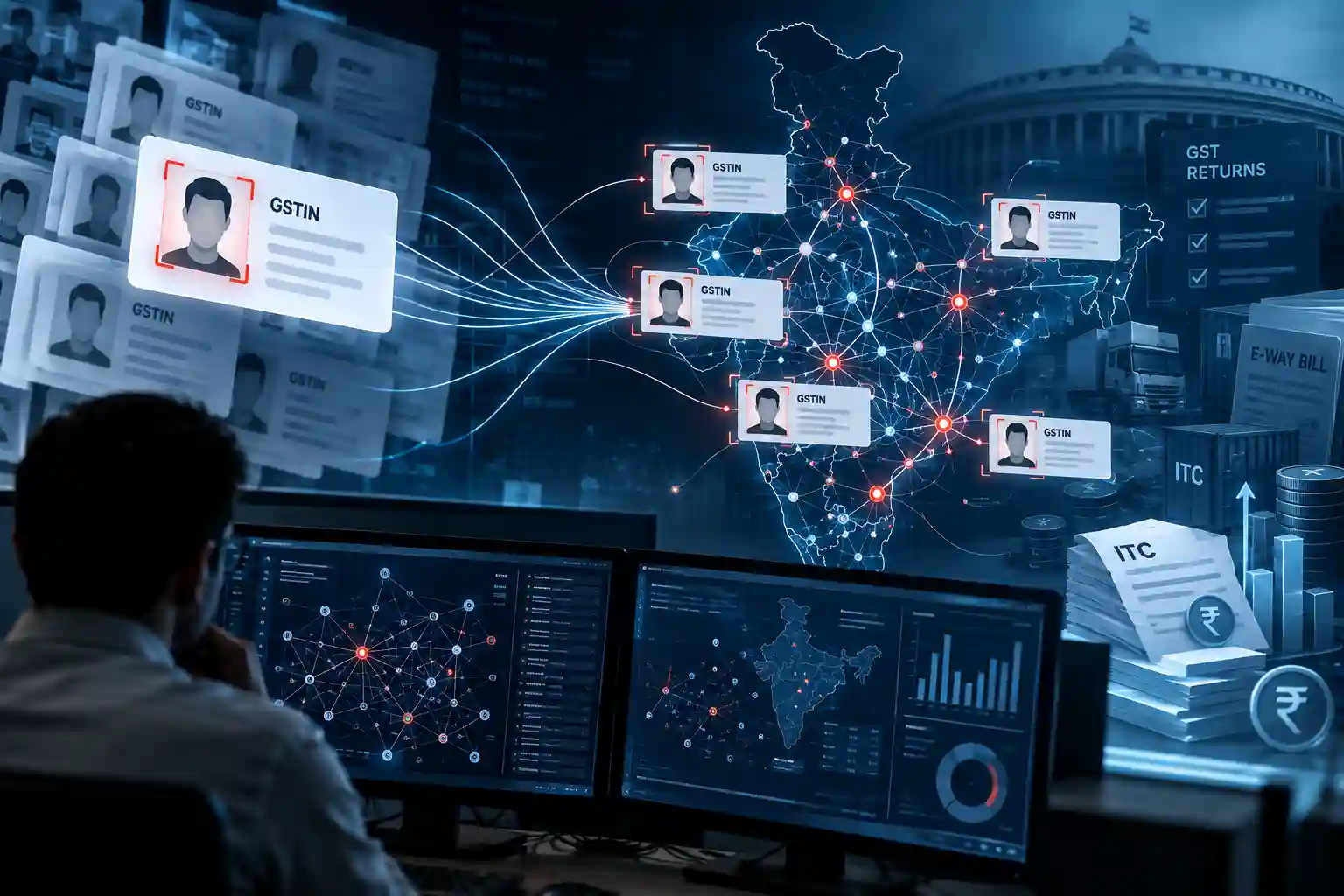
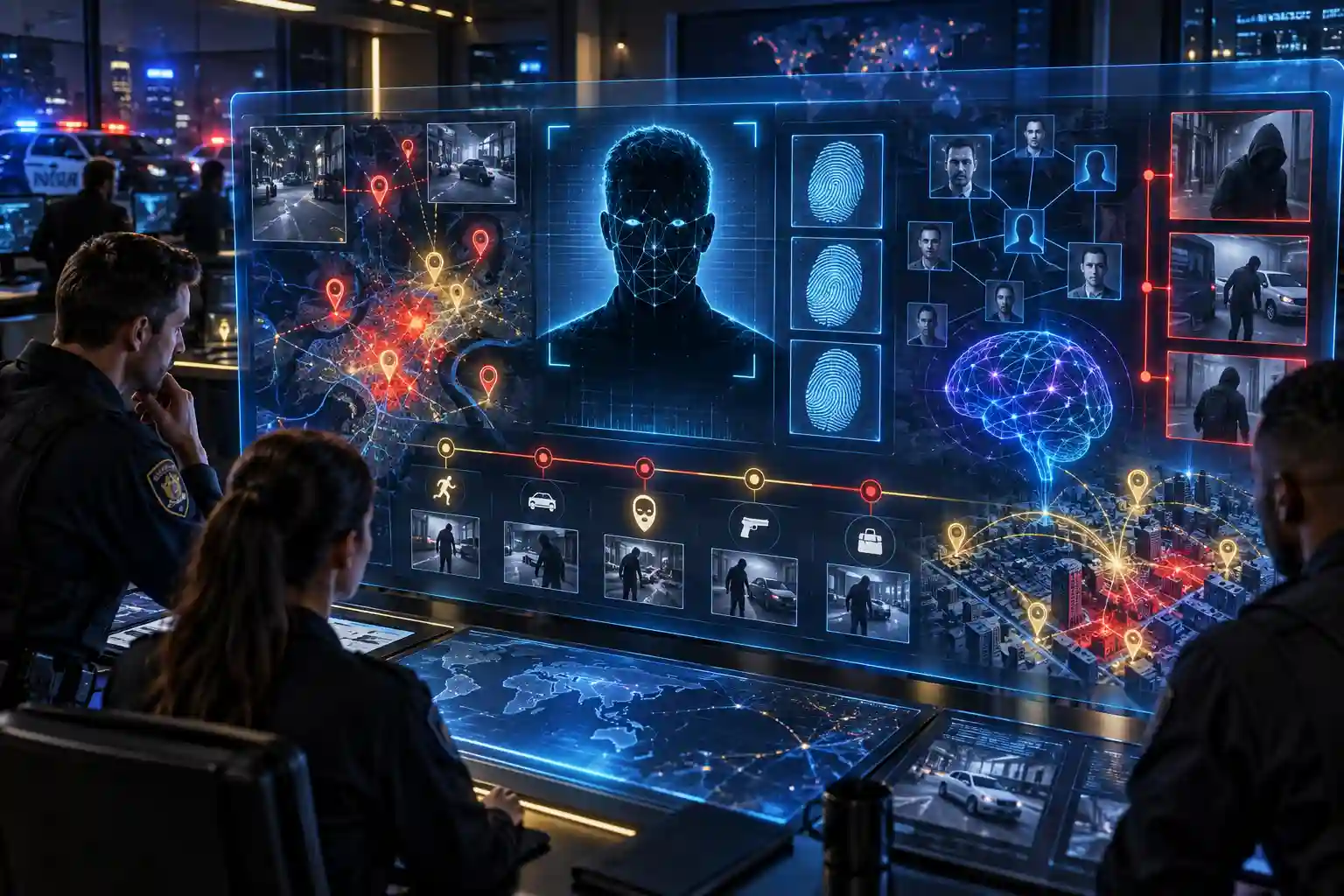
A serious organised crime investigation draws evidence from CDRs (telecom), financial transaction records (banking/FIU), forensics data (labs), CCTNS and FIRs (police records), surveillance footage (CCTV/video analytics), OSINT (social media, dark web), and court records, each managed by a different system, requiring separate queries, separate data exports, separate processing. Connecting them requires a human to manually extract, clean, and cross-reference across all of them.
Jurisdictional fragmentation by design
Organised criminal networks, narcotics, human trafficking, financial fraud, and cybercrime deliberately distribute their operations across districts and states. CCTNS now connects over 15,000 police stations for real-time sharing of FIRs and investigation data, which is significant infrastructure progress. But the investigative cross-referencing across this data, identifying the network that spans multiple FIRs in multiple states, still requires human investigators to do the analysis manually.
Sequential workflows applied to parallel problems
The standard investigation workflow processes data sequentially, CDRs first, then forensics, then financial records, then OSINT. But complex criminal investigations don’t unfold sequentially. All threads develop simultaneously. The financial angle in week two changes the interpretation of the CDR data from week one. The OSINT finding in week three identifies a person who appears in the forensics data from the beginning. Sequential processing means the picture is always assembled in the past tense, not in real time.
The volume-to-investigator ratio is unsustainable
Persistent staffing shortages in law enforcement agencies globally, including in India, mean agencies are operating with investigative teams that face escalating caseloads and longer response times. The number of complex cases requiring intensive multi-thread investigation is growing faster than investigative capacity can scale.
These four characteristics, data fragmentation, jurisdictional distribution, sequential workflow design, and staffing constraints, are the specific operational conditions that multi-agent AI is architecturally suited to address.
What Multi-Agent AI Actually Is, Specifically

“Multi-agent AI” sounds technical. The operational concept is straightforward.
A single AI agent is like a highly capable investigator working alone, they can pursue one line of enquiry at a time, move from one data source to the next sequentially, and build a picture by themselves. This is already valuable. But for complex investigations, a single agent still processes threads one at a time.
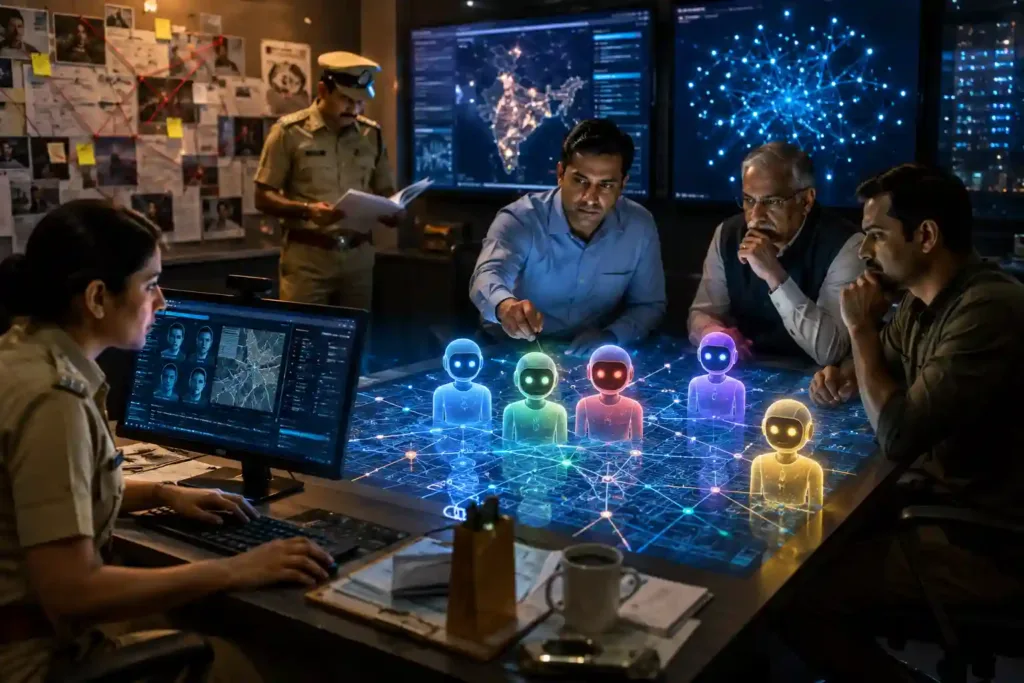
A multi-agent AI system deploys multiple specialised agents simultaneously, each assigned a specific role, a specific data domain, and a specific task, with the agents coordinating and validating each other’s outputs as they work in parallel.
In an investigation context, this might look like:
- Agent 1, Communication Intelligence: Processes CDR data across all identified numbers and devices, maps the communication network, identifies IMEI links across SIM changes, surfaces the common contacts and communication clusters
- Agent 2, Financial Intelligence: Traces transaction flows across all identified accounts, maps the money trail, flags hawala indicators, identifies beneficial ownership connections
- Agent 3, Identity and Records: Cross-references all identified individuals against CCTNS, NCRB, prior FIRs across districts, known criminal databases, and forensics records
- Agent 4, Open Source Intelligence: Monitors relevant channels across the surface web, deep web, and dark web for intelligence related to the identified entities and networks
- Agent 5, Synthesis and Report: Receives structured outputs from all four agents, identifies cross-thread connections and contradictions, and generates a consolidated investigation brief
These five workstreams run simultaneously, not sequentially. The synthesis agent doesn’t wait for Agent 1 to finish before Agent 2 starts. When Agent 2 finds a financial connection that changes the significance of a number in Agent 1’s network graph, the synthesis layer incorporates that immediately rather than discovering the connection weeks later during manual review.
The investigator who receives the output is not presented with five separate reports to reconcile manually. They receive a structured intelligence brief that already reflects the cross-thread synthesis, with the raw data fully accessible and auditable behind every finding.
This is the operational difference between a single-agent AI and a multi-agent AI system applied to investigative work.
What This Could Mean for Specific Investigation Types in India

Organised Financial Fraud and Cybercrime
India’s cybercrime caseload, over 36 lakh complaints in 2024 and ₹22,845 crore in losses, represents an investigation demand that far exceeds available investigative capacity. The majority of these cases share a structural characteristic: they involve coordinated networks rather than solo actors, with financial flows moving through multiple accounts and channels simultaneously.
Multi-agent AI applied to these investigations could simultaneously process the communication network (who coordinated with whom), the financial flows (how money moved and where it went), the identity layer (who are these entities, what is their prior record), and the digital evidence from seized devices, producing a consolidated network map and evidence brief that would otherwise require weeks of manual multi-agency coordination.
Organised Crime Networks Spanning Districts
When a trafficking or narcotics network is busted in one district, the standard investigation focuses on the individuals arrested. The network leadership, typically insulated by several operational layers, often continues operating because the network mapping that would expose them requires connecting evidence across multiple prior cases in multiple jurisdictions.
A multi-agent system could cross-reference the evidence from a new arrest automatically against all prior case data in the system, FIRs, CDR records, and forensics across all districts simultaneously. The connection to a prior case in another state that a human investigator might not know to look for surfaces as a standard output rather than a serendipitous discovery.
Chargesheet Preparation Under the Bhartiya Nyaya Sanhita
The BNS, alongside its associated procedural laws, mandates forensic investigation and stricter evidentiary standards. Building a court-ready chargesheet now requires correlating forensic evidence, digital evidence, witness statements, CDR records, and financial data, then applying the correct sections of the relevant law accurately.
A multi-agent approach could assign separate agents to evidence gathering, forensic correlation, and legal section identification and then a validation agent to independently stress-test the chargesheet for evidentiary gaps, the way a senior officer reviews a junior’s work, but simultaneously rather than sequentially.
To Conclude
The complexity of serious crime in India is not going to simplify. Financial fraud, cybercrime, organised trafficking, and narcotics supply chains are deliberately structured to distribute themselves across jurisdictions, data environments, and investigative agencies. The complexity is the strategy.
Sequential, manual investigation workflows applied to parallel, distributed criminal operations produce a structural disadvantage that shows up in investigation timelines, in cross-jurisdiction connectivity gaps, and in the ratio of cases detected to cases fully prosecuted.
Multi-agent AI does not solve this by working harder. It solves it by working in parallel, deploying specialised agents simultaneously across the data environments that complex investigations span, synthesising findings in real time, and delivering to the investigating officer an intelligence picture that reflects the full complexity of the case rather than the slice that was manually reachable under the available time and staffing constraints.
This is not a speculative capability. It is an emerging operational one, with a clear architectural framework, a clear governance requirement, and a clear path to deployment for agencies that are ready to evaluate it seriously.
The question for India’s investigative agencies is not whether multi-agent AI will change how complex criminal investigations are conducted. It is when and whether the deployment architecture chosen will meet the data sovereignty and governance standards that the sensitivity of this work demands.
Frequently Asked Questions
1. What is multi-agent AI, and how is it different from single-agent AI in criminal investigations?
A single AI agent pursues investigation tasks sequentially, one data source at a time, one thread at a time. A multi-agent AI system deploys multiple specialised agents simultaneously, each assigned a specific data domain or investigative function, working in parallel and coordinating their outputs. In a complex criminal investigation, this means CDR analysis, financial tracing, identity cross-referencing, and OSINT monitoring can happen at the same time rather than in sequence, with a synthesis agent integrating findings across all threads in real time. The operational difference is significant: investigation timelines that currently take weeks can be compressed to hours, and cross-thread connections that might be discovered late in a sequential process surface at the beginning.
2. What types of criminal investigations would benefit most from multi-agent AI?
Investigations that involve multiple simultaneous evidentiary threads are where multi-agent AI offers the most significant advantage over sequential, single-agent approaches. These include organised financial fraud and cybercrime (multiple accounts, coordination networks, and digital evidence); narcotics and trafficking networks (cross-district coordination and supply chain mapping); complex economic offences (shell company structures and financial flows across entities and jurisdictions); and terrorism-related investigations (multi-source intelligence synthesis across communications, financial, and movement data). Any investigation where the evidence is distributed across multiple independent data environments benefits from parallel multi-agent processing.
3. How does multi-agent AI handle the jurisdictional fragmentation problem in Indian investigations?
Multi-agent AI systems can query data across multiple jurisdictions simultaneously; they do not recognise investigative silos because they are not structured around them. A network mapping agent processing CDR data, for example, analyses all numbers in the dataset regardless of which state they are associated with. Financial agents trace transaction flows across all connected accounts regardless of which bank or which geography. The cross-jurisdiction connections that currently emerge only through formal inter-agency requests, or through an investigator happening to know the right person to call, surface as standard outputs of the parallel agent analysis.
4. What governance safeguards are needed before deploying multi-agent AI in criminal investigations?
Several safeguards are non-negotiable for responsible deployment in this context. Full audit trails of every agent action, what data was accessed, what decisions were made, and what outputs were generated must be maintained for accountability. Agents must operate within defined parameters, with human review required before any finding becomes the basis for operational action. Data sovereignty requirements must be met through on-premise, air-gapped deployment with no external data calls. Output confidence indicators must distinguish between strongly supported findings and inferences requiring further investigation. And the governance policy for how AI outputs are used in case-related work must be explicitly defined before deployment.
5. Is multi-agent AI currently deployed in Indian law enforcement?
Multi-agent AI for complex criminal investigations is an emerging capability that Indian law enforcement agencies are evaluating. It is not yet in widespread operational deployment in Indian policing. The global trajectory is clear, and Indian agencies are at the evaluation and readiness stage for this class of capability. Platforms like Sarvagata AI by Innefu Labs are designed to meet the specific data sovereignty, air-gapped deployment, and governance requirements that Indian law enforcement contexts demand, positioning agencies to deploy this capability as their evaluation concludes.
6. What is the difference between multi-agent AI and existing tools like CCTNS or intelligence fusion platforms?
CCTNS and intelligence fusion platforms are extraordinary infrastructure achievements; they have digitalised case records, connected police stations, and enabled data sharing that was previously impossible. They make data available. Multi-agent AI acts on that data autonomously, querying it, cross-referencing it, synthesising findings across it, without requiring a human investigator to initiate each step of the analysis. The relationship is additive, not competitive: multi-agent AI is most powerful when the underlying data infrastructure is strong. Agencies that have invested in CCTNS integration, forensics digitalisation, and intelligence fusion are best positioned to benefit from multi-agent AI because the data those systems hold become the raw material the agents work with.