
Crime Patterns Are Rarely Obvious, UntilIt’s Too Late
A series of minor incidents unfolds across a city. A phone snatching here. A vehicle theft there. An unfamiliar face reported loitering near transit hubs. Each case is logged at a different police station, reviewed by a different team, and closed as routine.
On paper, nothing connects them.
But beneath the surface, these incidents share locations, time windows, communication trails, and behavioural similarities. Together, they form the early shape of a coordinated network, one that only becomes visible after escalation, when the cost of intervention is already high.
This is the challenge modern law enforcement faces.
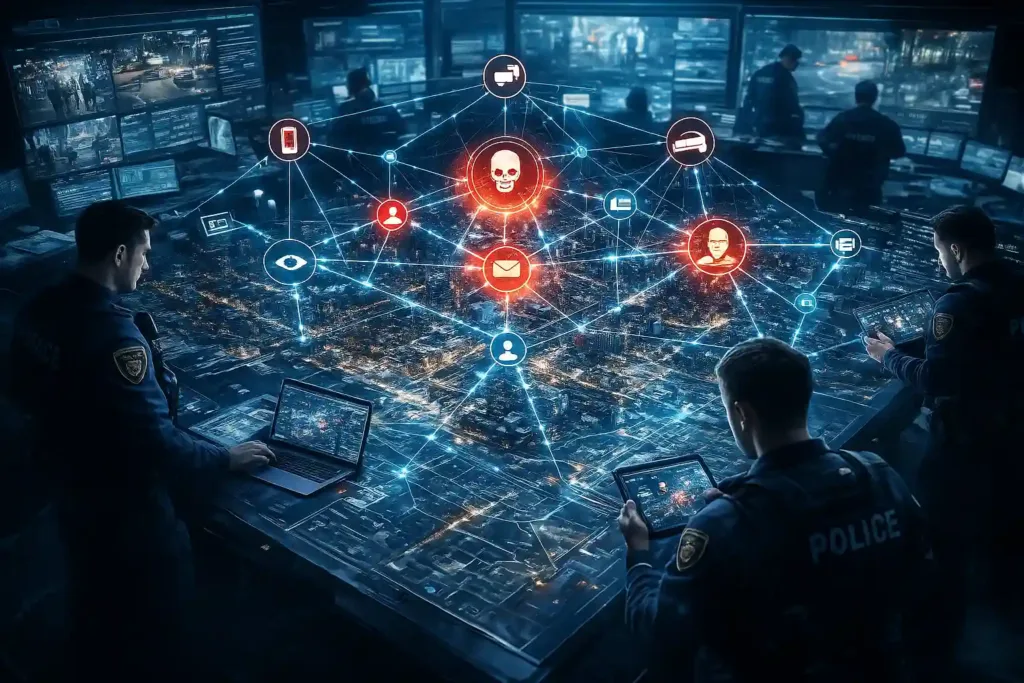
Today’s crime is rarely isolated. It is networked, mobile, and often digitally coordinated. At the same time, policing generates vast amounts of data:case records, communication metadata, CCTV outputs, field reports, and open-source intelligence, spread across disconnected systems.
Predictive policing emerged to address this gap. Not as a way to “predict crimes,” but as a method to identify risk patterns early, before incidents compound into larger threats.
At the heart of this shift lies data fusion,the ability to bring fragmented signals together and interpret them as a whole.
Key Takeaways
Predictive policing is about foresight, not certainty. It focuses on identifying risk patterns early to enable preventive, human-led decisions.
Siloed police data limits visibility. When FIRs, CCTV outputs, communication metadata, and OSINT remain disconnected, critical patterns emerge too late.
Data fusion provides context. By connecting people, locations, devices, events, and time, law enforcement gains a network-level view of crime.
Early risk indicators matter more than predictions. Fused intelligence highlights where attention is needed—before escalation occurs.
Human judgment remains central. Analytics and data fusion support decision-making; they do not automate enforcement.
Unified intelligence platforms make predictive policing operational. Fusion, institutional memory, and secure analytics environments are foundational for sustainable outcomes.
What Predictive Policing Really Means (And What It Doesn’t)

Before going further, it’s important to clarify what predictive policing is, and what it is not.
Predictive policing does not mean automated accusations, individual profiling, or surveillance-led enforcement. Decisions remain human-led, governed by law, oversight, and operational judgment.
In practice, predictive policing focuses on:
- Identifying patterns, trends, and risk indicators
- Supporting resource planning and preventive strategy
- Helping agencies act earlier and more proportionately
Prediction here does not imply certainty. It reflects probability informed by context, interpreted by trained professionals.
For a deeper definition and framework, please visit the comprehensive guide on Predictive Policing.
Why Siloed Police Data Limits Predictive Capabilities

Fragmentation Across Police Systems
In most policing environments, data exists in silos.
Incident reports reside in one system.
Call detail and lawful communication metadata in another.
CCTV feeds and video analytics operate separately.
OSINT monitoring, if present, runs in parallel tools.
Each system captures a fragment of reality. None provides the full picture.
An investigator may sense a connection intuitively, but without technical correlation across datasets, those connections remain unverified or undiscovered.
The Cost of Disconnected Signals
When data remains disconnected, patterns emerge too late.
Repeat offenders slip through jurisdictional gaps.
Emerging networks remain invisible until they act at scale.
Preventive action gives way to reactive response.
In such environments, intelligence becomes episodic instead of continuous. Predictive capability weakens not because data is missing,but because it is not connected.
What is Data Fusion in a Policing Context?

Data fusion, in simple terms, is the process of integrating multiple policing data sources into a unified analytical environment, allowing relationships, patterns, and trends to surface naturally.
This includes both structured and unstructured data:
- Incident and case records
- Lawfully authorised communication and location metadata
- CCTV and video analytics outputs
- Open-source intelligence from public platforms
- Historical crime data
- Field reports, interrogation summaries, and analyst notes
The critical distinction is this:
Data fusion is not about collecting more data. It is about connecting what already exists.
Context matters as much as volume. A single data point rarely indicates risk,but its relationship with others often does.
How Data Fusion Enables Predictive Policing

This is where predictive policing moves from concept to capability.
Pattern Recognition Across Time and Geography
When data is fused, crime stops appearing as isolated incidents and begins to reveal structure.
Patterns emerge across neighbourhoods, time windows, and jurisdictions.
Seasonal spikes align with specific offence types.
Similar incidents recur along transit routes or commercial corridors.
What once appeared as unrelated thefts across districts may, when analysed together, reveal a coordinated network testing patrol response times and escape paths.
Data fusion enables policing teams to see how incidents relate,not just where they occurred.
Network and Entity Correlation
Beyond locations and timelines, data fusion allows agencies to map relationships.
People connect to devices.
Devices connect to locations.
Locations link to events.
Events connect back to networks.
Through entity correlation, investigators can identify facilitators, repeat nodes, and indirect connections that traditional case-by-case analysis often misses.
This marks a fundamental shift,from incident-based policing to network-aware policing, where the focus moves from individual events to the systems that enable them.
Early Risk Indicators, Not Predictions
A critical ethical distinction must be maintained. Data fusion does not “predict crimes.” It surfaces risk indicators.
These indicators guide:
- Patrol allocation
- Preventive deployments
- Surveillance prioritisation
- Community interventions
They highlight where attention may be needed,not where action must occur.
In predictive policing, data fusion informs preparedness. Human judgment determines response.
From Insight to Prevention: Operational Impact on Policing

When fused intelligence reaches operational teams in time, its value becomes tangible.
Patrol plans become more targeted instead of routine. Resources are deployed where risk is emerging, not where incidents already peaked. Inter-unit coordination improves as all teams operate from a shared intelligence picture.
Response times shrink, not because officers move faster, but because decisions are made earlier.
Importantly, analytics does not replace operational authority. It supports it. The outcome is not automation, but better-informed prevention.
Data Fusion Platforms and Predictive Policing

For predictive policing to function reliably, data fusion cannot be manual or ad hoc.
It requires platforms capable of:
- Multi-source data ingestion
- Correlation across time, entities, and locations
- Long-term institutional memory
- Secure, on-premise analytics environments suitable for law enforcement use
This is where modern intelligence platforms play a role.
Platforms like Innefu’s Prophecy Guardian illustrate how data fusion can be operationalised, bringing disparate policing data into a unified intelligence layer that supports predictive insights while keeping humans firmly in control.
The emphasis is not on automation, but on continuity, context, and clarity.
To conclude: Predictive Policing Works Best When Data Works Together
Crime today is complex, interconnected, and adaptive. Siloed data obscures early warning signs. Disconnected systems delay understanding.
Predictive policing succeeds not by predicting the future, but by understanding patterns early enough to prevent harm.
Data fusion enables that understanding,by connecting incidents into narratives, signals into context, and past intelligence into present decisions.
The future of predictive policing lies not in forecasting crime,but in ensuring that when patterns begin to form, law enforcement can see them clearly, early, and responsibly.
Frequently Asked Questions (FAQ)
1. What is data fusion in predictive policing?
Data fusion in predictive policing refers to integrating multiple law enforcement data sources—such as case records, communication metadata, video analytics outputs, and open-source intelligence—into a single analytical environment to identify patterns and relationships that are not visible in isolation.
2. Does predictive policing mean predicting individual crimes?
No. Predictive policing does not predict crimes or assign guilt. It identifies trends, patterns, and risk indicators that help law enforcement allocate resources, plan interventions, and act early to prevent escalation.
3. How is data fusion different from traditional crime analysis?
Traditional analysis often reviews data in silos or on a case-by-case basis. Data fusion connects datasets across time, geography, and entities, enabling a broader understanding of networks, repeat patterns, and emerging risks.
4. What types of data are commonly fused for predictive policing?
Typical data sources include incident and case records, lawful communication metadata, CCTV and video analytics outputs, open-source intelligence, historical crime data, and analyst reports. The value lies in correlation, not collection.
5. Is data fusion used to automate policing decisions?
No. Data fusion supports analysts and decision-makers by surfacing insights and early warning signals. All operational decisions—such as deployments or interventions—remain human-led.
6. How does data fusion support crime prevention?
By revealing early risk indicators and hidden connections, data fusion helps law enforcement intervene earlier, deploy resources more effectively, and prevent minor incidents from escalating into serious crimes.
7. Why is institutional memory important in predictive policing?
Institutional memory ensures that past cases, patterns, and intelligence remain accessible even when personnel change. This continuity strengthens long-term pattern recognition and improves the accuracy of future assessments.