Sometimes the most dangerous crimes are the ones that look ordinary.
This one began the way many urban crimes do, quietly.
A traveller reporting a sudden assault, another describing being cornered on a deserted stretch, several recounting the same unsettling loss of valuables under similar conditions.
Incidents like these rarely make noise. They slip through the cracks, logged as routine complaints, scattered across stations, buried under daily workloads. But when the same unease starts surfacing again and again, across weeks, across neighbourhoods, across different reporting channels, and across hundreds of unconnected data points, a pattern begins to stir beneath the surface.
And when these fragments finally fuse together, a far more dangerous truth can emerge.
This is the real case story of how Prophecy Alethia helped law enforcement uncover a hidden loot racket operating around the city’s transit routes, not through chance, but through intelligence.
The Complaints That Wouldn’t Add Up
The first hints didn’t look like a pattern at all.
A few complaints came from travellers arriving late at night from bus and railway terminals. Then a few more. And then a few more still. Each report described a similar sequence: an auto-rickshaw ride that unexpectedly detoured into quieter lanes, followed by intimidation, threats, and theft.

Nothing too dramatic in isolation. But over several weeks, the numbers kept growing.
Each complaint belonged to a different police station’s jurisdiction.
Each incident seemed disconnected.
Each victim described the attackers slightly differently.
There was no obvious thread for any officer to pull.
Until Prophecy Alethia began fusing the data.
When Routine Complaints Turn into a Pattern
As new Dial 100 call transcripts and complaint entries flowed into the system, Alethia’s analytics engine began stitching them together.
On the Incident Heatmap, a faint cluster appeared around transit hubs. As more entries accumulated, the cluster deepened, stretching outward into the same pockets of dimly lit internal roads.

It wasn’t the number of complaints that stood out. It was the similarity of circumstances that no human could have cross-referenced across so many scattered stations:
- Passengers picked up near transport hubs
- Late-night rides
- Sudden detours onto the same limited set of internal routes
- Descriptions of “additional passengers” boarding midway
- Complaints registered in a predictable geographic arc
What had looked like isolated crimes suddenly had a pulse. A rhythm. A method.
Alethia had surfaced what officers suspected but could never quite prove. This wasn’t random. It was an organised loot racket.
A Challenge Too Complex for Manual Review
Before Alethia, such patterns were nearly impossible to detect.
Complaint narratives lived in different stations. Dial 100 calls were handled by operators who rarely knew what other callers had reported. Descriptions varied, timelines blurred, and the offenders changed locations often enough to avoid suspicion.
There was no failure in policing, only a flood of information too fragmented for any single team to connect.
Alethia changed that by giving the officers something they never had before: Situational awareness built on fused, multi-source data.
The system wasn’t tracking auto-rickshaws. It wasn’t tagging culprits.
It was simply revealing a hidden shape formed by complaint metadata, route patterns, time windows, geographic clustering, and much more.
And once the shape became visible, the racket became undeniable.
The Intelligence Briefing That Led to Action
Within days, officers had a clear picture:
- The crimes were happening along specific detour corridors
- Mostly between late evening and early night
- Starting with pickups from transport hubs
- With predictable “mid-route boarding” behaviour by the attackers
It was enough to craft a plan. Not a large operation though, that would alert the criminals instantly.
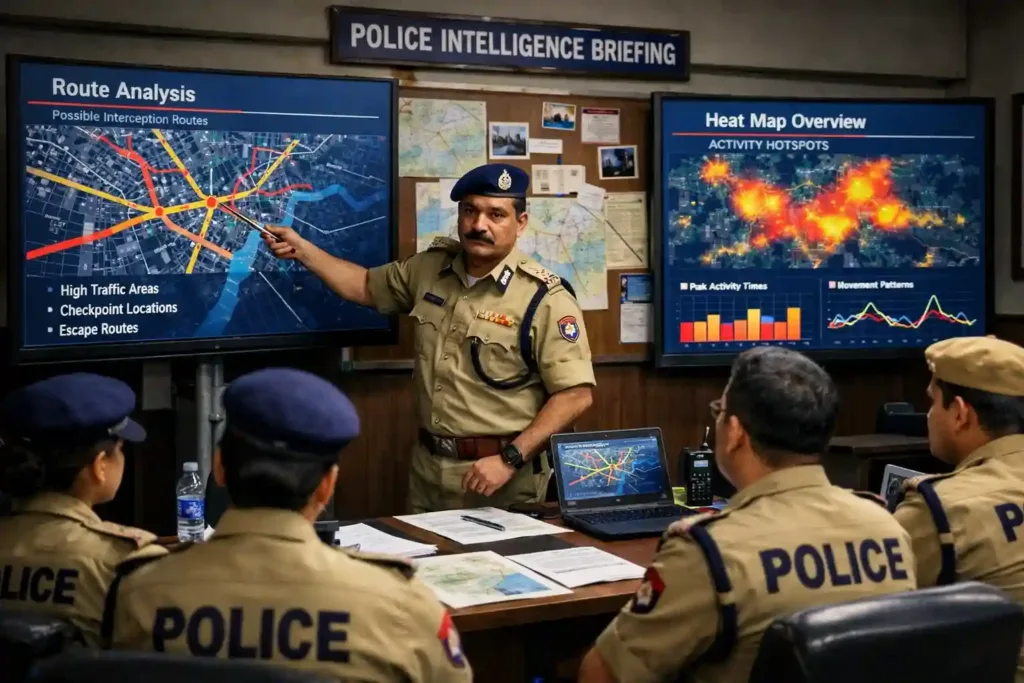
Instead, the team opted for a covert, medium-scale, tactically quiet deployment based entirely on Alethia’s fused intelligence.
Undercover officers spread out across the hotspots. Another set positioned themselves at the predicted detour pockets. Shadow teams waited just outside the routes Alethia had identified as high-risk corridors.
This wasn’t random patrolling. It was smart policing, guided by predictive hotspots and time-window analysis.
The Night the Pattern Finally Broke
On the third night of the operation, a plain-clothed undercover officer boarded an auto-rickshaw near one of the marked terminals.
A few minutes into the ride, the driver drifted off the main road, exactly where Alethia had indicated many incidents began. Two men stepped onto the auto-rickshaw at an internal crossing, just as several victims had described.
The officer didn’t need to send an alert. The teams already knew the probable routes and timing.
Covert units moved in quietly from both ends of the detour corridor. Another team approached the intersection ahead, blocking escape without drawing attention.

When the suspects attempted to corner the passenger, the officers intervened with precision. No chase. No confrontation on the open street.
The auto-rickshaw racket, one that had operated quietly for months, finally met a force that had anticipated its every move.
The Network Behind the Crimes
Interrogations over the following days revealed the depth of the operation:
- Auto-rickshaws rented under fake names
- Rotating groups of offenders so no descriptions matched
- Pick-up points chosen specifically to avoid patrol routes
- Pre-identified detour lanes selected for their isolation
Without Alethia’s fused, cross-station analysis, this structure would have remained invisible.
But by correlating complaint patterns, Dial 100 call attributes, route anomalies, and geographic clustering, Prophecy Alethia reconstructed the entire crime model.
Not with guesswork. But with data.
Smart Monitoring. Predictive Policing. Real Impact.
After the bust, the intelligence didn’t go to waste.
Alethia’s hotspot dashboards helped police redesign night patrolling routes. Officers were deployed to vulnerable pockets identified by the heatmap. Transport hubs received focused monitoring during peak hours of vulnerability. Internal lanes previously ignored became part of regular patrol loops.
Within weeks, the number of such complaints dropped sharply.

Predictive policing wasn’t just a theoretical concept anymore. It was working – visibly, measurably, undeniably.
And the biggest shift was not just operational. It was emotional. Late-night commuters who once travelled with quiet fear felt safe again. Workers returning from shifts no longer hesitated at auto-rickshaw stands. Passengers stepped out of transit hubs with greater confidence.
The police had not only dismantled a racket. They had restored trust.
Because with Prophecy Alethia, even the quietest patterns don’t remain hidden. Not when smart policing is powered by intelligence.
See first hand how predictive policing works in real-world operations. Request a demo of Prophecy Alethia.