
Everyone in government is being told the same thing: adopt AI or fall behind.
And for once, the hype isn’t entirely wrong. Large language models can compress hours of document review into minutes. They can surface patterns across thousands of intelligence reports. They can answer complex queries in plain language, generate summaries on demand, and give analysts the kind of cognitive support that was unimaginable five years ago.
But here’s the part the AI evangelists conveniently skip over: the same technology that makes commercial LLMs like ChatGPT, Claude, Perplexity useful in a consumer context is fundamentally unsafe for government use, as-is.
That’s not a minor footnote. It’s the entire problem.
The False Comfort of “Enterprise AI”

When commercial AI vendors pitch their “enterprise-grade” or “secure” offerings to government buyers, they typically mean one or more of the following: data encryption in transit, role-based access controls, compliance certifications, and audit logs.
These are necessary. They are not sufficient.
Here is what they do not address: your data still leaves your environment. When a government analyst queries a cloud-hosted LLM, even a “private” one, the inference happens on infrastructure you do not control. Prompts are transmitted. Responses are generated externally. Depending on the terms of service, that data may be used to retrain models, stored in logs accessible to vendor staff, or exposed in a breach you will never know about.
For a retail company, this is a manageable risk. For an intelligence agency, a financial intelligence unit, or a law enforcement command processing sensitive operational data, it is unacceptable.
The question you should be asking isn’t “is this AI secure?” The question is: “Where does my data go when I use this AI tool?”
If the honest answer is “somewhere outside our network,” then you already have your answer.
What “Secure LLM for Government” Actually Means

Genuine security in government AI deployment is not a feature checkbox. It’s an architectural requirement. There are five dimensions worth understanding:
Deployment location
A truly secure LLM for government runs on-premise i.e., within the organisation’s own servers, within its own network perimeter, behind its own security controls. No data crosses the boundary. No inference happens in the cloud. The model lives where your data lives.
This is also called air-gapped AI deployment when the environment is completely isolated from external networks, the standard for the most sensitive operational contexts.
Data residency and sovereignty
Sovereign AI deployment means the government retains complete ownership, control, and custody of both the model and the data it processes. There is no dependency on a foreign vendor’s infrastructure. No risk of data being routed through foreign data centres. No exposure to extraterritorial legal frameworks that could compel a vendor to hand over your data.
This matters particularly for Indian government agencies, where data sovereignty is not just an operational preference but increasingly a strategic imperative.
No model training on your data
Commercial LLMs improve over time, in part by learning from usage. A secure on-premise LLM does not phone home. It does not improve by exposing your classified queries and documents to a training pipeline you cannot audit or control. What you query stays within your system, period.
Auditability and explainability
Government decisions, especially in law enforcement, financial intelligence, and national security, carry legal and operational weight. An AI system that produces outputs without traceable reasoning is not just technically weak; it’s a liability. A secure LLM for government must be able to show its work: which documents informed a response, how a summary was derived, what sources were referenced.
Multi-modal capability on sensitive data
Government data is not just text. Intelligence reports, interrogation transcripts, CCTV footage, scanned FIRs, handwritten field notes, intercepted audio, etc. it comes in every format imaginable. A genuinely useful government LLM needs to work across all of these, without any of it being transmitted to an external server for processing.
The Assumption You Need to Challenge

There’s a pervasive assumption among technology decision-makers in government: that cutting-edge AI capability and airtight data security are a trade-off. That you can have one or the other, but not both. That the best models are cloud-only, and if you want on-premise, you’re stuck with inferior technology.
This assumption is outdated, and it’s costing organisations both security and operational effectiveness.
The technology has matured. It’s now entirely possible to deploy a powerful, multi-modal, retrieval-augmented generation (RAG) system, one that can process text, images, audio, and video, answer complex questions, summarise large document sets, and support real-time decision-making, entirely within your own infrastructure.
What RAG means in practice: instead of the model relying only on what it was trained on, it actively retrieves relevant information from your own document repositories before generating a response. This gives you current, contextually accurate answers grounded in your actual operational data, not generic outputs based on public internet training. It’s particularly powerful for intelligence agencies managing large volumes of historical reports, case files, and multi-source data.
The question is no longer whether this is technically possible. The question is whether the organisations evaluating AI are asking the right questions when they do so.
What Government Agencies Should Be Getting From AI, But Often Aren’t
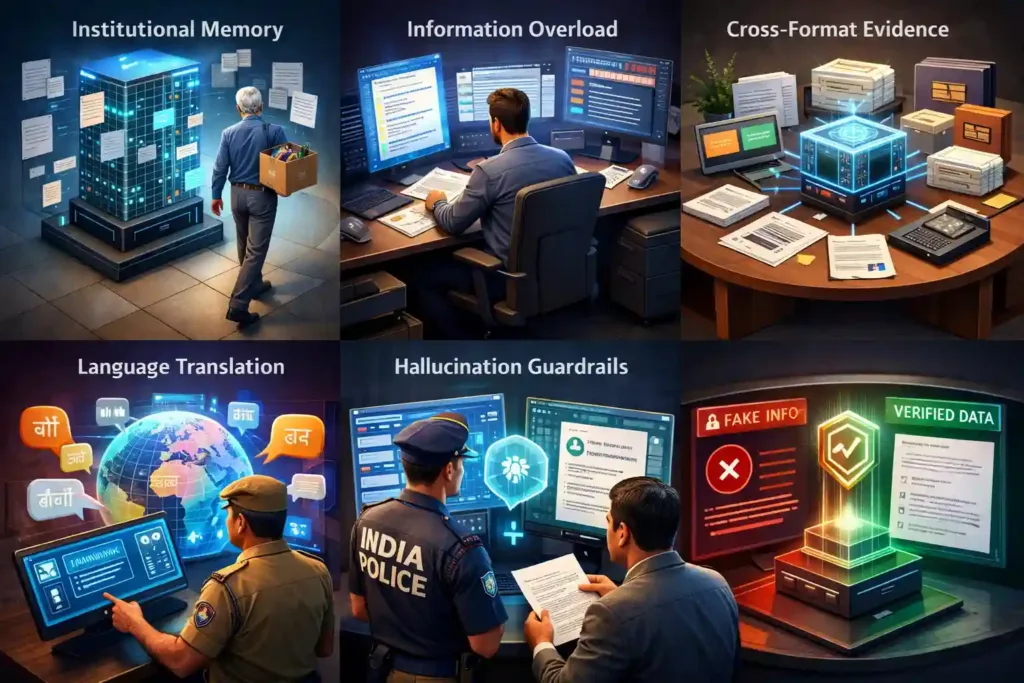
Let’s be specific about the operational gaps that a secure LLM can close:
Institutional memory loss
When an experienced officer retires or transfers, they take years of contextual knowledge with them. Case histories, source networks, analytical frameworks developed over careers, gone. A properly implemented AI system that ingests and indexes historical reports, investigation files, and operational documents becomes an institutional memory that doesn’t walk out the door.
Learn more about Institutional Memory.
Information overload in high-stakes environments
An intelligence analyst processing hundreds of reports a day cannot read everything. AI summarisation that works on classified documents within the organisation’s secure environment changes the calculus entirely. The analyst focuses on judgement, not data processing.
Cross-format evidence synthesis
A financial intelligence unit investigating a money laundering network might have transaction records, intercepted communications, property registration documents, and court filings, all in different formats, stored in different systems. A multi-modal AI platform that can ingest, cross-reference, and synthesise across all of these, securely and on-premise, is not a luxury. It is an operational advantage.
Language barriers in multilingual environments
Indian law enforcement operates across dozens of languages and dialects. Intelligence gathered in regional languages sits unprocessed because translation capacity is limited. An LLM, Prophecy GPT to be exact, that supports 70+ languages, deployed securely within the organisation, removes this bottleneck.
The hallucination problem
This deserves direct attention, because it is the issue that rightly gives senior officials pause. General-purpose LLMs confidently produce false information. For government use, where outputs may inform operational decisions, investigations, or legal proceedings, hallucination is not an acceptable risk. RAG architecture substantially mitigates this by anchoring responses in verified, retrieved documents rather than generating from statistical patterns alone. The system cites its sources. Analysts can verify. Accountability is maintained.
ProphecyGPT: Built for Exactly This Problem

Innefu’s ProphecyGPT was designed from the ground up for organisations that cannot compromise on data security, intelligence agencies, law enforcement, financial intelligence units, and large enterprises handling sensitive operational data.
It is not a consumer AI product adapted for government. It’s a purpose-built secure GenAI platform that operates entirely within your infrastructure.
ProphecyGPT’s core capabilities include:
- On-premise deployment: Your data never leaves your environment
- Multi-modal processing: Text, images, audio, and video, all within a single unified system
- AI summarisation: Large document sets distilled into actionable intelligence
- Smart search and question answering: Natural language queries against your own document repositories
- OCR: Handwritten and printed documents converted to searchable digital text
- Speech-to-text: Spoken content, interviews, and audio evidence converted to text for analysis
- Translation across 70+ languages: Multilingual intelligence processed without external exposure
- Facial recognition and object detection: Visual data analysed within the secure environment
- RAG architecture: Responses grounded in your actual documents, not generic training data
The result is a system that gives government and security organisations the full power of modern AI, without the security liabilities that come with cloud-based alternatives.
A Practical Starting Point

If you are evaluating AI for a government or security context, the first set of questions to ask any vendor is not about features. It is about architecture:
- Where does inference happen, on our infrastructure or yours?
- Does our data ever leave our network boundary?
- Can this be deployed in an air-gapped environment?
- Is the model retrained on our queries and data?
- How are responses traced back to source documents?
- What happens to our data if we terminate the contract?
The answers to these questions will tell you more about whether a platform is genuinely fit for government use than any feature comparison matrix.
Governments that get AI right will do so not because they adopted it fastest, but because they adopted it most responsibly, with security architecture that matches the sensitivity of the data they are entrusted to protect.
That is the standard ProphecyGPT is built to meet. Learn more about ProphecyGPT →