
When Policing Meets Scale, Speed, and Uncertainty
On an ordinary day, policing follows familiar rhythms. Patrols are planned, risks are distributed, and incidents unfold within manageable boundaries. High-risk public events disrupt this balance entirely.
A single event, a festival, political gathering, sporting match, or religious procession, can bring tens of thousands of people into a confined space within hours. Movement becomes dense. Emotions run high. Small disruptions travel fast through a crowd.
Most large-scale incidents don’t begin as violent acts. They often start with:
- A sudden surge at an entry point
- A rumour spreading faster than official communication
- A minor altercation amplified by crowd panic
- Unexpected weather or a nearby unrelated incident
In such environments, even well-managed, peaceful gatherings can escalate within minutes.
Traditionally, crowd control at events has relied on:
- Static deployment plans designed days or weeks in advance
- Manual intelligence inputs based on past experience
- Real-time reaction, where intervention begins only after visible disruption
While this approach ensures presence, it often lacks anticipation. It struggles to account for how crowds actually behave once an event is underway.
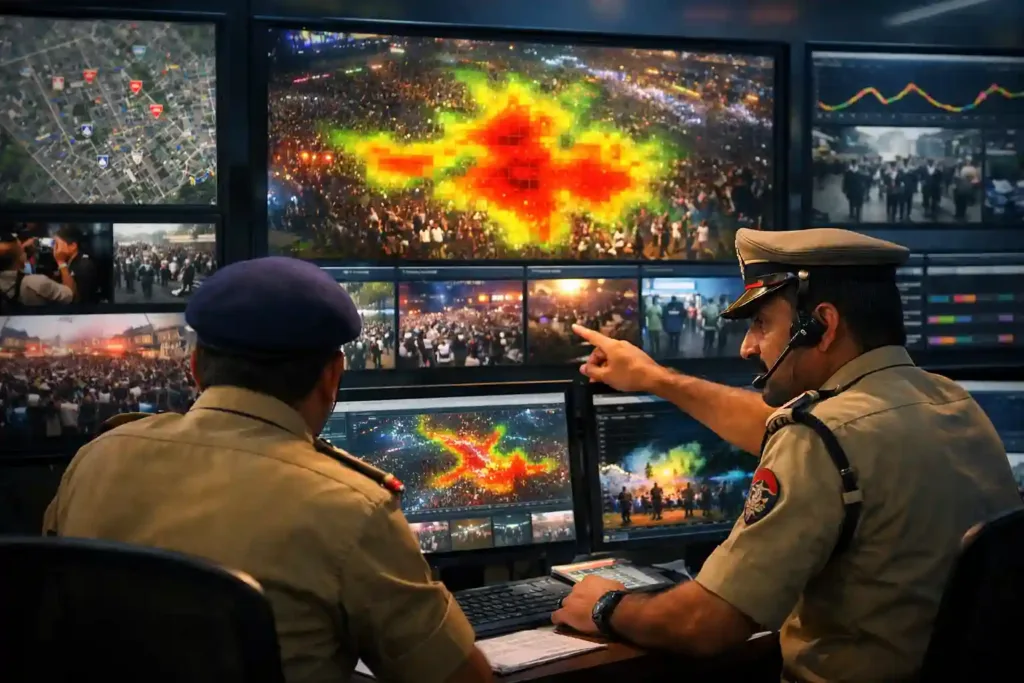
High-risk events demand foresight, not just presence. This is where predictive policing plays a critical operational role—helping agencies anticipate risk patterns, prepare for escalation points, and make informed decisions before situations spiral out of control.
Key Takeaways
- High-risk events require a different policing approach than routine operations.
- Predictive policing supports pre-event planning, live situational awareness, and post-event learning.
- Early, localised interventions reduce the need for disruptive or force-heavy responses.
- Event-specific resource deployment improves safety while maintaining normal event flow.
- Predictive-led crowd management prioritises prevention, coordination, and public confidence.
Why High-Risk Events Require a Different Policing Approach
Policing a large public event is fundamentally different from routine patrol operations. The environment is temporary, compressed, and highly volatile.
Unlike everyday policing, high-risk events operate within intense but short risk windows. A few hours can define the entire outcome of public safety, leaving little room for trial-and-error decision-making.
Crowd density can change rapidly, sometimes in seconds. Entry gates, transport hubs, food zones, and exit routes can shift from orderly to congested without warning. When this happens, risks multiply quickly.

External triggers further complicate the situation:
- Unverified rumours spreading through crowds or social media
- Sudden weather changes affecting movement and visibility
- Incidents occurring nearby but unrelated to the event itself
At the same time, these operations place enormous pressure on multi-agency coordination. Police forces must work in sync with local administration, emergency services, transport authorities, and event organisers, all while maintaining clear command and communication structures.
In such scenarios, there is often zero margin for error. Delayed decisions or blanket responses can escalate panic rather than restore control.
This is why effective crowd management is not about enforcement alone. It is about prevention, controlled movement, and situational flow, ensuring safety while allowing the event to proceed with minimal disruption.
Predictive-led approaches support this goal by helping decision-makers understand where risks are likely to emerge, how crowd behaviour may evolve, and when early intervention is most effective.
Role of Predictive Policing Before an Event (Pre-Event Planning)
High-risk events are won or lost before the first attendee arrives. Unlike routine policing, pre-event planning is not about patrol routes or fixed deployment. It’s about understanding how risk is likely to emerge once thousands of individuals begin moving, gathering, and reacting together.
Predictive policing supports this phase by helping agencies anticipate pressure points and prepare for multiple possible outcomes, rather than relying on a single static plan.

Risk Profiling of Events
Every event carries its own risk profile. Predictive-led planning begins by analysing patterns from similar events, rather than treating each gathering as a blank slate.
Key considerations include:
- Historical incident data from comparable events, such as past festivals, rallies, or sporting fixtures
- Venue-specific vulnerabilities, including layout constraints, access points, visibility limitations, and surrounding infrastructure
- Timing-based risk escalation, particularly during entry surges, peak attendance windows, and exit phases when fatigue and congestion increase
This layered view allows planners to distinguish between low-risk periods and high-exposure moments, ensuring preparedness aligns with when risk is most likely to surface.
Anticipating Crowd Behaviour Patterns
Crowd behaviour is rarely random. It follows patterns influenced by space, timing, and external conditions. Predictive insights help agencies anticipate these patterns in advance.
This includes understanding:
- Expected footfall surges, especially during opening hours, headline moments, or ceremonial phases
- Bottlenecks and congestion zones, where crowd flow naturally slows or compresses
- Likely stress points, such as parking areas, transport hubs, checkpoints, food zones, or emergency exits
By mapping how crowds are likely to move and gather, planners can proactively manage flow, reduce pressure points, and prevent minor disruptions from turning into safety risks.
Intelligence-led Preparedness
The most critical advantage of predictive policing in pre-event planning is scenario readiness.
Rather than assuming ideal conditions, agencies can:
- Identify potential flashpoints based on historical patterns and environmental context
- Align deployment and response strategies before the event begins, ensuring clarity across command and field teams
- Prepare for multiple scenarios, such as delayed entry, sudden weather changes, or unexpected crowd surges
This approach replaces fixed assumptions with adaptive preparedness, allowing decision-makers to respond confidently when conditions deviate from plan.
Predictive Insights During Live Crowd Situations
Once an event is underway, conditions can change faster than traditional reporting cycles allow. Crowd management at this stage is about situational awareness and response timing, not retrospective analysis.
Predictive insights support real-time decision-making by helping command teams maintain a continuous view of evolving conditions.
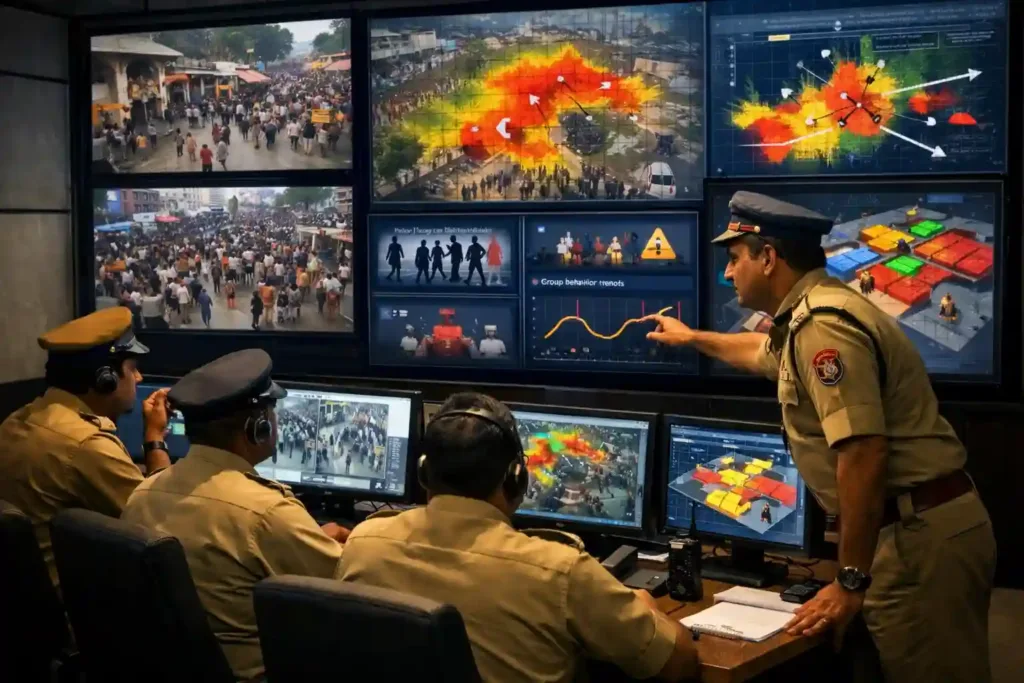
Key capabilities include:
- Monitoring crowd density as it changes, rather than relying on static headcounts
- Detecting abnormal movement or congregation patterns, such as sudden clustering, reverse flow, or dispersal anomalies
- Early identification of escalation risks, allowing intervention before visible disorder emerges
- Dynamic prioritisation of response zones, ensuring attention is focused where risk is increasing, not where it has already peaked
In crowd management, minutes matter. Predictive insights help decision-makers act before situations escalate, enabling measured, targeted responses that protect public safety while maintaining control.
Managing High-Risk Scenarios Within Crowds
High-risk situations within large crowds rarely announce themselves clearly. They often emerge locally, triggered by movement, perception, or uncertainty rather than intent. Managing these moments effectively requires early awareness and precise intervention.
One of the most critical risks during large events is crowd surge and stampede potential. Sudden increases in movement, often caused by rumours, perceived threats, or unexpected delays—can compress space rapidly. Predictive insights help identify where density is rising abnormally, allowing teams to intervene early through controlled flow adjustments rather than reactive crowd control.

Another common challenge is localised unrest or panic triggers. A minor altercation, equipment failure, or communication gap can escalate quickly when surrounded by thousands of people. Predictive-led monitoring helps distinguish isolated disturbances from wider escalation risks, enabling focused responses that prevent spread.
Events are also vulnerable to spillover risks from nearby incidents. Traffic disruptions, protests, or emergencies outside the venue can influence crowd behaviour inside it. Predictive awareness allows command teams to assess impact zones and prepare targeted adjustments without disrupting unaffected areas.
Entry and exit points present their own risks. Choke points during arrivals and dispersals often account for the highest safety exposure. Predictive insights help anticipate pressure buildup at these locations, enabling phased movement, temporary access controls, or rerouting before congestion becomes hazardous.
Across all these scenarios, the key advantage lies in containing risk locally. Rather than deploying blanket responses that disrupt the entire event, predictive-led approaches support measured, proportional actions—protecting safety while preserving order and continuity.
Resource Deployment for Event Security
Event security requires a fundamentally different deployment approach than routine policing. The objective is not continuous coverage, but timed, situational presence aligned with crowd dynamics.

Predictive insights enable staggered deployment based on event phases:
- Entry and buildup periods
- Peak attendance windows
- Dispersal and exit phases
Each phase carries different risk characteristics and requires tailored resource positioning.
Effective event security also depends on matching resource types to crowd risk levels. High-density or high-sensitivity zones may require greater visibility and rapid response capability, while lower-risk areas benefit from a lighter presence that supports flow without creating friction.
A predictive-led approach helps prevent over-policing, which can heighten tension or disrupt normal event activity. Instead, resources are positioned purposefully, visible enough to reassure, flexible enough to respond, and restrained enough to avoid unnecessary escalation.
As conditions evolve, predictive insights support real-time reallocation. Resources can be shifted quickly to emerging pressure points, ensuring attention remains aligned with actual risk rather than predefined assumptions.
By treating deployment as a dynamic, event-specific exercise, agencies maintain safety, visibility, and control—without resorting to rigid structures or excessive force.
Multi-Agency Coordination and Command Decision Support
High-risk events rarely fall under the responsibility of a single agency. Effective crowd management depends on seamless coordination between multiple stakeholders operating under intense time pressure.
This typically includes:
- Police forces, responsible for on-ground control and response
- Local administration, overseeing permissions, infrastructure, and civic coordination
- Emergency services, including medical response, fire safety, and disaster management units
Predictive-led operations strengthen this coordination by improving central command visibility. Instead of fragmented updates flowing through parallel channels, decision-makers gain a unified operational picture of crowd conditions, risk zones, and resource status across the event area.

With clearer situational awareness, command centres can:
- Align agencies around shared priorities
- Issue precise, timely directives
- Avoid contradictory actions that create confusion on the ground
In high-pressure environments where seconds matter, predictive insights support faster, clearer decision-making—reducing hesitation, minimizing escalation, and improving overall control during critical moments.
Post-Event Intelligence and Learning Loops
The value of predictive policing does not end when an event concludes. High-risk events generate valuable operational insights that, when analysed properly, strengthen preparedness for the future.
Post-event analysis enables agencies to:
- Review crowd behaviour patterns, including movement, congestion, and response effectiveness
- Identify what worked and what didn’t, across planning, deployment, and coordination
- Understand how external factors influenced outcomes
These insights feed into learning loops that refine future event planning. For recurring festivals, annual gatherings, or frequently used venues, this creates institutional memory, allowing each iteration to be safer and more efficient than the last.
Rather than starting from scratch, agencies build on accumulated experience, improving readiness while reducing uncertainty. This reinforces predictive policing as a process of continuous improvement, not a one-time prediction exercise.
Why Predictive Policing is Especially Valuable for High-Risk Events
High-risk events are temporary, but their consequences can be lasting. A single failure in crowd management can undermine public trust, disrupt civic life, and place lives at risk.
Predictive policing is especially valuable in these environments because it prioritises prevention over reaction. By anticipating where risks are likely to emerge, agencies can intervene early, often quietly, before situations escalate.
This approach enables better preparedness without excessive force. Decisions are guided by situational insight rather than assumption, supporting measured responses that maintain safety without unnecessary disruption.
Ultimately, predictive-led event management helps ensure public safety without compromising the event itself, allowing communities to gather, celebrate, and participate with confidence.
To Conclude: From Crowd Control to Crowd Intelligence
High-risk events test policing at its limits, where scale, speed, and uncertainty converge. Predictive policing helps agencies move beyond reactive crowd control toward anticipatory, intelligence-led event management.
By enabling better preparation, real-time situational awareness, and coordinated decision-making, predictive insights allow risks to be addressed early and locally, often before they are visible to the crowd itself. The result is safer events, smoother operations, and public safety maintained without disruption.
As public gatherings grow larger and more complex, predictive-led crowd management is no longer optional, it is operationally essential.
If you’re planning or securing large public events, explore how predictive policing frameworks can strengthen preparedness, coordination, and crowd safety, before the first risk emerges.
FAQs – Frequently Asked Questions
- How does predictive policing help in managing large public events?
Predictive policing helps agencies anticipate crowd risks, identify pressure points, and make informed decisions before situations escalate during large events.
- Is predictive policing used only before an event begins?
No. Predictive insights support pre-event planning, real-time situational awareness during the event, and post-event analysis to improve future preparedness.
- Can predictive policing prevent crowd-related incidents like stampedes?
Predictive-led monitoring helps identify rising crowd density and abnormal movement early, enabling preventive action to reduce the risk of such incidents.
- Does predictive crowd management require excessive policing presence?
No. The goal is proportional, targeted deployment—maintaining safety and visibility without unnecessary disruption or over-policing.
- Is predictive policing suitable for recurring events and festivals?
Yes. It is particularly effective for recurring events, as post-event insights build institutional memory and improve planning year after year.