The year is 2016. An officer at a district police station receives a report of a narcotics peddler arrested in the next district. There is no way to know that a peddler arrested in his own district six months earlier shared a forensic exhibit with this new arrest, same supplier, different courier. That connection goes unseen. The investigation closes without following the thread. The network continues operating.
The year is 2024. India’s three new criminal laws, the Bharatiya Nyaya Sanhita, Bharatiya Nagarik Suraksha Sanhita, and Bharatiya Sakshya Adhiniyam, came into effect on 1 July 2024, replacing the colonial-era IPC, CrPC, and Indian Evidence Act. Among the most consequential changes: the BNSS mandates forensic investigation for offences punishable with seven years of imprisonment or more, with forensic experts required to visit crime scenes to collect evidence and record the process.
The same officer who had no way to connect two arrests in 2016 now operates under a legal framework that requires forensic evidence collection as a matter of law, and under an expectation from senior leadership, state governments, and the courts that investigations will be thorough, evidence-backed, and timely.
The gap between that legal expectation and operational reality is exactly what police modernisation technology exists to close.
This is the practitioner’s framework. Six pillars of genuine police modernisation, what technology exists at each pillar, what the gap between modernised and unmodernised looks like operationally, and what an integrated modernisation roadmap actually means in practice.
Key Takeaways
- The legal mandate has arrived: BNSS forensic requirements, Zero FIR, electronic evidence admissibility, and time-bound investigations have created compliance obligations that manual processes cannot meet at scale.
- Modernisation is not a single purchase: It is a stack of six interconnected capability pillars; investing in one without the others produces point solutions that underdeliver.
- The data problem is the core problem: Indian police forces have more data than ever; what they lack is the infrastructure to correlate it, analyse it, and act on it in real time.
- Predictive policing is operationally proven in India: Not a future concept; deployed systems have forecast crime events with over 75% accuracy, enabling preemptive force deployment.
- The BNS forensics mandate creates urgency: Every force that cannot process forensic evidence at the volume the new law requires is already behind.
- Technology at the lowest level matters most: Modernisation that only helps senior officers leaves the station-level officer: the person who files FIRs, interviews witnesses, and does the daily investigative work, exactly where they were.
- Integration is what separates modernisation from procurement: Connected systems over a shared data lake deliver exponentially more than disconnected point solutions.
The Context: Why Police Modernisation in India Has Reached an Inflection Point
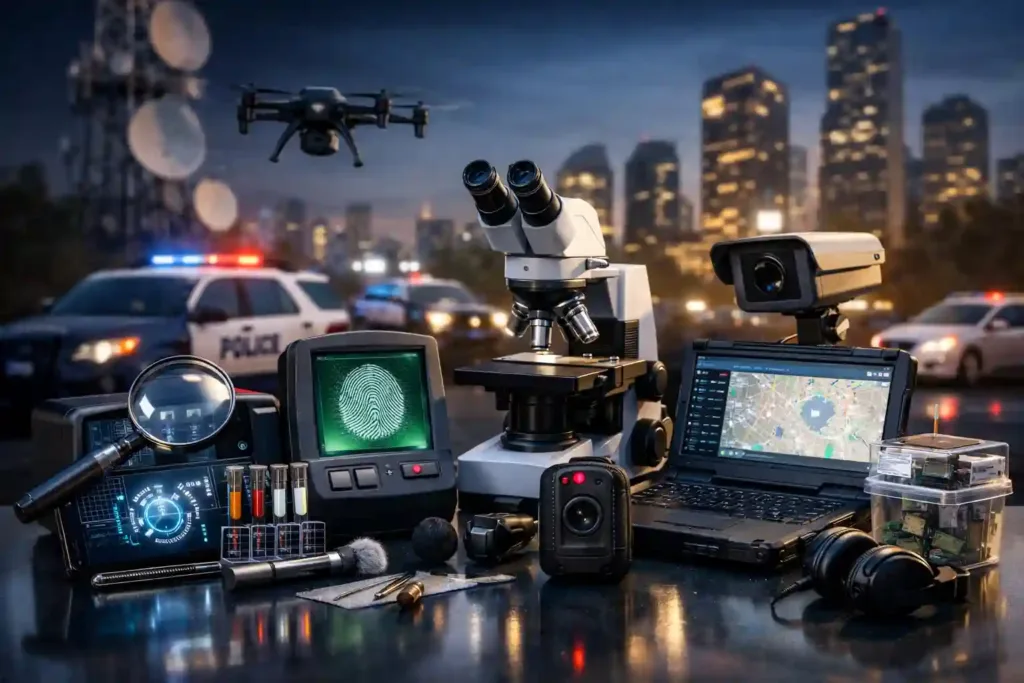
Indian policing has been modernising incrementally for two decades: CCTNS, Dial 112, VAAHAN integration, the Smart Cities Mission, various Safe City projects. These have been real investments with real results in specific areas. But 2024 marks a qualitative shift in urgency.
Several forces are converging simultaneously:
The BNS/BNSS legislative transformation
The new laws implement Zero FIR, compulsory recording of electronic evidence, time-bound investigation, and forensic integration in serious offences. These are not aspirational guidelines, they are statutory requirements. A police force that cannot process forensic evidence at the volume the new law mandates, or that cannot handle electronic evidence in the formats the Bharatiya Sakshya Adhiniyam contemplates, is operating in non-compliance with the law of the land.
The crime complexity curve
Narcotics trafficking, organised financial fraud, cybercrime, human trafficking, and terror financing have all grown in sophistication faster than the investigative tools deployed against them.
Networked crime i.e. crime that operates across districts, states, and national borders through coordinated individuals who don’t know each other, requires networked investigation.
Most police forces in India are still investigating with tools designed for single-location, single-accused cases.
The manpower constraint
India’s police-to-population ratio remains below global averages, and significant expansion is not on the immediate horizon. The only way to do more with the same force strength is to make each officer significantly more effective through better tools and better information. Technology multiplies investigative capacity; it does not replace it.
The data accumulation inflection
CCTNS holds more records than ever. VAAHAN has vehicle ownership data for hundreds of millions of registrations. Dial 112 generates emergency call data across states. Digital forensics from seized phones produces gigabytes of evidence per case.
The data available to a police force today is categorically more than it was five years ago, but the analytical infrastructure to make that data useful has not kept pace. The data is there. The tools to use it are not.
These pressures together make 2025-26 the most consequential window for police modernisation investment in India’s recent history.
The Six Pillars of Police Modernisation Technology
Pillar 1: Intelligence Fusion and Situational Awareness
What it is
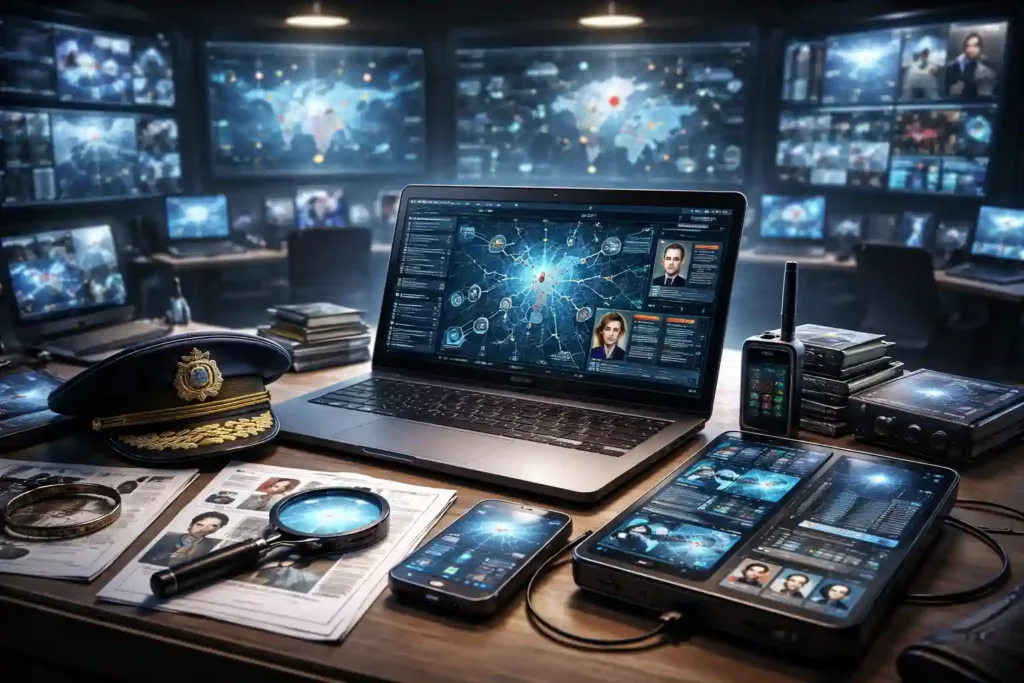
The infrastructure that brings all data sources, CCTNS, Dial 112, VAAHAN, CDR/IPDR, forensic data, criminal dossiers, OSINT, bank statements, case diaries, into a single data lake, and applies AI to correlate across them in real time.
The problem it solves
India’s police data landscape is fragmented across dozens of databases and systems, most of which cannot talk to each other.
An investigating officer trying to build a complete picture of a suspect, a network, or a crime trend has to manually query each system separately, if they have access to all of them at all. Critical connections between data points in different systems remain permanently invisible without a fusion layer.
What modern technology delivers
A unified intelligence fusion platform ingests all available data sources and maintains a continuously updated, correlated picture across all of them. Senior officers get real-time situational dashboards, which districts are seeing rising crime, what types, which habitual offenders are out on bail, what emergency call patterns are indicating.
Station-level officers get AI-generated criminal profiles at a click, everything the system knows about a suspect or gang, pulled from all available data, assembled automatically. Predictive analytics identify which areas and times carry highest crime probability over the upcoming days, enabling data-driven force deployment rather than allocation by habit or hierarchy.
The operational difference
In a deployment with this capability in place, predictive AI models have forecast crime-related events in specific regions with over 75% accuracy, enabling authorities to take pre-emptive action and deploy forces based on predicted need rather than responding after the fact.
Prophecy Alethia by Innefu is an intelligence fusion platform built specifically for this pillar. It integrates data from CCTNS, Dial 112, VAAHAN, E-Beatbook, CDR/IPDR, forensic dumps, criminal dossiers, and OSINT into a single data lake. All on-premise, never connected to the internet.
It has been deployed across multiple state police forces and central agencies, enabling crime forecasting, criminal profiling, cross-district case linkage, and real-time situational awareness at both the senior officer and station level.
Learn more about Prophecy Alethia →
Pillar 2: Digital Forensics and Evidence Management
What it is
Technology that processes forensic evidence, from seized mobile phones, computers, storage devices, email dumps, and financial records; at the volume, speed, and analytical depth that modern investigations and the new legal mandates require.
The problem it solves
The BNSS forensics mandate creates an immediate operational challenge: most police forces do not have the analytical infrastructure to process forensic evidence at the volume the new law requires.
A single seized smartphone can contain tens of thousands of messages, thousands of images, years of location data, and multiple apps’ worth of activity. Manual review of even one device per case is slow and incomplete.
When a serious case involves five, ten, or twenty seized devices, plus computers and email dumps, the forensic backlog becomes insurmountable without AI assistance.
What modern technology delivers
AI-powered forensic analytics platforms ingest data from all sources, classify and correlate across devices, run OCR on images and scanned documents to make their contents searchable, identify common contacts and shared locations across multiple suspects’ devices, analyse bank statements in PDF format, and generate court-ready reports at a click.
What previously took weeks of manual review can be completed in hours, and at a level of cross-device correlation that manual review structurally cannot achieve.
The operational difference
In a documented deployment, an AI forensics platform processed over 13 terabytes of forensic data, computer dumps, mobile phones, and email archives, identifying crucial linkages between individuals who had denied any connection, connections that months of prior manual analysis had not found.
Argus by Innefu is a forensic analytical toolkit built on an AI/ML backbone, designed for exactly this requirement. It ingests data from multiple extraction tools, merges forensic data with CDR and bank statement records, runs cross-device correlation automatically, maintains evidence integrity for court admissibility, and produces clear reports usable in charge sheets and judicial proceedings.
Pillar 3: Telecom Data Analytics
What it is
Purpose-built tools for analysing Call Data Records (CDR), IP Detail Records (IPDR), and tower dump data, the telecom evidence layer that underpins the majority of serious criminal investigations in India.
The problem it solves
CDR data is rich with investigative intelligence: communication networks, movement timelines, device associations, suspect location history. But raw CDR data is a wall of numbers that is analytically unusable without dedicated tools.
A three-month CDR for a single suspect can run to hundreds of thousands of rows. Most investigations use a fraction of available CDR intelligence simply because the analytical capacity to work with the full dataset doesn’t exist.
What modern technology delivers
CDR analysis platforms transform raw telecom records into visual investigative intelligence, movement maps using Google Earth integration, link analysis graphs showing communication networks and the strength of connections between nodes, IMEI tracking across number changes, tower dump analysis to place suspects at crime scenes, and IPDR correlation for internet activity patterns.
Analysis that would take weeks manually is completed in hours, and at a level of network visualisation that enables investigators to see the full structure of a criminal network rather than its individual members in isolation.
Intelelinx by Innefu is a purpose-built CDR and IPDR analysis platform covering all these capabilities, designed for both routine case investigations and large-scale national security operations.
Pillar 4: Video and Image Analytics for Surveillance and Identification
What it is
AI-powered systems that analyse CCTV footage, body camera feeds, drone video, and static images: performing automatic facial recognition, object detection, behaviour analysis, suspect path tracing, and real-time alerting.
The problem it solves
India has invested heavily in CCTV infrastructure: smart cities, safe city projects, police stations, public spaces, transport hubs. Most of this footage is reviewed manually and retrospectively, if at all. The analytical value of CCTV is almost entirely unrealised at scale.
A suspect walks through frame for two seconds on camera 11 at 3:47 AM. Nobody sees it until the investigation is already several days old, if ever.
What modern technology delivers
AI video analytics processes all camera feeds simultaneously and automatically. Facial recognition matches against criminal dossier databases in real time, alerting when a wanted individual appears on any connected camera.
Object detection flags weapons, suspicious packages, and vehicles of interest. Behaviour analysis identifies loitering, crowd formation, and other threat indicators automatically. Body camera integration enables patrol officers to run live facial recognition in the field.
Attribute-based search allows investigators to find a person by physical description: height, build, glasses, moustache, even when a face is obscured.
The operational difference
In one field deployment, AI Vision’s facial recognition system, trained on Indian datasets, enabled the identification of over 3,000 missing children in four days, a result that national and international media covered extensively.
The system has also enabled identification of criminal suspects from masked and unclear CCTV footage that manual review could not resolve.
AI Vision by Innefu is deployed across police forces and safe city projects with 99.7% facial recognition accuracy on the NIST framework, trained specifically on Indian datasets. It accepts feeds from over 500 cameras simultaneously and integrates with body cameras for field deployment.
Pillar 5: GenAI and Natural Language Capabilities for Frontline Officers
What it is
On-premise generative AI that enables officers at every level, not just tech-savvy analysts, to interact with all available data in plain language, automating the most time-consuming documentation and reporting tasks.
The problem it solves
Modernisation that only serves senior officers and specialists leaves the station-level officer, the SHO, the beat officer, the investigating officer with a stack of cases, exactly where they were.
CCTNS compliance remains low because filling FIR entries manually is slow and officers are under-resourced. Reports take time that investigations need. Interrogation transcripts sit untranscribed. Case diary entries are incomplete. The information exists; it just never makes it into the system in usable form.
What modern technology delivers at the station level:
CCTNS auto-fill: An officer describes what happened in plain speech or text, in Hindi or English. The AI extracts structured data and auto-populates the relevant CCTNS fields. What took 45 minutes of careful form-filling takes 5 minutes of natural description. CCTNS compliance goes up. Data quality goes up. The records that downstream analytics depend on become more complete.
Natural language querying: Instead of navigating separate database interfaces, an officer types a question: “Show me all repeat offenders in this area who are currently out on bail with prior narcotics arrests.” The system queries across CCTNS, criminal dossiers, and court records and returns the answer in seconds.
Automatic summarisation: Case files running to hundreds of pages can be summarised into structured briefs automatically, saving hours of reading for supervisory officers reviewing cases or taking handover.
Speech-to-text for interrogations and field reports: Recordings of interrogations, witness statements, and field officer voice notes are automatically transcribed: in Hindi, Urdu, Punjabi, or any of the relevant languages, making their content searchable and analysable alongside all other case data.
ProphecyGPT by Innefu is an on-premise GenAI platform, never connected to the internet, all models inbuilt, that operates as the AI intelligence layer over the entire Prophecy data lake. It is the technology that enables the “converse with your data” capability for police forces: officers at every level can query the full system in plain language and receive structured, sourced answers.
For a deep dive into how on-premise GenAI works in law enforcement environments, read: On-Premise GenAI for Law Enforcement →
Pillar 6: Cybersecurity and IT Infrastructure Security
What it is
The security infrastructure that protects the modernised police IT environment itself: authentication, access controls, endpoint protection, and secure communication channels.
The problem it solves
A modernised police force holds more sensitive data than ever, such as criminal records, intelligence inputs, informant identities, ongoing case data, biometric records. This data is a high-value target for both criminal networks and hostile actors. The modernisation investment itself creates a new attack surface. Without robust security infrastructure, modernisation creates vulnerability rather than capability.
What modern technology delivers
Multi-factor authentication that ensures only authorised officers can access sensitive systems, even if credentials are compromised. Role-based access controls that limit each officer’s data access to what their operational role and clearance level requires. Network and time policies that prevent access outside authorised locations and hours.
Geo-fencing that blocks access attempts from outside authorised geographies. Deep packet inspection that secures legacy email and communication protocols that modernisation has not yet replaced. Adaptive authentication that increases verification requirements when access patterns appear anomalous.
AuthShield by Innefu is a unified authentication platform deployed across multiple police forces and paramilitary organisations, securing Windows login, VPN access, email systems, web applications, and remote access from a single platform.
It’s the first Indian company to achieve OATH certification; and has replaced legacy authentication solutions across critical government and security infrastructure.
What Integration Actually Means, And Why It Matters More Than Any Single Pillar
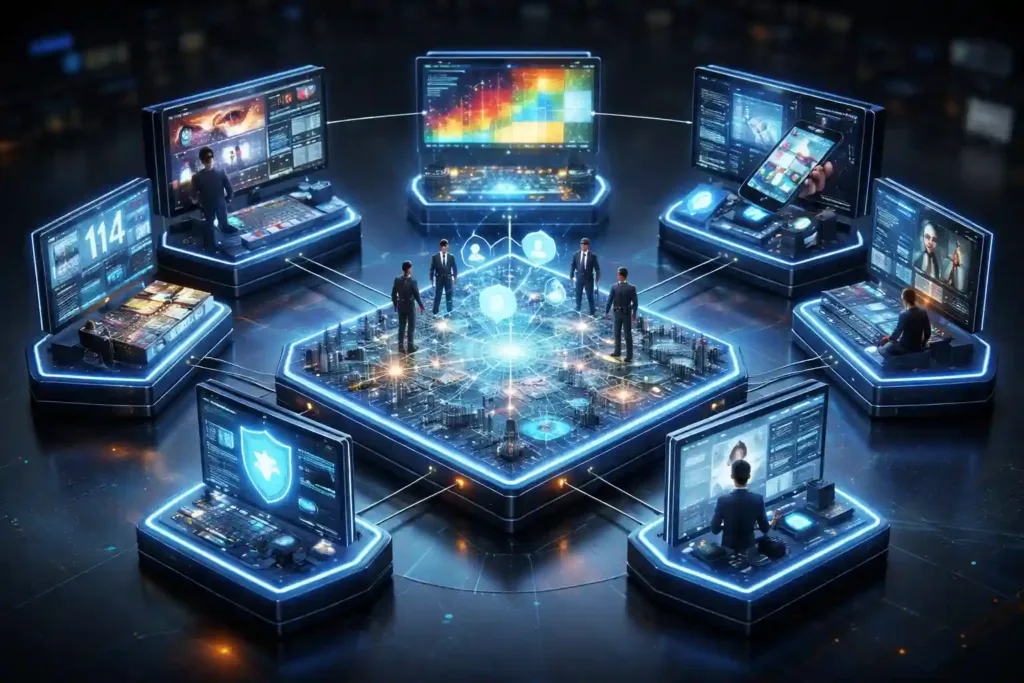
The six pillars above are each genuinely valuable in isolation. The transformative value comes from integration, when all six pillars operate over the same data lake, with the same security architecture, under unified access controls.
Consider a realistic modernised investigation workflow when all six are connected:
An emergency call comes in. The Dial 112 data enters the fusion platform. AI analysis of call patterns flags that this area has seen a 40% increase in similar calls over the past two weeks, potential emerging hotspot. Predictive models are already suggesting elevated deployment in this district.
An arrest is made. The Argus forensics platform processes the seized device within hours. It identifies a phone number that appears in both the suspect’s CDR data and a case file from a different district eight months ago, a cross-case connection that would never have been found manually. The investigating officer is alerted.
The suspect appears on camera at a nearby ATM two days before the arrest. AI Vision has already matched the face against the criminal dossier database and added the location data point to the profile automatically.
ProphecyGPT is queried in Hindi: “What is the complete picture on this individual across all our data?” Within seconds, it returns a structured profile: prior arrests, known associates, locations, financial patterns, communication network; citing sources from CCTNS, CDR, forensic data, and OSINT simultaneously.
Throughout, every query, every data access, every file download is logged. AuthShield ensures only authorised users are accessing the system. Role-based controls ensure junior officers access only what their clearance permits.
This is not a technology demonstration. It’s a description of integrated, deployed capability that exists and operates across Indian law enforcement environments today.
Frequently Asked Questions
1. What does police modernisation in India involve?
Police modernisation in India encompasses the adoption of technology across six key pillars: intelligence fusion and situational awareness, digital forensics and evidence management, telecom data analytics, video and image analytics, GenAI capabilities for frontline officers, and IT infrastructure security. Together, these capabilities enable data-driven policing, faster investigation, better inter-district coordination, BNSS compliance, and more effective force deployment. True modernisation connects all six pillars over a shared data infrastructure rather than deploying isolated point solutions.
2. What is the BNS/BNSS forensics mandate and why does it matter for police technology?
The Bharatiya Nagarik Suraksha Sanhita (BNSS), which came into effect on 1 July 2024, mandates forensic investigation for all offences punishable with seven years or more imprisonment. Forensic experts must visit crime scenes, collect evidence, and record the process electronically. This creates a statutory requirement for forensic processing capacity that most police forces in India cannot currently meet at scale through manual methods alone. AI-powered forensic analytics platforms are the only practical way to process the volume of forensic evidence this mandate generates within operationally realistic timeframes.
3. What is predictive policing and is it being used in India?
Predictive policing uses historical crime data, emergency call patterns, socioeconomic indicators, and AI models to forecast where and when crimes are most likely to occur, enabling proactive force deployment rather than reactive response. It is already deployed and operational in India. In documented deployments, AI-powered predictive policing systems have forecast crime events in specific regions with over 75% accuracy, enabling authorities to take preemptive action. The NITI Aayog and Delhi Police Open Innovation Challenge specifically recognised predictive policing as a priority area for Indian law enforcement.
4. What is CCTNS and how does modern technology improve it?
CCTNS (Crime and Criminal Tracking Networks and Systems) is India’s national database for crime records and criminal data, deployed across police stations. Its effectiveness depends on data quality and completeness, which has historically been limited by the burden of manual data entry on under-resourced station-level officers. Modern technology improves CCTNS utilisation in two ways: AI-powered auto-fill that reduces data entry from 45 minutes to minutes by extracting structured data from verbal or text descriptions, and intelligence fusion that makes CCTNS records more valuable by correlating them with CDR, forensic, and VAAHAN data in a single analytical layer.
5. What is an intelligence fusion centre and which police forces use them?
An intelligence fusion centre is a platform that ingests data from multiple sources: CCTNS, CDR, forensics, OSINT, criminal dossiers, bank statements, into a unified data lake and applies AI to correlate and analyse across all of them simultaneously. Innefu’s Prophecy intelligence fusion platform has been deployed across multiple state police forces, central investigative agencies, and paramilitary forces in India, including a safe city deployment that integrates data from eight different operational databases for real-time crime management.
6. How does AI help with CCTV footage analysis in policing?
AI transforms CCTV from a reactive evidence source (reviewed after a crime) to a proactive security tool. Facial recognition running continuously against all camera feeds alerts when a wanted individual appears anywhere on the network. Object detection flags weapons and suspicious behaviour in real time. Behaviour analysis identifies threat indicators before incidents escalate. Suspect path tracing reconstructs movement across multiple cameras automatically. In field deployments in India, AI-powered facial recognition has identified criminal suspects from masked and unclear footage that manual review could not resolve, and enabled large-scale missing persons identification operations.
7. Why must police IT systems be on-premise rather than cloud-based?
Police and intelligence systems contain operationally sensitive, legally protected, and often classified data: ongoing case files, informant identities, intelligence inputs, suspect profiles, biometric records. Cloud deployment routes this data through external servers that the police organisation does not own or control, creating intelligence risk, chain of custody problems, and potential non-compliance with data classification requirements. On-premise deployment, where all data, all processing, and all AI models run on hardware the organisation physically controls, is the baseline security requirement for sensitive law enforcement data. It also enables operation in environments without internet connectivity, which is operationally essential for many deployment contexts.
8. What are the key considerations when evaluating police technology vendors?
Experience with Indian deployments at comparable agencies (not enterprise reference customers), support for Indian language data and CCTNS/VAAHAN formats, on-premise deployment capability with genuine air-gap operation, integration with existing systems rather than requiring replacement, training and implementation support, and evidence integrity features suitable for court admissibility. The vendor’s track record with Indian law enforcement specifically matters more than global credentials, the operational environment, data structures, and language requirements are distinct.