
Terror Financing Is Networked, Not Local
Terror financing rarely moves through a single channel. It rarely announces itself through one large, obvious transaction.
Instead, it flows quietly across systems and borders through:
- Cross-border micro-transactions
- Shell entities with layered ownership
- Charitable fronts masking financial flows
- Trade mis-invoicing and invoice manipulation
- Digital donation ecosystems and online transfers
Individually, these transactions often appear legitimate. They may fall below reporting thresholds. They may align with declared business activities. Collectively, however, they can form structured funding networks, designed to obscure origin, destination, and ultimate beneficiaries.
The challenge for intelligence agencies is not detecting one suspicious transaction. It’s detecting the ecosystem behind it. Cross-border terror financing is a network problem. It’s relational, layered, and adaptive. Monitoring individual alerts in isolation rarely exposes the full architecture of funding flows.
Modern cross-border terror financing tracking requires more than transaction monitoring. It requires the integration of:
- OSINT (Open-Source Intelligence)
- Financial intelligence data
- Knowledge graph analytics
- AI-driven risk modeling
- Cross-domain intelligence fusion
Only when fragmented signals are connected can hidden financial networks become visible.
Key Takeaways
- Terror Financing Is Network-Based: Cross-border terror financing operates through layered, interconnected ecosystems.
- Monitoring Alone Is Not Enough: Transaction alerts detect anomalies, not full networks.
- OSINT Strengthens Financial Intelligence: Publicly available intelligence enriches entity profiles and reveals hidden associations.
- AI Enables Network-Level Detection: Knowledge graph analytics expose structural funding relationships.
- Intelligence Fusion Is Essential: Integrating OSINT, financial data, and AI-driven risk scoring improves cross-border CTF effectiveness.
- Structured Platforms Enable Operational Clarity: Integrated solutions like Innsight, Prophecy Eagle I, and Prophecy Guardian support intelligence-led counter-terror financing operations.
Why Cross-Border Terror Financing Is Difficult to Detect
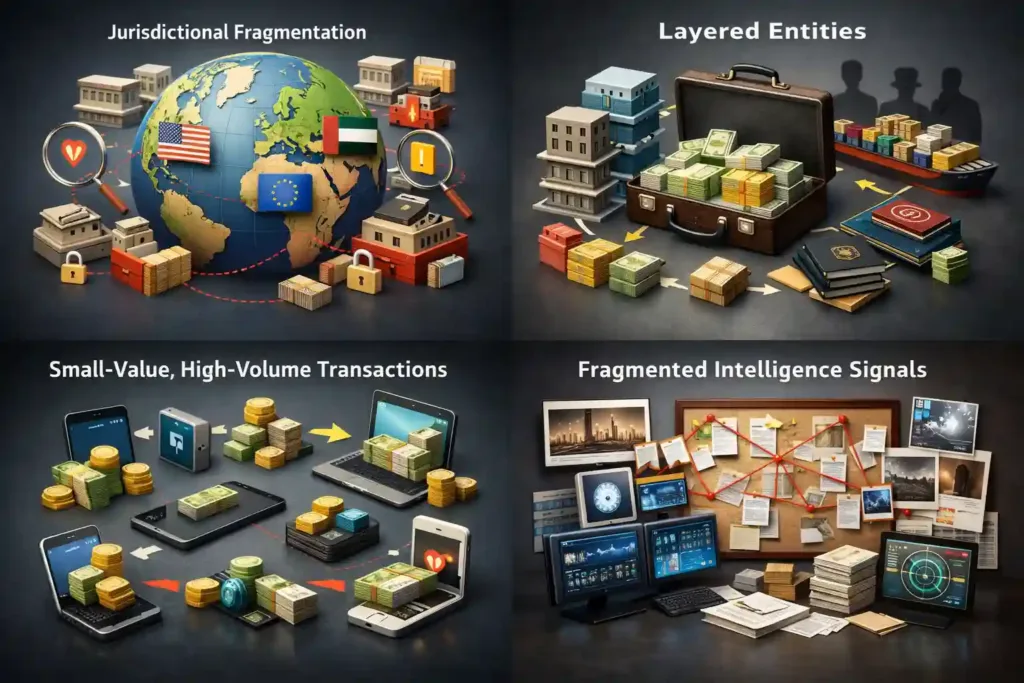
Detecting cross-border terror financing is not merely a technical challenge. It’s structural. The complexity arises from how funds move, how entities are layered, and how intelligence signals remain fragmented across systems.
Understanding these cross-border financial intelligence challenges is essential for designing effective counter-terror financing frameworks.
Jurisdictional Fragmentation
Funds often move across multiple countries in rapid succession. Each jurisdiction may have:
- Different reporting thresholds
- Different regulatory frameworks
- Distinct data retention policies
- Limited real-time data-sharing mechanisms
Information silos slow coordination between agencies. Cross-border requests for data may face procedural delays, creating blind spots in network visibility.
When financial flows cross jurisdictions faster than intelligence exchange, detection becomes reactive rather than proactive.
Use of Layered Entities
Terror financing networks frequently rely on structured layering mechanisms to obscure relationships. These may include:
- Shell companies with minimal physical presence
- Proxy directors and nominee shareholders
- Informal value transfer systems
- Trade-based money movement through manipulated invoices
Detecting terror financing networks under such structures requires identifying relationships between entities, not just suspicious transactions.
Without network-level analysis, layered ownership chains can remain concealed behind legally registered fronts.
Small-Value, High-Volume Transactions
Unlike large-scale financial fraud, terror financing may operate through distributed models. This includes:
- Structuring transactions below reporting thresholds
- Multiple low-value transfers across accounts
- Digital wallets and cross-platform payment ecosystems
- Micro-donations aggregated over time
Individually, these transactions may not trigger significant alerts. Collectively, they can sustain operational funding.
This is where AI for counter-terror financing becomes critical, identifying patterns across time, entities, and jurisdictions rather than relying solely on static thresholds.
Fragmented Intelligence Signals
Financial intelligence rarely exists in isolation. Risk indicators may appear across:
- Suspicious transaction reports
- Corporate registries
- Sanctions lists
- Media reports
- Social media platforms
- Trade documentation
Yet these signals often remain disconnected. Financial alerts, OSINT signals, and geopolitical indicators may reside in separate systems managed by different units.
The result: Monitoring systems detect anomalies. They do not always reveal networks.
Without structured intelligence fusion, fragmented signals fail to form a coherent threat picture, limiting the ability of FIUs and national security agencies to detect and disrupt cross-border terror financing ecosystems.
What Is OSINT in Counter-Terror Financing?

Open-Source Intelligence (OSINT) in counter-terror financing refers to the structured analysis of publicly available information, including corporate registries, sanctions databases, media reports, digital platforms, trade records, and public filings, to identify risk indicators, hidden financial relationships, and cross-border network signals linked to terror financing activities.
OSINT is not covert surveillance. It does not involve hacking or classified interception. It:
- Uses publicly accessible data
- Operates within legal and regulatory frameworks
- Supports financial intelligence operations, it does not replace them
In counter-terror financing (CTF), OSINT strengthens visibility into entities, affiliations, narratives, and cross-border signals that may not appear within transactional monitoring systems alone.
Core OSINT Sources in Counter-Terror Financing Contexts
Effective OSINT for AML and counter-terror financing integrates multiple public intelligence sources, including:
Corporate & Beneficial Ownership Registries
- Company registration databases
- Director and shareholder filings
- Beneficial ownership disclosures
- Cross-border corporate linkages
These help identify shell entities, proxy directors, and layered ownership structures.
Sanctions Lists & Watchlists
- National and international sanctions databases
- Designated individual and entity lists
- Politically exposed persons (PEPs) databases
- Global compliance watchlists
Automated correlation enables early detection of indirect or alias-based associations.
Media & Investigative Reporting
- Newspaper archives
- Investigative journalism platforms
- Public investigative reports
- Regional media coverage
Media intelligence often provides contextual insights into financial irregularities and emerging network signals.
Social Media & Digital Platforms
- Public posts and associations
- Organizational affiliations
- Crowdfunding and digital donation campaigns
- Sentiment and narrative trends
Advanced OSINT platforms such as Innsight analyze surface web, deep web, and dark web signals, transforming scattered digital footprints into structured intelligence.
Surface Web & Search Engines
- Search engine indexed pages
- Web archives
- Public directories
- Government notices
These help validate entity claims and uncover inconsistencies.
Deep Web & Dark Web Intelligence
- Dark web aggregators
- Leaked databases
- Illicit trade forums
- Underground financial marketplaces
While remaining within lawful frameworks, structured analysis of dark web signals can identify early risk indicators and emerging financial networks.
Trade & Customs Databases
- Import-export records
- Shipping manifests
- Trade corridor activity
- Invoice discrepancies
Trade-based money movement often reveals geographic and structural patterns when correlated with financial intelligence.
Public Litigation & Court Records
- Legal filings
- Bankruptcy records
- Enforcement actions
- Cross-border dispute documentation
Litigation data can expose financial disputes, regulatory scrutiny, and repeated entity involvement.
RSS Feeds & Real-Time News Streams
- Multi-geography news monitoring
- Event-specific intelligence
- Emerging security developments
Real-time monitoring enables proactive situational awareness.
OSINT as an Intelligence Multiplier
OSINT for counter-terror financing does not replace financial transaction monitoring systems. Instead, it enriches them.
It helps answer critical questions:
- Who are the individuals behind an entity?
- Are there indirect associations with sanctioned groups?
- Is a charity linked to high-risk narratives?
- Do corporate records align with declared financial behavior?
- Are there geographic or digital signals that elevate risk?
When integrated into AI-driven platforms, OSINT becomes a structured layer within open-source intelligence financial crime detection frameworks.
It enables:
- Entity enrichment
- Relationship mapping
- Cross-border link identification
- Narrative and sentiment analysis
- Real-time risk alerting
Platforms like Innsight operationalize this capability by transforming vast volumes of surface web, deep web, dark web, social media, and news data into actionable intelligence dashboards, alerts, and structured profiles for intelligence agencies.
In cross-border terror financing tracking, OSINT acts as the connective tissue between financial signals and real-world entity behavior, strengthening the ability of FIUs and national security agencies to detect structured funding ecosystems before they escalate.
How OSINT Strengthens Cross-Border Terror Financing Detection

Cross-border terror financing is rarely exposed through financial data alone. Open-Source Intelligence (OSINT) acts as an enrichment layer, connecting financial anomalies to real-world entities, affiliations, and geographic signals.
When structured correctly, OSINT transforms suspicious transaction alerts into contextualized network intelligence.
Entity Enrichment
One of the most immediate benefits of OSINT in counter-terror financing is entity enrichment for AML investigations.
When a suspicious account or entity is flagged, OSINT enables investigators to enhance that profile with:
- Corporate affiliations across jurisdictions
- Directorship overlaps with other high-risk entities
- Known associates appearing in public records
- Sanction exposure or indirect linkages
Rather than analyzing a transaction in isolation, FIUs can evaluate the broader ecosystem surrounding an entity. Entity enrichment strengthens prioritization by answering not only what happened, but who is connected to whom.
Beneficial Ownership Discovery
Cross-border terror financing networks often rely on layered corporate structures to conceal ultimate beneficiaries.
Beneficial ownership analysis using AI enables:
- Layered ownership mapping across multiple entities
- Detection of proxy directors or nominee shareholders
- Identification of hidden shareholding patterns
- Cross-border corporate structure correlation
By combining corporate registry data with OSINT signals, agencies can trace structural ownership chains that may otherwise remain opaque. This visibility is essential in detecting financing networks operating behind legally registered fronts.
Sanctions & Watchlist Correlation
Sanctions compliance alone is not sufficient for counter-terror financing. What matters is structured correlation.
AI-driven sanctions screening supports:
- Automated matching against global sanctions lists
- Alias and transliteration detection
- Cross-jurisdictional risk scoring
- Identification of indirect or second-degree associations
Sanctioned individuals and entities may operate through intermediaries. Knowledge graph-based matching improves detection of indirect relationships that static name screening might miss.
In cross-border environments, contextual sanctions correlation becomes a critical risk signal amplifier.
Digital Footprint & Network Pattern Detection
Financial networks often leave digital traces in public domains. Structured OSINT analysis enables:
- Identification of public digital associations
- Organizational and ideological linkages
- Narrative patterns and affiliation signals
- Cross-border connection indicators
Advanced network analysis for terror financing leverages digital footprint signals to uncover relational structures that may not appear in transactional datasets.
When social, corporate, and financial signals are correlated, hidden associations become visible as network patterns rather than isolated anomalies.
Trade & Geographic Pattern Correlation
Cross-border terror financing may intersect with trade flows and geographic concentration patterns.
Through GIS analysis for financial intelligence, agencies can:
- Identify suspicious trade corridors
- Map geographic concentrations of high-risk entities
- Detect cross-border movement alignment with financial flows
- Generate risk heatmaps across jurisdictions
Geospatial overlays provide a strategic layer of visibility, enabling investigators to detect regional clusters and structural movement patterns that indicate coordinated activity.
The Role of AI & Knowledge Graph Analytics
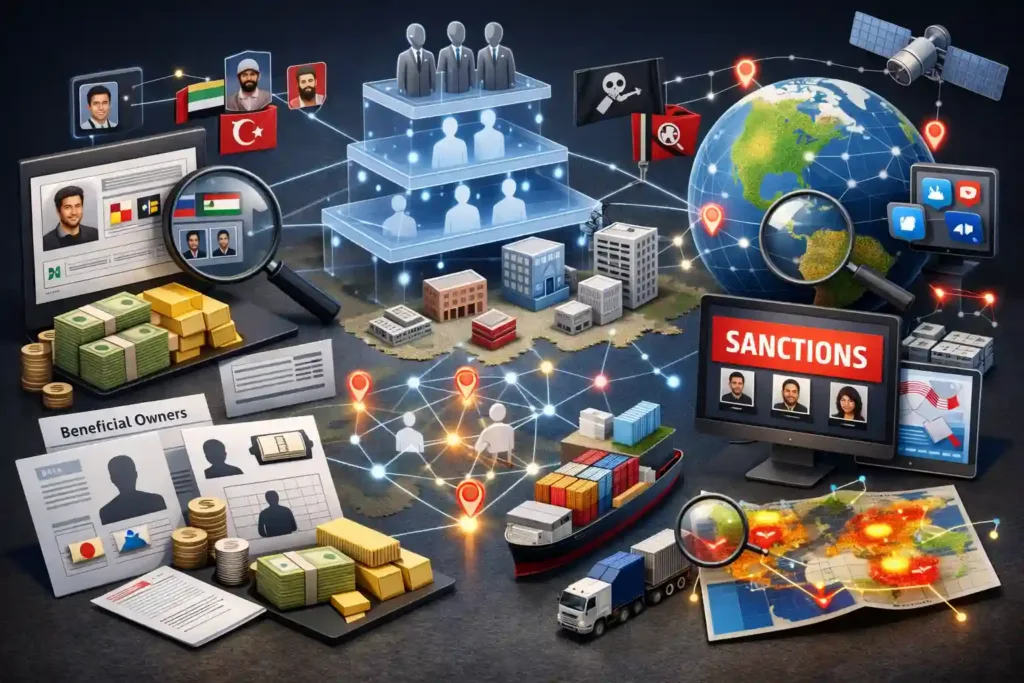
OSINT produces vast volumes of publicly available data. Financial systems generate equally large transactional datasets. On their own, these datasets remain fragmented. AI and knowledge graph analytics provide the fusion layer.
Modern AI-based terror financing detection frameworks enable:
- Entity resolution across datasets, identifying when two records across systems represent the same entity
- Cross-platform identity linking, correlating financial accounts, corporate registrations, digital signals, and geographic indicators
- Knowledge graph modeling, mapping complex relationships between entities, transactions, and locations
- Centrality detection, identifying high-influence nodes within financial networks
- Dynamic threat scoring, assigning contextual risk based on relational behavior
- Pattern modeling, detecting recurring structural behaviors across cases
Within a financial intelligence fusion platform, knowledge graph AML capabilities enable ecosystem-level detection, revealing how entities interconnect across borders and domains.
This shift from alert-based monitoring to AI-powered network modeling is foundational in modern counter-terror financing operations.
Conclusion: From Fragmented Monitoring to Intelligence-Led Counter-Terror Financing
Cross-border terror financing is adaptive, layered, and structurally networked. It does not rely on a single funding channel. It leverages jurisdictions, entities, digital platforms, and trade systems to obscure financial intent.
Traditional monitoring systems are designed to detect anomalies. Modern counter-terror financing (CTF) operations must detect ecosystems.
OSINT-based cross-border terror financing tracking enables Financial Intelligence Units (FIUs) and national security agencies to move beyond isolated suspicious transaction alerts. By integrating:
- Publicly available intelligence (OSINT)
- Financial transaction analytics
- Knowledge graph modeling
- AI-based threat scoring
- Cross-domain intelligence fusion
agencies gain the structured visibility required to detect hidden funding networks before they scale.
Platforms such as Innsight and Prophecy Eagle I, together enable an AI-powered financial intelligence fusion framework, connecting open-source signals, financial data, and network analytics into a unified operational view.
In cross-border environments, detection depends on integration. In modern CTF strategy, fusion is not an advantage, it’s a necessity.
Frequently Asked Questions (FAQs)
1. What is OSINT in counter-terror financing?
OSINT in counter-terror financing refers to the structured analysis of publicly available data, such as corporate registries, sanctions lists, media sources, and digital platforms, to identify risk indicators linked to terror financing networks.
2. How does OSINT support AML and CTF investigations?
OSINT enriches suspicious entities with contextual intelligence, such as ownership structures, sanctions exposure, digital affiliations, and cross-border associations, strengthening AML and CTF investigations.
3. Is OSINT legal to use in financial intelligence operations?
Yes. OSINT uses publicly accessible information and operates within legal and regulatory frameworks. It complements financial intelligence processes without replacing them.
4. What is AI-based terror financing detection?
AI-based terror financing detection uses machine learning, knowledge graph analytics, and dynamic risk scoring to identify structured financial networks rather than isolated suspicious transactions.
5. Why is cross-border terror financing difficult to detect?
It exploits jurisdictional fragmentation, layered corporate entities, small-value distributed transactions, and disconnected intelligence signals across systems.
6. What role do knowledge graphs play in counter-terror financing?
Knowledge graphs map relationships between entities, transactions, and geographic signals, enabling investigators to visualize hidden financial ecosystems.
7. How does intelligence fusion improve CTF operations?
Intelligence fusion integrates OSINT, financial data, geospatial analysis, and cross-case correlation to provide a unified network-level threat view.
8. What is a financial intelligence fusion platform?
A financial intelligence fusion platform integrates multi-source financial data, OSINT, AI-based risk scoring, and network analytics to strengthen AML and counter-terror financing enforcement.