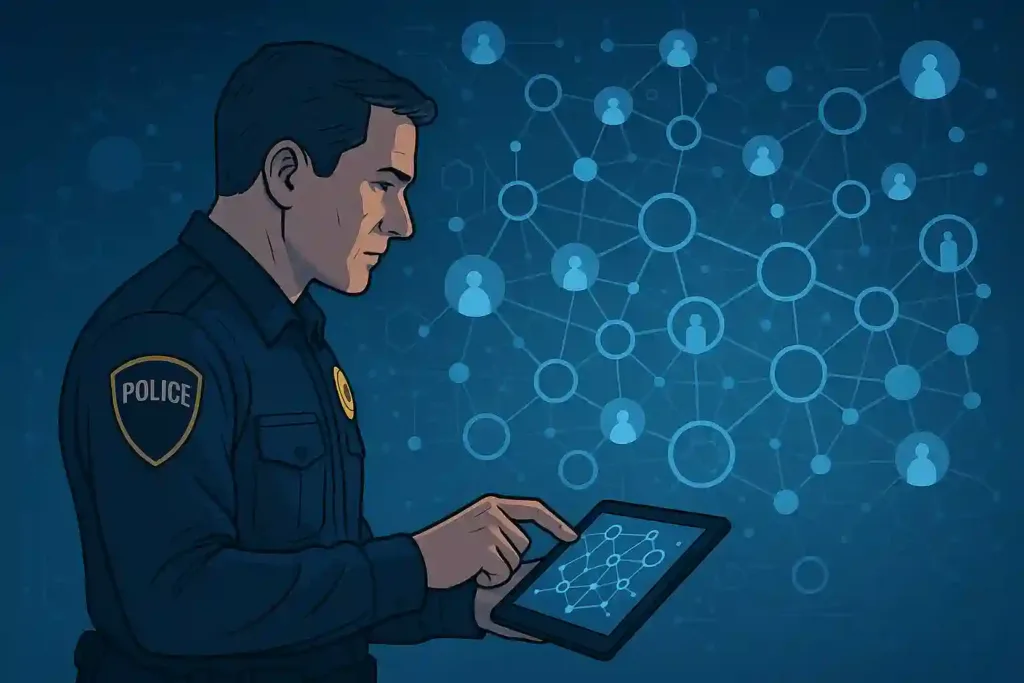
The Invisible Web Behind Crimes
Imagine a covert drug trafficking network operating across multiple cities. Each courier uses a different phone, bank account, and vehicle. No single lead reveals the full picture, and yet, every transaction, call, and movement leaves a trace.
Traditional investigative methods, relying on spreadsheets and siloed databases, are simply too slow to connect these dots. By the time links are uncovered, the network may have shifted, gone dark, or caused irreparable damage.
This is where modern policing faces its greatest challenge: the hidden connections between people, places, and events. Criminal networks thrive in complexity, exploiting the sheer scale of digital and physical interactions to stay ahead of law enforcement.

AI-driven link analysis changes the game. By ingesting and analysing vast amounts of structured and unstructured data, it can reveal relationships, patterns, and hierarchies that human analysts would miss or take weeks to discover.
AI-powered link analysis transforms raw, disconnected information into actionable intelligence, and does it in real time.
Key Takeaways
- Link analysis uncovers hidden networks
AI reveals connections between people, vehicles, accounts, and other entities that traditional methods often miss, providing a complete view of criminal activity. - Real-time AI enhances investigative speed and accuracy
Processing millions of records in real time, AI prioritizes leads, detects anomalies, and identifies indirect or subtle relationships. - Multi-source integration strengthens intelligence
Data from call records, financial transactions, open sources, law enforcement databases, and sensor feeds create a unified, actionable network. - Visual dashboards improve comprehension and actionability
Interactive network graphs, filters, and drill-downs help investigators quickly interpret complex networks and make informed decisions. - Predictive insights enable proactive policing
AI can simulate “what-if” scenarios, score network risk, and highlight emerging threats, supporting intelligence-led interventions before incidents occur. - Platforms like RapiDFIR empower law enforcement
Advanced tools integrate AI-powered link analysis, call data record processing, and multi-source intelligence to accelerate investigations and enhance situational awareness.
What is Link Analysis in the Context of Police Investigations?
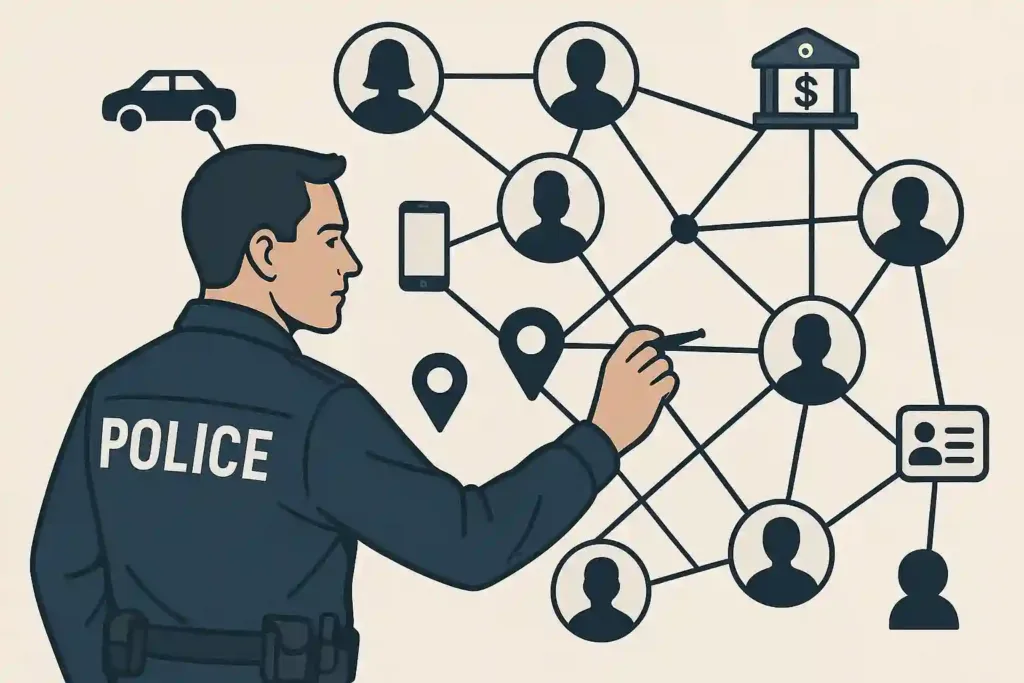
Link analysis is the systematic process of mapping entities, such as people, phone numbers, vehicles, bank accounts, social media profiles, or even geolocations, and the relationships between them.
Think of it as turning a list of names, calls, or transactions into a living network graph, where connections reveal more than isolated data points ever could.
In its simplest form, link analysis might look like a diagram built manually by investigators, showing who called whom or which bank account received which funds. But today’s investigations demand far more than static visuals.
AI-powered link analysis takes the concept further by automatically discovering hidden connections, weighting the strength of relationships, spotting anomalies, and predicting how networks might evolve over time.
This capability sits at the heart of intelligence-led policing. Modern investigative teams no longer want only to react to crimes after the fact; they want to uncover patterns, identify high-value targets, and prevent incidents before they occur.
Whether it’s identifying the mastermind behind a drug syndicate, mapping the movement of terror financiers, or tracking cross-border human trafficking rings, AI-enhanced link analysis gives investigators a powerful way to combine multiple data sources into a single, actionable view.
How AI Transforms Link Analysis for Law Enforcement
Traditional link analysis often struggles under the weight of modern investigative data. Investigators face enormous volumes of call records, financial transactions, vehicle movements, and social media interactions, far beyond what a human team can process efficiently.
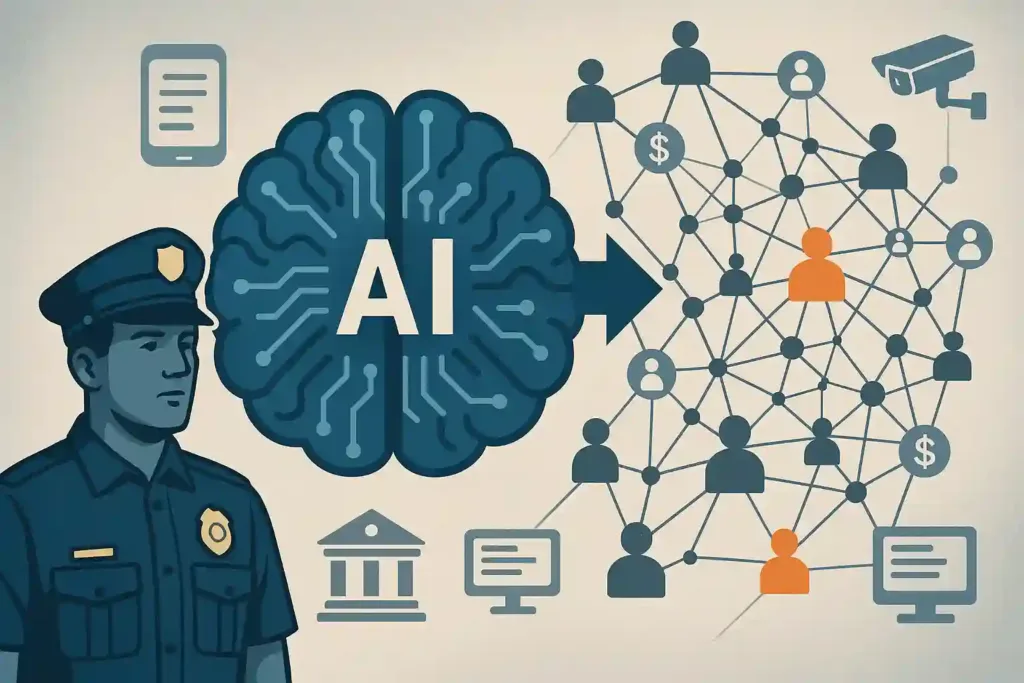
This is where AI steps in, transforming link analysis into a scalable, faster, and more intelligent tool for law enforcement.
Key-ways AI enhances link analysis:
- Scale: AI can process millions of call data records, bank transactions, and social media nodes simultaneously, linking entities across time and geography without manual bottlenecks.
- Speed: Real-time prioritization of leads means investigators can act on the most critical patterns immediately, reducing the lag between detection and intervention.
- Smarter Insights: AI doesn’t just map direct connections. It identifies indirect relationships, temporal trends, and hidden hierarchies within networks, often exposing orchestrators or key facilitators that humans might overlook.
- Predictive Capability: Modern systems can assign risk scores to network nodes, simulate “what-if” scenarios, and forecast potential criminal activity or escalation points. This enables proactive interventions rather than reactive investigations.
- Integrated Intelligence: By fusing data from multiple sources; call records, financial systems, CCTV, and OSINT, AI creates a holistic view of criminal networks, turning disparate datasets into actionable intelligence.
Impact on law enforcement:
- Faster investigation timelines.
- Reduced manual effort in sifting through records.
- Improved situational awareness and resource allocation.
- Higher likelihood of pre-empting complex crimes or disrupting organized networks.
Core Data Sources Feeding Link Analysis
AI-powered link analysis thrives on diverse, multi-format datasets that traditional methods often struggle to integrate. By combining telecommunication, financial, open-source, and sensor data, investigators gain a 360° view of networks and interactions.
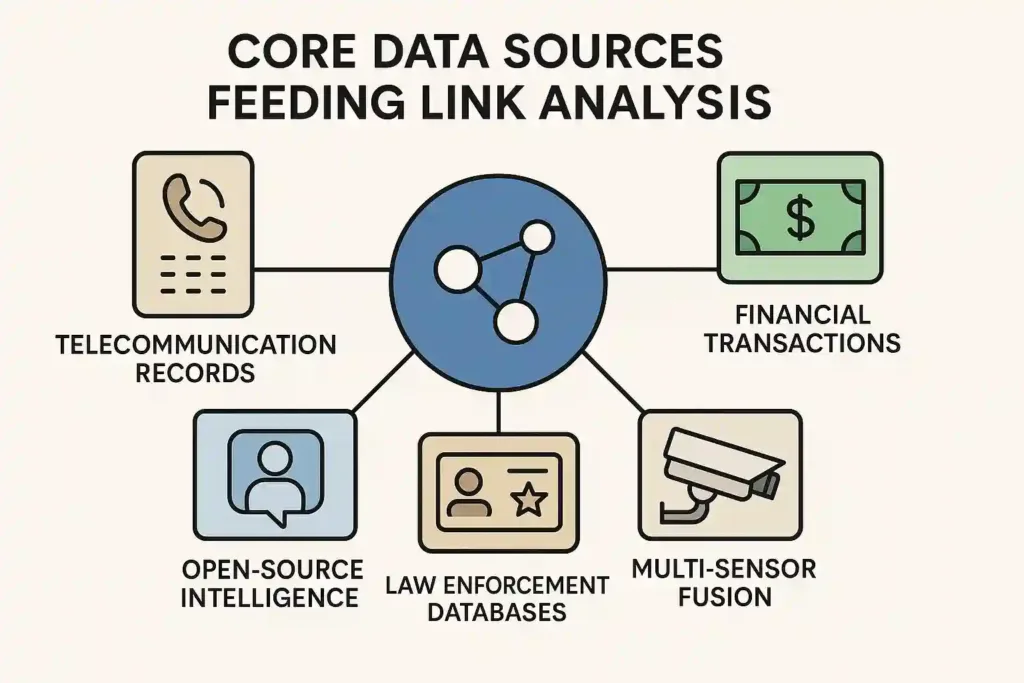
Key data sources:
- Telecommunication Records: Call data records, SMS metadata, and messaging app logs provide the backbone for mapping connections between suspects. AI can identify patterns such as frequent contacts, unusual calling times, or indirect relationships across multiple networks.
- Financial Transactions: Bank accounts, digital wallets, GST filings, and other transaction records allow investigators to trace money flow. AI uncovers hidden financial links, detects suspicious transfers, and flags anomalies that indicate criminal collaboration.
- Open-Source Intelligence (OSINT): Social media profiles, public forums, and online postings offer insights into affiliations, intentions, or emerging threats. AI tools can analyze sentiment, detect coordinated activity, and integrate these insights into the overall network.
- Law Enforcement Databases: Vehicle registrations, criminal histories, immigration records, and other official databases provide verified entity information. Integrating these ensures that links are anchored to accurate identities.
- Multi-Sensor Fusion: CCTV feeds, facial recognition outputs, and vehicle recognition data act as additional nodes. When combined with CDRs or financial data, they provide context-rich evidence of movements, interactions, and associations.
Impact: By feeding these varied sources into AI-powered link analysis, law enforcement can visualize hidden networks, prioritize high-risk connections, and respond proactively to complex criminal activities.
Techniques & Technologies Behind AI-Driven Link Analysis
AI-powered link analysis combines advanced computational techniques with domain-specific intelligence to reveal hidden networks and relationships. Modern law enforcement relies on a suite of technologies that transform raw data into actionable insights.
Graph Databases & Network Science
At the core of link analysis are graph databases, which model entities (people, vehicles, accounts) as nodes and their relationships as edges. Network science algorithms calculate centrality, detect clusters, and identify key influencers or brokers in criminal networks. This enables investigators to see beyond linear connections and uncover indirect or hidden relationships.
Machine Learning Models
Supervised and unsupervised machine learning models enhance link analysis by detecting anomalies, predicting potential threats, and clustering suspicious nodes. AI can prioritize high-risk links, highlight unusual communication patterns, and even simulate potential network disruptions to support proactive interventions.
Temporal & Geospatial Analysis
Time and location are critical dimensions in investigations. Temporal analysis tracks sequences of interactions, call patterns, and recurring events, while geospatial analysis maps movements and convergence points. Combining these insights helps law enforcement anticipate encounters, hotspots, and coordinated activity across regions.
Natural Language Processing (NLP)
Unstructured data from emails, chat logs, social media, and open-source intelligence contains valuable relational information. NLP techniques extract entities (names, organizations, locations), detect sentiment, and identify contextual connections. This ensures that textual data becomes an integral part of the network map rather than being siloed.
Visual Analytics Dashboards
Interactive dashboards turn complex networks into visual maps that investigators can explore intuitively. Features like dynamic node highlighting, filtering by relationship type, and drill-downs into sub-networks allow teams to investigate efficiently, share intelligence securely, and communicate findings effectively.
Impact: By combining these techniques, AI-driven link analysis transforms fragmented and overwhelming datasets into cohesive, actionable intelligence. Law enforcement can uncover hidden hierarchies, identify high-risk individuals, and optimize investigative resources.
To Conclude
AI-driven link analysis is revolutionizing the way law enforcement approaches investigations. Traditional methods, spreadsheets, siloed databases, and manual charting, simply cannot keep pace with the scale and complexity of modern criminal networks. With AI, agencies can process millions of records, uncover hidden hierarchies, and prioritize actionable leads in real time.
From telecommunication metadata and financial transactions to open-source intelligence and multi-sensor surveillance, AI-powered link analysis fuses diverse data sources into an integrated, visualized network. Investigators can detect anomalies, predict potential threats, and simulate “what-if” scenarios to guide proactive interventions.
For agencies seeking operational efficiency, faster investigative outcomes, and better situational awareness, Innefu Labs’ RapiDFIR platform offers a robust solution for AI-driven link analysis, call data record processing, and multi-source intelligence integration.
FAQs – Frequently Asked Questions
- What is link analysis in police investigations?
Link analysis maps entities (people, vehicles, accounts) and their relationships to uncover hidden connections in criminal networks. - How does AI improve traditional link analysis?
AI scales to millions of records, detects indirect links, performs anomaly detection, and provides predictive insights in real time. - What types of data feed into link analysis?
Telecom records, financial transactions, open-source intelligence, law enforcement databases, and multi-sensor surveillance feeds. - Can link analysis predict criminal activity?
Yes. AI models can score network risk, identify emerging threats, and simulate scenarios for proactive policing. - How do visual dashboards help investigators?
Dashboards display interactive network maps, enable filtering and drill-downs, and allow secure sharing of insights for faster decision-making.