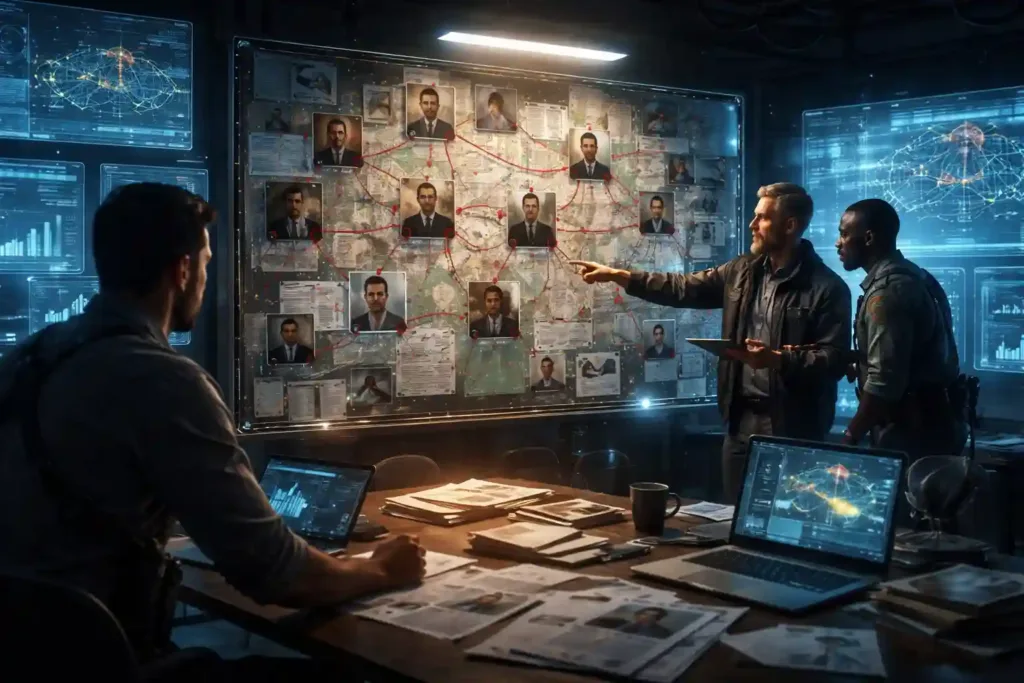
Criminal Networks Rarely Reveal Themselves Directly
In most investigations, interrogations are conducted with a clear and practical objective: establish the role of the individual sitting across the table.
Who were they?
What did they do?
Who helped them?
The focus is necessary, but it comes with a limitation.
Criminal networks are rarely exposed in a single interrogation because they are not designed to be visible end-to-end. Organised crime survives by fragmentation. Tasks are distributed. Roles are compartmentalised. Individuals know only what they need to know.
As a result, interrogations tend to surface people, not networks.
The immediate case may move forward. Charges may be framed. But the larger structure, the facilitators, coordinators, and enablers, remains largely untouched.
This is where interrogation reports hold untapped value.
While suspects may not describe networks explicitly, they leave behind traces: repeated names, recurring locations, indirect references, and operational details that only make sense when viewed together.
Interrogation reports often contain the clearest human signals of network activity, not because suspects confess to them, but because networks are implied through consistency, repetition, and context.
The challenge is not access to this information. It is how it is analysed after the interrogation ends.
Key Takeaways
- Criminal networks rarely reveal themselves in a single interrogation.
- Interrogation reports contain implicit intelligence about relationships, roles, and structures.
- Analysing interrogation reports collectively exposes hidden network patterns.
- Interrogation intelligence strengthens link analysis and crime pattern analysis.
- Treating interrogation data as intelligence enables strategic network disruption.
Why Criminal Networks Stay Hidden in Traditional Investigations
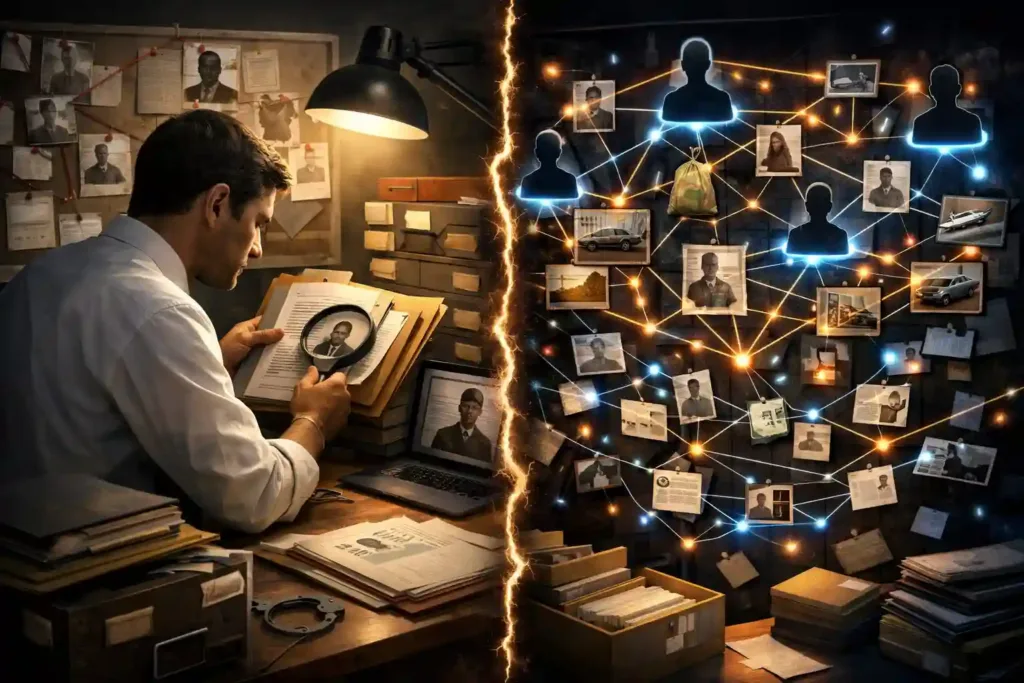
The difficulty in uncovering criminal networks does not stem from investigative effort. It stems from structural constraints within traditional investigation workflows.
The Individual-Suspect Lens
Most investigations are structured around clear procedural units:
- One FIR
- One primary suspect or group
- One defined case outcome
This structure is legally necessary and operationally efficient. But it also creates invisible boundaries.
Each case is treated as a self-contained unit. Interrogation reports are evaluated for their relevance to that FIR. Anything outside the immediate scope is noted, but rarely explored further.
Network behaviour, by its nature, spans:
- Multiple cases
- Multiple time periods
- Multiple jurisdictions
When analysis remains confined within case boundaries, network-level intelligence is masked, even when it appears repeatedly across interrogations.
Fragmented Interrogation Records
Interrogation reports are typically stored as:
- PDFs
- Case file attachments
- Physical dossiers
Each report exists as a standalone document. There is no systematic way to view interrogations collectively across cases.
No easy mechanism to ask:
- Where else has this name appeared?
- How often has this location been referenced?
- Which intermediaries recur across unrelated cases?
As a result, valuable connections remain distributed across hundreds or thousands of files, visible only if someone knows exactly where to look.
This fragmentation does not reflect lack of diligence. It reflects how interrogation data has historically been stored and accessed.
Over-reliance on Human Memory
In the absence of structured cross-case analysis, investigators rely heavily on memory.
Officers remember:
- Interrogations they personally conducted
- Names that stood out in recent cases
- Patterns they encountered firsthand
But no individual can retain organisational-level memory over years, transfers, or case volume.
As teams rotate and cases close:
- Context is lost
- Prior linkages fade
- Networks quietly reappear under new identities
This is not a human failing. It is a systemic gap. Without a way to preserve and connect interrogation insights over time, criminal networks benefit from organisational amnesia.
What Interrogation Reports Actually Contain (That Networks Depend On)

Interrogation reports are often read as narratives. In reality, they are dense intelligence documents. Beyond direct admissions, they contain the raw material networks depend on to function.
This includes:
Names That Never Appear as Accused
Facilitators, intermediaries, handlers, financiers, individuals mentioned casually, often repeatedly, but rarely placed in the foreground.
Locations Used Repeatedly
Meeting points, transit routes, safe houses, drop locations, places that recur across interrogations even when cases are unrelated.
Communication Patterns and Intermediaries
Who passed instructions, who connected whom, who never appeared directly but coordinated activity.
Financial, Logistical, and Operational References
How resources were arranged, funds moved, tools procured, or access enabled.
Indirect Mentions and Contextual Clues
Half-references, assumptions, and phrases that seem insignificant in isolation but gain meaning when repeated elsewhere.
Criminal networks rarely confess their structure. They imply it. They reveal themselves not through declarations, but through consistency across interrogations. When interrogation reports are analysed collectively, rather than individually, these implications form patterns. And those patterns reveal the network.
From Isolated Statements to Network Signals

Most interrogation reports are read the way they are stored, one at a time. An investigator reads a statement, extracts what is relevant to the case, and moves on. The report serves its immediate purpose and is then archived.
This approach is efficient for case progression. It is ineffective for network discovery.
Why Reading Reports One-by-One Fails
Criminal networks do not reveal themselves in single documents. When interrogation reports are analysed in isolation:
- Connections between people remain invisible
- Repetition across cases goes unnoticed
- Escalation patterns fail to register
A name mentioned once seems insignificant. A location referenced in one case feels incidental. A method described in passing appears routine. Individually, these details lack weight. Collectively, they often form the backbone of a network.
Reading reports one-by-one keeps investigations confined to case logic. Network logic requires a different lens, one that looks across interrogations, not just within them.
What Changes When Reports Are Analysed Collectively
When interrogation reports are viewed together, their meaning changes. Patterns begin to surface that are impossible to detect in isolation.
Recurring names start to appear, not as accused, but as connectors. Shared locations emerge across unrelated cases. Common facilitators show up repeatedly, often on the periphery.
Most importantly, roles begin to differentiate.
Some individuals appear frequently but never directly. Others surface briefly and disappear. A few recur across time, geography, and cases.
This is the point where interrogation reports stop being narratives and start becoming network signals.
How Interrogation Reports Reveal Network Structure
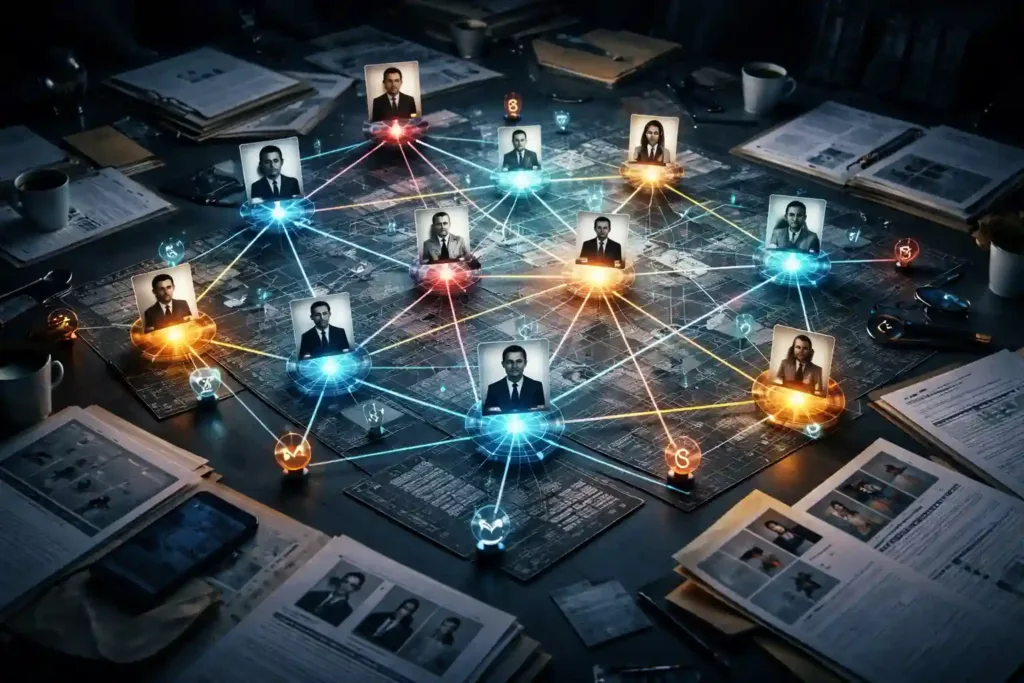
Criminal networks are structured for resilience. Interrogation reports, when analysed properly, expose that structure.
Identifying Network Roles
Across multiple interrogations, different types of actors begin to stand out.
Core operators
These are individuals repeatedly referenced across cases. They may appear directly or indirectly, but their presence is consistent.
Facilitators and financiers
Rarely interrogated themselves. Often mentioned in logistical or financial contexts. Their names recur quietly.
Overground workers
Individuals who bridge legal and illegal activity, arranging resources, access, or coordination.
Disposable intermediaries
Low-level actors who appear briefly, take risk, and disappear. Their short lifespan in interrogation data is itself a signal.
No single interrogation reveals these roles. Patterns across interrogations do.
Mapping Relationships Across Interrogations
Interrogation reports also reveal how relationships function inside networks. By comparing statements across cases, investigators can observe:
- Who consistently appears together
- Who is never mentioned directly but influences multiple actors
- Who is referenced indirectly through actions, locations, or instructions
Absence becomes as meaningful as presence. An individual who never appears as accused, never appears together with others, yet is repeatedly referenced, often occupies a strategic position.
Interrogation reports, analysed collectively, allow investigators to map these hidden relationships without relying on explicit confessions.
Separating Noise from Signal
Not every mention matters. Not every coincidence is a connection. One of the most important outcomes of collective analysis is the ability to distinguish:
- Casual mentions from recurring relevance
- One-off coincidence from structural pattern
A name mentioned once is noise. A name appearing across cases, contexts, and timeframes is signal. Interrogation reports provide volume. Patterns provide meaning.
Temporal and Spatial Clues Hidden in Interrogations
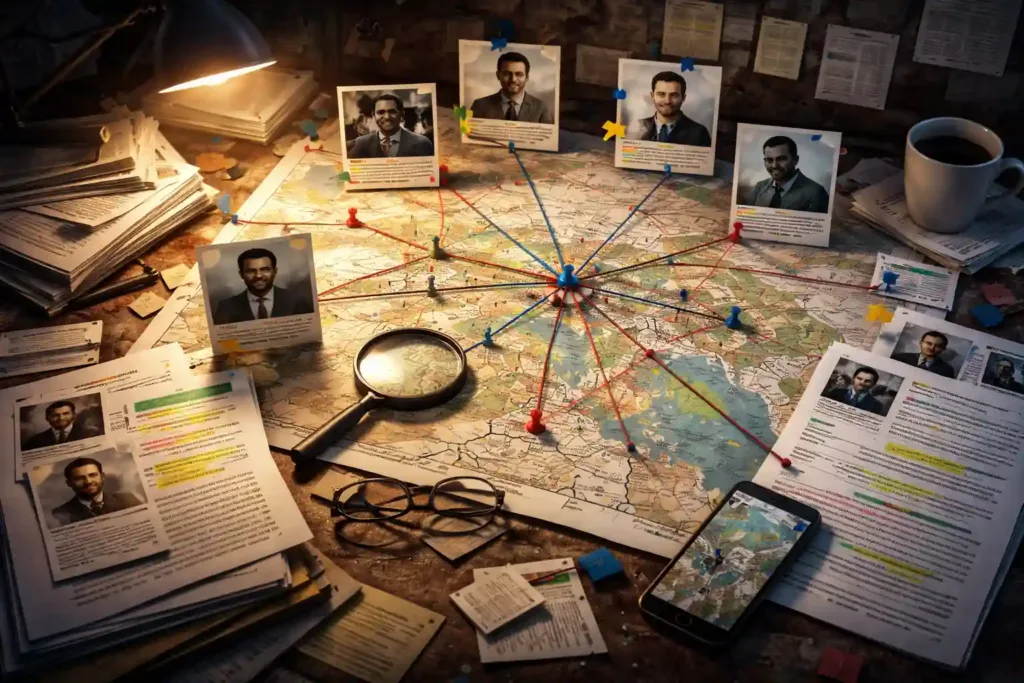
Networks do not operate in snapshots. They operate over time and space. Interrogation reports capture this movement, often unintentionally. Across multiple statements, timelines begin to align:
- Preparatory activity appears before execution
- Testing behaviour precedes escalation
- Certain actors surface early, others only later
Movement patterns also emerge:
- Repeated meeting points
- Familiar transit routes
- Geographic clustering around logistics or facilitation hubs
Viewed individually, these details feel anecdotal. Viewed together, they reveal how the network evolves. This is a critical distinction.
Criminal networks do not reveal themselves in one interview. They reveal themselves over time, through repetition, progression, and spatial consistency. Interrogation reports already contain these signals. The difference lies in whether they are read as isolated documents, or as pieces of a larger network puzzle.
Interrogation Reports as a Foundation for Link Analysis

Interrogation reports are often seen as narrative records. In reality, they are one of the richest sources of human intelligence available to law enforcement.
Every interrogation captures how individuals describe relationships, dependencies, instructions, and interactions, often unintentionally. These descriptions form the raw material for relationship mapping, even when suspects never explicitly describe a network.
When viewed collectively, interrogation reports reveal:
- Who interacts with whom
- Who influences decisions without appearing directly
- Which actors serve as connectors between otherwise separate cases
This makes interrogation data a natural foundation for link analysis.
Unlike transactional or technical data, interrogation intelligence reflects human behaviour, trust, delegation, avoidance, and hierarchy. It adds context that pure data sources often lack.
By strengthening link analysis with interrogation insights, agencies gain:
- Deeper understanding of how networks function internally
- Clearer separation between central actors and peripheral participants
- Stronger basis for identifying leverage points within criminal structures
The same applies to crime pattern analysis. Interrogation reports often explain why patterns exist, not just that they do. This contextual intelligence makes pattern detection more actionable and supports targeted network disruption strategies, rather than reactive enforcement.
From Network Visibility to Network Disruption

Visibility alone does not dismantle criminal networks. Disruption does. When interrogation reports reveal network structure, law enforcement can shift focus from individual arrests to strategic intervention.
This enables agencies to:
- Target facilitators instead of repeatedly arresting foot soldiers
- Disrupt logistics, funding channels, and coordination mechanisms
- Prioritise arrests and surveillance based on network impact, not just case strength
Removing low-level actors may close cases, but it rarely weakens the organisation. Disrupting coordination and enablement creates friction that networks struggle to recover from.
Over time, this approach reduces network regeneration, the ability of criminal groups to replace arrested members and resume activity.
Interrogation intelligence turns enforcement from episodic action into structural disruption.
The Strategic Importance of Interrogation Intelligence

Beyond individual operations, interrogation intelligence delivers long-term strategic value. For leadership, it:
- Supports long-running and complex investigations
- Preserves investigative context across team changes
- Prevents rediscovery of the same networks under new identities
Instead of relearning the same structures repeatedly, agencies accumulate institutional memory, a continuously evolving understanding of criminal ecosystems.
This enables intelligence-led policing at scale:
- Better prioritisation of threats
- More effective allocation of resources
- Stronger continuity across cases, timeframes, and jurisdictions
Interrogation intelligence ensures that knowledge gained through effort is retained, refined, and reused, not lost once a file is closed.
Conclusion: Networks Speak, If We Know How to Listen
Criminal networks rarely expose themselves directly. They do not confess their structure. They do not outline hierarchies. They do not announce coordination.
Yet, through interrogation reports, they leave behind signals, repeated names, recurring locations, consistent roles, and shared context. The intelligence is already there.
The gap is not informational. It is analytical.
When interrogation reports are treated as collective intelligence rather than isolated documents, they reveal the networks behind the crimes, and provide law enforcement with the insight needed to disrupt them effectively.
Criminal networks rarely announce themselves, they reveal themselves through repetition, relationships, and context.
Frequently Asked Questions (FAQs)
- What are criminal networks in the context of interrogations?
Criminal networks are groups of individuals connected through roles, relationships, and shared operations that are often implied across multiple interrogations rather than explicitly stated. - How do interrogation reports reveal hidden criminal networks?
They contain recurring names, locations, roles, and behavioural patterns that, when analysed collectively, expose network structures and relationships. - Why don’t individual interrogations expose entire networks?
Because organised crime operates through fragmentation, where individuals know only limited details of the broader structure. - Are interrogation reports useful beyond individual cases?
Yes. When treated as intelligence, interrogation reports contribute to cross-case analysis, long-term investigations, and institutional memory. - How does interrogation intelligence support network disruption?
It helps identify facilitators, coordinators, and logistics enablers, enabling targeted interventions that weaken networks rather than just closing cases.