
From Sherlock Holmes to Crime Algorithms
For over a century, detectives have relied on sharp instincts, painstaking observation, and manual profiling to solve crimes. Think of Sherlock Holmes piecing together clues with deductive reasoning – brilliant, but limited by human capacity and the data available at the time.
Fast-forward to today, and the nature of crime has evolved dramatically. Offenders leave digital footprints across social media, financial transactions, and connected devices, while law enforcement agencies collect mountains of structured and unstructured data every day.
The result: a scale and complexity no single investigator, no matter how skilled, can process alone.
This is where crime algorithms come in. In simple terms, a crime algorithm is a machine learning system trained on historical crime data to identify patterns, highlight anomalies, and predict future risks.
Just as weather models forecast storms, these algorithms can forecast potential hotspots, high-risk behaviours, or connections between seemingly unrelated events. Instead of replacing human intuition, they augment it, giving officers and analysts a clearer, data-driven picture of what might happen next.

Law enforcement agencies worldwide are turning to these tools for three main reasons:
- Growing crime complexity: Offenders are more mobile, connected, and technologically enabled than ever before.
- Explosion of data: CCTV footage, call data records, financial transactions, open-source intelligence (OSINT), and digital evidence streams are growing exponentially.
- Pressure to act faster: Public expectations demand real-time responses, not weeks-long investigations.
This blog will unpack how crime algorithms actually work, from ingesting raw data to producing actionable insights. We’ll explore their benefits, the challenges they bring, and why explainability and responsible AI matter more than ever in policing.
By the end, you’ll see how machines are reshaping crime-fighting, not as replacements for human expertise, but as powerful partners in building safer societies.
Key Takeaways
- Crime algorithms = AI models trained on historical crime data to predict risks, hotspots, and offender behavior.
- Machine learning process: ingest data, extract features, train models, deliver risk scores or alerts.
- Benefits for policing: faster trend detection, better resource allocation, uncovering hidden criminal networks, and stronger data-driven leads.
- Responsible AI matters: explainability, transparency, and human oversight are essential to maintain trust and fairness.
- Future outlook: multi-modal, real-time, and context-aware crime prediction that partners human expertise with machine intelligence.
What is a Crime Algorithm?
At its core, a crime algorithm is an AI model that learns from past crime data to help predict what might happen next. It looks at historical incidents, behavioural indicators, and contextual variables, such as time of day, location, or offender networks, to calculate the likelihood of future crimes or offender activity.

Think of it as an advanced crime map powered by mathematics and machine learning, rather than pins and paper.
Traditionally, crime analysis involved analysts poring over case files, compiling reports, and manually comparing incidents. This approach worked when data volumes were small, but today’s reality, millions of data points from CCTV footage, call records, financial trails, and open-source intelligence, makes manual analysis slow and often incomplete.
Crime algorithms automate much of this legwork, scanning vast datasets in seconds to spot subtle connections humans might miss.
A useful analogy is healthcare. Just as doctors use a patient’s medical history, lab results, and lifestyle data to predict disease risk, a crime algorithm uses historical crime records, behavioural signals, and environmental factors to forecast potential threats. Both aim to catch problems early and allocate resources where they’re needed most.
Some common applications of crime algorithms include:
- Predictive policing: Identifying crime hotspots before incidents occur, enabling better patrol planning.
- Criminal profiling: Highlighting patterns of behaviour or risk factors associated with repeat offenders.
- Hotspot detection: Mapping clusters of related incidents (e.g., burglaries, fraud, or cybercrime) to understand emerging trends.
In essence, crime algorithms act as a force multiplier. They don’t replace investigators but provide an extra layer of intelligence, helping law enforcement shift from reactive to proactive strategies.
How Machines Learn to Predict Offender Behaviour
If you’ve ever wondered how a machine “learns” to forecast crime, think of it like teaching a new detective – only this detective can memorize millions of cases and crunch data at lightning speed. Crime algorithms follow a structured learning process, transforming raw data into actionable intelligence.
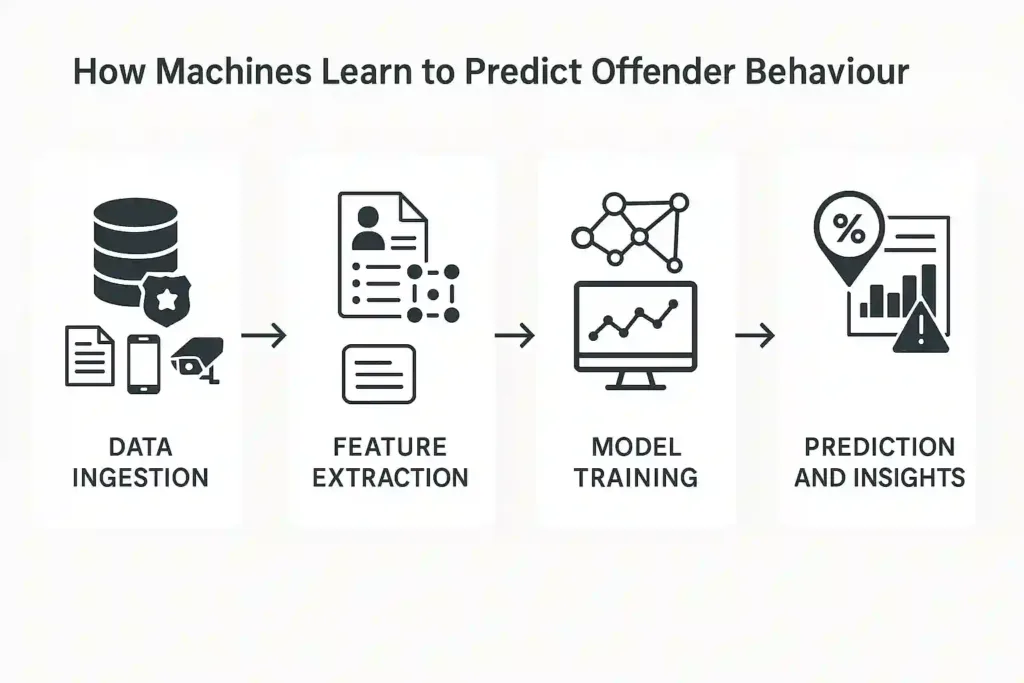
Here’s how it typically works:
Data Ingestion
It starts with pulling together data from multiple sources, police reports, call data records (CDRs), social media OSINT, surveillance footage, financial transactions, and other digital evidence streams. Each dataset adds another piece to the puzzle.
Feature Extraction
Next, the system identifies patterns and attributes that matter:
- Time of day or week when crimes occur
- Location clusters and hotspots
- Offender networks and known associates
- Modus operandi (tactics, tools, behaviours)
By extracting these features, the algorithm converts unstructured information into structured, analyzable inputs.
Model Training
With features in place, the system begins “learning.” Two main methods are common:
- Supervised learning: The model is trained on labeled past incidents (e.g., known crimes) to predict future events.
- Unsupervised learning: The model looks for hidden clusters or anomalies without prior labels, revealing patterns humans might never have spotted.
Over time, the algorithm fine-tunes itself, becoming better at spotting emerging trends or high-risk behaviors.
Prediction and Insights
Finally, the trained model produces outputs such as:
- Probabilities of certain crimes occurring in specific areas
- Risk scores for potential offenders or networks
- Alerts for emerging hotspots or suspicious patterns
This predictive layer helps law enforcement shift resources intelligently, from reactive patrols to preemptive intervention.
Benefits of Crime Algorithms in Policing
Crime algorithms aren’t just a high-tech novelty, they’re transforming how agencies plan, investigate, and prevent crime. By turning massive data streams into actionable intelligence, these systems give law enforcement a sharper, faster edge.

Faster Detection of Emerging Crime Trends
Instead of waiting weeks for analysts to uncover patterns, machine learning models flag unusual spikes or evolving typologies in near real time. This can help police get ahead of organized retail thefts, online fraud schemes, or coordinated street crimes before they peak.
Enhanced Resource Allocation
By identifying hotspots and high-risk windows, crime algorithms guide patrols to the right place at the right time. This data-driven deployment maximizes limited personnel and equipment, ensuring response efforts match actual risk rather than assumptions.
Identifying Hidden Criminal Networks
Sophisticated algorithms can link seemingly unrelated cases, suspects, or locations – revealing networks that might otherwise remain invisible. For example, analyzing shared phone numbers, financial trails, or geospatial overlaps can expose coordinated criminal activity.
Supporting Investigators with Data-Driven Leads
Rather than starting from scratch, investigators receive prioritized leads or high-probability scenarios. This accelerates case-building and improves clearance rates while freeing up skilled staff for deeper analysis and fieldwork.
Real-World Impact
Around the world, agencies using ML-based tools have reported measurable improvements. For instance, some U.S. cities piloting predictive policing platforms documented reductions in burglaries and auto thefts in designated areas. In Europe, network analysis tools have helped dismantle organized crime groups by revealing cross-border connections invisible to traditional methods.
When combined with sound investigative judgment, these benefits translate to more proactive policing, faster interventions, and ultimately, safer communities.
Conclusion
Crime algorithms represent the next leap in law enforcement’s ability to anticipate and prevent crime. By analyzing massive, complex datasets in real time, they uncover hidden patterns, forecast risks, and empower agencies to act proactively rather than reactively.
Yet their true power lies not in replacing human judgment but in augmenting it, offering officers, analysts, and policy makers deeper insight while preserving the principles of fairness, transparency, and accountability.
As machine learning evolves, responsible and explainable AI will remain the foundation for trustworthy crime prediction and safer communities.
FAQs – Frequently Asked Questions
Q1. What is a crime algorithm?
A crime algorithm is a machine learning system that analyzes historical crime data, behavioral indicators, and contextual factors to predict risks, hotspots, or offender activity. It helps law enforcement make proactive, data-driven decisions.
Q2. How does machine learning help policing?
Machine learning accelerates pattern recognition, connects disparate data sources, and provides risk scores or alerts, enabling faster response times and more efficient resource allocation in policing.
Q3. Are crime algorithms accurate?
Accuracy depends on data quality, model design, and ongoing validation. Well-designed systems can improve trend detection and forecasting, but human oversight is essential to interpret outputs correctly.
Q4. What are the benefits of predictive policing with crime algorithms?
Key benefits include faster detection of emerging crime trends, enhanced patrol planning, identifying hidden networks, and supporting investigators with data-driven leads.
Q5. Why is explainable AI important in crime prediction?
Explainability ensures officers understand why a system flagged a suspect, location, or pattern. Transparent AI builds trust, reduces bias, and allows responsible decision-making.
Q6. How do crime algorithms protect privacy?
Responsible AI frameworks and strict data governance policies ensure that sensitive information is anonymized, access-controlled, and used only for legitimate investigative purposes.