
The Urban Crime Complexity Problem
Tier-1 cities such as Mumbai, Delhi, Bengaluru, and Hyderabad are not just population centers, they are economic engines, migration hubs, transportation nodes, and high-density digital ecosystems.
With rapid urban expansion comes complexity:
- Millions of daily movements
- High crime reporting volumes
- Inter-state migration
- Organized crime adaptation
- Digitally connected offenders
Police leadership in these cities operate in a high-pressure environment where jurisdiction expands faster than resources. Patrol units remain finite. Investigation teams are stretched. Yet expectations from citizens, judiciary, and media continue to rise.
At the same time, urban policing is now data-heavy:
- Call Detail Records (CDRs)
- CCTV feeds across public and private infrastructure
- Financial transaction trails
- Social media signals
- Interrogation reports and intelligence inputs
The problem is no longer a lack of data, it is the ability to interpret and operationalize it in time.
Traditional policing models are largely reactive. They respond after an incident occurs, analyze patterns retrospectively, and deploy resources based on historical trends. While effective in many contexts, this model struggles in fast-moving urban crime ecosystems where escalation can occur within hours.
This is where predictive policing represents a structural evolution.
Predictive policing is a data-driven policing approach that uses historical crime data, behavioral patterns, geospatial intelligence, and AI-based models to forecast potential crime risks before incidents escalate.
It builds on intelligence-led policing but moves a step further, from analyzing what has happened to anticipating what may happen.
This blog explores how predictive policing works, where it creates measurable impact in tier-1 cities, and how metropolitan police departments can implement it effectively.
Key Takeaways
- Urban Crime Is Pattern-Driven:Most city crimes follow identifiable spatial and temporal trends.
- Data Alone Is Not Intelligence:Integrated analytics arerequired to convert records into risk insights.
- Predictive Policing Enables Proactive Deployment:Patrols can beallocated based on risk instead of routine rotation.
- AI Augments, Not Replaces, Officers:Human judgmentremains central to operational decisions.
- Early Detection Reduces Escalation:Small recurring signals can prevent larger crime clusters.
- Resource Optimization Improves Efficiency:Targeted deployment reduces operational waste.
- Accountability Becomes Data-Backed:Leadership decisions are supported by measurable intelligence outputs.
- Tier-1 Cities Require Anticipatory Models:High-density urban environments demand forward-looking policing frameworks.
What is Predictive Policing?
Definition
Predictive policing is a data-driven approach that uses historical crime data, behavioral indicators, geospatial mapping, and AI models to forecast potential crime risks.
Instead of focusing solely on past incidents, predictive policing identifies patterns that indicate where crimes are likely to occur, which zones may require increased patrol presence, or where escalation risks are emerging.
It transforms crime analysis from retrospective reporting into forward-looking operational intelligence.
Learn more about predictive policing in detail.
How Predictive Policing Differs from Traditional Crime Analysis
Traditional crime analysis typically reviews incidents after they occur, producing reports that guide future decisions.
Predictive policing systems, in contrast, continuously analyze incoming and historical data to generate dynamic risk scores, hotspot forecasts, and early-warning indicators.
The shift is from documenting crime to anticipating crime.
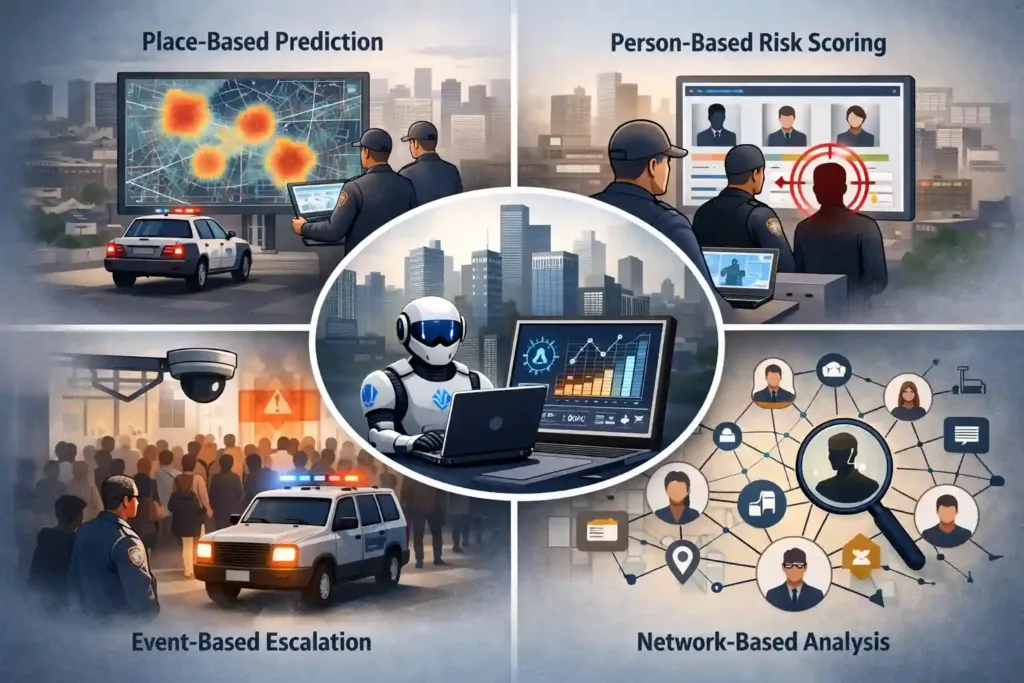
Types of Predictive Policing Models
Predictive policing systems can operate through multiple analytical models, depending on operational objectives:
Place-based Prediction (Hotspot Analysis)
Identifies geographic zones with a high probability of crime occurrence based on historical patterns, time-of-day trends, and environmental factors. Outputs typically include heatmaps and patrol allocation recommendations.
Person-based Risk Scoring
Assesses the likelihood of repeat offending or victimization using historical records,behavioral indicators, and network associations. Supports focused monitoring and intervention strategies.
Event-based Escalation Detection
Monitors real-time indicators to detect potential escalation scenarios, such as recurring incidents in a locality or rising tensions during public events.
Network-based Crime Linkage
Analyzesassociations between individuals, devices, financial transactions, and locations to identify hidden networks behind organized crime or repeat patterns.
Each model serves a distinct operational purpose but collectively contributes to proactive urban crime control.
Why Tier-1 Cities Need Predictive Policing

High Population Density & Crime Concentration
Tier-1 cities experience concentrated urban activity, commercial hubs, transport corridors, high-footfall markets, and densely populated residential zones.
This often leads to:
- Crime clustering in specific micro-locations
- Recurring incidents in predictable time windows
- Rapid escalation if early signals are ignored
Manual monitoring struggles to identify these patterns in real time. Predictive systems surface concentrated risks before they become visible through raw FIR volumes.
Resource Allocation Challenges
Urban police forces operate under structural constraints:
- Limited patrol vehicles and personnel
- Expanding city boundaries
- High call volumes in control rooms
- Manual beat allocation systems
Without risk-based prioritization, patrol deployment often relies on static planning or past averages.
Predictive policing introduces:
- Dynamic patrol allocation based on real-time risk
- Zone-based prioritization
- Evidence-backed deployment decisions
- Reduced randomness in resource utilization
This improves operational efficiency without necessarily increasing manpower.
Multi-Source Data Explosion
Urban investigations increasingly involve multi-format data:
- CCTV feeds from traffic systems, metro stations, commercial complexes
- CDRs linking suspects across geographies
- Financial transaction trails
- Social intelligence inputs
- Interrogation reports and case diaries
When these datasets remain siloed, insights remain fragmented.
Predictive policing platforms integrate structured and unstructured data to generate unified risk assessments. Instead of officers manually correlating multiple sources, AI models detect patterns across them.
Pressure for Faster Charge Sheets & Measurable Outcomes
Tier-1 cities face intense scrutiny from judiciary, media, and oversight bodies. Delayed investigations, repeat offenses, or visible crime spikes quickly attract attention.
Police leadership must demonstrate:
- Faster case resolution
- Reduced repeat crime
- Efficient resource utilization
- Data-backed accountability
Predictive policing contributes by:
- Identifying high-risk zones early
- Supporting focused intervention
- Reducing investigation blind spots
- Enhancing evidence-backed decision-making
In high-density urban ecosystems, reactive policing is increasingly insufficient. Tier-1 cities require anticipatory models that convert historical records and live data into actionable intelligence.
Predictive policing represents that operational shift, from response to readiness.
How Predictive Policing Works in a Tier-1 City (Step-by-Step Operational Flow)
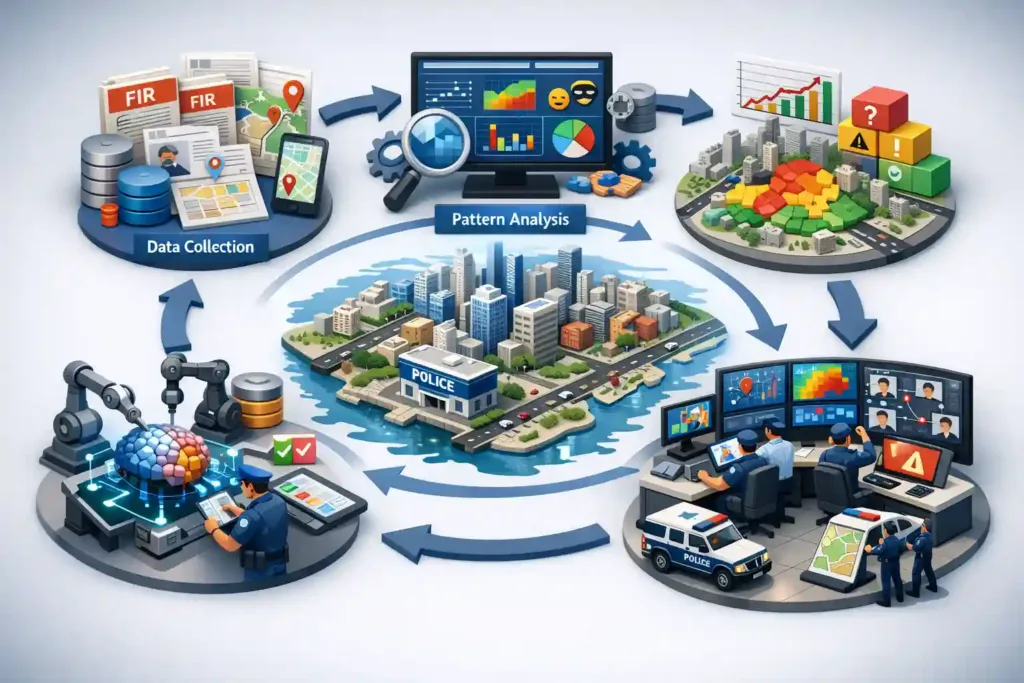
In a metropolitan environment like Mumbai, Delhi, or Bengaluru, predictive policing must operate at scale, across zones, crime categories, and data formats.
Below is a structured operational flow that senior police leadership can align with.
Step 1: Data Aggregation
The foundation of predictive policing is unified, multi-source data ingestion.
Typical data inputs include:
- FIR records (structured crime categories, timestamps, location codes)
- Historical crime data spanning multiple years
- Location data (beat maps, geo-coordinates, jurisdiction boundaries)
- Repeat offender history and prior case involvement
- Incident timelines across crime categories
The objective at this stage is not analysis, it’s consolidation. Instead of data residing in separate district systems or spreadsheets, predictive platforms aggregate and normalize it into a unified intelligence layer.
Step 2: Pattern Identification
Once data is aggregated, AI-driven analytics identify hidden and recurring patterns.
Key pattern categories include:
- Time-of-day patterns (e.g., late-night burglary spikes)
- Seasonal spikes (e.g., festive season theft increase)
- Festival/event correlations (large gatherings, political events, examinations)
- Neighborhood risk concentration (micro-hotspots within broader jurisdictions)
Unlike manual crime analysis, which often depends on periodic reviews, predictive systems continuously scan for anomalies and trend shifts.
Step 3: Risk Modelling
Pattern identification feeds into structured risk models.
Core analytical outputs include:
- Risk scoring of zones: Each locality receives a dynamic risk score based on historical density, current signals, and contextual indicators.
- Probability forecasting: Models estimate the likelihood of specific crime categories occurring within defined time windows.
- Escalation prediction: Repeated low-intensity incidents may indicate potential escalation into larger patterns. The system flags these clusters.
This stage transforms descriptive analysis into predictive intelligence.
Step 4: Operational Output
Predictive policing is not theoretical, it must directly influence deployment.
Actionable outputs typically include:
- Heatmaps showing high-risk micro-zones
- Patrol allocation recommendations based on dynamic risk levels
- Suspect linkage insights connecting repeat offenders across cases
- Early warning alerts for emerging escalation patterns
These outputs are designed for control rooms, zone DCPs, and operational supervisors, enabling risk-based resource allocation instead of uniform deployment.
Step 5: Continuous Learning
Urban crime ecosystems are dynamic. Predictive systems must adapt.
Continuous learning involves:
- Updating models based on new incidents
- Incorporating fresh FIR data and investigation outcomes
- Refining risk scoring based on field validation
- Establishing a feedback loop from field officers
When patrol officers confirm ground realities or investigation teams close cases, that intelligence feeds back into the system, improving model accuracy over time.
Use-Case Scenarios in Tier-1 Cities
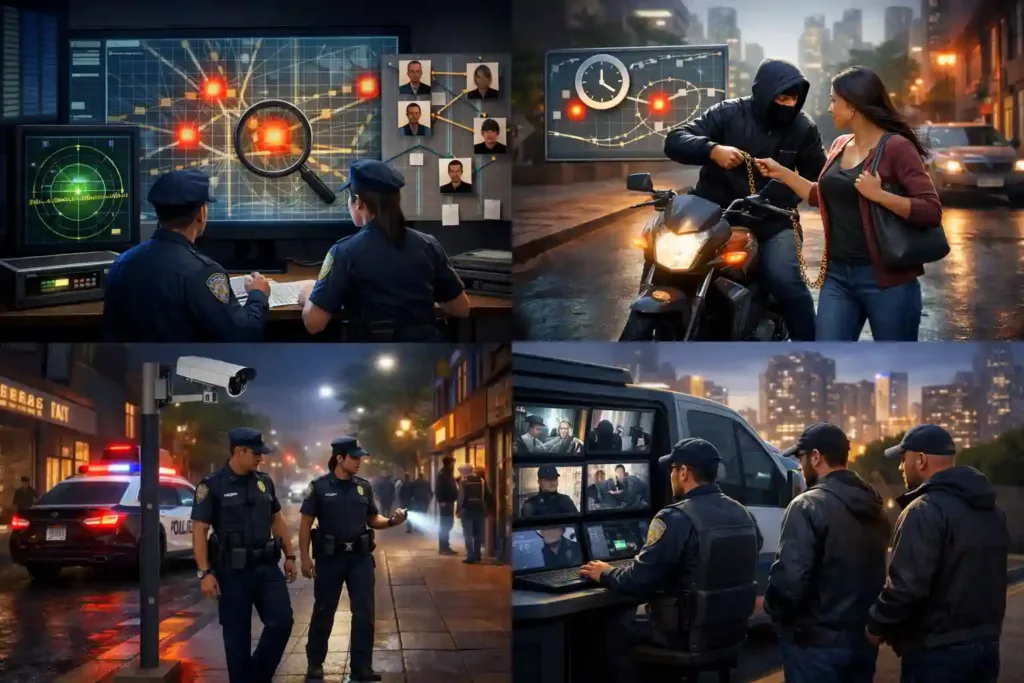
Concrete operational examples demonstrate how predictive policing transforms urban crime control.
Preventing Chain Snatching Clusters
Challenge: Chain snatching incidents appear sporadic but often follow repeat patterns in specific corridors or time bands.
Predictive Approach:
- Identify emerging hotspots based on micro-location data
- Detect repeat time windows
- Cross-reference repeat offender movement patterns
Operational Action:
- Deploy focused patrols in flagged zones
- Increase surveillance visibility in identified corridors
- Monitor linked suspects proactively
Impact: Reduction in recurrence within high-risk zones and deterrence through visible presence.
Organized Crime Network Detection
Challenge: Organized crime networks often operate across jurisdictions, using intermediaries and indirect associations.
Predictive Approach:
- Link suspects across multiple FIRs
- Identify shared phone numbers, financial links, or geolocation overlaps
- Detect hidden associations through network analysis
Operational Action:
- Prioritize high-risk network nodes
- Coordinate across district boundaries
- Support evidence-backed intervention
Impact: Disruption of networks rather than isolated arrests.
Crowd Risk Forecasting During Major Events
Challenge: Tier-1 cities host large public gatherings, religious festivals, political rallies, examinations, sports events.
Predictive Approach:
- Analyze historical event data
- Identify prior unrest zones
- Detect early tension indicators
Operational Action:
- Pre-position response teams
- Increase patrol density in flagged areas
- Coordinate with local intelligence units
Impact:
Reduced response time and minimized escalation risk.
Detecting Emerging Crime Patterns Before FIR Volume Spikes
Challenge: By the time FIR volumes visibly spike, patterns are already established.
Predictive Approach:
- Detect small but recurring incident clusters
- Flag anomalies in low-frequency categories
- Identify geographic diffusion trends
Operational Action:
- Initiate preventive patrolling
- Engage local intelligence sources
- Monitor high-risk individuals
Impact: Prevention of large-scale crime clusters.
Measurable Impact on Urban Crime Control

For senior leadership, predictive policing must translate into tangible outcomes. While impact varies by implementation maturity, typical measurable benefits include:
- Reduction in repeat offenses: Focused intervention in high-risk zones lowers recurrence rates.
- Faster investigation timelines: Linked data reduces manual correlation time.
- Optimized patrol allocation: Resources deployed based on risk instead of routine rotation.
- Improved resource efficiency: Targeted deployments reduce wasted operational effort.
- Higher charge-sheet accuracy: Data-backed evidence correlation strengthens case documentation.
- Data-backed accountability: Deployment decisions become measurable and reviewable.
Predictive policing does not replace traditional investigative skills. Instead, it augments decision-making, enabling metropolitan police forces to move from reactive response models toward structured, intelligence-driven urban crime control.
In tier-1 cities, where scale amplifies complexity, this shift is not optional, it is structural.
To Conclude
Tier-1 cities operate in environments where crime patterns evolve rapidly, data volumes expand continuously, and operational pressure never stabilizes. Traditional reactive models, while foundational, are no longer sufficient on their own.
Predictive policing enables metropolitan police leadership to shift from incident response to risk anticipation. By integrating historical records, real-time signals, and AI-driven analytics, it transforms fragmented data into structured, actionable intelligence.
For urban crime control in large cities, predictive policing is not merely a technology upgrade, it is a modernization of decision-making itself.
Frequently Asked Questions (FAQs)
1. What is predictive policing?
Predictive policing is a data-driven approach that uses historical crime data, geospatial mapping, and AI models to forecast potential crime risks and support proactive deployment.
2. How does predictive policing work in metropolitan cities?
It aggregates multi-source data, identifies patterns, generates risk scores for zones or individuals, and provides actionable outputs like heatmaps and patrol recommendations.
3. Does predictive policing replace police officers?
No. It augments human decision-making by providing intelligence-backed insights. Operational judgment remains with officers and leadership.
4. What type of data is used in predictive policing systems?
Typical inputs include FIR records, historical crime data, location mapping, repeat offender history, incident timelines, and other structured intelligence inputs.
5. Is predictive policing only useful for tier-1 cities?
While especially impactful in high-density urban areas, predictive policing can also support district-level and specialized crime units.
6. Can predictive policing reduce repeat crimes?
Yes. By identifying high-risk zones and recurring patterns early, police can deploy preventive measures that reduce recurrence.
7. How is predictive policing different from traditional crime analysis?
Traditional crime analysis reviews past incidents. Predictive policing forecasts potential risks before escalation.
8. What are the key benefits for police leadership?
Improved resource allocation, faster investigations, better accountability, and structured intelligence-driven decision-making.