
Criminal Networks Rarely Look Like Networks
Most criminal networks don’t look organised at first glance.
They show up as isolated suspects, unrelated cases, or what appear to be one-off incidents. A theft here. A financial irregularity there. A name that surfaces briefly and then disappears.
To investigators, these often look like coincidental overlaps, not coordinated activity. In practice, what investigators encounter are fragments:
- a familiar name mentioned in one interrogation
- a location referenced casually in another case
- a passing detail that feels insignificant at the time
Individually, none of these raise alarms. They sit quietly in separate interrogation reports, attached to different cases, handled by different teams.

But criminal networks rarely announce themselves. They reveal themselves only when connections are examined together.
This is the critical gap. Interrogation reports already contain the raw material of network intelligence: relationships, recurring references, shared touchpoints. What’s often missing is the ability to see how these pieces relate.
That is where link analysis comes in. It doesn’t add new information. It brings existing connections into focus.
Key Takeaways
- Criminal networks rarely appear organised when viewed case by case.
- Interrogation reports contain relationship-rich intelligence often missed in isolated analysis.
- Link analysis focuses on connections, not just individuals.
- Fragmented dossiers and memory loss delay network recognition.
- Early visibility into relationships improves investigative prioritisation and decision quality.
- Link analysis supports human judgment by reducing cognitive overload.
- Modern investigations require relational intelligence to match organised crime structures.
Why Criminal Networks Stay Hidden in Traditional Investigations
Criminal networks don’t remain hidden because investigators fail to look for them. They remain hidden because traditional investigation structures are not designed to reveal them.
Case-by-Case Investigation Structures
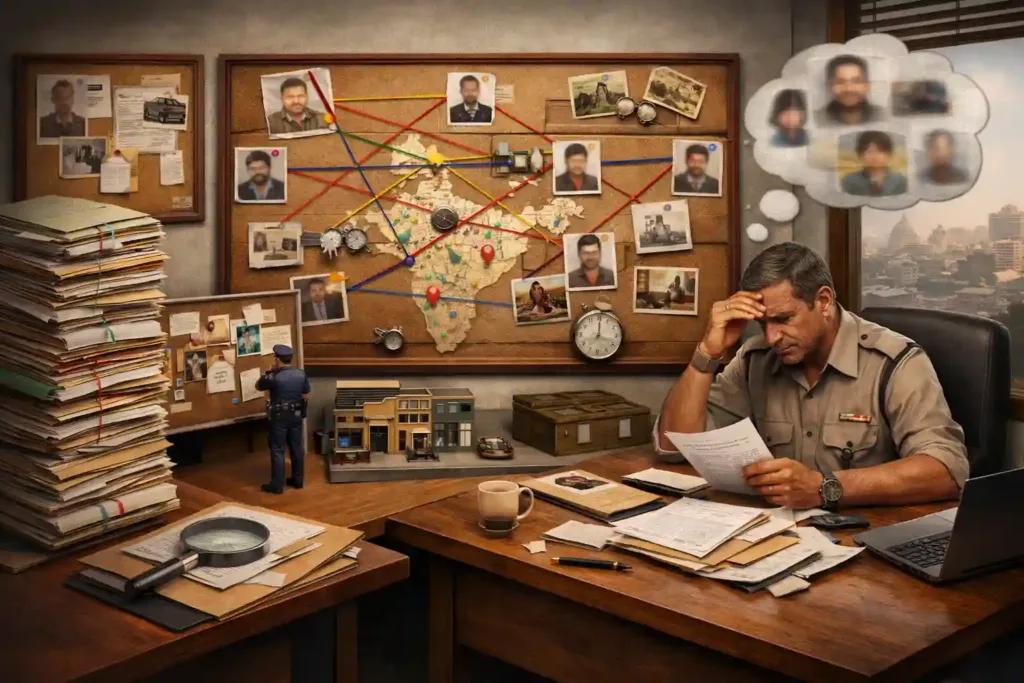
Most investigations move vertically, one case at a time.
Each case is examined on its own merits, with its own suspects, evidence, and timelines. This approach is necessary for legal and procedural reasons, but it has a limitation.
Criminal networks don’t operate vertically. They operate horizontally, spreading across cases, jurisdictions, and time periods.
When intelligence is confined within individual case files, the broader structure of a network remains out of view. Connections that span multiple investigations are treated as coincidences rather than signals.
Fragmented Interrogation Intelligence
Interrogation reports are typically reviewed in isolation.
Each interrogation is analysed for what it contributes to a specific case. Rarely is it examined in relation to other interrogations conducted months or years earlier.
This means:
- Recurring names are not automatically linked
- Shared locations don’t stand out
- Roles played across cases remain undefined
The intelligence exists, but without consolidation, it never comes together.
Reliance on Human Memory
In many investigations, recognising patterns depends heavily on individual recall.
An experienced officer may remember that a name sounds familiar or that a location has surfaced before. But no individual—no matter how skilled, can reliably track dozens of overlaps across hundreds of interrogations over time.
As investigations grow in scale and complexity, this reliance on memory becomes a bottleneck. Patterns are noticed late, if at all.
The reality is this:
Networks don’t evade detection because they’re invisible, they evade detection because their connections are scattered.
What Link Analysis Really Means in Criminal Investigations

In criminal investigations, link analysis is often misunderstood as a technical or analytical exercise. In reality, it is a way of thinking, not a tool or a formula.
At its core, link analysis is about examining relationships, not just individuals.
Instead of asking “Who is this suspect?”, link analysis asks:
- Who is this person connected to?
- How often do those connections appear?
- In what context do they surface?
- How do those relationships change across cases and time?
This relational view helps investigators move beyond isolated facts and toward structural understanding. In practical terms, link analysis helps answer questions investigators routinely struggle with:
- Who appears repeatedly across multiple interrogations, even in unrelated cases?
- Which individuals quietly connect otherwise separate investigations?
- Which locations, vehicles, or tools keep resurfacing?
- How do roles shift as networks adapt and evolve?
This isn’t about technology or complex theory. It’s about recognising that crime is rarely individual, and intelligence shouldn’t be either.
Why Interrogation Reports Are Ideal for Link Analysis

Not all investigative records are equally suited for understanding relationships. Interrogation reports stand apart because they capture how people relate to one another, not just what they did.
Interrogation reports often include:
- Direct associations: names mentioned, contacts referenced, known accomplices
- Indirect links: aliases, intermediaries, vague references that gain meaning later
- Behavioural context: hesitation, deflection, selective disclosure
- Evolving narratives: how stories change across time and questioning
- Informal admissions and relationships: details unlikely to appear in formal case summaries
This makes interrogation reports uniquely valuable. FIRs record incidents. Interrogation reports reveal relationships.
While FIRs and chargesheets establish what happened, interrogation reports show who knows whom, how they interact, and how those interactions shift over time.
That is why interrogation reports are relationship-rich intelligence and why they form the most effective raw material for link analysis.
From Isolated Statements to Network Intelligence

To understand the power of link analysis, consider a common investigative scenario.
In one interrogation, a suspect casually mentions someone named “X.” The reference seems minor and doesn’t directly affect the case.
In a separate investigation, months later, another suspect mentions “X” again, but in a different context. Still, nothing conclusive.
In a third interrogation, “X” isn’t named directly, but a shared location or facilitator surfaces, one that overlaps with earlier mentions.
Individually, these statements mean very little. They remain buried in separate dossiers, attached to unrelated cases.
Together, something changes.
A pattern begins to form. Relationships take shape. What once looked like coincidence starts to resemble coordination. This is the turning point where intelligence emerges.
Link analysis turns coincidence into context.
It allows investigators to move from reacting to isolated incidents to understanding how those incidents connect.
Identifying Roles Within Criminal Networks

One of the most valuable outcomes of link analysis is its ability to reveal roles, not just participants.
Criminal networks are rarely flat. Different individuals play different functions, and not all of them are obvious.
Link analysis helps investigators identify:
- Facilitators, who enable movement, communication, or logistics
- Coordinators, who appear across multiple interactions without direct involvement in every act
- Repeat intermediaries, who connect separate groups or cases
- Overground workers, whose roles appear routine but recur consistently
- Peripheral versus central actors, based on frequency and context of connections
This distinction matters. Not everyone in a network carries the same weight or influence.
The strength and frequency of links often reveal far more than individual statements. Who appears repeatedly? Who connects otherwise disconnected individuals? Who remains present even as others change?
By focusing on relationships instead of labels, link analysis provides investigators with a clearer, more accurate picture of network structure, without relying on assumptions or sensational characterisations.
Why Criminal Networks Are Missed Without Cross-case Link Analysis

Criminal networks are rarely exposed in a single case. They unfold gradually: across time, locations, and investigations. Without cross-case link analysis, this slow emergence becomes a blind spot.
Fragmented dossiers hide repeated associations. The same names, places, or facilitators appear across interrogations, but because they are stored separately, their recurrence is easy to miss.
Loss of institutional memory makes the problem worse. As officers change and cases move between units, long-term visibility breaks down. What one team once suspected, another may never see.
As a result, networks that span years often remain unnoticed, not because they are well concealed, but because intelligence is never viewed together.
The core issue is structural: Networks don’t form overnight, but investigations often treat them as if they do.
When intelligence is examined only within individual cases, networks remain fragmented on paper, even when they are clearly connected in reality.
The Investigative Value of Early Network Visibility

Early visibility into network structures changes how investigations unfold.
When relationships begin to surface early, investigators can prioritise more effectively, focusing attention on individuals and connections that matter most, rather than treating all leads equally.
Interrogation strategies become more targeted. Questioning is informed by existing context, not conducted in isolation. Investigators know what to probe, what to validate, and what to revisit.
Decision-making becomes more focused. Effort is directed where patterns are emerging, reducing the need for broad, exploratory investigation that consumes time and resources.
Most importantly, investigations rely less on chance discovery. When links are visible early, investigative effort shifts from reactive to deliberate and informed. This is not about doing more, it is about doing what matters sooner.
Link Analysis as a Force Multiplier, Not a Replacement

It is important to be clear: link analysis does not replace investigative judgment.
Experience, intuition, and contextual understanding remain essential. What link analysis does is support those strengths, not override them.
By bringing connections into view, link analysis reduces cognitive overload. It helps investigators see patterns that would otherwise require months of manual comparison or exceptional recall.
Instead of relying on memory alone, investigators can focus on interpretation and decision-making, where human judgment matters most.
In this sense, link analysis acts as a force multiplier. It amplifies insight, sharpens focus, and allows investigators to apply their expertise more effectively.
Why Link Analysis Is Essential for Modern Criminal Investigations
Crime today is more complex, more interconnected, and more persistent than ever before. Offences rarely exist in isolation; they are shaped by networks, facilitators, and recurring relationships.
Traditional, case-centric investigation structures struggle to keep pace with this reality. They are designed to resolve incidents, not to understand structures.
Link analysis addresses this gap by shifting the investigative lens from individual cases to connected intelligence. The conclusion is unavoidable: Modern crime is organised. Investigations must be relational.
When relationships are examined alongside facts, investigations stop chasing fragments, and start understanding networks.
To Conclude: When Connections Are Seen, Networks Are Understood

Criminal networks rarely reveal themselves through a single confession or a single case file. They emerge gradually, through repeated names, shared locations, evolving roles, and quiet connections spread across interrogation reports.
When these connections remain fragmented, investigations focus on incidents instead of structures. Patterns surface late. Networks remain partially understood. Effort is spent rediscovering intelligence rather than building on it.
Link analysis changes this dynamic. By examining relationships across interrogations, it transforms scattered details into coherent intelligence. Coincidences become context. Isolated cases become connected narratives.
The shift is subtle but decisive: investigations stop reacting to fragments and start understanding networks.
When interrogation intelligence is connected, investigations move beyond isolated cases, and begin revealing the structures behind crime.
FAQs – Frequently Asked Questions
1. What is link analysis in criminal investigations?
Link analysis examines relationships between people, locations, and events to identify patterns and connections that are not visible when cases are viewed individually.
2. Why are interrogation reports important for link analysis?
Interrogation reports capture associations, references, behavioural context, and evolving narratives that reveal how individuals and groups are connected over time.
3. Why do criminal networks often go undetected in investigations?
Networks remain hidden when intelligence is fragmented across cases, analysed in isolation, or dependent on individual memory rather than consolidated context.
4. How does link analysis improve investigative decision-making?
By revealing connections early, link analysis helps investigators prioritise leads, focus questioning, and reduce random or duplicated investigative effort.
5. Does link analysis replace investigator experience?
No. Link analysis supports investigative judgment by organising information and highlighting relationships, allowing officers to apply their expertise more effectively.
6. Is link analysis useful only for large or organised crime cases?
While especially valuable for organised and network-based crime, link analysis also improves understanding in smaller investigations by revealing recurring associations.