Investment fraud investigations rarely begin with clarity. More often, they start with fragments. Complaints that appear isolated. Victims who have never met. Transactions that seem unrelated.
This case was no different.
Two victims reported investment fraud through separate complaints. On the surface, there was no visible connection between the incidents. Different narratives, different circumstances, and no obvious overlap. Yet investigators suspected that the simplicity was deceptive.
The turning point came through mobile forensic intelligence powered by ARGUS.
The Challenge: Two Unrelated Cases
Initially, the two cases were treated as independent incidents. Each had its own set of digital artifacts, suspects, and timelines. Traditional investigation methods provided limited visibility into whether a broader pattern existed.
Fraud networks are designed to avoid detection. Roles are distributed, contacts are rotated, and communication is deliberately fragmented. Identifying such coordination requires a forensic platform capable of connecting the dots across devices and data types.
To move beyond assumptions, investigators relied on ARGUS, a mobile forensics platform built for correlation, context, and clarity.

ARGUS as the Investigation Enabler
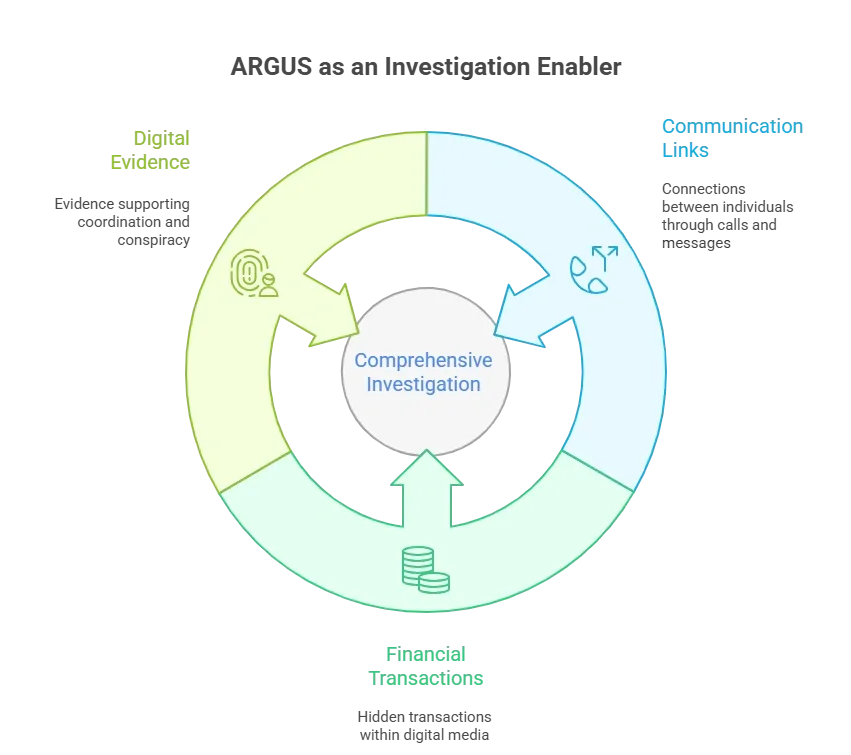
ARGUS enabled investigators to go beyond basic data extraction and focus on behavioral analysis. Calls, messages, chats, media, and transaction artifacts were consolidated into a single analytical view.
The investigation focused on uncovering:
- Communication links between individuals
- Financial transactions hidden within digital media
- Digital evidence supporting coordination and conspiracy
ARGUS provided the foundation to analyze these dimensions together rather than in isolation.
Communication Analysis: Revealing the First Connection
Using ARGUS’s communication analysis capabilities, investigators conducted a detailed examination of suspects and accused individuals.
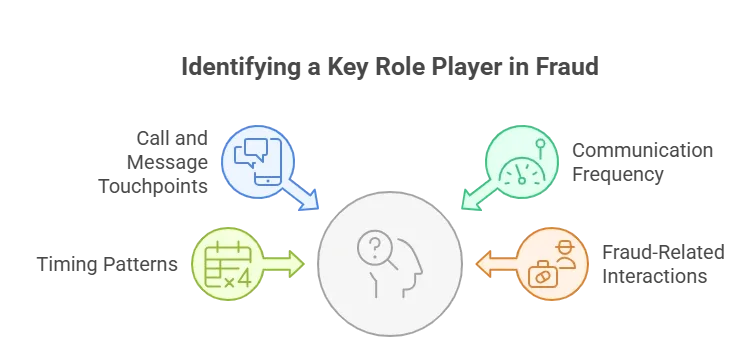
This analysis helped identify:
- Significant call and message touchpoints
- Communication frequency and timing patterns
- Key interactions linked to fraud-related activity
What emerged was a common contact repeatedly interacting across both cases. While not immediately apparent during initial inquiry, ARGUS highlighted this individual as a potential key role player.
The strength of ARGUS lay not just in showing that communication occurred, but in revealing patterns that indicated coordination.
Expanding the Network Through B-Party Analysis
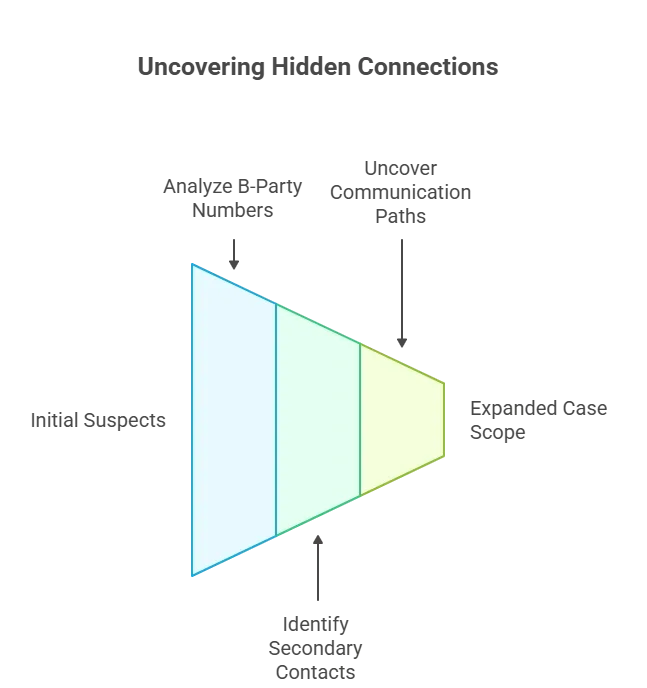
The investigation then expanded beyond primary suspects. ARGUS enabled investigators to analyze B-party numbers, uncovering indirect connections that extended the scope of the case.
Through this analysis, investigators identified:
- Links between secondary contacts and other suspects
- Communication paths suggesting a structured network
This step was critical. Without B-party analysis, these connections would likely have remained invisible.
Keyword-Based Chat Analysis: Establishing Coordination
Large volumes of chat data rarely contain explicit confessions. Instead, coordination is revealed through repetition, shared references, and contact exchange.
ARGUS’s Keyword Search with Boolean Filters allowed investigators to isolate relevant conversations efficiently. This analysis uncovered:
- Repeated references to specific individuals
- Evidence of contact sharing
- Indicators of coordinated communication
When viewed collectively, these chats established a clear picture of organized activity rather than coincidental interaction.
Financial Evidence Uncovered Through ARGUS
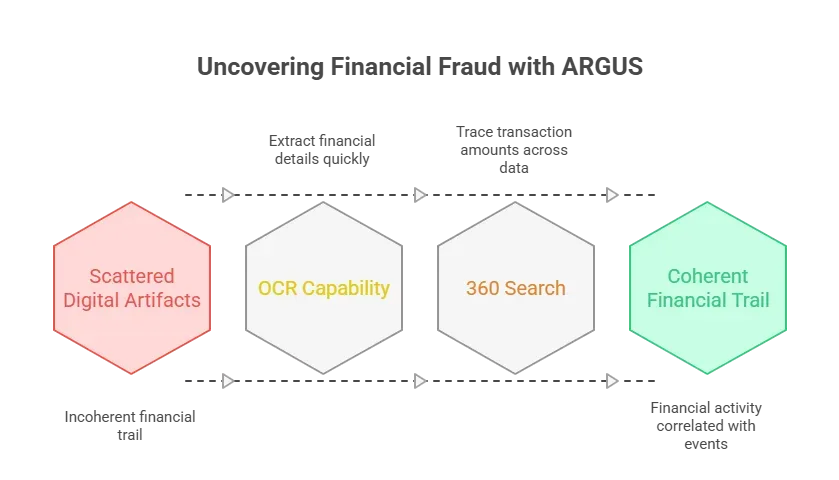
Financial proof is essential in investment fraud cases. In this investigation, transaction screenshots stored on mobile devices became a key source of evidence.
ARGUS’s OCR capability quickly identified transaction screenshots and extracted embedded financial details, eliminating the need for manual review.
Using 360 Search, investigators traced specific transaction amounts across chats, images, and other data sources. This made it possible to correlate financial activity directly with communication events and suspect interactions.
Together, these features transformed scattered digital artifacts into a coherent financial trail.
From Analysis to Impact
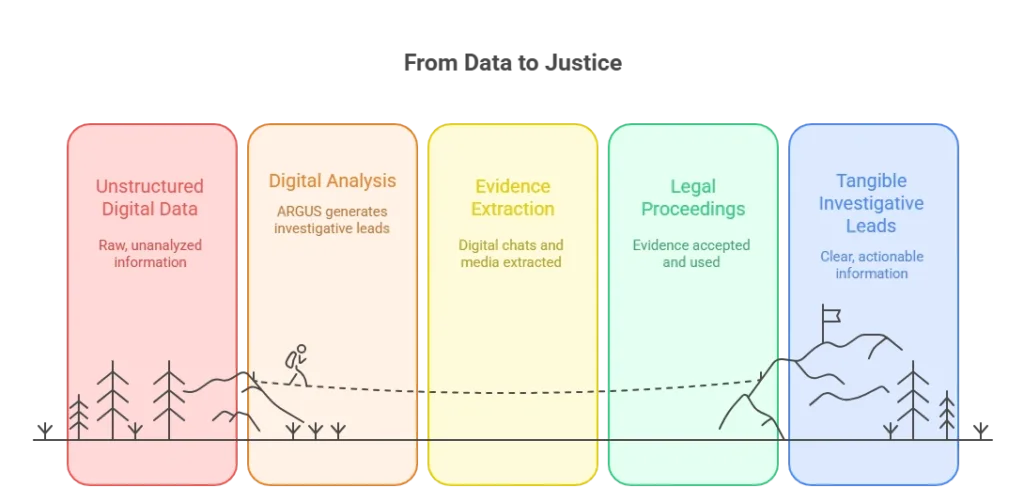
Insights generated through ARGUS provided investigators with tangible investigative leads. Communication links, financial evidence, and network relationships were clearly established through digital analysis.
Key outcomes included:
- Identification of a central role player
- Digital evidence supporting coordination and conspiracy
- Financial artifacts strengthening the fraud narrative
The extracted digital chats and media were accepted as evidence and used in further legal proceedings, reinforcing the overall integrity of the case.
Why ARGUS Made the Difference
This case demonstrates a core truth of modern investigations: the value of mobile data lies in correlation, not volume.
ARGUS empowered investigators to:
- Connect fragmented cases through communication intelligence
- Reveal hidden networks using secondary contact analysis
- Convert mobile data into court-admissible evidence
By combining advanced search, communication analysis, and financial discovery in a single platform, ARGUS played a decisive role in uncovering the full scope of the fraud network.
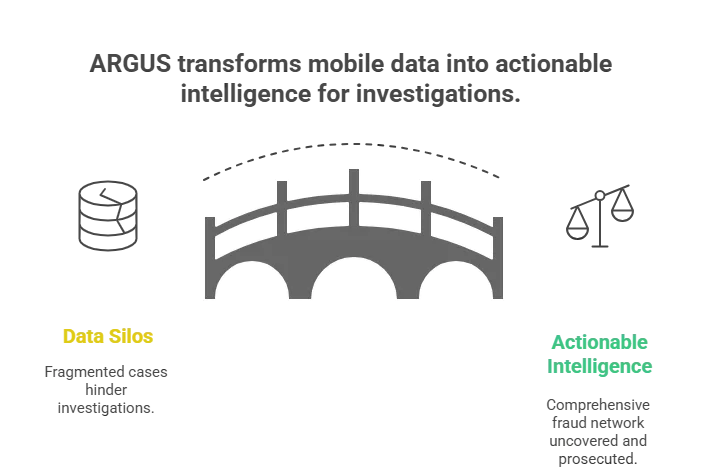
What began as two unrelated investment fraud complaints evolved into a connected investigation supported by strong digital evidence. The difference was not coincidence, but insight driven by the right forensic platform.
This anonymized case highlights how ARGUS enables investigators to transform mobile devices into sources of actionable intelligence, uncover hidden coordination, and strengthen complex fraud investigations.
In an era where fraud is digital by default, mobile forensics powered by ARGUS is essential.