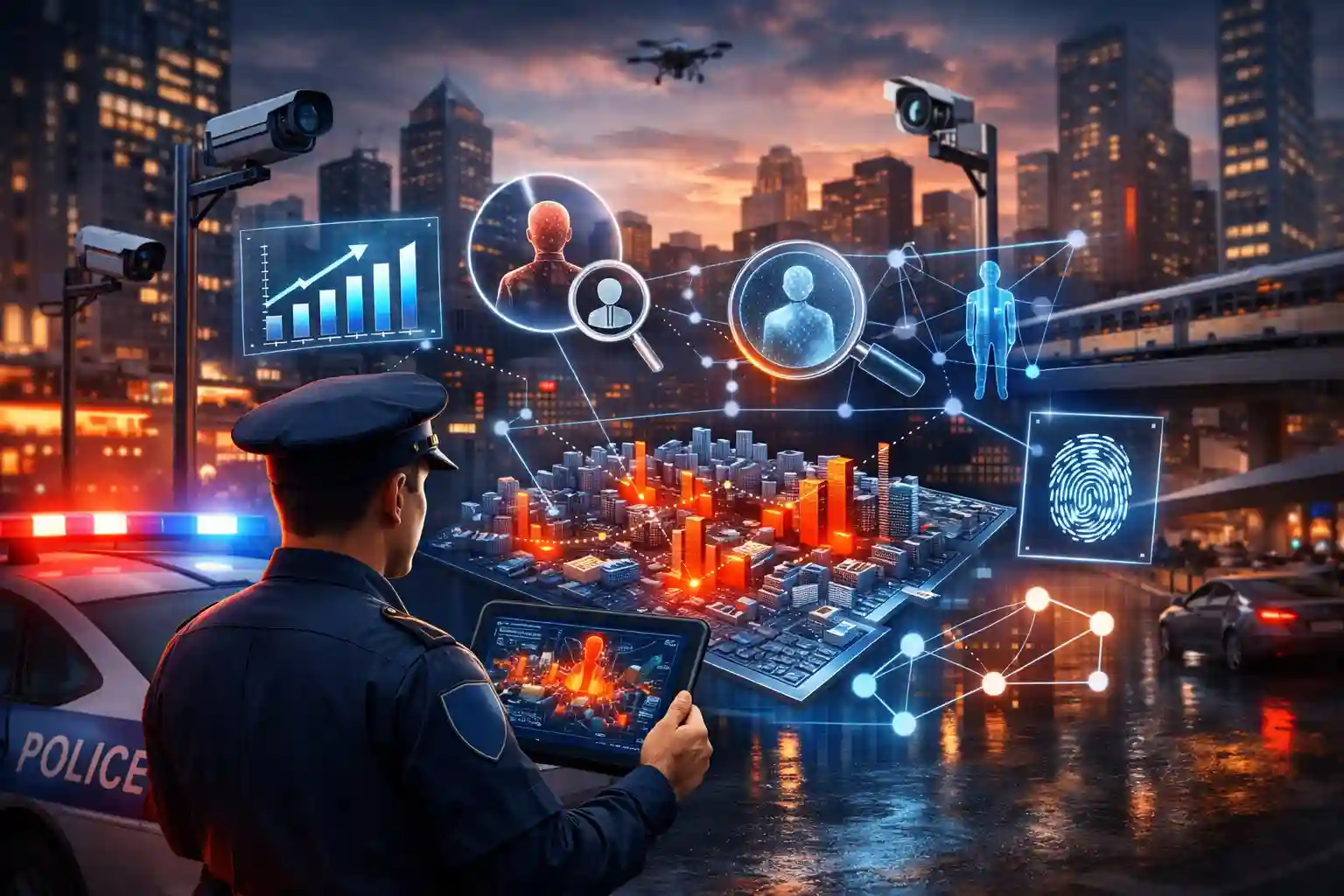
Why Generative AI Matters in Defence and Law Enforcement
Generative AI is often associated with chatbots and digital art, but in the context of defence and law enforcement, it carries far greater potential. At its core, generative AI refers to systems that can create new outputs, scenarios, data, reports, or insights, based on learned patterns from existing information.
Unlike traditional AI models that only classify or detect, generative AI can simulate, predict, and synthesize knowledge in ways that directly impact national security.
The urgency for such technology stems from today’s reality: threats are more complex, intelligence is more fragmented, and data volumes are overwhelming human analysts.
Defence organisations are flooded with satellite feeds, drone footage, cyber alerts, and communication intercepts. Law enforcement faces rising digital forensics workloads, massive social media data, and increasingly sophisticated criminal networks. Without smarter tools, vital connections are missed, slowing down response and putting mission-readiness at risk.
This is where generative AI stands apart. By powering scenario simulation, synthetic training data, automated intelligence summaries, and conversational interfaces, it delivers faster, deeper insights tailored to military and policing operations.
Crucially, unlike consumer-grade AI, generative AI for security domains must be air-gapped, on-premise, and mission-specific, ensuring accuracy, security, and trust at every step.
In the following sections, we’ll explore how generative AI in defence and law enforcement is reshaping simulation, intelligence analysis, digital forensics, and decision-making, paving the way for smarter, safer operations.
Powerful Use Cases for Defence and Law Enforcement
Scenario Simulation & Wargaming
One of the most powerful applications of generative AI in defence is its ability to create realistic battlefield and policing scenarios for simulation and training. Traditional wargaming often relies on static models and pre-defined variables, but generative AI can dynamically produce countless variations of missions, terrains, and adversary tactics, making training far more adaptable to real-world complexity.
For defence organisations, this means AI can simulate adversary manoeuvres, cyber intrusions, drone swarms, or coordinated attacks, helping commanders and soldiers test strategies under diverse conditions.
Law enforcement agencies can use similar simulations to model riot control, border smuggling patterns, or coordinated crime networks, preparing teams for scenarios that would be impossible to rehearse in reality.
Another critical advantage lies in red teaming and adversary prediction. Generative AI doesn’t just simulate “blue force” movements, it can also generate probable adversary courses of action, enabling strategists to stress-test their plans against unexpected tactics. This provides decision-makers with foresight that goes beyond human intuition, strengthening readiness for both combat and policing operations.
By embedding generative AI into training and strategy, defence and law enforcement agencies gain a living, evolving training environment, where new threats can be modelled in hours instead of months.
Synthetic Data for AI Training
One of the biggest challenges in applying AI to defence and law enforcement is data availability. Real datasets, whether battlefield imagery, communication intercepts, or forensic case files, are often classified, scarce, or sensitive. This limits the ability to train robust AI models without risking security leaks.
This is where generative AI becomes a game-changer. Instead of relying solely on real-world data, generative models can create synthetic yet highly realistic datasets:
- Satellite and drone imagery for object detection models.
- Network traffic data to train cybersecurity and intrusion detection systems.
- Facial and biometric datasets to improve recognition accuracy in controlled environments.
- Forensic case data to test investigative software without exposing real evidence.
By generating synthetic data, agencies can scale training without compromising security. AI models can be stress-tested against diverse, simulated inputs, helping them adapt to rare or evolving threats like drone swarms, cyberattacks, or disinformation campaigns.
Most importantly, synthetic data preserves operational secrecy while ensuring AI systems continue to learn and evolve. For defence and policing agencies, this balance between accuracy and confidentiality is critical.
Intelligence Summarization & Report Generation
Military and law enforcement agencies deal with overwhelming amounts of unstructured data – surveillance feeds, interrogation notes, sensor logs, social media chatter, and more. Analysts spend countless hours compiling this into usable reports.
Generative AI can change this workflow by automating summaries and intelligence reports:
- Condensed threat assessments from hundreds of raw inputs.
- Automated interrogation reports built from transcripts or notes.
- Real-time incident summaries for commanders or investigators.
- Multi-source correlation reports that merge cyber, human, and open-source intelligence.
With air-gapped, on-premise LLMs, agencies can achieve the same conversational power as commercial AI tools like ChatGPT, without risking data leakage. Analysts can quickly ask:
👉 “Summarize cyber intrusions in the last 48 hours and flag unusual traffic near base X.”
The result: Faster insights, reduced cognitive overload, and sharper decision-making under time pressure.
Conversational Interfaces for Intelligence Fusion Centres
Traditional fusion centres require analysts to navigate complex dashboards and query multiple databases. This slows down response time and makes it harder to connect the dots across intelligence sources.
Generative AI introduces conversational interfaces that allow analysts to interact with systems using natural language queries:
- “Show smuggling routes detected in the last 90 days across border region X.”
- “List financial transactions linked to suspected terror financing groups.”
- “Summarize satellite and drone imagery anomalies from last week.”
This approach eliminates the need for advanced technical query skills, enabling analysts and commanders alike to access insights instantly.
When combined with air-gapped, on-premise LLMs, these interfaces remain secure while giving users the speed, flexibility, and accuracy of a ChatGPT-like experience, but for classified defence and law enforcement intelligence.
👉 The result: Mission-ready intelligence that can be accessed in seconds, not hours.
Mission Briefing & Decision Support
In high-stakes defence and policing operations, commanders need concise, accurate, and timely updates. Traditional reporting often overwhelms decision-makers with data overload, forcing them to sift through pages of intelligence before acting.
Generative AI transforms mission briefing by:
- Summarizing multi-source intelligence into actionable insights (satellite feeds, cyber alerts, HUMINT, OSINT, etc.).
- Highlighting probable adversary moves using predictive and generative modelling.
- Tailoring reports to the audience, field units receive tactical details, while senior leadership gets strategic overviews.
- Generating multiple “what-if” scenarios to guide decisions under uncertainty.
Instead of static slides or lengthy documents, leaders can receive dynamic, AI-generated briefings that evolve in real time as new data streams in.
👉 This ensures faster, more informed decision-making while reducing the cognitive load on commanders and analysts.
Digital Forensics & Law Enforcement
Investigations today involve huge volumes of digital evidence, from mobile devices, laptops, cloud storage, to social media activity. Analysts often spend weeks piecing together events, creating interrogation reports, and building timelines for courtroom use.
Generative AI accelerates this process by:
- Auto-generating case summaries from thousands of documents, chats, and call data records.
- Creating interrogation reports by summarizing statements, highlighting contradictions, and extracting key insights.
- Reconstructing forensic timelines by aligning logs, device data, and surveillance records into a clear sequence of events.
- Converting unstructured evidence into structured intelligence that can be searched, linked, and visualized for investigators.
For law enforcement agencies, this means faster investigations, stronger case files, and reduced human error in analysing evidence.
Generative AI doesn’t replace investigators – it augments their capabilities, giving them more time to focus on strategy and judgment rather than administrative reporting.
OSINT & Social Media Intelligence
Open-source intelligence (OSINT) and social media monitoring are becoming critical for both defence and law enforcement. From tracking extremist narratives to identifying disinformation campaigns, agencies deal with massive volumes of multilingual, fast-changing data.
Generative AI enhances OSINT by:
- Generating real-time alerts on emerging threats, keywords, or sentiment spikes across platforms.
- Summarizing sentiment and narratives from thousands of posts, articles, and videos into clear, digestible reports.
- Mapping influence networks by revealing how disinformation or propaganda spreads across accounts and geographies.
- Multilingual intelligence generation, enabling cross-border monitoring without language barriers.
Instead of manually analysing fragmented feeds, analysts gain narrative maps and concise summaries, helping them detect risks and shape responses quickly.
This is especially valuable in counter-terrorism, election security, and tracking organized crime.
Conclusion: The Future of Generative AI in Defence and Law Enforcement
Generative AI is moving beyond creative applications into the heart of national security and public safety. From scenario simulation and synthetic data generation to intelligence summarization and forensic reporting, it equips agencies with faster, more reliable insights.
The key advantage lies in its ability to transform overwhelming, unstructured data into mission-ready intelligence, whether that’s predicting adversary behaviour, accelerating investigations, or monitoring global narratives in real time.
As defence and law enforcement organisations confront increasingly complex, data-driven challenges, generative AI will play a defining role in building systems that are more adaptive, secure, and intelligent.
FAQ: Generative AI in Defence and Law Enforcement
Q1. What is generative AI in defence?
Generative AI in defence refers to AI models that can create synthetic data, simulate scenarios, and generate intelligence summaries to support military operations and decision-making.
Q2. How can generative AI be used in law enforcement?
In law enforcement, generative AI assists in creating forensic case summaries, automating interrogation reports, and analysing social media intelligence to track criminal or disinformation networks.
Q3. Why is synthetic data important for defence and law enforcement AI?
Since real defence and police data is often classified and limited, generative AI can create synthetic yet realistic datasets (e.g., satellite images, facial data, communication logs) to train machine learning models without exposing sensitive information.
Q4. What are the benefits of generative AI for intelligence agencies?
Generative AI enables faster analysis, reduces analyst workload, and provides mission-ready insights. It also enhances wargaming, predictive modelling, and multilingual intelligence summarization.
Q5. Is generative AI secure for defence and LEAs?
Yes. When deployed in air-gapped, on-premise environments, generative AI ensures that sensitive intelligence remains isolated from the internet while still offering advanced natural-language and summarization capabilities.