
The Era of Paper Dossiers: How Interrogation Management Originally Worked
In its original form, interrogation management was straightforward and procedural.
Interrogation reports were handwritten or typed, signed, and added to physical case files. Each file was organised around an FIR, with documents arranged chronologically. Cross-referencing between cases, if needed, relied entirely on manual effort.
Officers depended heavily on:
- Their familiarity with local records
- Personal experience with earlier cases
- Informal knowledge of who had been questioned before
This approach had clear strengths.
Paper-based interrogation management:
- Ensured accountability, with clear records and signatures
- Created formal documentation that could be produced in court
- Established procedural discipline, keeping investigations structured
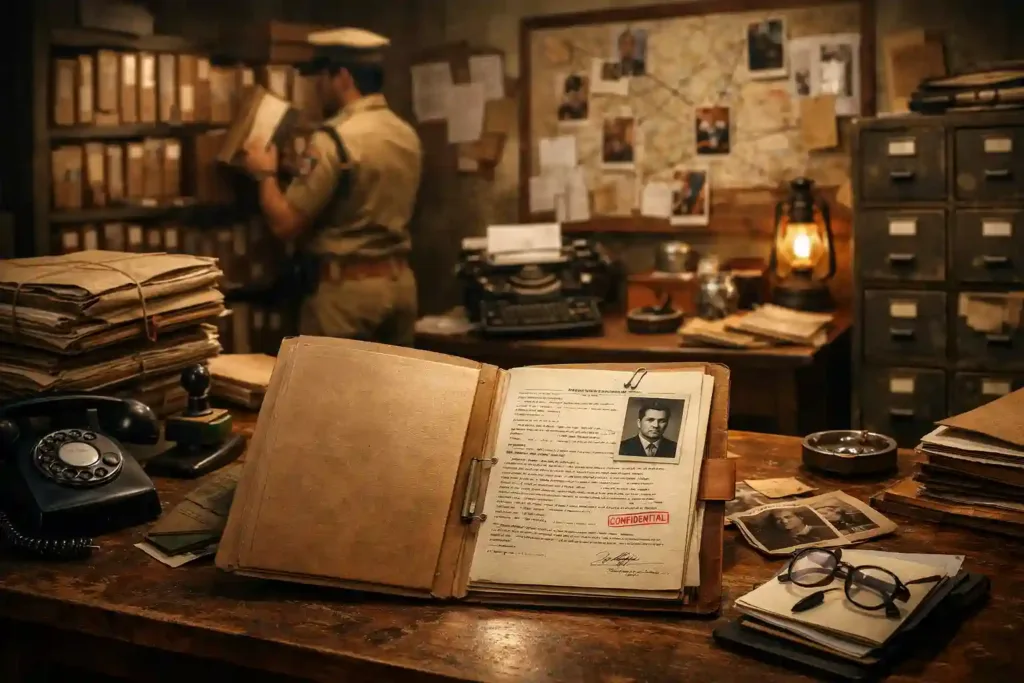
For single-case investigations or short-duration matters, it worked well. The officer who conducted the interrogation often remained involved through most of the case. Context stayed intact because the people and files rarely changed.
But this model had limits. As cases grew longer and interconnected, and as personnel rotated, the reliance on physical files and personal memory became a constraint rather than a strength.
Paper preserved records, but it was never designed to preserve intelligence across time and scale.
Key Takeaways
- Paper-based interrogation management ensured records but did not scale with modern investigations.
- Early digitisation improved storage but failed to unlock intelligence or context.
- Modern interrogation management focuses on intelligence flow, not just documentation.
- Intelligence-centric systems preserve context across cases, time, and personnel changes.
- Better interrogation management reduces duplication and improves investigative continuity.
- Investigations move faster and deeper when intelligence compounds instead of resetting.
The Limits of Paper and Why Early Digitisation Wasn’t Enough
As investigations grew in scale and complexity, the limitations of paper-based interrogation management became impossible to ignore.
Finding past interrogation records was often slow and uncertain. Locating a statement from an earlier case could mean searching through stacks of files or relying on someone who remembered where it might be. Connecting interrogation reports across cases was even harder, there was no simple way to see whether a name, location, or detail had surfaced elsewhere.

Over time, investigations became heavily dependent on individual memory. Officers who had worked earlier cases carried critical context in their heads. When they transferred or retired, that knowledge often left with them.
Physical records introduced their own risks. Files degraded with time, were misplaced, or became incomplete as cases moved between units. And while interrogation reports contained rich detail, they were rarely reused. Once a case progressed, those insights were effectively archived, out of sight and out of mind.
The underlying issue was structural: paper preserved records, not intelligence. Recognising these limits, law enforcement agencies took the first major step forward: digitisation.
Paper files were scanned. Cupboards were replaced with servers. Interrogation reports became PDFs stored in digital folders, and basic case management systems began to emerge. Access improved. Storage became safer. Retrieval no longer required a physical search.
But something important didn’t change.
Digitisation made dossiers easier to store, but not easier to understand. Searching a PDF for a name is not the same as recognising a pattern. Digital storage didn’t automatically connect related interrogations, highlight recurring associations, or surface hidden context.
In many ways, digitised paper remained… paper, just on a screen.
The first wave of digitisation solved the problem of where interrogation data lived. It didn’t solve the problem of how intelligence was used.
The Shift from Record Keeping to Intelligence Management

For a long time, interrogation management was viewed as a documentation exercise. The objective was clear: record what was said, store it securely, and retrieve it if required. That mindset no longer holds.
Modern investigations generate far more interrogation data than any individual or team can mentally track. Treating this information as static records limits its value to the moment it was created.
The shift underway is a change in how interrogation data is perceived:
- From storing reports to using interrogation data
- From static records to evolving intelligence
- From case closure to investigative continuity
This change recognises a simple truth: interrogation insights rarely belong to just one case. Their value grows when they can be revisited, compared, and connected over time.
Interrogation management is no longer about documentation. It’s about intelligence flow, ensuring that insights move across cases, teams, and time instead of remaining locked in files.
What Defines an Intelligence-centric Interrogation System

An intelligence-centric approach to interrogation management is not defined by technology labels or interfaces. It is defined by outcomes.
At its core, such a system enables:
- A centralised view of interrogation intelligence, rather than scattered case files
- The ability to see connections across reports, revealing relationships and patterns
- Context preserved across time and personnel, so knowledge survives team changes
- Interrogation data that is reusable beyond a single case, contributing to future investigations
The emphasis shifts from where documents are stored to how intelligence is accessed and applied. Investigators are no longer forced to reconstruct history; they can build on it.
This approach respects investigative experience while ensuring that intelligence compounds rather than disappears.
How Modern Interrogation Systems Change Investigative Outcomes

When interrogation management becomes intelligence-centric, the impact is immediate and practical.
Investigators gain faster access to prior context, allowing them to understand background and relationships before questioning begins. Interrogations become more focused and informed, rather than exploratory.
Duplication reduces. Individuals are not questioned repeatedly on the same issues simply because earlier insights were hard to locate. Effort is redirected toward advancing understanding.
Patterns surface earlier. Recurring names, shared locations, and overlapping narratives become visible before networks fully mature.
Most importantly, continuity improves. Long-running cases retain momentum even as teams change, because intelligence is preserved and accessible.
The result is not just efficiency, it’s effectiveness. Investigations move faster when intelligence compounds instead of resetting.
Conclusion: From Files That Store to Systems That Think
The evolution of interrogation management was never about replacing paper with screens. It was about recognising that record-keeping alone cannot support modern investigations.
Paper dossiers preserved accountability. Early digitisation improved storage. But neither was designed to help investigators see connections, retain context, or build intelligence over time.
As crime became more networked and investigations more complex, interrogation management had to evolve, from static documentation to intelligence that flows across cases, teams, and years.
When interrogation data is allowed to connect, evolve, and compound, investigations stop restarting from scratch. They move forward with clarity, continuity, and purpose.
When interrogation intelligence flows instead of fragmenting, investigations stop looking backward and start moving forward.
FAQs – Frequently Asked Questions
1. What is interrogation management in criminal investigations?
Interrogation management refers to how interrogation reports are recorded, stored, accessed, and used throughout an investigation and across related cases.
2. Why did paper-based interrogation systems stop being effective?
They worked well for simple, short-duration cases but struggled with large volumes, cross-case connections, and long-running investigations.
3. Did digitisation solve interrogation management challenges?
Digitisation improved storage and access, but it did not automatically enable intelligence reuse, context preservation, or pattern recognition.
4. What does intelligence-centric interrogation management mean?
It means treating interrogation data as evolving intelligence that can be reused, connected, and revisited across investigations, not just stored as records.
5. How does modern interrogation management improve investigations?
It enables faster access to prior context, better-informed questioning, reduced duplication, earlier network visibility, and stronger continuity over time.
6. Is modern interrogation management only useful for large cases?
No. While especially valuable for complex and long-running cases, it improves efficiency and decision quality across all types of investigations.