The Fog of Data War
It was a humid Monday afternoon at a Military Intelligence Coordination Centre in North India. The war room hummed with quiet urgency, glowing screens flickered with satellite feeds, border maps, and intercepted chatter.
A group of seasoned analysts who have proved their mettle in the past, sat in the corner surrounded by a storm of data. Drone footage, SIGINT intercepts, HUMINT field reports, social media chatter, all pouring onto their screens from every direction.
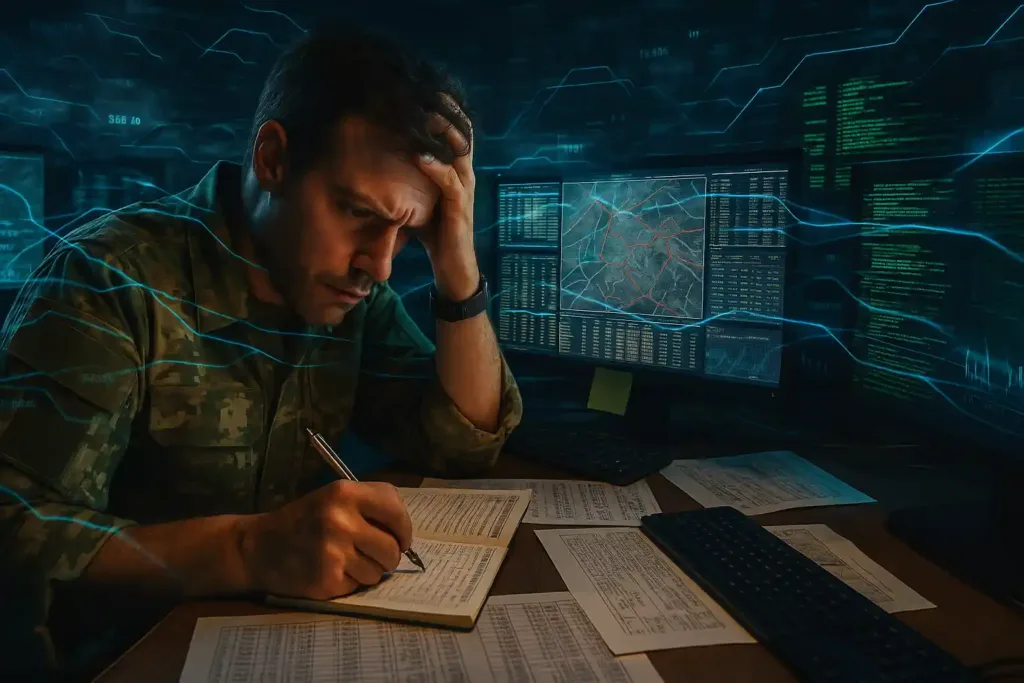
“Data is coming in from everywhere… I’ve to check everything manually,” one of the analysts muttered, copying coordinates between tabs, manually cross-checking timestamps.
Another one tried desperately to connect the dots: a sudden shift in troop positions here, a cryptic radio message there, a spike in online activity on an obscure forum. But everything was fragmented. Slow. Disconnected.
There was no shortage of data.
But there was no time to collate the intelligence.
Not yet.
The Breaking Point
Three days later, a high-priority alert landed at the Coordination Centre.
Satellite imagery confirmed suspicious troop build-up, uncomfortably close to the Line of Control. But it wasn’t a surprise, not entirely. The warning signs had been surfacing for days.
Drone footage had captured rows of camouflaged tents tucked into ridge-lines.
Intercepted radio frequencies hinted at logistical movement.
HUMINT reports flagged unusual activity.
And somewhere in the digital fog, OSINT chatter spiked in known adversary circles.

Each thread had been observed. Logged.
But in the crush of daily operations, they remained scattered.
Analysts had done their best, juggling hundreds of inputs, each from a different silo, each demanding immediate attention.
By the time patterns emerged and the dots were connected, the adversary had already fortified its forward position. Military’s response was swift, but reactive.
It wasn’t a failure of vigilance.
It was a failure of visibility.
And in that moment, the unit realized: the challenge wasn’t in knowing what was happening, it was in seeing everything together, as one unified story.
Enter Prophecy Guardian
Six weeks later, things looked very different.
The same war room.
The same team.
But now, something had changed.
A new system pulsed quietly at the heart of the operations centre, integrating feeds, automating correlation, and surfacing real-time patterns. For the first time, field intelligence, satellite imagery, SIGINT, ELINT, HUMINT, IMINT, OSINT, TECHINT, SATINT, CDRs, and surveillance footage weren’t just coexisting, they were talking to each other.
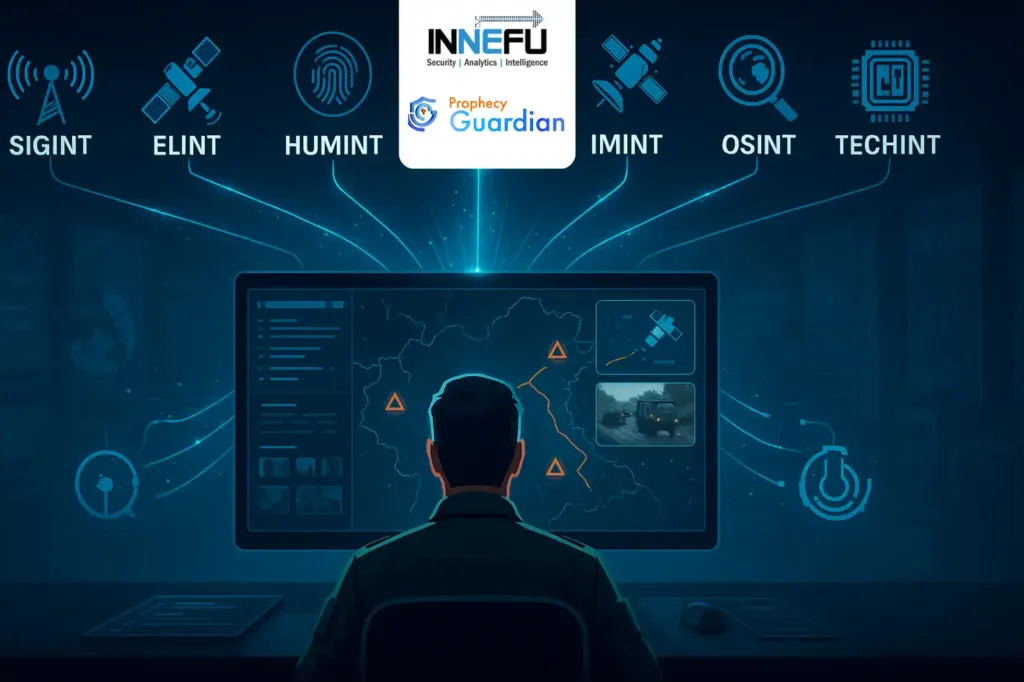
Prophecy Guardian wasn’t another dashboard.
It was an intelligent fusion engine, stitching together thousands of data points from across agencies, units, and technologies to create a single, dynamic threat picture.
The team no longer had to rely on gut instinct alone.
If a convoy moved across a border, facial recognition flagged repeat offenders at a nearby checkpoint, or encrypted messages spiked in darknet forums, Guardian lit up the map with contextual insights, not just raw data.
For the first time, the team wasn’t responding to intelligence.
They were working with it, in real time.
The Transformation
Over the next 90 days, the transformation was undeniable.
Incidents that previously took hours to piece together were now flagged in minutes, sometimes even before they reached human review.
A suspicious movement across the border?
Guardian fused drone footage with heat signatures, matched vehicle types with historic patterns, and cross-checked routes with prior infiltration events, triggering predictive alerts before boots crossed the line.
An intercepted call in a foreign dialect?
Guardian’s multilingual NLP engine translated it in real time, extracted entities, and linked the voiceprint to a known handler, previously caught on OSINT video at a protest 200 km away.
An unclaimed device found near a communication tower?
CDR analysis, IMSI catching, and geolocation tagging ran simultaneously. Within seconds, it was tied to two burner numbers, both traced back to a wider terror financing network Guardian had been mapping over weeks.
And it didn’t stop there.
- Facial Recognition scanned incoming feeds for wanted suspects and flagged honey-trapped recruits attempting base entry.
- Object Detection AI monitored sensitive zones for dropped payloads, hidden arms, or unusual behavior patterns.
- Heatmaps & Link Analysis visualized how one arrest in the northeast could ripple across a network spanning five states and two international borders.
- Cross-agency Fusion finally broke down silos, enabling seamless coordination between defence, cyber, intel, and law enforcement units.
And above all, actionable alerts, not noise.
Guardian wasn’t built to overwhelm.
It was built to prioritize, using AI to rank threats, highlight what matters, and help decision-makers act faster and smarter.
This wasn’t just an upgrade.
It was a shift in posture, from reactive to predictive. From fragmented to fused.
From isolated inputs to unified intelligence.
And it changed everything!
The New Normal
Today, the screens in the war room still glow.
But they tell a different story.
No more juggling fragmented feeds.
No more second-guessing stale data.
No more waiting for incidents to unfold before acting.

Now, every decision, whether it’s troop movement, surveillance expansion, or a cross-agency response, is informed by real-time, AI-driven foresight.
Commanders see not just what happened, but why, how, and what’s next.
And it’s not just this war room.
Across theatres, from border intelligence hubs to cyber command centres, Prophecy Guardian is quietly transforming the way Military fuses, understands, and acts on intelligence.
It’s not about replacing human instinct.
It’s about augmenting it, with the power of data, automation, and insight.
For the teams protecting the nation, this is the new normal:
A world where intelligence isn’t just gathered…
It’s connected.
It’s predictive.
It’s Innefu-enabled.
“Modern warfare isn’t just fought on the frontlines, it’s fought in data streams, intercepted calls, scattered footage, and unstructured intelligence. Prophecy Guardian was built to bring order to that chaos. To help our forces see the unseen, connect the unconnected, and stay five steps ahead. Because in national security, the margin between threat and response is razor-thin, and Guardian is built to close that gap.”
– Tarun Wig, Co-founder & CEO, Innefu Labs
Ready to See it in Action?
Request a live demo of Prophecy Guardian and experience how AI-powered intelligence fusion can transform the way your agency prevents threats, accelerates investigations, and safeguards national security.